comet
9P/Tempel 1
Tempel 1 is a Jupiter-family comet with an elongated nucleus about 7.6 km long and 4.9 km wide. Discovered by Wilhelm Tempel in 1867, it circles the Sun every five and a half years between the orbits of Mars and Jupiter. On 4 July 2005 NASA’s Deep Impact mission flew a 372 kg impactor into it, the first time a spacecraft had blasted material from the surface of a comet.12345
The collision threw out a vast cloud of extremely fine dust, showing that the surface is coated in powdery material with almost no strength. The whole nucleus is so light that most of its volume must be empty space. Its surface mixes rough, pitted ground with smooth, raised plains that look like flows. In 2011 NASA’s Stardust-NExT became the first spacecraft to revisit a comet, and found the small crater Deep Impact had left.25678
Shape and size
Tempel 1’s nucleus is elongated, roughly 7.6 km long and 4.9 km wide. Images from Deep Impact in 2005 and Stardust-NExT in 2011 together cover about 70 per cent of the surface and give a mean radius of 2.83 km, a volume of 95.2 km³ and a surface area of 108 km². The distance from centre to surface varies from 2.10 to 3.97 km.126
The mass was worked out from how the cloud thrown up by Deep Impact’s collision rose and fell back in the comet’s weak gravity: about 4.5 × 10¹³ kg. With the latest volume this gives a mean density of 470 kg/m³, under half that of water, but the uncertainty is large, from about 240 to 1,250 kg/m³, because escaping gas may also have pushed on the particles.6
Gravity at the surface is tiny, between 0.30 and 0.38 mm/s². At the impact site the surface layers are about 75 per cent empty space, consistent with the low density of the nucleus as a whole. Rosetta later found that comet 67P/Churyumov–Gerasimenko is similarly porous.5612
Orbit and rotation
Tempel 1 is a Jupiter-family comet: its orbit takes less than 20 years and has been shaped by close passes of Jupiter. Its path, tilted 10.5° to the ecliptic, runs from 1.54 au from the Sun out to 4.75 au, between the orbits of Mars and Jupiter. One circuit takes about 5.6 years, a little less than the 5.68 years measured when the comet was discovered.134
The nucleus turns slowly, once every 40.8 hours or so, and it is speeding up. Observations from Earth and from Deep Impact show that the spin period shortened by 16.8 minutes during the comet’s passage around the Sun in 2000 and by 13.7 minutes in 2005, most likely because water vapour escaping from the surface near perihelion pushes on the nucleus.9
Discovery
Ernst Wilhelm Leberecht Tempel, usually known as Wilhelm Tempel, discovered the comet from Marseille on 3 April 1867. In May of the same year C. Bruhns recognised that it was periodic, returning on a regular orbit. The comet is named after Tempel, and the P in 9P/Tempel 1 marks a periodic comet, one that orbits the Sun in less than 200 years.134
Surface
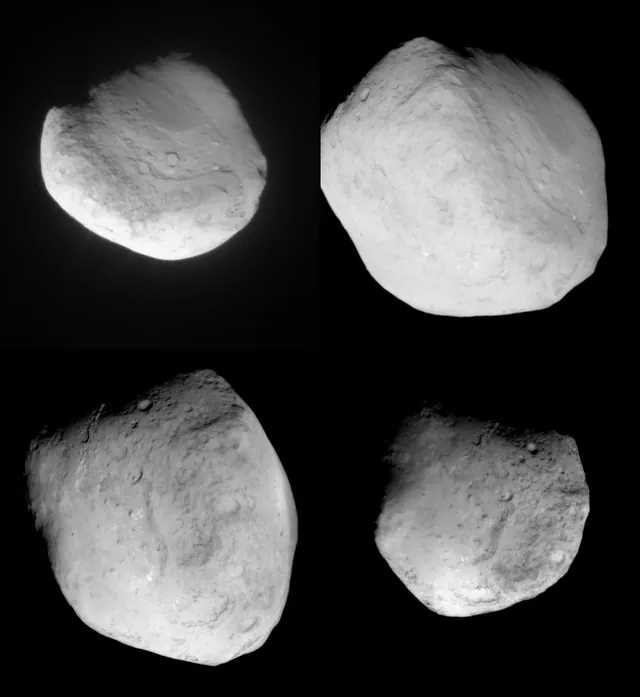
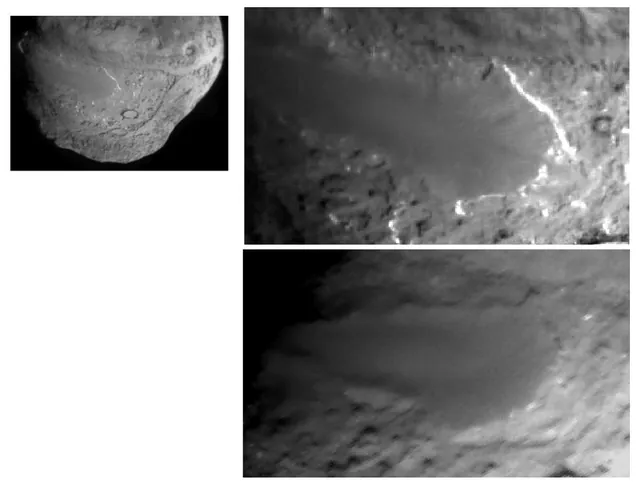
Images from the two flybys show two kinds of terrain. Rough, pitted ground is dotted with round depressions from about 10 m, the limit of the cameras, to about 1 km across, from crisp, steep-walled pits to faint rings. Three gravitationally low regions hold smoother terrain, parts of which look like deposits left by flows that spread across the surface.26
Much of the surface shows layering, some of it perhaps dating back to the time the nucleus was assembled. Smooth areas cover about half of the face first imaged in 2011 and are confined to gravitational lows, which suggests they erupted onto the surface after the nucleus had taken its present shape.68
What it is made of
Deep Impact’s collision showed that the comet’s outer layer is made of fine particles, 1 to 100 micrometres across, with almost no strength holding them together. The amount of organic material in the cloud rose sharply during and after the impact, while carbon dioxide changed less relative to water.2
NASA’s Spitzer Space Telescope analysed the ejecta and found amorphous and crystalline silicates, amorphous carbon, carbonates, clay-like phyllosilicates, polycyclic aromatic hydrocarbons, sulphides, and water as gas and ice. The overall make-up matches solar and primitive meteorite abundances, and the mix of materials formed hot and cold implies they were stirred together across the young Solar System. There was at least 1.3 times as much dust as gas.10
Coma and activity
Tempel 1 is restless. Approaching in June 2005, Deep Impact spotted outbursts on 14 and 22 June, and it observed frequent natural outbursts throughout its approach. The comet is estimated to lose about 3 × 10⁹ kg of water every orbit, and 7–14 × 10⁹ kg of gas and dust in all, roughly one to three ten-thousandths of its mass.256
When Stardust-NExT returned in 2011, the coma and jets were weaker than in 2005. Its dust instruments recorded bursts of impacts, as if larger clumps of material leaving the nucleus were breaking into smaller particles in the coma, as had been seen at comet Wild 2 in 2004.8
Notable features
Deep Impact site
The impactor hit the sunlit side of the nucleus at an oblique angle of about 25°, throwing up a cloud of dust that hid the new crater from the departing flyby spacecraft. Revisiting in 2011, Stardust-NExT found a subdued scar about 50 m across, far smaller than the roughly 150 m crater first estimated, implying surface material like dry, loose snow.458
Smooth flows
Four smooth deposits, interpreted as flows, cover about 11 km² in gravitational lows; the front of one is generally 8–15 m high. Between 2005 and 2011 the scarps at the edge of one retreated by up to about 50 m, the clearest change seen between the visits, as ices evaporated from the cliffs.6813
Pitted terrain
Most of the rest of the surface is rough and pitted, with round depressions from about 10 m to about 1 km across. How they are spread with height suggests the pits are a background landscape that the smooth flows have buried in places.6
Water-ice patches
Deep Impact detected water ice exposed on the surface in three small, oddly coloured areas, as 3–6 per cent ice grains 10–50 micrometres across. The patches cover far too little area to supply the water the comet gives off, so most of its gas must come from below the surface.11
Deep Impact and Stardust-NExT
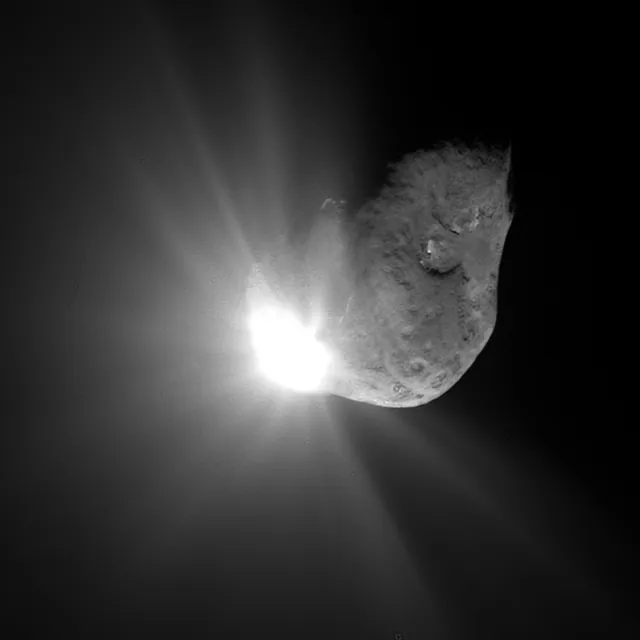
NASA’s Deep Impact, the eighth mission of its Discovery programme, launched on 12 January 2005 and travelled 429 million km in six months to reach Tempel 1. On 3 July it released its 372 kg impactor, which hit the comet the next day at 05:44:58 UT, moving at about 37,000 km/h. The collision released energy equivalent to 4.7 tons of TNT.45
Minutes later the flyby spacecraft passed about 500 km from the nucleus, imaging the plume, the whole nucleus and the dust-shrouded impact site, while Hubble, Spitzer, Rosetta and telescopes on the ground watched. Deep Impact went on to fly past comet Hartley 2 in 2010 as part of its EPOXI extended mission; contact was lost in August 2013.5
NASA then sent Stardust, the first spacecraft to bring comet samples to Earth, back to Tempel 1 as Stardust-NExT. It flew past at 181 km on 14 February 2011, US time, returning 72 images, the first time a comet had been revisited. Stardust made its final engine burn and sent its last transmission on 24 March 2011.78
Quick answers
- How big is 9P/Tempel 1?
- 9P/Tempel 1 has a mean radius of 2.83 km (± 0.1 km, from images taken by both visiting spacecraft).6
- How massive is 9P/Tempel 1?
- 9P/Tempel 1 has a mass of about 4.5 × 10¹³ kg (estimated from the flight of Deep Impact’s ejecta).6
- How dense is 9P/Tempel 1?
- 9P/Tempel 1 has a mean density of 0.47 g/cm³ (uncertain: roughly 0.24 to 1.25 g/cm³).6
- How strong is gravity on 9P/Tempel 1?
- Gravity at the surface of 9P/Tempel 1 is 0.30–0.38 mm/s² (for a density of 0.47 g/cm³).6
- How long is a day on 9P/Tempel 1?
- A day on 9P/Tempel 1 lasts 40.8 hours (40.827 h between 2006 and 2010; the spin speeds up at each perihelion).9
- How long does 9P/Tempel 1 take to complete one orbit?
- 9P/Tempel 1 completes one orbit in 5.6 years (2,040 days; NASA gives 5.56 years).13
- How far is 9P/Tempel 1 from the Sun?
- 9P/Tempel 1 is 1.54–4.75 au from the Sun (about 230 million to 710 million km).1
Sources
- Small-Body Database Lookup: 9P/Tempel 1 — NASA/JPL Solar System Dynamics
- Deep Impact: excavating comet Tempel 1 (A’Hearn et al.) — Science, 2005
- 9P/Tempel 1 — NASA Science
- Deep Impact — NASA NSSDC
- Deep Impact (EPOXI) — NASA Science
- The nucleus of Comet 9P/Tempel 1: Shape and geology from two flybys (Thomas et al.) — Icarus, 2013
- Stardust / Stardust NExT — NASA Science
- Return to Comet Tempel 1: Results from Stardust-NExT (Veverka et al.) — EPSC-DPS Joint Meeting 2011, 2011
- Stardust-NExT, Deep Impact, and the accelerating spin of 9P/Tempel 1 (Belton et al.) — NASA Technical Reports Server, 2011
- Spitzer spectral observations of the Deep Impact ejecta (Lisse et al.) — Science, 2006
- Exposed water ice deposits on the surface of comet 9P/Tempel 1 (Sunshine et al.) — Science, 2006
- A homogeneous nucleus for comet 67P/Churyumov-Gerasimenko from its gravity field (Pätzold et al.) — Nature, 2016
- Changes to Smooth Terrain (Unannotated), PIA13863 — NASA Science Photojournal, 2011
Figures checked against these sources in November 2026. Where a quantity is not known, it is left out rather than estimated.

