comet
Pons–Brooks
Comet Pons–Brooks, catalogued as 12P, is a Halley-type comet that returns to the inner Solar System about every 71 years. Jean-Louis Pons discovered it from Marseille in 1812, and William Brooks found it again in 1883. Before its latest perihelion, on 21 April 2024, it erupted again and again, swelling up to a hundred times in brightness and growing coma shapes that looked like horns.123
It is one of the brightest and most active periodic comets known. Astronomers have traced it back to comets recorded in 1385 and 1457, and probably in AD 245. During its 2024 visit the ALMA telescope array mapped the water in its coma and found a ratio of heavy to ordinary hydrogen matching that of Earth’s oceans, a hint that comets like it may have helped bring water to the young Earth.14
The nucleus
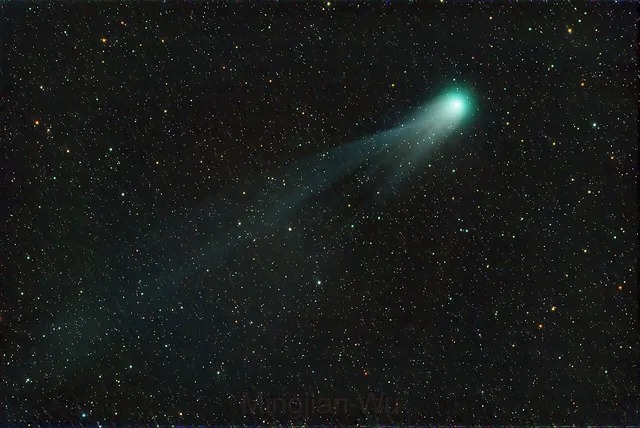
The nucleus has never been seen clearly, because the comet was already active when it was recovered in 2020, 11.89 au from the Sun. Photometry then gave a radius of 17 ± 6 km, assuming a dark surface, but dust and gas around the nucleus mean this is only an upper limit. The comet may have been active since it was about 30 au from the Sun.25
Its outbursts give a rough lower bound. If, as seems most likely, they are driven by buried amorphous ice turning crystalline and releasing trapped gas, each one needs a patch of surface roughly 5 km in radius, so the nucleus cannot be much smaller than that. Over time, the outbursts should also twist the nucleus into a more complicated spin.2
Orbit
Pons–Brooks follows a long ellipse with an eccentricity of 0.955. At perihelion it comes within 0.78 au of the Sun, inside Earth’s orbit, and at aphelion it reaches 33.6 au. One trip takes about 71 years. Its orbit is very like Halley’s in size and shape, but it is tilted 74° to the plane of the planets and runs in the same direction as they do, while Halley’s runs backwards.23
Its latest perihelion was on 21 April 2024, and it passed closest to Earth on 2 June 2024, at a distance of about 231 million km. Backward calculations show that its orbit has been very stable for at least a thousand years. Over about a million years, though, it is expected to be thrown out of the Solar System, and its orbit could change drastically before then.1236
Discovery and history
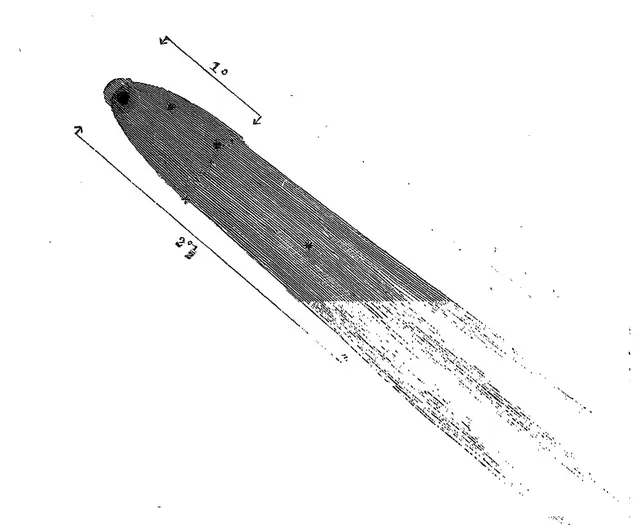
Jean-Louis Pons discovered the comet from Marseille on 21 July 1812 and followed it until 28 September. Johann Franz Encke estimated a period of about 70 years from those two months of data. William Brooks found it again on 2 September 1883 from Phelps, New York, and it was soon recognised as the comet of 1812, so it bears both names.137
The comet had outbursts at both of its later returns, in 1883–84 and 1953–54. In November 1883 it became visible to the naked eye, and telescopic observers reported a strange T-shaped coma. In 2020 a study linked it to comets recorded in 1385 and 1457, and to a probable sighting in Chinese records in AD 245, a white “broom star” about 3° long.157
- Linked historical comets
- 1385 and 14571and probably AD 245
The horned outbursts of 2023–24
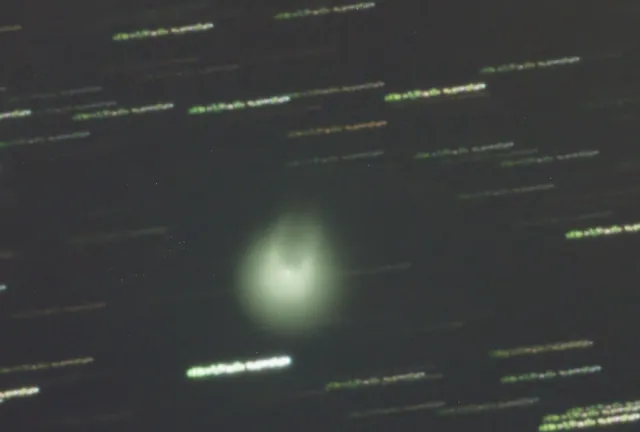
Starting about 4 au from the Sun, Pons–Brooks had a remarkable series of outbursts. In a few hours its brightness could jump by up to 100 times as several billion kilograms of dust burst out. The first big one began on 20 July 2023; others followed in October and November 2023, including one on 14 November, and another on 2 April 2024.27
Each outburst threw dust off the warm, sunward side of the nucleus at hundreds of metres per second. Sunlight then pushed the dust back, and seen from Earth the expanding cloud looked like an upturned umbrella with a dark, hollow zone behind the nucleus, giving the comet its horns. After the July 2023 outburst the horned look faded by late September but came back with later outbursts.2
Water like Earth’s
In April and May 2024, around perihelion, the ALMA telescope array made the first maps of water (H₂O) and semi-heavy water (HDO) in the coma of a Halley-type comet. Both appear to come directly from the nucleus. The ratio of deuterium to ordinary hydrogen, (1.71 ± 0.44) × 10⁻⁴, lies at the low end of values measured in comets and is consistent with Earth’s ocean water.4
Before this, the ratio had been published for 11 other comets, ranging from about 0.9 to 4.2 times the value in ocean water. The result suggests that part of the Oort cloud’s ice may share a common origin with the water delivered to the young Earth. The observations also detected methanol and ethylene glycol.4
- D/H ratio in water
- (1.71 ± 0.44) × 10⁻⁴4consistent with Earth’s oceans
Quick answers
- How big is Pons–Brooks?
- Pons–Brooks has a mean radius of at most about 17 km (upper limit from 2020, probably too large because of dust; its outbursts suggest it is not much smaller than about 5 km).25
- How long does Pons–Brooks take to complete one orbit?
- Pons–Brooks completes one orbit in about 71 years (26,021 days (71.2 years) in JPL’s orbit solution).13
- How far is Pons–Brooks from the Sun?
- Pons–Brooks is 0.78–33.6 au from the Sun (116.8 million km at perihelion; about 5.0 billion km at aphelion).3
- When was Pons–Brooks discovered?
- Pons–Brooks was discovered on 21 July 1812, by Jean-Louis Pons at Marseille; rediscovered by William Brooks on 2 September 1883.123
- What is Pons–Brooks made of?
- Pons–Brooks is made of ice and dust (water with an Earth-like deuterium-to-hydrogen ratio; methanol also detected).4
Sources
- Comet 12P/Pons-Brooks: Identification with Comets C/1385 U1 and C/1457 A1 (Meyer, Kobayashi, Nakano & Green) — arXiv, 2020
- Multiple Outbursts of Halley-Type Comet 12P/Pons-Brooks (Jewitt & Luu) — arXiv, 2025
- Small-Body Database: 12P/Pons-Brooks (orbit solution K242/85) — JPL Solar System Dynamics
- A D/H Ratio Consistent with Earth’s Water in Halley-type Comet 12P from ALMA HDO Mapping (Cordiner et al.) — Nature Astronomy, 2025
- Recovery of Returning Halley-Type Comet 12P/Pons-Brooks With the Lowell Discovery Telescope (Ye et al.) — Research Notes of the AAS, 2020
- Horizons ephemeris of 12P/Pons-Brooks from Earth, 28 May–6 June 2024 — JPL Solar System Dynamics
- The July 2023 Outburst of Comet 12P/Pons-Brooks: Observations and Modeling of Dust Coma and Arc Structure (Hasegawa et al.) — Publications of the Astronomical Society of Japan, 2025
Figures checked against these sources in November 2026. Where a quantity is not known, it is left out rather than estimated.

