comet
Tsuchinshan–ATLAS
Comet Tsuchinshan–ATLAS, catalogued as C/2023 A3, was the great comet of 2024. Found in early 2023 by Purple Mountain Observatory in China and by the ATLAS survey in South Africa, it rounded the Sun on 27 September 2024 and then lit up the evening sky in October with a long dust tail, visible to the naked eye from around the world.12345
It most likely came from the distant Oort cloud. In early October, as it passed almost between the Sun and Earth, its dust scattered sunlight forwards and made it briefly one of the brightest comets ever seen by the SOHO spacecraft. Soon afterwards it showed a rare anti-tail pointing towards the Sun. Despite predictions that it would break up, its nucleus survived.56789
Nucleus and dust
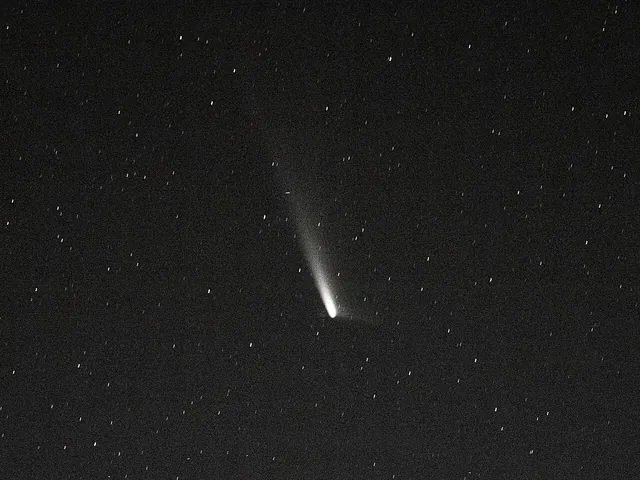
The nucleus has not been seen directly through its coma. Measurements of the light scattered by the comet in February 2024 set an upper limit on its radius of about 5.9 km, assuming a dark surface. Extrapolating its growing dust cloud backwards suggests that it became strongly active around 25 July 2022, when it was still 9.1 au from the Sun, too far for water ice to boil away.8
In July 2024 one analysis argued that the comet had begun to fragment and would collapse before perihelion. It did not. Modelling of its dust loss found the nucleus stable against tidal forces, heating and spin, consistent with its survival. Near perihelion it was shedding dust at up to about 100,000 kg per second, mostly as very small grains.8911
Spectra taken before and after perihelion show that the comet is depleted in carbon: molecules such as C₂ and C₃ are scarce compared with cyanogen (CN). Only a handful of long-period comets are known to be like this, which suggests that the material in the Oort cloud is varied.4
Orbit
Tsuchinshan–ATLAS reached perihelion on 27 September 2024, passing 0.391 au, about 58.6 million km, from the Sun. Its orbit is tilted 139° to the plane of the planets, so it moves round the Sun in the opposite direction to them. It passed closest to Earth on 12 October 2024, at 0.47 au, about 70.7 million km away.3710
Its eccentricity is a hair above 1, so its path is a hyperbola rather than a closed ellipse. Orbit computations by Syuichi Nakano of the Central Bureau for Astronomical Telegrams give negative values of the inverse semi-major axis for both its incoming and outgoing paths, meaning it is moving fast enough to leave the Solar System. ESA describes it as most likely coming from the Oort cloud.367
Discovery and name
Purple Mountain Observatory first recorded the comet on 9 January 2023 at its XuYi Station in China. The object was posted for confirmation but no further observations followed, and on 30 January it was removed as presumed lost. On 22 February 2023 the ATLAS survey found an apparently asteroid-like object with a 0.5 m telescope at Sutherland, South Africa, and other observers soon saw that it had a coma.12
Staff at the Minor Planet Center then matched the ATLAS object to the January observations from China. The comet was named after both discoverers, using Tsuchinshan, the traditional name for comets found by Purple Mountain Observatory. Earlier images taken in December 2022 by the Zwicky Transient Facility at Palomar already showed a small coma and a short tail.12
The 2024 display
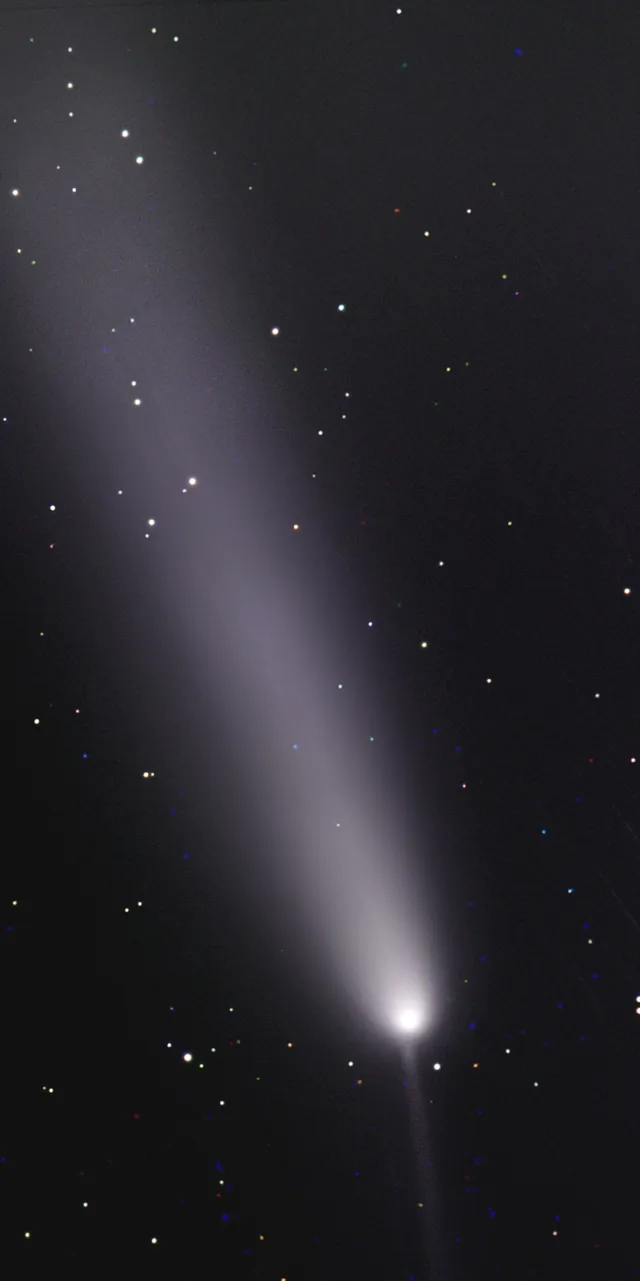
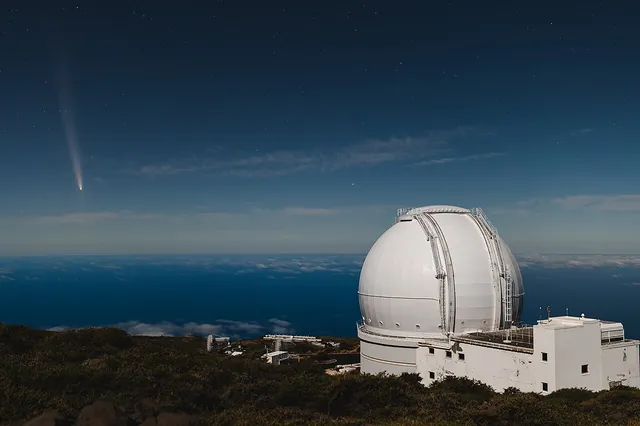
Through late September and early October 2024 the comet showed a long, dusty tail in the pre-dawn sky. From 7 to 11 October it passed through the view of the SOHO spacecraft’s coronagraph, becoming the second-brightest comet SOHO had seen in nearly 29 years, after Comet McNaught in 2007. From 12 October it moved into the evening sky, visible to the naked eye with a tail over 20° long in photographs.567
Its brilliance near the Sun came from forward scattering. Dust grains scatter sunlight most strongly in the forward direction, and on 9 October the comet lay almost between the Sun and Earth, at a scattering angle of only 7°. The effect had been predicted weeks earlier. Measurements of SOHO images gave a total brightness of about magnitude −3; ESA’s estimate is just beyond −4.6712
In October the comet also showed an anti-tail: a long, thin spike pointing towards the Sun, opposite the main tail. It is an effect of perspective. Larger dust grains collect in the plane of the comet’s orbit, and when that plane is seen edge-on they line up into a narrow streak that appears to point sunwards.68

- Minimum scattering angle
- 7°129 October 2024
Quick answers
- How big is Tsuchinshan–ATLAS?
- Tsuchinshan–ATLAS has a mean radius of at most about 5.9 km (upper limit from the light scattered by its dust, assuming a dark surface (albedo 0.04)).8
- How far is Tsuchinshan–ATLAS from the Sun?
- Tsuchinshan–ATLAS is 0.391 au at perihelion from the Sun (about 58.6 million km; the orbit is open, so there is no aphelion).37
Sources
- CBET 5228: Comet C/2023 A3 (Tsuchinshan-ATLAS) — IAU Central Bureau for Astronomical Telegrams, 2023
- MPEC 2023-D77: Comet C/2023 A3 (Tsuchinshan-ATLAS) — IAU Minor Planet Center, 2023
- Small-Body Database: C/2023 A3 (Tsuchinshan-ATLAS) (orbit solution JPL 113) — JPL Solar System Dynamics
- Unveiling the Nature of C/2023 A3 (Tsuchinshan-ATLAS): A Multi-Technique Observational Approach (Ahuja et al.) — arXiv, 2026
- ESA/NASA’s SOHO Spies Bright Comet Making Debut in Evening Sky — NASA Science, 2024
- Comet C/2023 A3 brightens SOHO’s week — ESA, 2024
- CBET 5468: Comet C/2023 A3 (Tsuchinshan-ATLAS) — IAU Central Bureau for Astronomical Telegrams, 2024
- Great comet C/2023 A3 (Tsuchinshan-ATLAS): dust loss before perihelion (Liu, Hui & Liu) — Astronomy & Astrophysics, 2025
- Inevitable Endgame of Comet Tsuchinshan-ATLAS (C/2023 A3) (Sekanina) — arXiv, 2024
- Horizons ephemeris of C/2023 A3 (Tsuchinshan-ATLAS) from Earth, 9–15 October 2024 — JPL Solar System Dynamics
- Dust environment of long-period comet C/2023 A3 (Tsuchinshan-ATLAS) (Moreno et al.) — arXiv, 2025
- CBET 5445: Comet C/2023 A3 (Tsuchinshan-ATLAS) — IAU Central Bureau for Astronomical Telegrams, 2024
Figures checked against these sources in November 2026. Where a quantity is not known, it is left out rather than estimated.

