comet
NEOWISE
Comet NEOWISE, catalogued as C/2020 F3, was the great sight of the northern summer of 2020. NASA’s NEOWISE infrared space telescope discovered it on 27 March 2020, and after skimming past the Sun just inside Mercury’s orbit on 3 July it became bright enough to see with the naked eye, trailing a long tail. It was the brightest comet in the northern sky since Hale–Bopp in 1997.123
Its icy nucleus is only about 5 km across and coated in dark, sooty dust. The Hubble Space Telescope showed that it survived its close pass of the Sun intact, firing two jets of gas and dust. NEOWISE is now heading back to the outer Solar System on a long, narrow orbit and will not return to the inner planets for about 6,800 years.1234
The nucleus
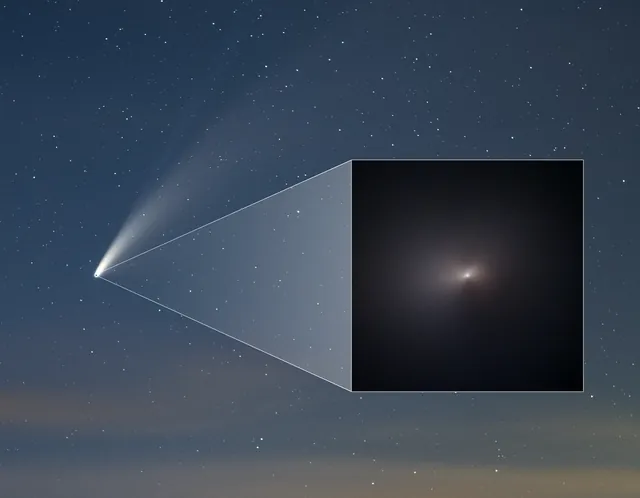
From the heat it gave off, measured by the NEOWISE telescope in infrared light, the comet’s nucleus is about 5 km across. Combining those measurements with visible-light images showed that the nucleus is covered with sooty, dark particles left over from its formation near the birth of the Solar System, 4.6 billion years ago.1
Hubble photographed the comet on 8 August 2020, after its pass by the Sun. Comets often break apart under the heat and tidal stress of such close passes, but NEOWISE’s nucleus stayed intact. Hubble could not see the nucleus itself, which it estimated at no more than 4.8 km across, but it resolved two jets of sublimating ice, shooting out in opposite directions and fanned out by the nucleus’s rotation.26
Orbit
NEOWISE reached perihelion on 3 July 2020, passing 0.295 au, or 44 million km, from the Sun, just inside Mercury’s orbit. Its orbit is tilted 129° to the plane of the planets, so it travels round the Sun in the opposite direction to them. On 23 July it passed Earth at a harmless 103 million km, and by mid-August it had crossed back outside Earth’s orbit.145
The orbit is a very long, narrow ellipse, with an eccentricity of 0.999. JPL’s orbit for 6 July 2020, just after perihelion, gives a period of about 6,787 years and carries the comet out to about 717 au from the Sun. NASA rounds this to about 6,800 years before NEOWISE returns to the inner Solar System.34
Discovery
The comet is named after the space telescope that found it. NASA’s Near-Earth Object Wide-field Infrared Survey Explorer, NEOWISE, picked it up on 27 March 2020 with its two infrared channels, which sensed the heat of the comet as the Sun began to warm it. Even while still far away it appeared as a glowing, fuzzy dot moving across the sky, and its predicted close pass of the Sun raised hopes of a good show.137
The telescope was launched in December 2009 as WISE to map the whole sky in infrared light, and in 2013 it was given a new task, as NEOWISE, of finding asteroids and comets that come close to Earth. NASA ended the mission on 31 July 2024 as drag from an atmosphere expanded by solar activity made its orbit decay, and the spacecraft burned up in Earth’s atmosphere on 1 November 2024.18
The 2020 display
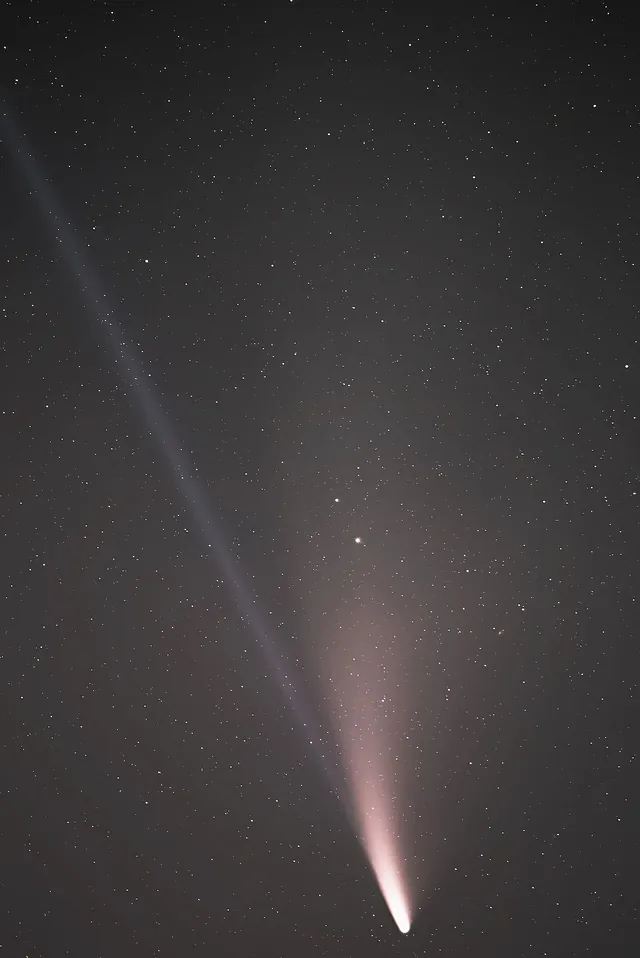
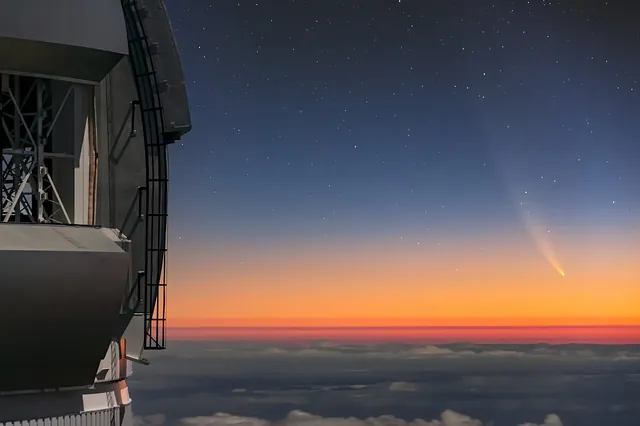
In early July 2020 NEOWISE rose about an hour before sunrise, low in the north-east as seen from the United States, and from 11 or 12 July it appeared in the evening sky after sunset. In dark skies it was visible to the naked eye, and binoculars showed its long, streaky tail. NASA called it the brightest comet to grace northern skies in decades; ESA/Hubble, the brightest since Hale–Bopp in 1997.123
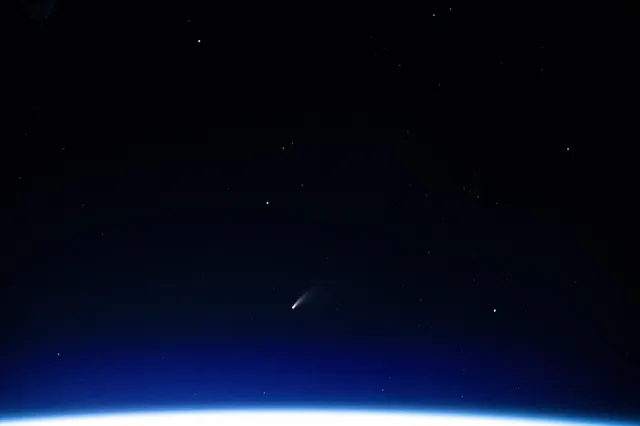
Satellite data showed a dust tail and possibly two tails of ionised gas, stretching from hundreds of thousands to millions of kilometres and pointing away from the Sun. Astronauts photographed the comet from the International Space Station, and one shot more than 340 pictures on 5 July as it rose above the sunlit edge of Earth.3
Quick answers
- How big is NEOWISE?
- NEOWISE has a mean radius of about 2.5 km (nucleus about 5 km across from its infrared glow; Hubble put it at no more than 4.8 km).12
- How long does NEOWISE take to complete one orbit?
- NEOWISE completes one orbit in about 6,800 years (6,787 years (2,478,985 days) in JPL’s orbit for 6 July 2020, just after perihelion).34
- How far is NEOWISE from the Sun?
- NEOWISE is 0.295–717 au from the Sun (44 million km at perihelion; about 107 billion km at aphelion on its outbound orbit).4
Sources
- Comet NEOWISE Sizzles as It Slides by the Sun, Providing a Treat for Observers — NASA Jet Propulsion Laboratory, 2020
- Hubble Snaps Close-Up of Comet NEOWISE — ESA/Hubble, 2020
- On This Day in 2020: Comet NEOWISE — NASA Earth Observatory, 2023
- Small-Body Database: C/2020 F3 (NEOWISE) (orbit solution JPL 31) — JPL Solar System Dynamics
- Horizons ephemeris of C/2020 F3 (NEOWISE) from Earth, 20–26 July 2020 — JPL Solar System Dynamics
- Comet NEOWISE (Hubble image) — NASA Science, 2020
- Comets: Facts — NASA Science
- WISE/NEOWISE — NASA Science
Figures checked against these sources in November 2026. Where a quantity is not known, it is left out rather than estimated.

