comet
Hale–Bopp
Comet Hale–Bopp, C/1995 O1, also called the Great Comet of 1997, was one of the brightest comets of the twentieth century. Alan Hale and Thomas Bopp found it independently on 23 July 1995, when it was still an amazing 7.15 au from the Sun. It went on to stay visible to the naked eye for 18 months in 1996 and 1997.123
Its brilliance came from an unusually large nucleus, tens of kilometres across and at least three times the size of Halley’s. It passed closest to the Sun on 1 April 1997 and, at its best, shone at about magnitude −0.7, with a broad white dust tail, a straight blue ion tail and a faint third tail of sodium atoms. On its present orbit it will not return for more than 2,000 years.134567
Discovery
Two observers found the comet independently on the night of 23 July 1995. Alan Hale saw it from Cloudcroft, New Mexico, with a 41 cm reflector; Thomas Bopp, observing with J. Stevens near Stanfield, Arizona, came across it while looking at M70 through a 44 cm telescope. All described a diffuse glow with some central condensation and no tail, of about magnitude 10.5 to 10.8.12
It was found an astonishing 7.15 au from the Sun, and earlier pictures were later identified: JPL’s orbit uses observations from as early as 27 April 1993, more than two years before the discovery. The comet is named after both of its discoverers, and the ‘C’ in C/1995 O1 marks it as a long-period comet; the 1995 is the year it was found.17
The nucleus
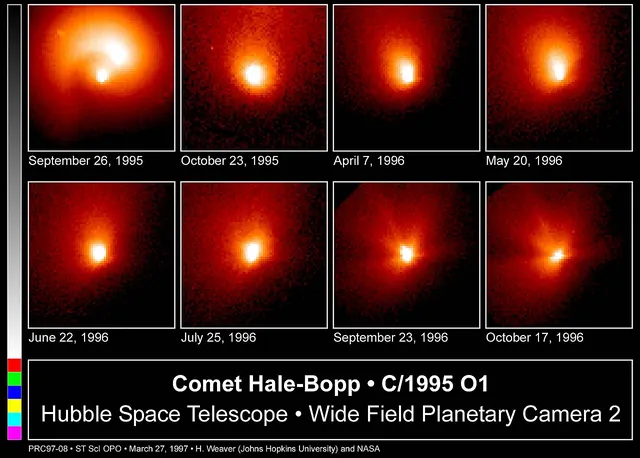
Hale–Bopp is the largest and best-studied comet of modern times, but its nucleus was always hidden inside a bright coma, so its size is hard to pin down. Hubble images suggested a diameter of 27 to 42 km, at least three times that of Halley’s. JPL and NASA list about 60 km, and a 2012 study combining Herschel, Hubble and Very Large Telescope data found a radius of 37 ± 3 km.1478
The nucleus rotates once every 11.35 hours. Before perihelion it was as dark as other comets, reflecting about 3 per cent of sunlight, but once its activity had died away its albedo had roughly doubled, to about 8 per cent. Astronomers suggest that icy grains, unable to escape such a massive body in the cold far from the Sun, fell back and coated it with fresh frost.8
What it gave off
Hale–Bopp was extraordinarily dusty. Near perihelion it released about 2,000 tonnes of dust every second, more than five times its output of gas, and it added some 3 × 10¹³ kg of particles to the dust between the planets. One analysis of its motion concludes that water ice made up at most 57 per cent, and possibly less than half, of all the gas it gave off.1112
Infrared spectra showed the strongest silicate emission yet seen from any comet, including the signature of crystalline olivine. Large organic molecules, many still unidentified, were individually scarce but together may have made up an important share of the gas, and they may have played a major role in driving the finest dust particles away from the nucleus at up to 0.7 km/s.1213
- Dust production near perihelion
- about 2,000 tonnes per second11
- Dust-to-gas ratio
- more than 511by mass, from submillimetre observations
- Dust added to interplanetary space
- 3 × 10¹³ kg11
- Water’s share of the gas
- at most 57 per cent12by mass
- Dust minerals
- amorphous and crystalline silicates13including crystalline olivine
Three tails
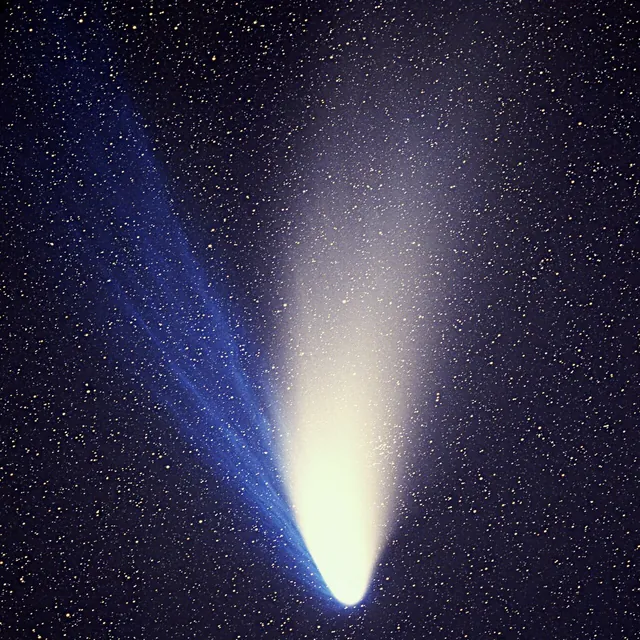
In photographs Hale–Bopp showed two main tails. A broad tail of dust fanned out to one side, while a narrow blue ion tail of electrically charged gas pointed straight away from the Sun. Measurements from the Midcourse Space Experiment satellite near perihelion found a faint, diffuse third tail of neutral sodium atoms lying between the two.514
The sodium tail was reported in 1997 as a third type of comet tail, entirely different from the familiar dust and ion tails. Sodium atoms absorb and re-emit sunlight, a process called resonance fluorescence, and the pressure of that light pushes them away from the comet. Ground-based images traced the sodium for more than 3.5 million km, and its main source appeared to be the inner coma and nucleus.614
- Ion tail
- narrow and blue5points straight away from the Sun
Orbit
Hale–Bopp’s orbit is tilted at 89.3°, almost at right angles to the planets’ orbits, and is extremely elongated, with an eccentricity of 0.995. At perihelion on 1 April 1997 it came 0.914 au from the Sun, just inside Earth’s orbit, and the far end of its orbit lies about 354 au from the Sun, according to JPL’s current solution.17910
Published periods differ because the planets keep altering the orbit: JPL’s solution gives about 2,360 years, NASA quotes about 2,534 years and NSSDC about 4,000 years. A 2017 study suggests that the comet passed within 0.005 au of Jupiter in 2252 BC, and calculates that its future orbital period will shorten to about 1,000 years.171012
The Great Comet of 1997
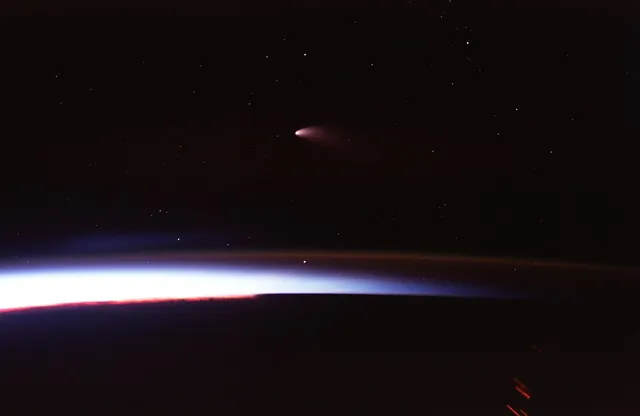
Hale–Bopp’s large nucleus kept it visible to the naked eye for 18 months in 1996 and 1997. It passed closest to Earth on 22 March 1997, at 1.32 au, and reached about magnitude −0.7 on 26 March. By JPL’s stricter measure of a naked-eye comet, magnitude 3.4 or brighter in a dark sky, it qualified for about 215 days.1310
JPL’s Don Yeomans notes that a comet usually becomes great only by passing very close to the Sun, so that it produces huge amounts of gas and dust, or by passing close to Earth. Hale–Bopp did neither, staying 0.91 au from the Sun and 1.32 au from Earth; NASA credits its long naked-eye spell to the sheer size of its nucleus.13
Watching it fade
Hale–Bopp was followed for years by telescopes on the ground and in space. The Hubble Space Telescope imaged the region around its nucleus repeatedly in 1995 and 1996, and the European Infrared Space Observatory measured the heat from its dust five times between 4.6 and 2.8 au from the Sun, finding prominent silicate features.4815
Long after perihelion the comet stayed active, still showing significant activity 25.7 au from the Sun in late 2007. Its activity ceased between late 2007 and March 2009, at about 28 au. On 4 December 2010, ESO’s 2.2-metre telescope at La Silla recorded it at 30.7 au, then the most distant comet ever observed, far beyond the orbit of Neptune.816
Quick answers
- How big is Hale–Bopp?
- Hale–Bopp has a mean radius of about 30 km (diameter about 60 km; estimates range from 27–42 km across (Hubble, 1997) to 74 km (Herschel, 2012)).1478
- How long is a day on Hale–Bopp?
- A day on Hale–Bopp lasts 11.35 hours (rotation period; its spin made the inner coma vary in brightness).8
- How long does Hale–Bopp take to complete one orbit?
- Hale–Bopp completes one orbit in about 2,360 years (JPL’s orbit for 2022; NASA gives about 2,534 years).17
- How far is Hale–Bopp from the Sun?
- Hale–Bopp is 0.914–354 au from the Sun (about 137 million km at perihelion in 1997; aphelion from JPL’s orbit).7910
Sources
- C/1995 O1 (Hale-Bopp) — NASA Science
- IAU Circular 6187: Comet 1995 O1 — IAU Central Bureau for Astronomical Telegrams, 1995
- Great Comets in History — JPL Solar System Dynamics, 2007
- The Activity and Size of the Nucleus of Comet Hale-Bopp (C/1995 O1) — Science, 1997
- Comet Hale-Bopp — ESO, 2009
- Neutral Sodium from Comet Hale-Bopp: A Third Type of Tail — Astrophysical Journal Letters, 1997
- Small-Body Database: C/1995 O1 (Hale-Bopp) — JPL Solar System Dynamics, 2022
- Evidence for fresh frost layer on the bare nucleus of comet Hale–Bopp at 32 AU distance — Astrophysical Journal, 2012
- Horizons System: osculating elements of C/1995 O1 (Hale-Bopp) at perihelion — JPL Solar System Dynamics, 2022
- Comet Fact Sheet — NASA NSSDC
- Particulate Mass Loss from Comet Hale-Bopp — Astronomical Journal, 1999
- Orbital Evolution, Activity, and Mass Loss of Comet C/1995 O1 (Hale-Bopp). I. Close Encounter with Jupiter in Third Millennium BCE and Effects of Outgassing on the Comet’s Motion and Physical Properties — arXiv, 2017
- Silicate Mineralogy of the Dust in the Inner Coma of Comet C/1995 O1 (Hale-Bopp) Pre- and Postperihelion — Astrophysical Journal, 1999
- On the sodium tail of comet Hale-Bopp (C/1995 O1) — Geophysical Research Letters, 1998
- Broadband infrared photometry of comet Hale-Bopp with ISOPHOT — Astronomy & Astrophysics, 2001
- Frozen to death? Detection of comet Hale-Bopp at 30.7 AU — Astronomy & Astrophysics, 2011
Figures checked against these sources in November 2026. Where a quantity is not known, it is left out rather than estimated.

