comet
103P/Hartley 2
Hartley 2 (103P/Hartley) is a small, hyperactive comet with a peanut-shaped nucleus just 2.33 km long. NASA’s Deep Impact spacecraft, on an extended mission called EPOXI, flew past it at 694 km on 4 November 2010. Its pictures showed jets driven by carbon dioxide gas blasting chunks of ice from the ends of the nucleus, while water vapour seeped from its smooth, narrow waist.1234
Malcolm Hartley discovered the comet in 1986 at Siding Spring Observatory in Australia. It circles the Sun every 6.5 years, ranging from just beyond Earth’s distance to almost 6 au. In 2011 ESA’s Herschel space observatory found that its water has almost the same ratio of deuterium to hydrogen as Earth’s oceans, reviving the idea that comets helped to bring water to our planet.4567
Size and shape
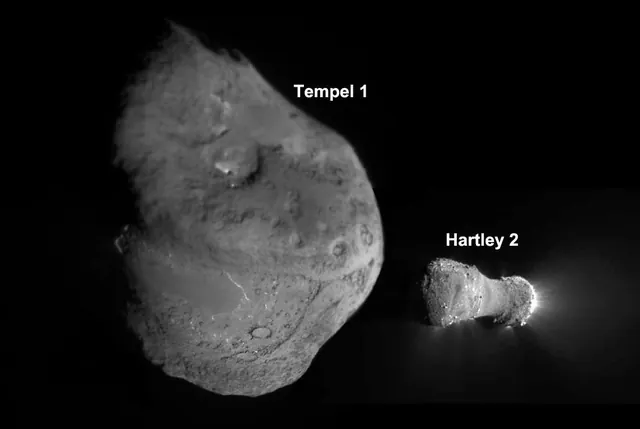
EPOXI’s images show a bi-lobed, elongated nucleus that is nearly symmetrical about its long axis, 2.33 km from end to end and between 0.69 and 2.33 km across depending on direction. Its volume, about 0.81 km³, equals that of a sphere 0.58 km in radius. Although Hartley 2 is about one-fifth the size of Tempel 1, it gives off a similar amount of gas at perihelion.1
Its mass has not been measured directly. Assuming that the smooth waist lies close to a level surface of gravity, the imaging team modelled a mean density of 200–400 kg/m³. At such a low density the comet loses more than 1 per cent of its mass every orbit: roughly 5 per cent during its 1997 passage and 2 per cent in 2010 if the density is 300 kg/m³.1
Orbit and spin
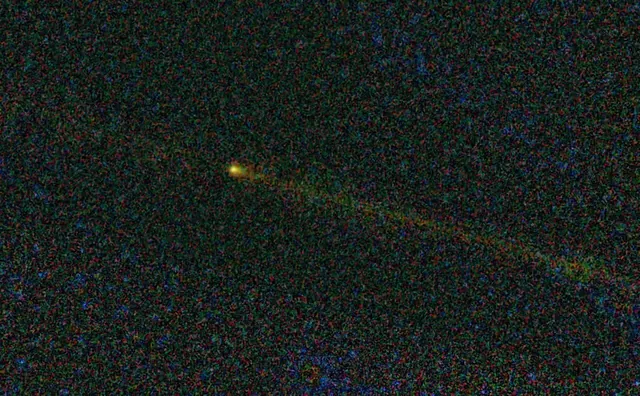
Hartley 2 is a Jupiter-family comet: its period is less than 20 years and its orbit has been reshaped by close passes of Jupiter. It swings from 1.06 au from the Sun out to 5.89 au, taking about 6.5 years per lap on an orbit tilted 13.6° to the ecliptic. On 20 October 2010 it passed 0.12 au (about 18 million km) from Earth.458
The nucleus does not spin simply: it rotates about one axis while tumbling about another. During the 2010 approach its main period was lengthening by about 0.1 per cent per turn, from about 16 hours two months before the flyby to about 18 hours around the encounter, and it also rolled about its long axis. JPL lists a rotation period of 18.1 hours.145
Discovery and name
Malcolm Hartley discovered the comet on 15 March 1986 with the UK Schmidt Telescope at Siding Spring Observatory in Australia. Like most comets it is named after its discoverer. The P in its designation, 103P/Hartley, marks a periodic comet, one that returns within 200 years.45
Surface and activity
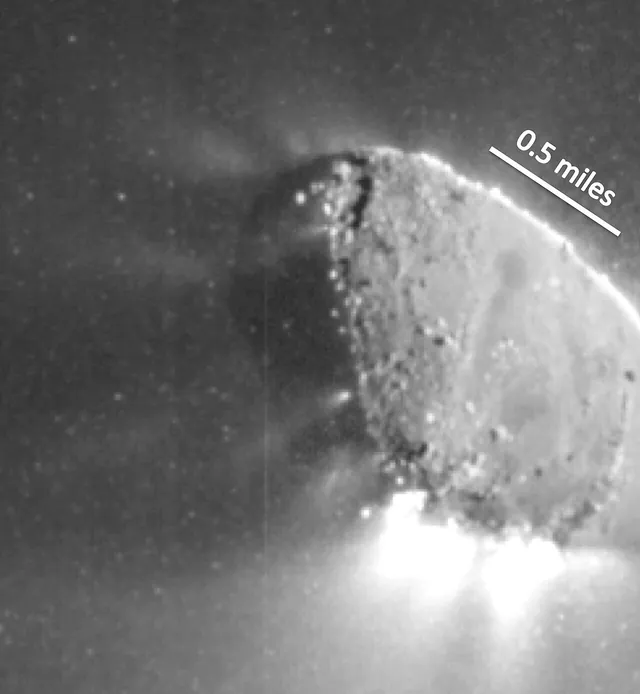
Hartley 2 looks unlike the comets visited before it. Its two lobes are rough, studded with mounds mostly less than 40 m across and with glittering blocks about 50 m high and 80 m wide that reflect two to three times more light than the average surface. Between the lobes lies a smooth, variegated waist that appears to be a low area filled and smoothed by deposited material.14
EPOXI found that, unlike larger and less active comets, Hartley 2 outgasses mainly because of carbon dioxide, which drags chunks of ice out of the nucleus. Carbon dioxide jets shoot from the ends, mostly from the small end, while water vapour comes from the waist with little or no carbon dioxide. Different parts of the nucleus release volatiles in different proportions, so it is not uniform.234
Ocean-like water
Water in Earth’s oceans holds about 1.56 deuterium atoms for every 10,000 hydrogen atoms. Six comets from the distant Oort cloud measured before 2011 averaged almost twice as much, so comets like them could have supplied only a small part of Earth’s water. Using the HIFI instrument on ESA’s Herschel space observatory, a team led by Paul Hartogh measured Hartley 2’s ratio at 1.61 ± 0.24 per 10,000.67
The result, published in October 2011, widened the reservoir of ocean-like water to include some comets. Hartley 2 is thought to have formed far beyond Pluto, in the Kuiper belt, where water ice could have taken on a different deuterium content from ice made in the warmer inner Solar System.67
The EPOXI flyby
Deep Impact was launched on 12 January 2005 and hit comet Tempel 1 with an impactor on 4 July 2005. With propellant to spare, NASA approved an extended mission, EPOXI, on 3 July 2007; its name joins Extrasolar Planet Observations (EPOCh) and Deep Impact Extended Investigation (DIXI). Its first target, comet 85P/Boethin, was lost, possibly because it had broken up, so the spacecraft was sent to Hartley 2.2
After Earth flybys in December 2007, December 2008 and June 2010, Deep Impact passed 694 km from the nucleus on 4 November 2010, a week after the comet’s perihelion, and studied it with its three instruments for three weeks. Hartley 2 was the fifth comet visited by a spacecraft. Contact was lost in August 2013, and NASA ended the mission on 20 September 2013.124
Quick answers
- How big is 103P/Hartley 2?
- 103P/Hartley 2 has a mean radius of 0.58 km (radius of a sphere of the same volume).1
- How dense is 103P/Hartley 2?
- 103P/Hartley 2 has a mean density of 0.2–0.4 g/cm³ (modelled from the shape of the smooth waist, not measured directly).1
- How strong is gravity on 103P/Hartley 2?
- Gravity at the surface of 103P/Hartley 2 is 0.019–0.044 mm/s² (varies over the surface; if the density is 0.3 g/cm³).1
- How long is a day on 103P/Hartley 2?
- A day on 103P/Hartley 2 lasts about 18 hours (complex, tumbling rotation; the period was lengthening in 2010).145
- How long does 103P/Hartley 2 take to complete one orbit?
- 103P/Hartley 2 completes one orbit in 6.49 years (about 2,370 days).5
- How far is 103P/Hartley 2 from the Sun?
- 103P/Hartley 2 is 1.06–5.89 au from the Sun (about 160–880 million km).5
Sources
- Shape, density, and geology of the nucleus of Comet 103P/Hartley 2 (Thomas et al.) — Icarus, 2013
- Deep Impact (EPOXI) — NASA Science
- EPOXI at comet Hartley 2 (A’Hearn et al.) — Science, 2011
- Comet 103P/Hartley (Hartley 2) — NASA Science
- Small-Body Database: 103P/Hartley 2 (orbit, physical parameters, discovery) — JPL Solar System Dynamics
- Ocean-like water in the Jupiter-family comet 103P/Hartley 2 (Hartogh et al.) — Nature, 2011
- Did Earth’s oceans come from comets? — ESA, 2011
- Close-Approach Data: 103P/Hartley 2 — JPL Solar System Dynamics
Figures checked against these sources in November 2026. Where a quantity is not known, it is left out rather than estimated.

