comet
81P/Wild 2
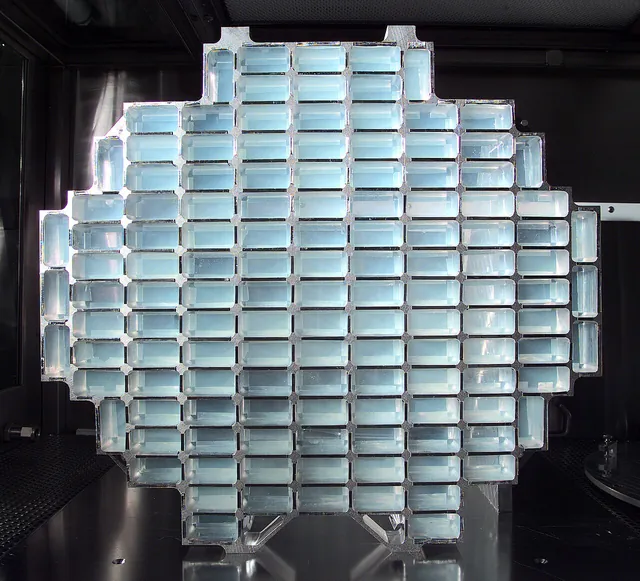
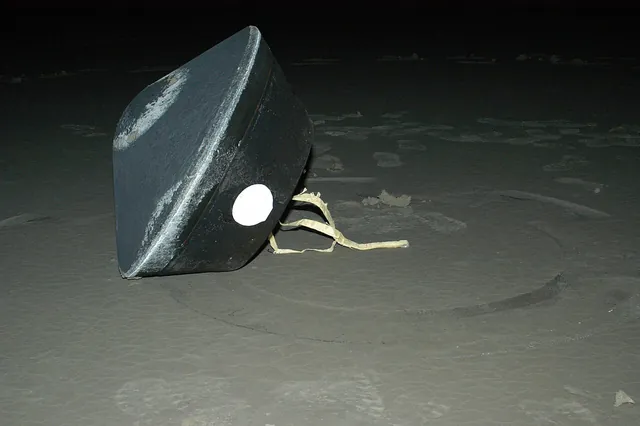
Wild 2 (81P/Wild) is a small comet, about 5.5 km long, that circles the Sun every 6.4 years between the orbits of Mars and Jupiter. It was the first comet whose dust a spacecraft brought back to Earth. NASA’s Stardust flew through its coma on 2 January 2004, caught particles in a feather-light silica foam called aerogel, and returned them by parachute to Utah on 15 January 2006.1234
Wild 2 is a newcomer to the inner Solar System. Until a close pass of Jupiter in September 1974 it stayed much farther from the Sun, and the Swiss astronomer Paul Wild found it in January 1978 on its first lap of the new orbit. Its dust held surprises: grains of minerals that formed at high temperatures near the young Sun, and the amino acid glycine.3567
Size and shape
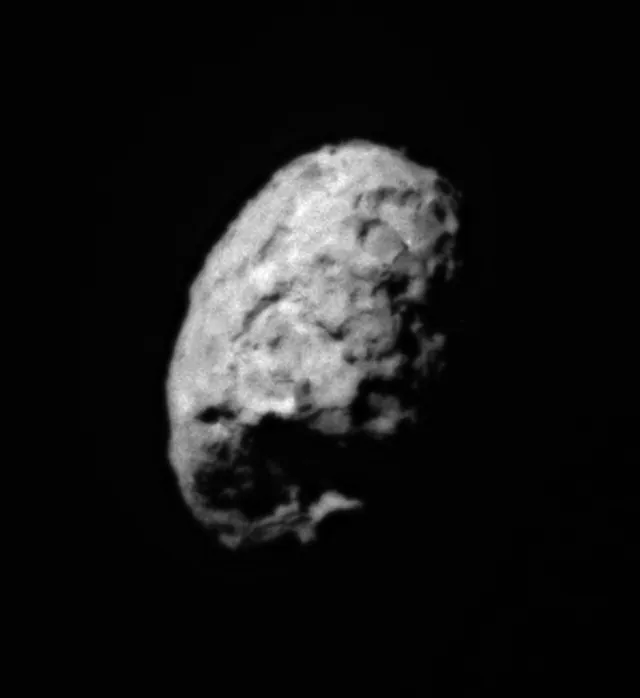
Stardust’s navigation camera took 72 pictures of the nucleus during the flyby. An ellipsoid fitted to the edge and the shadow line in those pictures has semi-axes of 2.75, 2.00 and 1.65 km, so Wild 2 measures about 5.5 × 4.0 × 3.3 km, each semi-axis uncertain by about 0.05 km. Only the sunlit half was seen, so the far side could differ from the model.14
The mission team described Wild 2 as an oblate body about 5 km across that does not look like a rubble pile: high-angle slopes show that its surface is cohesive and holds itself up. A detailed plate model finds relief from 600 m below to 250 m above its best-fitting ellipsoid. Observations from Earth give a rotation period of about 13.5 hours.5811
- Dimensions
- 5.5 × 4.0 × 3.3 km1semi-axes 2.75, 2.00 and 1.65 km, ± 0.05 km
- Mean radius
- about 2.1 km1volume-equivalent, computed from the ellipsoid
- Effective diameter
- 4.0 km2value listed by JPL, from Lamy et al. (2004)
- Relief
- −600 m to +250 m11relative to the best-fitting ellipsoid of the plate model
- Rotation period
- about 13.5 hours5
Orbit
Wild 2 orbits the Sun between Mars and Jupiter on an elongated path, ranging from 1.6 au (about 240 million km) at perihelion to 5.3 au at aphelion. One lap takes about 6.4 years, and the orbit is tilted only about 3° to the plane of Earth’s orbit. The comet last passed perihelion on 15 December 2022.23
This orbit is recent. On 10 September 1974 Wild 2 passed less than a million kilometres from Jupiter, whose gravity cut its orbital period from about 43 years to 6.4 years and pulled its perihelion in from 4.9 au to 1.59 au. Before that its orbit lay between those of Jupiter and Uranus, so it has made only about six close passes of the Sun on its present path.351213
Discovery and name
The Swiss astronomer Paul Wild discovered the comet on 6 January 1978 with a 40 cm Schmidt telescope at Zimmerwald, the observing station of the Astronomical Institute of Berne. He caught it during its first trip around the Sun on its new orbit. The comet is named after him, and Wild is pronounced “vilt”. The P in 81P marks a periodic comet, one that returns within 200 years.235
Surface and jets
Stardust’s images revealed a surface covered with remarkable landforms, including circular depressions that look like impact craters. Some have flat floors and others a “pit-halo” form; there are also irregular hollows thought to be shaped by sublimation and mass wasting. Pits range from tens of metres to about 2 km across. The surface is active, yet it still keeps ancient terrain.813
Mission scientists traced 20 jets of dust in the flyby images. Two rose from the night side, and seven sources, five of them in the Mayo depression, sit on relatively bright spots. Stardust’s dust monitors recorded impacts in sudden bursts as the craft crossed thin sheets of material from these small sources. Models suggest that today’s activity widens and softens pits rather than carving them.1314
What its dust is made of
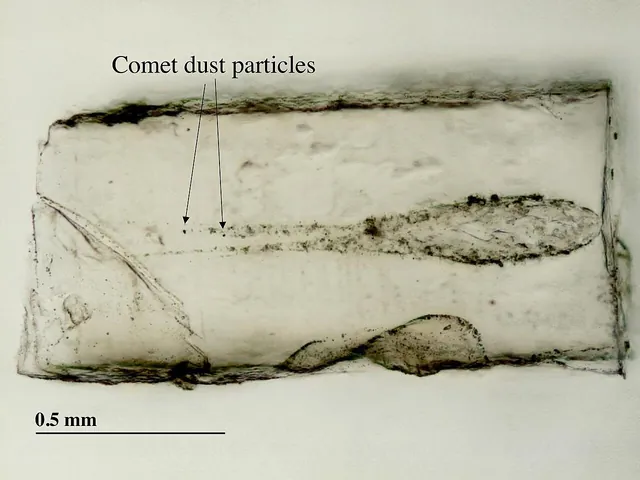
Stardust returned more than 10,000 particles larger than a micrometre. They are an unequilibrated mix of materials, some older than the Solar System and some formed within it. Many are silicate grains much larger than expected, and many of these are high-temperature minerals that formed in the inner solar nebula, so material from near the young Sun must have been carried out to where the comet formed.4615
Most of the dust is a weakly bound mixture of nanometre-sized grains with occasional larger crystals of olivine, pyroxene, iron-nickel sulphides and metal. No minerals formed in liquid water were found, so Wild 2 saw little or no watery alteration. The organic matter is rich in oxygen and nitrogen, and excesses of deuterium and nitrogen-15 suggest that some of it has an interstellar or protostellar origin.910
In 2009 NASA scientists reported glycine, an amino acid living things use to make proteins, in Stardust’s comet samples: the first amino acid found in a comet. They analysed aluminium foil lining the aerogel cells, and the glycine’s carbon isotopes showed an extraterrestrial signature, ruling out contamination from Earth.7
The Stardust mission
Stardust was launched on 7 February 1999, the fourth mission in NASA’s low-cost Discovery Program and the first American mission dedicated solely to a comet. After an Earth flyby in 2001 and a pass of the asteroid 5535 Annefrank in November 2002, it entered Wild 2’s coma on 31 December 2003 and made its closest approach at 19:22 UT on 2 January 2004, taking 72 images of the nucleus.4
Its aerogel collector, opened on 24 December 2003, was stowed and sealed about six hours after closest approach. At 05:57 UT on 15 January 2006 the sample capsule separated from the spacecraft, entered the atmosphere four hours later and landed under parachutes at 10:10 UT on the US Air Force Utah Test and Training Range. Recovery teams found it 44 minutes after landing.4
The spacecraft went on as Stardust-NExT and flew past comet Tempel 1 on 15 February 2011, the first time a comet had been revisited. It used up its propellant and sent its last signal on 24 March 2011. NASA gives the closest distance to Wild 2 as 236 km on its comet page and 250 km on its mission page.34
Quick answers
- How big is 81P/Wild 2?
- 81P/Wild 2 has a mean radius of about 2.1 km (radius of a sphere with the ellipsoid’s volume, computed from its semi-axes).1
- How long is a day on 81P/Wild 2?
- A day on 81P/Wild 2 lasts about 13.5 hours (rotation period measured from Earth).5
- How long does 81P/Wild 2 take to complete one orbit?
- 81P/Wild 2 completes one orbit in 6.41 years (about 2,340 days).23
- How far is 81P/Wild 2 from the Sun?
- 81P/Wild 2 is 1.6–5.3 au from the Sun (about 240–790 million km; average 3.45 au).2
Sources
- Shape Models of Comet Wild 2: description of the tri-axial ellipsoid model (SDU-C-NAVCAM-5-WILD2-SHAPE-MODEL-V2.0) — NASA Planetary Data System, Small Bodies Node
- Small-Body Database: 81P/Wild 2 (orbit, physical parameters, discovery) — JPL Solar System Dynamics
- 81P/Wild (Wild 2) — NASA Science
- Stardust / Stardust NExT — NASA Science
- Comet 81/P Wild 2: changes in the spin axis orientation during the last five apparitions (Oldani et al.) — Icarus, 2024
- Comet 81P/Wild 2 under a microscope (Brownlee et al.) — Science, 2006
- NASA Researchers Make First Discovery of Life’s Building Block in Comet — NASA Jet Propulsion Laboratory, 2009
- Surface of young Jupiter family comet 81P/Wild 2: view from the Stardust spacecraft (Brownlee et al.) — Science, 2004
- Mineralogy and petrology of comet 81P/Wild 2 nucleus samples (Zolensky et al.) — Science, 2006
- Organics captured from comet 81P/Wild 2 by the Stardust spacecraft (Sandford et al.) — Science, 2006
- Shape Models of Comet Wild 2: description of the plate model — NASA Planetary Data System, Small Bodies Node
- Close-Approach Data: 81P/Wild 2 and Jupiter — JPL Solar System Dynamics
- Pits on Jupiter Family Comets and the age of cometary surfaces (Guilbert-Lepoutre et al.) — arXiv, 2023
- Modeling the nucleus and jets of comet 81P/Wild 2 based on the Stardust encounter data (Sekanina et al.) — Science, 2004
- Isotopic compositions of cometary matter returned by Stardust (McKeegan et al.) — Science, 2006
Figures checked against these sources in November 2026. Where a quantity is not known, it is left out rather than estimated.

