comet
Swift–Tuttle
Comet Swift–Tuttle, catalogued as 109P, is the parent of the Perseids, the meteor shower that peaks every August. Its icy nucleus is about 26 km across, large for a comet and more than twice the size of the object thought to have ended the age of the dinosaurs. It travels round the Sun once every 133 years on a steep, backwards-running orbit that carries it out to about 51 times Earth’s distance from the Sun.123
Lewis Swift and Horace Tuttle found it independently in July 1862. It was not seen again until September 1992, when Tsuruhiko Kiuchi recovered it on its way to perihelion that December. Scientists at NASA’s Jet Propulsion Laboratory traced its path back more than two thousand years, matching it to comets recorded by Chinese astronomers in 69 BC and AD 188, and forward to its next return in 2126.134
The nucleus
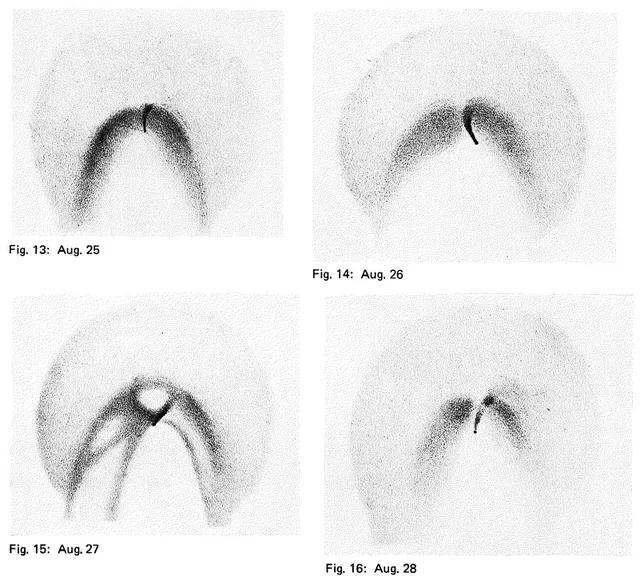
Swift–Tuttle is a large comet. Its solid nucleus, a lump of ice and dust hidden inside the glowing coma, is about 26 km across, the effective diameter listed by JPL from a 2004 review of comet nuclei. NASA notes that this is more than twice the size of the asteroid thought to have caused the extinction of the dinosaurs. JPL’s database lists no measured mass or rotation period.13
Its motion hints at a heavy nucleus. Most active comets are nudged off course by the jet-like push of the gas they release, but for Swift–Tuttle this effect appears negligible. The JPL team suggested that it either releases gas evenly towards the Sun or is far more massive than comets of similar activity, such as Halley. Its intrinsic brightness also seems to have stayed about the same for more than two thousand years.4
Orbit
Swift–Tuttle takes about 133 years to go round the Sun. Its orbit is a long, narrow ellipse: at perihelion it comes to 0.96 au from the Sun, just inside Earth’s orbit, and at aphelion it swings out to about 51 au, more than 7.6 billion km away. The orbit is tilted 113° to the plane of the planets, so the comet travels round the Sun in the opposite direction to them.13
JPL scientists integrated the orbit forward to AD 2392. The comet should pass perihelion on 12 July 2126 and come within 0.153 au (about 23 million km) of Earth on 5 August 2126, when it may reach magnitude 0.7, a visually impressive sight. They found virtually no chance of a collision then. At the following return, in 2261, it passes 0.147 au from Earth.34
Those predictions settled a worry raised in 1992. An early orbit fitted to only part of the 1862 data had shown that if the comet reached perihelion 15 days later than predicted, it could strike Earth in August 2126. Linking the 1737, 1862 and 1992 observations, without any need for gas-jet forces, removed that possibility.4
Discovery and history
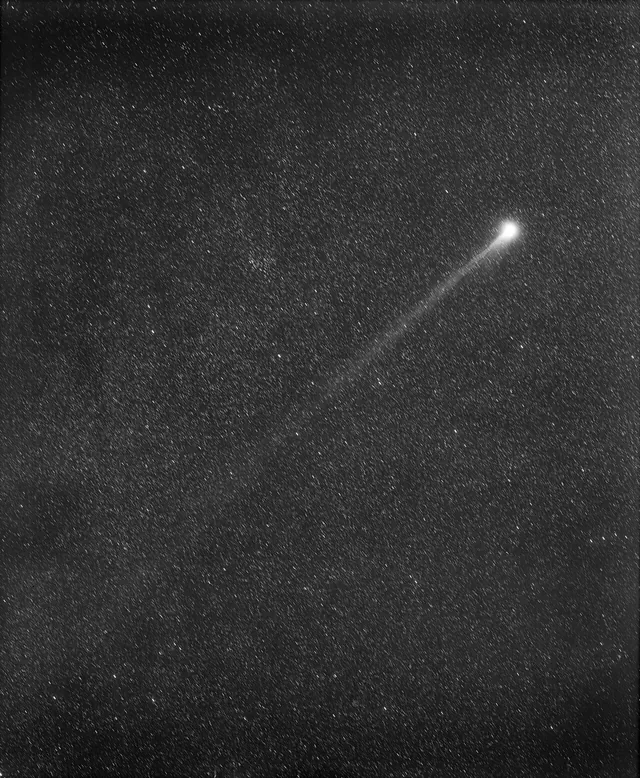
Lewis Swift discovered the comet on 16 July 1862 from Marathon, New York, and Horace Tuttle found it independently, so it carries both their names. The P in 109P marks it as a periodic comet, one that orbits the Sun in less than 200 years. It was followed until October 1862, and astronomers then expected it back after about 120 years.134
When it failed to appear in the early 1980s, Brian Marsden’s alternative prediction, based on a possible sighting in 1737 by the Jesuit astronomer Ignatius Koegler in Beijing, pointed to late 1992. Tsuruhiko Kiuchi recovered the comet on 26 September 1992, confirming that the 1737 comet was Swift–Tuttle. JPL scientists then identified two earlier returns in Chinese histories, in 69 BC and AD 188.4
The Perseid meteors
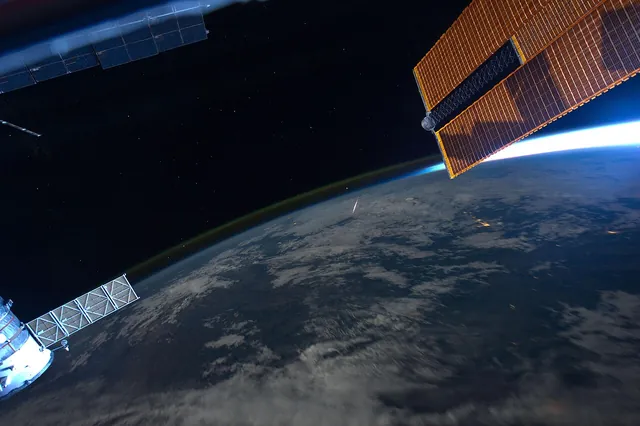
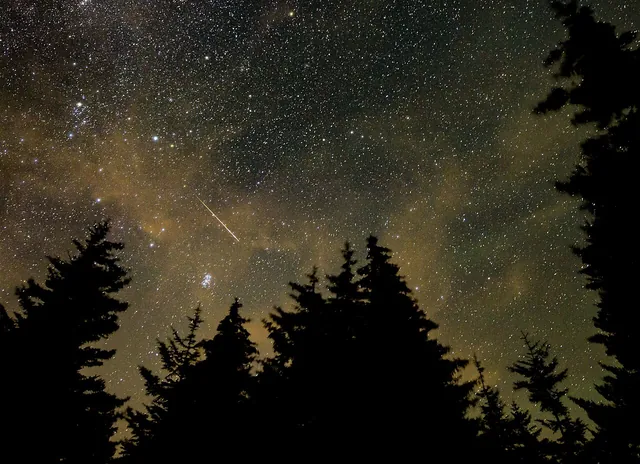
Every time Swift–Tuttle passes the Sun it sheds dust, which spreads along its orbit. Earth runs through this trail each August, and the grains burn up in the atmosphere as the Perseid meteors. Giovanni Schiaparelli realised in the 1860s that the comet was their source. The shower peaks in mid-August, and its meteors seem to stream from the constellation Perseus, which gives the shower its name.12
The Perseids are among the richest showers of the year. NASA gives about 25 meteors per hour under dark skies in its fact table, and 50 to 100 per hour at best. The grains hit the atmosphere at about 59 km per second, and the shower is known for its fireballs, brighter and longer-lasting meteors made by larger pieces of comet material.2
Quick answers
- How big is Swift–Tuttle?
- Swift–Tuttle has a mean radius of about 13 km (effective diameter of the nucleus 26 km).13
- How long does Swift–Tuttle take to complete one orbit?
- Swift–Tuttle completes one orbit in 133 years (48,681 days in JPL’s orbit solution).13
- How far is Swift–Tuttle from the Sun?
- Swift–Tuttle is 0.96–51.2 au from the Sun (about 143.5 million km at perihelion and 7.66 billion km at aphelion).3
- When was Swift–Tuttle discovered?
- Swift–Tuttle was discovered on 16 July 1862, by Lewis Swift at Marathon, New York; found independently by Horace Tuttle.13
- What is Swift–Tuttle made of?
- Swift–Tuttle is made of ice, dust and dark organic material (as NASA describes comet nuclei in general).5
Sources
- 109P/Swift-Tuttle — NASA Science
- Perseids — NASA Science
- Small-Body Database: 109P/Swift-Tuttle (orbit solution JPL 32) — JPL Solar System Dynamics
- The past and future motion of Comet P/Swift-Tuttle (Yau, Yeomans & Weissman) — Monthly Notices of the Royal Astronomical Society, 1994
- Comets: Facts — NASA Science
Figures checked against these sources in November 2026. Where a quantity is not known, it is left out rather than estimated.

