dwarf planet
Quaoar
Quaoar is one of the largest worlds in the Kuiper belt, an icy body about 1,094 km across that circles the Sun every 285 years at an average of 43 au, more than six billion kilometres away. Chad Trujillo and Michael Brown found it from Palomar Observatory in June 2002, and Hubble images soon showed it was the largest object discovered in the Solar System since Pluto.123
Quaoar has a small, dark moon, Weywot, and something no theory predicted: two thin rings orbiting far outside the distance at which ring material should clump into moons. Its surface is mostly crystalline water ice, with methane, ethane and carbon dioxide that hint at an interior that once melted. In 2025 a stellar occultation revealed one more object, either a tiny moon or a dense arc of material.45678910
Size and shape
Measuring Quaoar has taken two decades. Hubble’s 2002 images suggested a diameter of about 1,300 km, but stellar occultations, in which Quaoar passes in front of a star and observers time how long the star disappears, are far more precise. Combining more than 30 such events observed between 2011 and 2025, a 2026 study finds a slightly flattened body with equatorial radii of about 566 km and a polar radius of 511 km.13
Weywot’s orbit gives the combined mass, 1.21 × 10²¹ kg, and with the new volume a density of 1.76 g/cm³. Earlier estimates swung widely: in 2010 a smaller size and larger mass gave 4.2 g/cm³, possibly the highest in the Kuiper belt. Quaoar’s flattening matches the shape a fluid body spinning every 8.84 hours would take, so it can be in hydrostatic equilibrium, the condition for a dwarf planet.112
Orbit and rotation
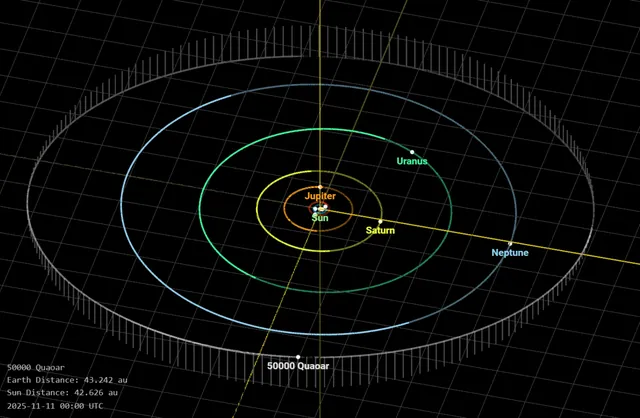
Quaoar follows a nearly circular path around the Sun at an average distance of 43.2 au, ranging between 41.6 and 44.7 au, and takes about 285 years to complete one lap. Its orbit is tilted about 8° to the plane of Earth’s orbit, enough to place it among the dynamically hot classical Kuiper belt objects rather than the undisturbed cold population. It will next reach perihelion, its closest point to the Sun, around 2079.123
Quaoar spins once every 8.84 hours, a period first worked out in 2003 from small changes in its brightness as it turns. Occultations show that its rings and its moon Weywot orbit close to Quaoar’s equator, although Weywot’s orbit is tilted by about 5° from the plane of the rings.125
Discovery and naming
Chad Trujillo and Michael Brown of Caltech found Quaoar on 4 June 2002 with the Samuel Oschin Schmidt telescope at Palomar Observatory, as a faint point of magnitude 18.5 creeping through the constellation Ophiuchus. Brown then used Hubble’s new Advanced Camera for Surveys on 5 July and 1 August 2002 to resolve its disc, the first direct measurement of the size of a Kuiper belt object.23
The discoverers proposed the name of the creator in the stories of the Tongva, the original people of the Los Angeles basin. In those stories Quaoar has no form or gender, and dances and sings Weywot, the Sky Father, into existence; Weywot later became the name of its moon. The object’s permanent designation is (50000) Quaoar, and its provisional one was 2002 LM60.23
What the surface is made of
In 2004 David Jewitt and Jane Luu found crystalline water ice on Quaoar. Ice in that ordered form must once have been warmed to at least 110 K, while radiation should disorder it within about ten million years, so they argued that the surface had been renewed recently, perhaps by cryovolcanism. Keck Observatory spectra in 2007 added methane and ethane, making Quaoar only the fifth Kuiper belt object known to carry volatile ices.78
The James Webb Space Telescope’s NIRSpec spectrograph has since recorded deep water-ice bands, carbon dioxide ice, methane, ethane and a possible trace of hydrogen cyanide. The light hydrocarbons form when methane is exposed to radiation, and their survival implies that fresh methane keeps reaching the surface, which the observers take as a sign that Quaoar’s interior once melted.9
No atmosphere has been detected. Stellar occultations, including one watched by JWST on 28 August 2024, rule out a global methane atmosphere with a surface pressure of more than about one billionth of a bar, so the hydrocarbons are unlikely to come from processes in the air.113
Moon and rings
Michael Brown and T.-A. Suer spotted Weywot in Hubble images taken on 14 February 2006, a dot 5.6 magnitudes fainter than Quaoar. It orbits about 13,300 km from Quaoar every 12.43 days. Hubble and occultation data give it a slightly elongated shape about 146 km across and a very dark surface reflecting under 4 per cent of the light, quite unlike the bright icy moons of Pluto and Haumea.1611
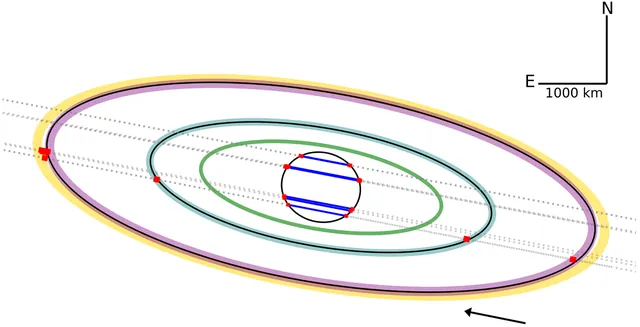
Occultations between 2018 and 2021, including the first ever observed from space, by ESA’s Cheops telescope, revealed a ring about 4,057 km from Quaoar’s centre, 7.4 times its radius. A second, fainter ring at 2,520 km turned up in August 2022. Both lie well outside Quaoar’s Roche limit of about 1,780 km, beyond which ring particles are expected to gather into a moon within decades.4514
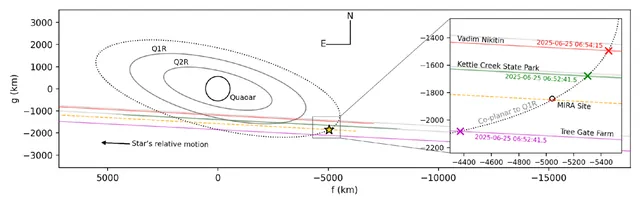
The outer ring is clumpy, between about 5 and 300 km wide, and sits near resonances with Quaoar’s spin and Weywot’s orbit that may help confine it, while unusually elastic collisions between cold, icy particles may stop it clumping. On 25 June 2025 two telescopes caught a sharp dip about 5,700 km from Quaoar: either a moon at least 15 km in radius or a dense arc, perhaps one member of a belt of small satellites.45101415
Observing Quaoar
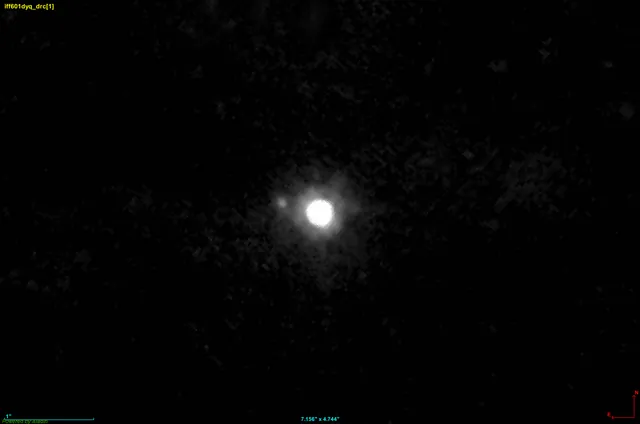
Quaoar has been revealed step by step through telescopes. Hubble first resolved its disc in 2002, and 11 more Hubble orbits of observations recently helped pin down Weywot’s size and shape. Since the first stellar occultation by Quaoar in 2011, professional observatories and amateur observers have recorded its shadow during 36 events, building up its shape and finding both rings.13614
Space telescopes have joined in. Cheops recorded the first occultation by a trans-Neptunian object seen from orbit, and JWST has both taken Quaoar’s spectrum and watched it pass in front of a star, detecting both rings and showing that the inner one is patchy. A search of JWST images for the object seen in 2025, thought to circle Quaoar in about 3.6 days, found no convincing sign of it.9131416
Quick answers
- How big is Quaoar?
- Quaoar has a mean radius of 547 km (volume-equivalent diameter 1,094 km; slightly flattened).1
- How massive is Quaoar?
- Quaoar has a mass of 1.21 × 10²¹ kg (Quaoar and Weywot together, from Weywot’s orbit).1
- How dense is Quaoar?
- Quaoar has a mean density of 1.76 g/cm³.1
- How long is a year on Quaoar?
- A year on Quaoar lasts 285 Earth years (about 104,000 days).2
- How far is Quaoar from the Sun?
- Quaoar is 43.2 au from the Sun (about 6.5 billion km on average; between 41.6 and 44.7 au).2
- What is the temperature on Quaoar?
- The temperature on Quaoar is about 40 K (−233 °C).8
- How many moons does Quaoar have?
- Quaoar has 1 known moon (Weywot; a much smaller possible second moon was seen once, in 2025).1011
Sources
- Size, shape, density, and atmospheric limit of (50000) Quaoar revealed from 14 years of stellar occultation (Margoti et al., preprint) — arXiv, 2026
- Small-Body Database Lookup: 50000 Quaoar (2002 LM60) — NASA/JPL Solar System Dynamics
- Hubble Spots an Icy World Far Beyond Pluto — NASA Science, 2002
- A dense ring of the trans-Neptunian object Quaoar outside its Roche limit (Morgado et al.) — Nature, 2023
- The two rings of (50000) Quaoar (Pereira et al.) — Astronomy & Astrophysics, 2023
- Size, Shape, and Geometric Albedo of Dwarf Planet Quaoar’s Largest Satellite Weywot (Collyer et al., preprint) — arXiv, 2026
- Crystalline water ice on the Kuiper belt object (50000) Quaoar (Jewitt and Luu) — Nature, 2004
- Detection of methane on Kuiper belt object (50000) Quaoar (Schaller and Brown) — The Astrophysical Journal Letters, 2007
- A Tale of 3 Dwarf Planets: Ices and Organics on Sedna, Gonggong, and Quaoar from JWST Spectroscopy (Emery et al.) — arXiv, 2023
- Evidence of a New Arc or a Belt of Small Satellites around (50000) Quaoar (Braga-Ribas et al.) — The Astrophysical Journal Letters, 2026
- IAU Circular 8812: Satellites of 2003 AZ84, (50000), (55637) and (90482) — Central Bureau for Astronomical Telegrams, 2007
- Quaoar: a rock in the Kuiper belt (Fraser and Brown) — The Astrophysical Journal, 2010
- Constraints on Quaoar’s rings and atmosphere from JWST/NIRCam observations of a stellar occultation (Proudfoot et al.) — arXiv, 2025
- ESA’s Cheops finds an unexpected ring around dwarf planet Quaoar — European Space Agency, 2023
- Dynamical implications of the recently detected feature around Quaoar and constraints on the presence of additional satellites (Madeira et al., preprint) — arXiv, 2026
- Orbital characterization of a newly discovered small satellite around Quaoar (Proudfoot et al.) — The Astrophysical Journal Letters, 2025
Figures checked against these sources in November 2026. Where a quantity is not known, it is left out rather than estimated.

