dwarf planet
Sedna
Sedna is one of the most distant known bodies in the Solar System: a strikingly red world about 1,000 km across that never comes closer to the Sun than about 76 au. Mike Brown, Chad Trujillo and David Rabinowitz found it in November 2003 and named it after the Inuit goddess of the sea. Astronomers who have studied it with the James Webb Space Telescope describe it as a dwarf planet.12345
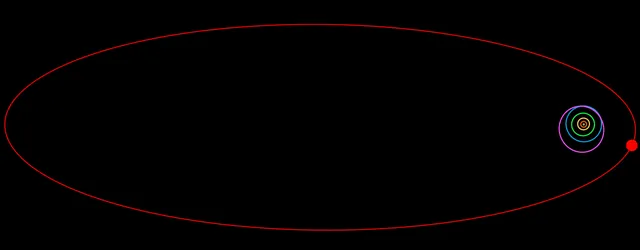
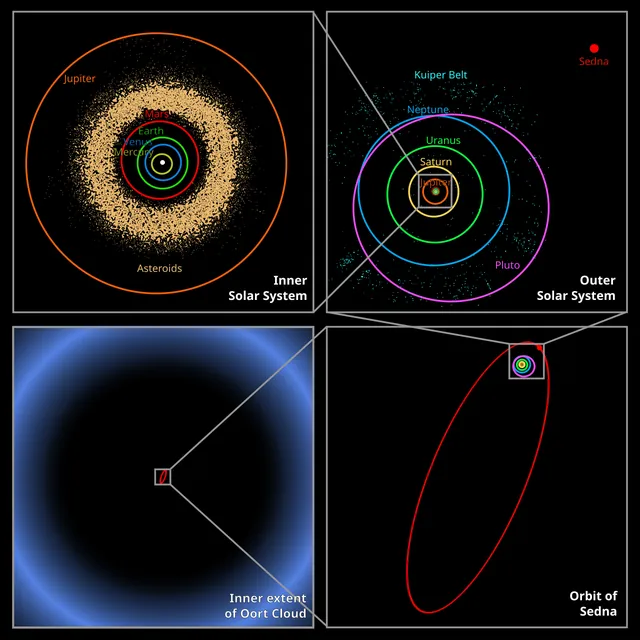
Its orbit is extraordinarily stretched. At its farthest, Sedna swings out to roughly 1,000 au, and one circuit takes well over 11,000 years. It is now heading inwards and will make its closest approach in about 2076. Such an orbit is hard to explain with the known planets, so its discoverers suggested it was shaped by an undiscovered planet, a passing star or the cluster of stars in which the Sun may have formed.267
Size and physical properties
Sedna is so distant that even the Hubble Space Telescope sees it as a single pixel. Images taken on 16 March 2004 set an upper limit of about 1,600 km on its diameter, and the Spitzer Space Telescope’s failure to detect its heat gave a similar limit. The best measurement came in 2012 from the Herschel Space Observatory’s thermal observations: 995 ± 80 km across, with a fairly bright surface reflecting about a third of visible light.139
Early measurements hinted at an extremely slow spin of 20 to 50 days, which astronomers thought could be explained by the pull of a moon. Hubble looked for one in 2004 and found nothing. Later photometry showed instead that Sedna rotates in about 10 hours, a normal rate for a Solar System body, so no massive companion is needed. With no known moon, its mass has not been measured.8910
Orbit
Sedna’s orbit is among the most elongated of any large body around the Sun, with an eccentricity of 0.86. JPL’s Small-Body Database places its perihelion at 76.2 au and gives an aphelion of 1,011 au and a period of 12,680 years. These are heliocentric values. Measured instead from the Solar System’s centre of mass, JPL’s Horizons system gives an aphelion of 937 au and a period of about 11,400 years.26
Sedna is now 82.8 au from the Sun and drawing closer, faint at magnitude 20.7 in the constellation Taurus. It will pass perihelion around 2076. Even then it stays well beyond the Kuiper belt, and it is counted among the detached trans-Neptunian objects. Its discoverers in 2004 quoted a period of about 10,500 years, from the orbit as known then.12367
How Sedna reached this orbit is unknown. Its discoverers proposed three possibilities: scattering by a yet-undiscovered planet, a close pass by another star, or the Sun’s birth in a cluster of stars. In the two they judged most likely, Sedna belongs to an inner Oort cloud, a population far closer than the long-hypothesised cloud of comets, implying many similar objects remain to be found.347
Discovery and naming
Mike Brown of Caltech, Chad Trujillo of the Gemini Observatory and David Rabinowitz of Yale University found Sedna on 14 November 2003, using the 48-inch Samuel Oschin Telescope at Palomar Observatory near San Diego. The discovery was announced on 15 March 2004. Sedna was then about 90 au away, the most distant Solar System object yet seen, and images from 2001 to 2003 helped pin down its orbit.2347
Because of its frigid temperatures, the team named it after Sedna, the Inuit goddess of the sea from whom all sea creatures were created. She rewards people with food from the sea, and without her blessing hunts fail. The name was formally published on 28 September 2004, replacing the provisional designation 2003 VB12; its minor-planet number is 90377.24
What is known of the surface
Sedna is one of the reddest objects known: when it was announced, NASA called it the second-reddest object in the Solar System after Mars. The James Webb Space Telescope’s NIRSpec instrument has recorded its spectrum from 0.7 to 5.2 micrometres and found many absorption features of ethane, along with acetylene, ethylene, water ice and possibly a little carbon dioxide.35
The spectrum also has a steep red slope and broad absorptions between 2.7 and 3.6 micrometres that point to complex organic molecules. These light hydrocarbons and organics are thought to form when radiation breaks up methane. Their continued presence implies that fresh methane reaches the surface, and the Webb team suggests that Sedna, like the larger dwarf planets, may have undergone internal melting.5
Observing Sedna
Everything known about Sedna comes from telescopes. Within days of its discovery, telescopes in Chile, Spain, Arizona and Hawaii observed it, and the new Spitzer Space Telescope tried to measure its heat. Hubble took 35 images on 16 March 2004, which confirmed by parallax that it belongs to the Solar System. Herschel’s measurements of its size were published in 2012, and Webb’s spectra, published in 2024, revealed its hydrocarbon ices.1359
Quick answers
- How big is Sedna?
- Sedna has a mean radius of about 500 km (diameter 995 ± 80 km, from Herschel thermal measurements).1
- How long is a day on Sedna?
- A day on Sedna lasts 10.27 hours (rotation period from 2004–05 photometry; not yet confirmed).28
- How long is a year on Sedna?
- A year on Sedna lasts about 11,400 Earth years (relative to the Solar System’s centre of mass; JPL’s heliocentric value is 12,680 years).26
- How far is Sedna from the Sun?
- Sedna is 82.8 au from the Sun (on 13 November 2026, about 12.4 billion km, and closing).6
- What is the temperature on Sedna?
- The temperature on Sedna is never above −240 °C.3
- When was Sedna discovered?
- Sedna was discovered on 14 November 2003, by Mike Brown, Chad Trujillo and David Rabinowitz at Palomar Observatory.23
- What is Sedna made of?
- Sedna is made of surface ices of ethane, acetylene, ethylene and water, with complex organic molecules.5
Sources
- Pál et al., “TNOs are Cool”: A survey of the trans-Neptunian region VII. Size and surface characteristics of (90377) Sedna and 2010 EK139 — Astronomy & Astrophysics, 2012
- Small-Body Database Lookup: 90377 Sedna (2003 VB12) — NASA/JPL Solar System Dynamics, 2026
- Most Distant Object in Solar System Discovered (ssc2004-05) — NASA Spitzer Space Telescope, Caltech/IPAC, 2004
- Sedna (2003 VB12) — Mike Brown, California Institute of Technology
- Emery et al., A tale of 3 dwarf planets: Ices and organics on Sedna, Gonggong, and Quaoar from JWST spectroscopy — Icarus, 2024
- Horizons System: barycentric elements and ephemeris of 90377 Sedna for 13 November 2026 — NASA/JPL Solar System Dynamics, 2026
- Brown, Trujillo and Rabinowitz, Discovery of a candidate inner Oort cloud planetoid — Astrophysical Journal, 2004
- Gaudi et al., On the Rotation Period of (90377) Sedna — Astrophysical Journal Letters, 2005
- Sedna Mystery Deepens as Hubble Offers Best Look at Farthest Planetoid — NASA Science, 2004
- Hubble Spots Moon Around Third Largest Dwarf Planet — NASA Science, 2017
Figures checked against these sources in November 2026. Where a quantity is not known, it is left out rather than estimated.

