dwarf planet
Gonggong
Gonggong is one of the largest known worlds beyond Neptune, about 1,230 km across, with one of the reddest surfaces in the Kuiper belt. Meg Schwamb, Mike Brown and David Rabinowitz found it at Palomar Observatory in July 2007, and for more than a decade it was known only as 2007 OR10, the largest unnamed world in the Solar System. In 2020 it was named after Gonggong, a Chinese water god.1234
Its stretched, steeply tilted orbit carries it between 33 and 101 au from the Sun once every 547 years; it is now about 90 au out and still receding. Gonggong has a small moon, Xiangliu, found in archival Hubble images, whose orbit gives the pair a mass of 1.75 × 10²¹ kg, close to that of Pluto’s moon Charon. Water ice, ethane and carbon dioxide have been detected on its surface.123567
Size and physical properties
Gonggong’s size has been revised more than once. In 2016, astronomers combined far-infrared measurements from the Herschel Space Observatory with a long light curve from the Kepler space telescope’s K2 mission and derived a diameter of 1,535 km with a dark surface, which would have put it among the three largest trans-Neptunian objects. NASA’s 2017 announcement of its moon quoted a similar size, about 950 miles.68
Once the moon’s orbit was known, the team reworked the thermal model on the assumption that the moon circles Gonggong’s equator, and found a diameter of 1,230 ± 50 km. Combined with the system mass of 1.75 × 10²¹ kg, that gives a density of 1.75 g/cm³. The earlier, larger size would imply just 0.92 g/cm³, unexpectedly low for a body this big.1
- Diameter
- 1,230 ± 50 km12019 estimate, using the moon’s orbit
- Earlier diameter
- 1,535 km82016 estimate from Herschel and K2 data; +75/−225 km
- System mass
- (1.75 ± 0.07) × 10²¹ kg1
- Mean density
- 1.75 ± 0.07 g/cm³1for the 1,230 km size
- Geometric albedo
- 0.08982016 estimate, tied to the larger size
- Absolute magnitude
- 1.823
Orbit and rotation
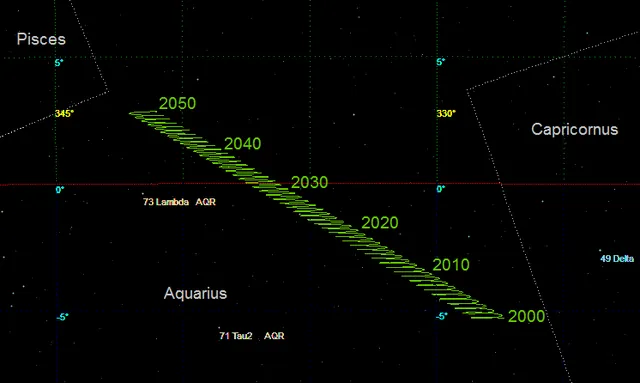
Gonggong follows an eccentric orbit, tilted 30.9° to the plane of Earth’s orbit. JPL’s Small-Body Database places its perihelion at 33.1 au and its aphelion at 100.6 au, with a period of 199,716 days, about 547 years. It last passed perihelion in 1856. On 13 November 2026 it was 89.9 au from the Sun and still moving outwards, a faint magnitude-21.5 speck in Aquarius.35
Gonggong spins slowly. A light curve from Kepler’s K2 mission gives a most likely rotation period of 44.81 hours, though a period of half that, 22.40 hours, cannot be ruled out. Most Kuiper belt objects turn in under 24 hours, and that slow spin was what first prompted astronomers to search Hubble’s archive for a moon whose pull might have braked it.68
Discovery and naming
Gonggong was found on 17 July 2007 at Palomar Observatory in California during the Palomar Distant Solar System Survey, a search for distant bodies in the Kuiper belt and beyond. The discoverers were Meg Schwamb, then a Caltech graduate student who helped run the survey; Mike Brown, its principal investigator; and David Rabinowitz, principal investigator of the QUEST camera used for the discovery.34
For over a decade it carried only its provisional designation, 2007 OR10. In 2019 the discoverers asked the public to choose between three names, Gonggong, Holle and Vili; more than 280,000 votes were cast and Gonggong won. The name was published in February 2020. In Chinese myth Gonggong is a red-haired water god with a serpent’s tail, attended by Xiangliu, a nine-headed snake, for whom the moon is named.349
What is known of the surface
Spectra published in 2011 showed strong near-infrared absorption by water ice. That was surprising, because most Kuiper belt objects with so much water ice have the neutral colour of ice, while Gonggong is among the reddest known. Its discoverers proposed that, like Quaoar, it is just large enough to hold on to traces of methane, which radiation turns into red compounds, but they could not detect methane directly.2
The James Webb Space Telescope has since filled in the picture. Its NIRSpec spectrum shows several weak ethane features, stronger and cleaner water ice bands than Sedna’s, and carbon dioxide mixed with other molecules, along with a steep red slope and broad absorptions that indicate complex organic molecules. Ethane forms from methane broken apart by radiation, so its presence implies methane is still being supplied to the surface.7
- Other ices
- Ethane; carbon dioxide complexed with other molecules7
The moon Xiangliu
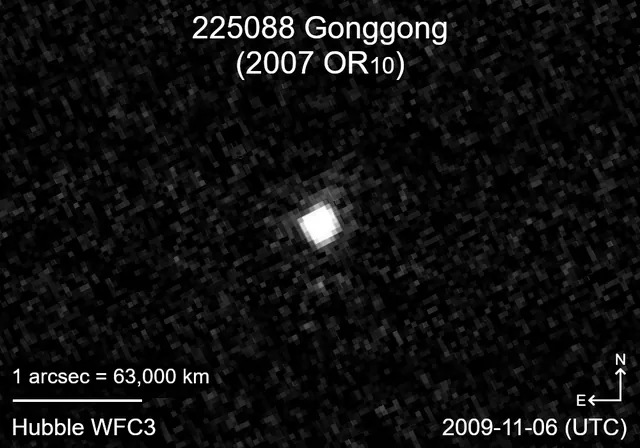
Xiangliu was found in archival images taken by Hubble’s Wide Field Camera 3. An earlier look at those images had missed it because it is so faint. It appears in two observations made a year apart, in November 2009 and September 2010, moving with Gonggong against the background stars, which shows it is bound to it. The discovery was announced in May 2017.6
Further Hubble observations in 2017 pinned down its orbit: Xiangliu circles Gonggong every 25.2 days at about 24,000 km, on a noticeably eccentric path. Its size is uncertain. NASA’s 2017 announcement put it at 150 to 250 miles across; the 2019 orbit study argued it is under 100 km wide, while a 2021 study of its tidal evolution put its radius close to 100 km, with a surface about as reflective as Gonggong’s.1610
Quick answers
- How big is Gonggong?
- Gonggong has a mean radius of about 615 km (diameter 1,230 ± 50 km).1
- How massive is Gonggong?
- Gonggong has a mass of 1.75 × 10²¹ kg (Gonggong and Xiangliu together).1
- How dense is Gonggong?
- Gonggong has a mean density of 1.75 g/cm³ (±0.07, assuming a spherical shape).1
- How long is a day on Gonggong?
- A day on Gonggong lasts 44.8 hours (from Kepler K2 photometry; 22.4 hours cannot be ruled out).8
- How long is a year on Gonggong?
- A year on Gonggong lasts 547 Earth years (199,716 days).3
- How far is Gonggong from the Sun?
- Gonggong is 66.9 au on average from the Sun (from 33.1 to 100.6 au; 89.9 au on 13 November 2026).35
Sources
- Kiss et al., The mass and density of the dwarf planet (225088) 2007 OR10 — Icarus, 2019
- Brown, Burgasser and Fraser, The surface composition of large Kuiper belt object 2007 OR10 — Astrophysical Journal Letters, 2011
- Small-Body Database Lookup: 225088 Gonggong (2007 OR10) — NASA/JPL Solar System Dynamics, 2026
- Public Invited to Help Name the Largest Unnamed World in the Solar System — The Planetary Society, 2019
- Horizons System: ephemeris of 225088 Gonggong for 13 November 2026 — NASA/JPL Solar System Dynamics, 2026
- Hubble Spots Moon Around Third Largest Dwarf Planet — NASA Science, 2017
- Emery et al., A tale of 3 dwarf planets: Ices and organics on Sedna, Gonggong, and Quaoar from JWST spectroscopy — Icarus, 2024
- Pál et al., Large size and slow rotation of the trans-Neptunian object (225088) 2007 OR10 discovered from Herschel and K2 observations — Astronomical Journal, 2016
- Schwamb, The People Have Voted on 2007 OR10’s Future Name! — The Planetary Society, 2019
- Arakawa et al., Tidal evolution of the eccentric moon around dwarf planet (225088) Gonggong — Astronomical Journal, 2021
Figures checked against these sources in November 2026. Where a quantity is not known, it is left out rather than estimated.

