galaxy
Andromeda Galaxy
The Andromeda Galaxy is the nearest large galaxy to our own, a spiral of about a trillion stars some 2.5 million light-years away. On a clear autumn night it shows to the unaided eye as a faint, cigar-shaped smudge in the constellation Andromeda. It is the only other giant galaxy in our Local Group and the most studied galaxy beyond our own.123456
Because we live inside the Milky Way, Andromeda is our best outside view of a galaxy like ours. Its stellar disc spans about 260,000 light-years and its thin gaseous halo reaches halfway to us. It is falling towards the Milky Way at about 110 km/s, but a 2025 study found only about an even chance that the two galaxies will merge within the next 10 billion years.2378910
Shape and size in space
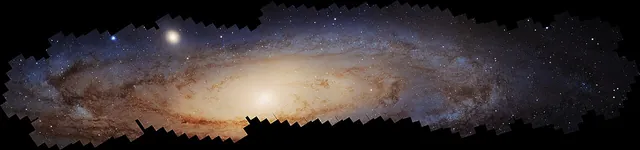
Andromeda is a spiral galaxy of type SA(s)b, seen steeply from one side: its disc is tilted by 77° to our line of sight. Its distance is among the best measured beyond the Milky Way. Hubble observations of 55 Cepheid variables give 761 ± 11 kiloparsecs, about 2.48 million light-years, the value used here; other Cepheid and eclipsing-binary measurements agree within their errors. NASA rounds it to 2.5 million light-years.124111516
How big it is depends on what you count. The bright disc fills about 3° × 1° of sky, and NASA puts the whole stellar disc at about 260,000 light-years across. A faint outer disc, built up from swallowed dwarf galaxies, has been traced to about 40 kiloparsecs from the centre, with stars detected out to 70. Beyond that lies a halo of thin ionised gas reaching 1.3 million light-years, and up to 2 million in places.3671718
Weighing Andromeda is harder. Its total mass, including the dark-matter halo, has been estimated from rotating gas, satellite galaxies, globular clusters, planetary nebulae and its giant stream, with results from about 0.8 to 2 trillion solar masses. A 2025 review of these studies adopted 1.3 ± 0.4 trillion, against about 1 trillion for the Milky Way, and judged it relatively likely that the two have similar masses.913
- Type
- SA(s)b spiral11
- Tilt of the disc
- 77° from face-on2
- Distance from an eclipsing binary (2005)
- 772 ± 44 kpc16
- Diameter of the stellar disc
- about 260,000 light-years7
- Extended outer disc
- traced to about 40 kpc radius; stars detected to 70 kpc17
- Gaseous halo
- 1.3 million light-years from the centre; up to 2 million in places3
- Total mass adopted in the 2025 study
- 1.3 ± 0.4 trillion solar masses9Milky Way: 1.0 ± 0.2 trillion
The stars inside
Andromeda holds about a trillion stars. Hubble’s great mosaic picks out some 200 million of them, but only those brighter than the Sun; the many fainter, less massive stars lie below its limit. A smooth spread of cool red stars underlies the whole disc, while clusters of young blue stars mark the spiral arms. Its brightest star cloud, NGC 206, has an NGC number of its own.2612
The galaxy has a large central bulge of older stars and a disc forming fewer new stars than its mass would suggest, so astronomers describe it as a transitional galaxy. Its stars record a busier recent past than the Milky Way’s: a galaxy-wide burst about 2 billion years ago formed roughly a fifth of its stars, and may have been set off by a major merger.219
Andromeda also has a rich family of globular clusters, estimated at about 450. The brightest, G1, is the most luminous globular cluster in the Local Group and outshines even Omega Centauri, the Milky Way’s brightest. Only one supernova has been seen in the galaxy: S Andromedae, found by Ernst Hartwig on 20 August 1885, the first supernova recorded beyond the Milky Way.6
Notable features
The double nucleus and black hole
In 1992 Hubble showed two bright peaks at the galaxy’s centre. The double is an illusion: an elliptical ring of old red stars orbits a black hole, and stars bunch up where they move slowest. Inside it, a disc of over 400 blue stars about 200 million years old whirls round a black hole of about 140 million solar masses.5142021
The ring of star formation
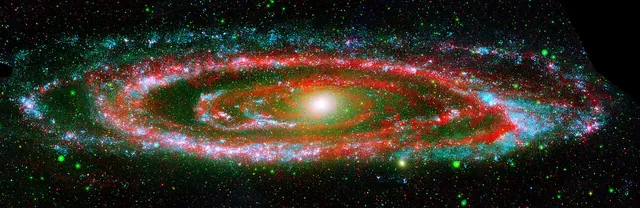
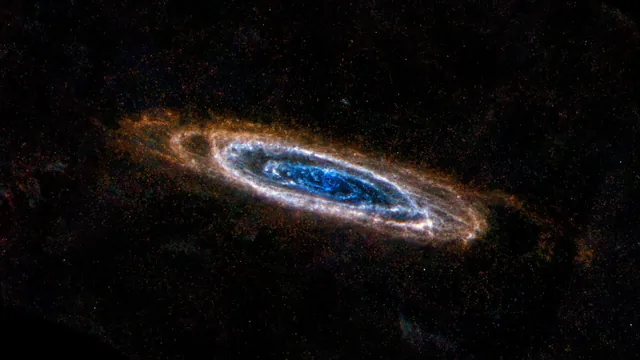
Infrared telescopes show Andromeda’s star formation concentrated in a ring about 10 kiloparsecs, some 33,000 light-years, from the centre, off-centre and split by a gap. It is a dynamical structure that also holds older stars. Herschel found most of the galaxy’s dust in two rings, at 10 and 15 kiloparsecs.2223242526
A smaller inner ring
A second ring of dust, about 1.5 by 1 kiloparsecs and offset some 0.5 kiloparsecs from the centre, was found in 2006. Simulations suggest that both rings are ripples spreading through the disc after a companion galaxy, most likely M32, plunged almost head-on through its centre about 210 million years ago.24
The giant stellar stream
A huge stream of metal-rich stars in Andromeda’s halo, discovered in 2001, is debris torn from a smaller galaxy. Models in 2018 linked it to one large merger about 2 billion years ago with a galaxy of some 25 billion solar masses in stars, whose stripped core may survive as M32.1927
NGC 206
The brightest star cloud in Andromeda’s disc. William Herschel catalogued it separately after observing it on 17 October 1786, which is why it carries its own NGC number. Hubble’s 2025 mosaic singles it out as the galaxy’s most conspicuous star cloud.26
Satellite galaxies
Andromeda leads a swarm of smaller galaxies that forms its own subgroup within the Local Group. The two brightest, the dwarf elliptical galaxies M32 and M110, show in binoculars, and Charles Messier drew both beside it. Fainter companions include NGC 185, NGC 147 and a long series of dwarf spheroidals named Andromeda I, II, III and so on. A 2025 Hubble survey studied 36 dwarf galaxies associated with its halo.628
Many satellites lie in a great plane around Andromeda, and about half of those Hubble studied formed stars very early, then stopped 8 to 10 billion years ago, a pattern rare among the Milky Way’s satellites. Compact M32 may be the stripped core of a galaxy that merged with Andromeda. The larger spiral M33, in Triangulum, is probably bound to Andromeda too.281928
Approach and possible collision
In 1912 Vesto Slipher found that Andromeda is approaching the Sun at about 300 km/s. Allowing for the Sun’s own motion round the Milky Way, the two galaxies are closing at about 110 km/s. In 2012 Hubble measured Andromeda’s sideways drift across the sky and found it so small that the motion looked almost head-on, implying a collision in about 4 billion years.6829
Gaia has since measured Andromeda’s motion across the sky too, finding a larger sideways speed, although still with large uncertainties. Folding these, Hubble data and the masses of M33 and the Large Magellanic Cloud into 100,000 simulations, a 2025 study found close to a 50% chance of no merger within 10 billion years, and only about 2% for a head-on collision within 4 to 5 billion years.9103031
In about half the simulations the galaxies pass within half a million light-years of each other, swing apart, and merge in the far future; in most of the rest they never come close enough to merge. M33 makes a merger more likely, while the Large Magellanic Cloud pulls the Milky Way off course. The authors stress that such long-range predictions remain highly uncertain.910
Discovery and history
No one can say who first noticed Andromeda, since it is plain to the eye. The earliest known record is in the Book of Fixed Stars by the Persian astronomer Abd al-Rahman al-Sufi, written in 964, which calls it a little cloud. Simon Marius gave the first telescopic description in 1612, and Charles Messier catalogued it on 3 August 1764, crediting Marius.16
For centuries it was the Great Andromeda Nebula. In 1864 William Huggins found that its spectrum was continuous, like starlight rather than glowing gas, and in 1887 Isaac Roberts photographed its spiral form. In 1923 Edwin Hubble found a Cepheid variable star, V1, in it. Announced on 1 January 1925, his Cepheid distances showed that Andromeda lies far beyond the Milky Way: a galaxy in its own right.63233
Hubble’s distance was wrong by more than a factor of two, because astronomers then did not know there are two kinds of Cepheid; the error was found only in 1953, once the 200-inch Palomar telescope was at work. Even so, his result settled the debate over the spiral nebulae and showed that the universe is far larger than the Milky Way.63233
- First telescopic description
- 1612, Simon Marius6
- Catalogued as M31
- 3 August 1764, Charles Messier6
- Starlike spectrum found
- 1864, William Huggins6
- First photographs showing spiral structure
- 1887, Isaac Roberts6
- Approach velocity first measured
- 1912, Vesto Slipher6
- Shown to be a separate galaxy
- announced 1 January 192533
Seeing it for yourself
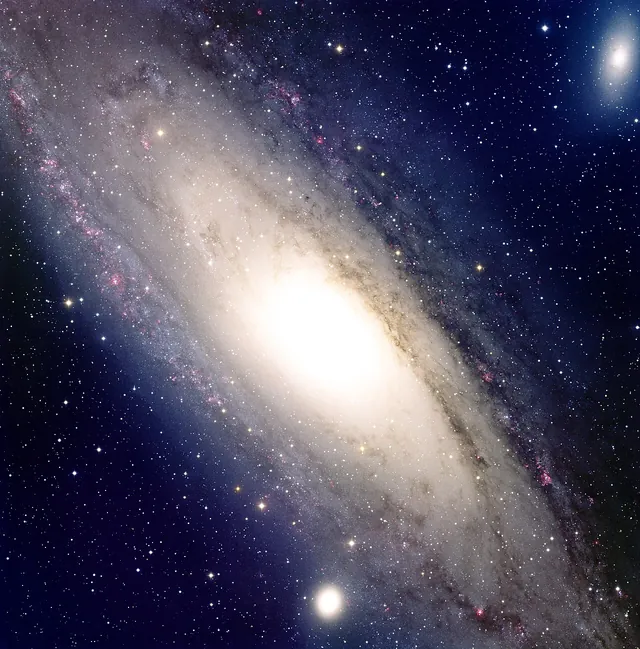
Andromeda is easy to see with the naked eye from a dark site, and NASA says it can be seen even under moderate light pollution. It is best placed in November, high in the autumn sky, and to the eye it appears as a faint, cigar-shaped glow. Its spiral form only emerged on photographs, first in 1887.1236
Under ordinary conditions the visible galaxy spans about 3° by 1°, six times the width of the full Moon. Binoculars show it well, together with its two bright companions M32 and M110, which are conspicuous in small telescopes. Owners of large amateur telescopes can even glimpse its brightest globular cluster, G1, at magnitude 13.7.26
Telescopes on Andromeda
Hubble has mapped Andromeda star by star. The Panchromatic Hubble Andromeda Treasury, PHAT, imaged a third of its star-forming disc from ultraviolet to near-infrared; its mosaic, released on 5 January 2015, joined 7,398 exposures into 1.5 billion pixels showing over 100 million stars. The southern survey PHAST added about 90 million more, and the combined mosaic of about 200 million stars was released on 16 January 2025.12122534
Other instruments see what Hubble cannot. NASA’s Galaxy Evolution Explorer imaged the galaxy in ultraviolet light in September 2003, tracing its young hot stars. Spitzer recorded about 11,000 snapshots at 24 microns on 25 August 2004 to map warm dust, and ESA’s Herschel mapped the coldest dust at 100 to 500 microns. Hubble’s spectrograph has also probed Andromeda’s gas halo against the light of 43 background quasars.32223263536
Measuring how Andromeda moves across the sky took years of patient work. Hubble compared images taken five to seven years apart for its 2012 result, and ESA’s Gaia added proper motions from its second and early third data releases. A Hubble Treasury programme of more than 1,000 orbits has also charted the lifetime star formation of 36 of its satellite galaxies.28293031
- PHAT survey
- 828 orbits; 6 filters from ultraviolet to near-infrared25
- PHAST survey
- 195 orbits; over 90 million stars34
- PHAT and PHAST mosaic released
- 16 January 2025234about 600 fields, 2.5 billion pixels, over 1,000 orbits in all
- GALEX ultraviolet mosaic
- 10 images taken in September 200335
- Herschel HELGA survey
- 100–500 microns over about 5.5° × 2.5°26
- Dust mass mapped by Herschel
- about 58 million solar masses26about 78% of it in the rings at 10 and 15 kpc
Quick answers
- How far away is the Andromeda Galaxy?
- The Andromeda Galaxy is about 2.5 million light-years from Earth (761 ± 11 kpc (2.48 million light-years) from Hubble observations of Cepheids).14
- How big is the Andromeda Galaxy?
- The Andromeda Galaxy is about 260,000 light-years across (the stellar disc; its gaseous halo reaches 1.3 million light-years from the centre).37
- Which constellation is the Andromeda Galaxy in?
- The Andromeda Galaxy lies in the constellation Andromeda.1
- How bright is the Andromeda Galaxy in the night sky?
- The Andromeda Galaxy has an apparent magnitude of 3.4 (visible to the unaided eye; NASA gives 3.1).1611
Sources
- Messier 31 (The Andromeda Galaxy) — NASA Science, Hubble’s Messier Catalog
- NASA’s Hubble Traces Hidden History of Andromeda Galaxy — NASA Science (Hubble news release), 2025
- Hubble Maps Giant Halo Around Andromeda Galaxy — NASA Science (Hubble news release), 2020
- A Sub-2% Distance to M31 from Photometrically Homogeneous Near-infrared Cepheid Period–Luminosity Relations Measured with the Hubble Space Telescope (Li et al.) — Astrophysical Journal (arXiv:2107.08029; doi:10.3847/1538-4357/ac1597), 2021
- Hubble Zooms in on Double Nucleus in Andromeda Galaxy — NASA Science (Hubble news release), 2012
- Messier 31 (H. Frommert & C. Kronberg) — SEDS Messier Database (Observatoire de Paris mirror)
- Amazing Andromeda Galaxy (sig06-024) — NASA Jet Propulsion Laboratory, Spitzer Space Telescope, 2006
- The M31 Velocity Vector. II. Radial Orbit toward the Milky Way and Implied Local Group Mass (van der Marel et al.) — Astrophysical Journal 753, 8 (arXiv:1205.6864), 2012
- No certainty of a Milky Way–Andromeda collision (Sawala et al.) — Nature Astronomy (arXiv:2408.00064; doi:10.1038/s41550-025-02563-1), 2025
- Hubble casts doubt on certainty of galactic collision (heic2508) — ESA/Hubble, 2025
- SIMBAD astronomical database: M 31 — Centre de Données astronomiques de Strasbourg (CDS)
- Hubble’s High-Definition Panoramic View of the Andromeda Galaxy (heic1502) — ESA/Hubble, 2015
- The Need for Speed: Escape velocity and dynamical mass measurements of the Andromeda galaxy (Kafle et al.) — Monthly Notices of the Royal Astronomical Society (arXiv:1801.03949; doi:10.1093/mnras/sty082), 2018
- HST STIS Spectroscopy of the Triple Nucleus of M31: Two Nested Disks in Keplerian Rotation around a Supermassive Black Hole (Bender et al.) — Astrophysical Journal (arXiv:astro-ph/0509839; doi:10.1086/432434), 2005
- Cepheid Period–Luminosity Relations in the Near-infrared and the Distance to M31 from the Hubble Space Telescope Wide Field Camera 3 (Riess, Fliri & Valls-Gabaud) — Astrophysical Journal 745, 156 (arXiv:1110.3769), 2012
- First Determination of the Distance and Fundamental Properties of an Eclipsing Binary in the Andromeda Galaxy (Ribas et al.) — Astrophysical Journal 635, L37 (arXiv:astro-ph/0511045), 2005
- On the Accretion Origin of a Vast Extended Stellar Disk around the Andromeda Galaxy (Ibata et al.) — Astrophysical Journal 634, 287 (arXiv:astro-ph/0504164), 2005
- Project AMIGA: The Circumgalactic Medium of Andromeda (Lehner et al.) — Astrophysical Journal (arXiv:2002.07818; doi:10.3847/1538-4357/aba49c), 2020
- The Andromeda galaxy’s most important merger about 2 billion years ago as M32’s likely progenitor (D’Souza & Bell) — Nature Astronomy (arXiv:1807.08819; doi:10.1038/s41550-018-0533-x), 2018
- Hubble Space Telescope Finds a Double Nucleus in the Andromeda Galaxy — NASA Science (Hubble news release), 1993
- Hubble Finds Mysterious Disk of Blue Stars Around Black Hole — NASA Science (Hubble news release), 2005
- Lady in Red: Andromeda Galaxy Shines in Spitzer’s Eyes (ssc2005-20) — NASA Jet Propulsion Laboratory, Spitzer Space Telescope, 2005
- Andromeda in the Infrared (ssc2005-20a1) — NASA Jet Propulsion Laboratory, Spitzer Space Telescope, 2005
- An almost head-on collision as the origin of two off-centre rings in the Andromeda galaxy (Block et al.) — Nature 443, 832 (arXiv:astro-ph/0610543), 2006
- The Panchromatic Hubble Andromeda Treasury (Dalcanton et al.) — Astrophysical Journal Supplement Series 200, 18 (arXiv:1204.0010), 2012
- The Herschel Exploitation of Local Galaxy Andromeda (HELGA). I. Global far-infrared and sub-mm morphology (Fritz et al.) — Astronomy & Astrophysics (arXiv:1112.3348; doi:10.1051/0004-6361/201118619), 2012
- A giant stream of metal-rich stars in the halo of the galaxy M31 (Ibata et al.) — Nature 412, 49 (arXiv:astro-ph/0107090), 2001
- The Hubble Space Telescope Survey of M31 Satellite Galaxies. IV. Survey Overview and Lifetime Star Formation Histories (Savino et al.) — Astrophysical Journal (arXiv:2501.13152), 2025
- NASA’s Hubble Shows Milky Way is Destined for Head-On Collision with Andromeda Galaxy — NASA Science (Hubble news release), 2012
- First Gaia Dynamics of the Andromeda System: DR2 Proper Motions, Orbits, and Rotation of M31 and M33 (van der Marel et al.) — Astrophysical Journal (arXiv:1805.04079; doi:10.3847/1538-4357/ab001b), 2019
- The proper motion of Andromeda from Gaia EDR3: confirming a nearly radial orbit (Salomon et al.) — Monthly Notices of the Royal Astronomical Society (arXiv:2012.09204; doi:10.1093/mnras/stab2253), 2021
- Hubble Views the Star that Changed the Universe — NASA Science (Hubble news release), 2011
- This Month in Physics History: Edwin Hubble expands view of universe — American Physical Society, APS News, 2008
- The Panchromatic Hubble Andromeda Southern Treasury (PHAST): mission overview — Mikulski Archive for Space Telescopes (MAST), STScI, 2025
- Andromeda Galaxy (PIA04921) — NASA/JPL Photojournal, 2003
- Andromeda’s Colorful Rings (nhsc2013-004a) — NASA Herschel Science Center, Caltech/IPAC, 2013
Figures checked against these sources in November 2026. Where a quantity is not known, it is left out rather than estimated.

