star cluster
Omega Centauri
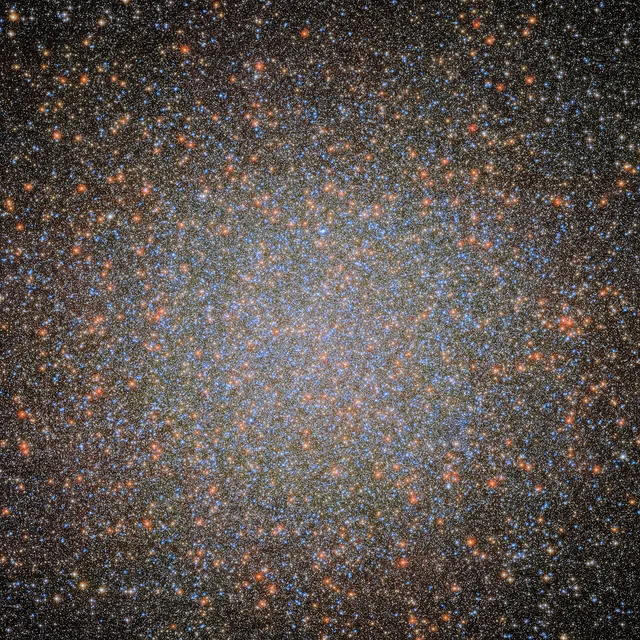
Omega Centauri is the largest and brightest globular cluster in the sky: a vast ball of roughly ten million stars about 17,700 light-years away in the southern constellation Centaurus. From a dark site it looks to the unaided eye like a fuzzy star, almost as large as the full Moon. Ptolemy listed it as a single star nearly two thousand years ago.12
It is the most massive of the Milky Way’s globular clusters, about four million times the mass of the Sun, and it does not behave like an ordinary one. It holds several generations of stars, rotates fast and is noticeably flattened. Some astronomers suspect it is the stripped core of a small galaxy swallowed by the Milky Way, and Hubble has found strong evidence for a black hole at its centre.12345
Size, shape and distance
Omega Centauri is about 150 light-years across and roughly ten times as massive as other big globular clusters, almost as massive as a small galaxy. Fits to the motions of its stars give about 3.9 million solar masses, with half its light inside 7.56 parsecs of the centre and a tidal radius of about 209 parsecs. An older estimate put it at about 5 million.1237
Unlike most globular clusters, it rotates fast and is markedly flattened. Combining Gaia parallaxes with Hubble and other data, Baumgardt and Vasiliev placed it 5.43 ± 0.05 kiloparsecs away, about 17,700 light-years. Older values range from 16,000 to 17,000 light-years, and William Harris’s catalogue gives 5.2 kiloparsecs. It lies 6.5 kiloparsecs from the centre of the Milky Way.123789
The stars inside
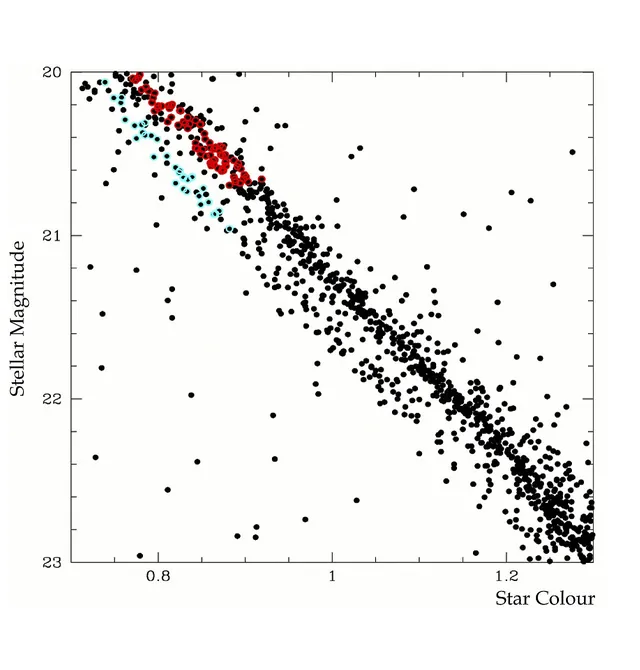
Most globular clusters were thought to contain stars of a single generation, but Omega Centauri has several. A 1999 study of 50,000 member stars found that they formed over about 2 billion years, in several bursts, the first time multiple populations had been found in a globular cluster. Hubble data later revealed two distinct main sequences of stars still burning hydrogen in their cores.2710
Spectra from ESO’s Very Large Telescope then showed that the bluer sequence, about a quarter of those stars, is richer in heavy elements, the opposite of expectations. The team concluded that these stars must be extremely rich in helium, with 39 per cent helium, perhaps formed from gas polluted by supernovae of the first generation.10
Notable features
The central black hole
Using more than 500 Hubble images spanning two decades, a team led by Maximilian Häberle found seven stars within 3″, about 0.08 parsecs, of the centre moving faster than the cluster’s escape velocity. Only a black hole of at least 8,200 solar masses can hold them, making it a compelling intermediate-mass candidate.14
A stripped galaxy core?
Its several stellar generations and possible black hole lead some astronomers to suspect Omega Centauri is the nucleus of a dwarf galaxy largely destroyed by the Milky Way. Simulations show such a nucleus could survive while the galaxy’s outer stars are stripped away, leaving a retrograde orbit like the cluster’s.25
Record motion catalogue
The 2024 Hubble study measured the motions of 1.4 million stars in the cluster, the largest catalogue of motions for any star cluster to date. Most of the images it used had been taken to calibrate Hubble’s instruments rather than for science.1
History
Ptolemy listed Omega Centauri as a single star nearly two thousand years ago and Johann Bayer later catalogued it as a star too. Edmond Halley reported it as a nebula in 1677, calling it a luminous spot or patch in Centaurus, and Lacaille included it in his catalogue as number I.5.127
In the 1830s the English astronomer John Herschel was the first to recognise it as a globular cluster. In 2008 Hubble and Gemini observations suggested a central black hole of roughly 40,000 solar masses; the idea stayed disputed until the fast-moving stars reported in Nature on 10 July 2024 gave the most direct evidence so far.124
Seeing it for yourself
Omega Centauri is a showpiece of the southern sky. At magnitude 3.7 it is visible to the unaided eye from a clear, dark site, where it looks almost as large as the full Moon. Even a modest amateur telescope reveals it as a dense sphere of glittering stars. It lies just above the plane of the Milky Way, in Centaurus.126
Telescopes on Omega Centauri
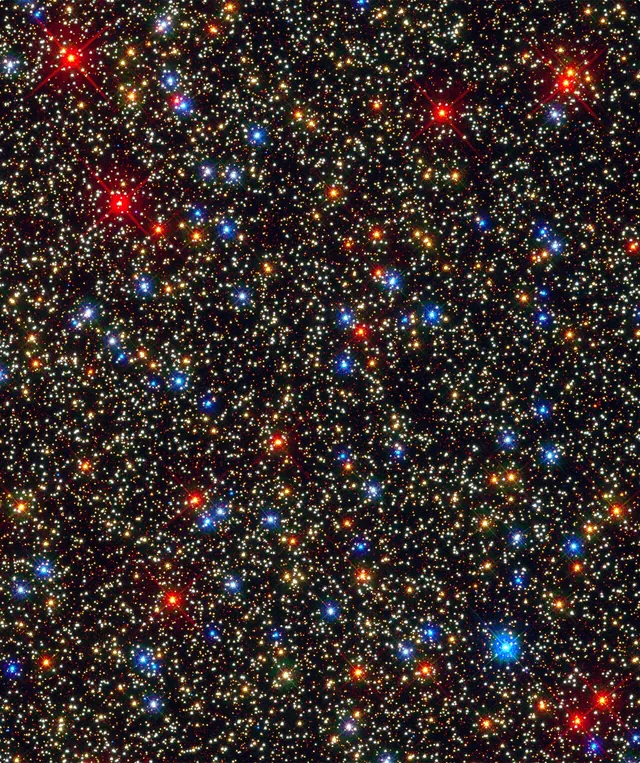
ESO’s Wide Field Imager at La Silla produced a classic portrait of the cluster in 2008, and the Very Large Telescope’s FLAMES spectrograph took 130 spectra at once to study its two main sequences. Hubble has returned again and again: its 2024 study combined more than 500 images, and the team has been granted time on the James Webb Space Telescope to measure the fast stars’ line-of-sight speeds.1210
ESA’s Gaia mission also featured Omega Centauri in a data release containing more than 500,000 of its stars. According to the Hubble team, even after three decades Hubble remains one of the best tools for measuring stellar positions in such crowded fields, complementing Gaia’s observations.1
Quick answers
- What kind of object is Omega Centauri?
- Omega Centauri is a globular star cluster (possibly the core of a disrupted dwarf galaxy).256
- Which constellation is Omega Centauri in?
- Omega Centauri lies in the constellation Centaurus.2
- How far away is Omega Centauri?
- Omega Centauri is about 17,700 light-years from Earth (5.43 ± 0.05 kpc from Gaia, Hubble and other data).138
- How big is Omega Centauri?
- Omega Centauri is about 150 light-years across.2
- How bright is Omega Centauri in the night sky?
- Omega Centauri has an apparent magnitude of 3.7 (visible to the unaided eye).27
- How big does Omega Centauri look in the sky?
- Omega Centauri covers 36.3′ of sky (almost as large as the full Moon).167
- How old is Omega Centauri?
- Omega Centauri is about 12 billion years old.2
- How massive is Omega Centauri?
- Omega Centauri has a mass of about 3.9 million solar masses ((3.94 ± 0.02) × 10⁶).3
Sources
- Hubble finds strong evidence for intermediate-mass black hole in Omega Centauri (heic2409) — ESA/Hubble, 2024
- Omega Centauri (eso0844) — European Southern Observatory, 2008
- Structural parameters of Galactic globular clusters (H. Baumgardt et al.) — Fundamental parameters of Galactic globular clusters, University of Queensland
- Fast-moving stars around an intermediate-mass black hole in ω Centauri (Häberle et al.) — Nature 631, 285 (arXiv:2405.06015), 2024
- Formation of ω Centauri from an ancient nucleated dwarf galaxy in the young Galactic disc (Bekki & Freeman) — Monthly Notices of the Royal Astronomical Society 346, L11 (arXiv:astro-ph/0310348), 2003
- SIMBAD astronomical database: NGC 5139 — Centre de Données astronomiques de Strasbourg (CDS)
- NGC 5139 (Omega Centauri) (H. Frommert & C. Kronberg) — SEDS Messier Database (Observatoire de Paris mirror), 1998
- Accurate distances to Galactic globular clusters through a combination of Gaia EDR3, HST and literature data (Baumgardt & Vasiliev) — Monthly Notices of the Royal Astronomical Society 505, 5957 (arXiv:2105.09526), 2021
- Catalog of parameters for Milky Way globular clusters (Harris 1996, 2010 edition) — W. E. Harris, McMaster University, 2010
- A Tale of Two Populations (eso0509) — European Southern Observatory, 2005
Figures checked against these sources in November 2026. Where a quantity is not known, it is left out rather than estimated.

