star cluster
Hercules Cluster (M13)
The Hercules Globular Cluster, Messier 13, is a ball of several hundred thousand ancient stars about 25,000 light-years away in the constellation Hercules. It is one of the brightest globular clusters in the northern sky: it is easy to spot with binoculars, and under dark skies it can be glimpsed without any optical aid. Edmond Halley discovered it in 1714.123
Its stars are about 12 billion years old, among the oldest in the galaxy, and are packed so tightly towards the centre that they sometimes collide. M13 is also famous for a message: in 1974 the Arecibo radio telescope beamed a short coded picture of humanity towards it. Moving at the speed of light, the signal had covered only a thousandth of the distance after 25 years.1456
Size, shape and distance
M13 is a globular cluster: a dense, roughly spherical swarm of old stars orbiting in the halo of the Milky Way, one of nearly 150 known around our galaxy. Its stars are packed into a ball about 150 light-years across. Near the core, NASA puts the density of stars at about a hundred times that around the Sun, though an older estimate gives five hundred times.135
Combining Gaia parallaxes with Hubble and other data, Baumgardt and Vasiliev placed M13 at 7.42 ± 0.08 kiloparsecs, a little farther than the 7.1 kiloparsecs in William Harris’s widely used catalogue. Computer fits to its stars’ motions give a mass of about 484,000 Suns, half its light within 3.47 parsecs of the centre and a tidal radius of about 130 parsecs.8910
M13 is moving towards the Sun at about 244 km/s along our line of sight, and it lies about 8.6 kiloparsecs from the centre of the Milky Way. Proper motions of 6,668 stars from Gaia and Hubble, and radial velocities of 426 stars, went into the models of its internal motions.7910
The stars inside
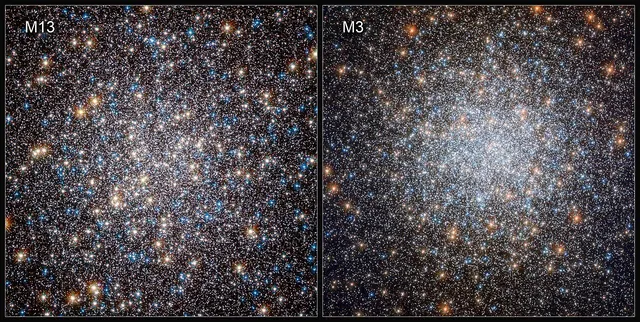
Like other globular clusters, M13 is old and poor in heavy elements: its iron abundance, written [Fe/H], is −1.53 on the logarithmic scale astronomers use, far below the Sun’s. A 2013 study of 55 globular clusters gave it an age of 12.00 ± 0.38 billion years. The brightest reddish stars are ageing red giants that have swollen and cooled; the blue-white ones are the hottest stars in the cluster.4510
In the crowded core, stars can collide or merge and form blue stragglers, stars that look younger than their neighbours. M13 also contains one young-looking B2-type star, Barnard 29, whose membership was confirmed by its radial velocity. In 2021 Hubble found that about 70 per cent of M13’s white dwarfs are still burning hydrogen on their surfaces, which slows their cooling.1235
Notable features
The Arecibo message
On 16 November 1974 the Arecibo radio telescope in Puerto Rico sent 1,679 binary digits towards M13 at 2,380 MHz, for about three minutes. Arranged 23 by 73, they form a picture of the chemicals of life, DNA, a human figure, the Solar System and the telescope. Frank Drake and colleagues developed it, with contributions from Carl Sagan.6
Blue stragglers
Stars that look hotter and younger than the rest of the cluster. In M13’s dense core stars come close enough to collide or merge, and the newly formed star can shine like a younger one. Astronomers study them closely for what they reveal about crowded stellar life.15
Barnard 29
A hot blue star of spectral type B2 in a cluster where almost every star is old and cool. Radial-velocity measurements confirmed that it belongs to M13, which made it a puzzle; one suggestion was that it is a captured field star.3
Star-poor lanes
Visual observers report four apparently star-poor regions crossing the cluster’s face, and hints of them can be seen in some photographs. About 40′ north-east lies the faint galaxy NGC 6207, of magnitude 11, which produced the type II supernova SN 2004A.3
History
Edmond Halley discovered M13 in 1714, noting that it shows itself to the naked eye when the sky is serene and the Moon absent. Charles Messier catalogued it on 1 June 1764 and was convinced that it contained no stars. Because the stars are so tightly packed, they were not resolved until 1779.13
Early age estimates were far too high: around 1960 Sandage estimated 24 billion years and Arp 17 billion, later revised by Arp to 14 billion. Modern models put M13 at about 12 billion years. In 1974 it was chosen as the target of one of the first radio messages addressed to possible extraterrestrial civilisations.346
Seeing it for yourself
M13 lies in Hercules and, at magnitude 5.8, it can be glimpsed with the unaided eye under dark skies, as Halley noted in 1714. NASA suggests binoculars, most easily in July. On photographs the cluster spans about 20′, but to the eye it appears closer to 13′ across. About 40′ to its north-east lies the faint galaxy NGC 6207, of magnitude 11.135
Telescopes and messages
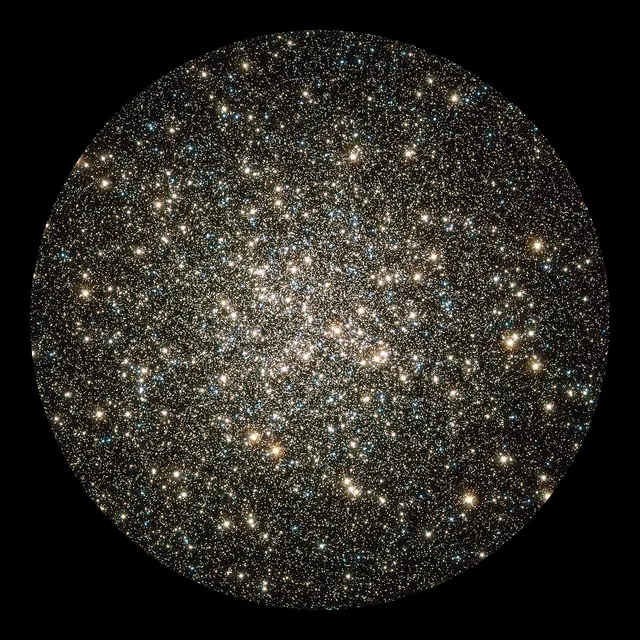
The Hubble Space Telescope has studied M13 repeatedly. Its best-known portrait combines archival images from four science programmes taken in November 1999, April 2000, August 2005 and April 2006, through blue, visible and infrared filters. In 2021 Hubble’s Wide Field Camera 3 compared more than 700 white dwarfs in M13 and M3 at near-ultraviolet wavelengths.25
The Arecibo transmission was strictly symbolic, a demonstration of the observatory’s newly installed radar transmitter and its 1,000-foot dish. It was aimed at a group of about 300,000 stars, but the cluster will have moved well out of the way, carried by the galaxy’s rotation, long before the signal arrives.6
Quick answers
- What kind of object is the Hercules Cluster (M13)?
- The Hercules Cluster (M13) is a globular star cluster.17
- Which constellation is the Hercules Cluster (M13) in?
- The Hercules Cluster (M13) lies in the constellation Hercules.1
- How far away is the Hercules Cluster (M13)?
- The Hercules Cluster (M13) is about 25,000 light-years from Earth (7.42 ± 0.08 kpc from Gaia, Hubble and other data).189
- How big is the Hercules Cluster (M13)?
- The Hercules Cluster (M13) is about 150 light-years across.5
- How bright is the Hercules Cluster (M13) in the night sky?
- The Hercules Cluster (M13) has an apparent magnitude of 5.8.13
- How big does the Hercules Cluster (M13) look in the sky?
- The Hercules Cluster (M13) covers 20′ of sky (about 13′ to the eye).3
- How old is the Hercules Cluster (M13)?
- The Hercules Cluster (M13) is 12.00 ± 0.38 billion years old.4
- How massive is the Hercules Cluster (M13)?
- The Hercules Cluster (M13) has a mass of about 484,000 solar masses ((4.84 ± 0.06) × 10⁵).9
Sources
- Messier 13 (The Hercules Cluster) — NASA Science, Hubble’s Messier Catalog
- Hubble discovers hydrogen-burning white dwarfs enjoying slow ageing (heic2108) — ESA/Hubble, 2021
- Messier 13 (H. Frommert & C. Kronberg) — SEDS Messier Database (Observatoire de Paris mirror), 2007
- The ages of 55 globular clusters as determined using an improved ΔV(TO,HB) method along with colour–magnitude diagram constraints (VandenBerg et al.) — Astrophysical Journal 775, 134 (arXiv:1308.2257), 2013
- A Celestial Snow Globe of Stars — NASA Science (Hubble news release), 2008
- It’s the 25th anniversary of Earth’s first attempt to phone E.T. — Cornell Chronicle, Cornell University, 1999
- SIMBAD astronomical database: M 13 — Centre de Données astronomiques de Strasbourg (CDS)
- Accurate distances to Galactic globular clusters through a combination of Gaia EDR3, HST and literature data (Baumgardt & Vasiliev) — Monthly Notices of the Royal Astronomical Society 505, 5957 (arXiv:2105.09526), 2021
- Structural parameters of Galactic globular clusters (H. Baumgardt et al.) — Fundamental parameters of Galactic globular clusters, University of Queensland
- Catalog of parameters for Milky Way globular clusters (Harris 1996, 2010 edition) — W. E. Harris, McMaster University, 2010
Figures checked against these sources in November 2026. Where a quantity is not known, it is left out rather than estimated.

