nebula
Cat’s Eye Nebula (NGC 6543)
The Cat’s Eye Nebula is the glowing gas thrown off by a dying Sun-like star, and one of the most intricate planetary nebulae ever observed. It lies about 3,000 light-years away in Draco, almost exactly in the direction of the north pole of Earth’s orbit. It was among the first planetary nebulae discovered, and the first whose light was split into a spectrum, proving such nebulae are made of gas.123
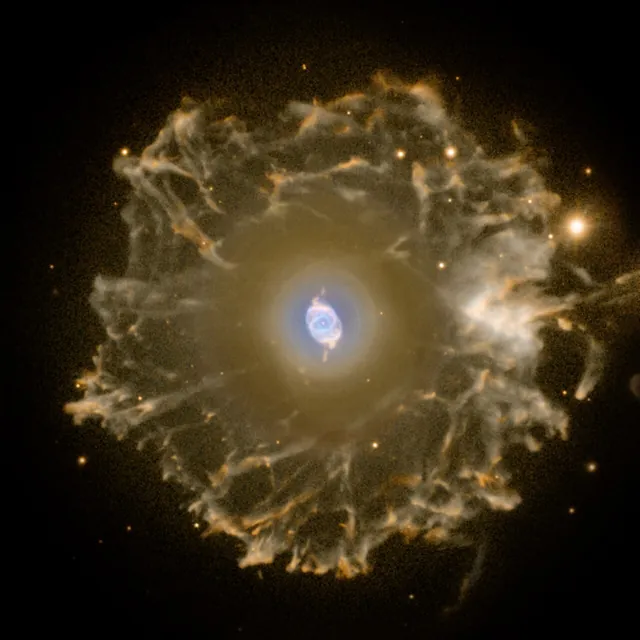
At its centre a hot star is shedding its last layers in a fast wind. Hubble has revealed nested shells, jets and shock-heated knots, wrapped in eleven or more faint rings left by puffs of gas about every 1,500 years. Around them all hangs a vast, ragged halo more than three light-years across, ejected tens of thousands of years earlier, while the bright core is only about a thousand years old.12456
Shape and size in space
The bright nebula is small on the sky, about 20″ across, but it is wrapped in a faint halo measuring 386″, or 5.8′. Hubble showed that the bright part is a tangle of nested shells, jets of fast gas and knots of shocked gas. Around it lie eleven or more concentric rings; each is the edge of a spherical bubble seen projected on the sky, so it looks brightest at its rim.123
Its distance is not settled. NASA gives about 3,000 light-years, and the SEDS catalogue 3,600. Comparing Hubble images taken three years apart, one team measured the core’s outward motion and combined it with spectroscopic speeds to obtain 1,001 ± 269 parsecs. NASA describes the whole nebula as about 5 light-years across; the halo alone spans over three light-years.1345
The nebula has a history written in layers. The halo was probably ejected some 50,000 to 90,000 years ago, while the star was a red giant. The rings followed in pulses about 1,500 years apart, each shell holding as much mass as all the Solar System’s planets combined. About 1,000 years ago the pattern changed and the bright inner nebula began to form.2345
What makes it shine
Most of the Cat’s Eye’s light comes from glowing gas, not starlight: Hubble’s early colour images mapped the light of hydrogen, nitrogen and oxygen separately, each tracing different parts of the nebula. Its surface brightness is among the highest of any object in the Caldwell catalogue, which is why so small a nebula still reaches magnitude 8.2.13
Not all of its gas is cool. In May 2000 NASA’s Chandra X-ray Observatory found a point of X-rays at the central star and diffuse X-ray emission filling the central elliptical shell. That gas is at about 1.7 million K and presses outwards about twice as hard as the cool shell around it, so it is still shaping the nebula.68
Where that hot gas comes from is debated. Its X-ray spectrum first suggested abundances like those of the star’s fast wind, which blows at about 1,750 km/s. A later model of the star’s wind found the iron in the X-ray gas depleted as in the nebula, pointing instead to nebular gas heated as the wind strikes it.69
The dying star
The central star, HD 164963, shines at visual magnitude 11.3. It is the exposed core of a star that has run out of hydrogen fuel. NASA describes how, as the core collapses and helium fusion ignites, bursts of energy push the outer layers into space, and the cycle can repeat to build a series of shells. The star is expected to become a white dwarf within a few million years.178
A detailed model of its wind found the star rich in hydrogen with a normal helium content, contrary to most earlier work; carbon is somewhat enhanced and iron slightly depleted compared with the Sun. Ultraviolet spectra from Hubble show large structures sweeping through the wind as the star turns, constraining its rotation speed to between 54 and 108 km/s.910
Notable features
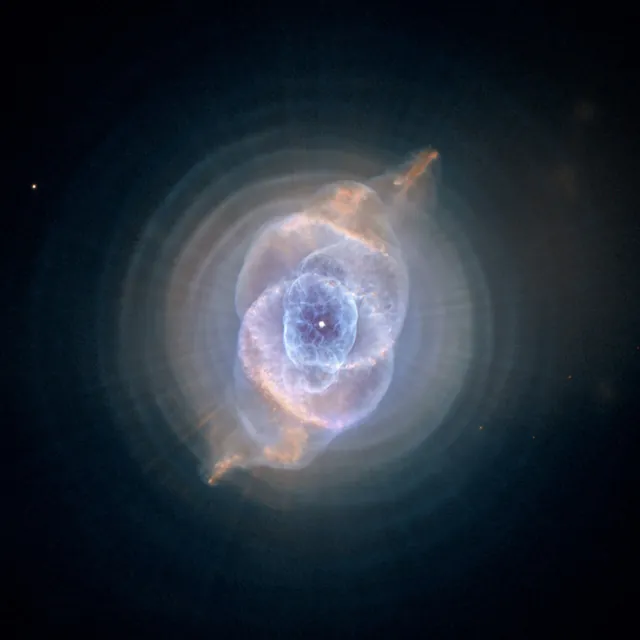
The concentric rings
A bull’s-eye of eleven or more rings around the bright nebula, each the edge of a bubble. They mark pulses of mass loss about 1,500 years apart. Suggested causes include magnetic cycles, a companion star and pulsations, or waves forming in a smooth outflow; none is yet confirmed.12
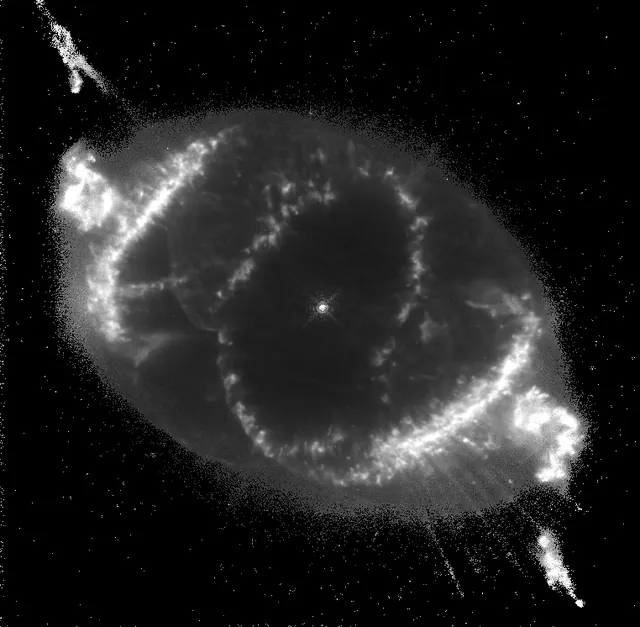
The jets and knots
Hubble’s first images in 1994 revealed jets of high-speed gas and unusual knots of gas compressed by shocks, sticking out from the ends of the inner nebula. Comparing images from 1994, 1997, 2000 and 2002 shows the nebula still expanding.12
The halo
A huge, extremely faint shell of gas around the whole nebula, 5.8′ on the sky and over three light-years across. It is probably material shed in earlier active episodes of the star’s life, most likely 50,000 to 90,000 years ago.34
The hot bubble
Chandra found gas at about 1.7 million K filling the central elliptical shell and two extensions along the nebula’s long axis. Its pressure is about twice that of the cool shell, so it continues to push the nebula outwards.6
Discovery and history
Charles Messier missed this northern nebula. William Herschel discovered it on 15 February 1786 and listed it as H IV.37. In 1864 the English amateur astronomer William Huggins turned a spectroscope on it and found the bright-line spectrum of a glowing gas, published in the Philosophical Transactions of the Royal Society. It was the first planetary nebula studied this way, showing that such nebulae are gaseous.1311
Seeing it for yourself
The Cat’s Eye is in Draco, close to the north ecliptic pole, and is best seen during the northern summer; observers near the equator in the Southern Hemisphere may catch it in mid-winter. A telescope is needed. The nebula is too small to show much detail, but its high surface brightness makes it easy to spot, and averted vision helps bring out its fainter gas.13
Telescopes on the Cat’s Eye
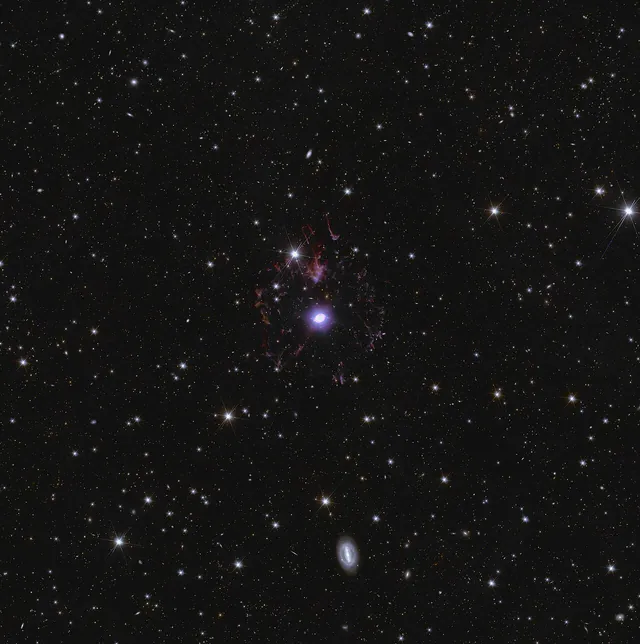
Hubble first revealed the nebula’s intricate structure in 1994 with its Wide Field and Planetary Camera 2. Images from 1994 and 1997 were enough to measure its expansion and distance. The Advanced Camera for Surveys took the famous ringed portrait in 2002, released on 9 September 2004 alongside a study showing that rings surround at least a third of planetary nebulae.125
Chandra observed the nebula on 10 May 2000 for about 13 hours, and NASA released a combined X-ray and optical image on 30 July 2008. Hubble’s Space Telescope Imaging Spectrograph followed the star’s wind for 5.8 hours to track structures within it. ESA’s Euclid caught the nebula and its halo in its Deep Field North survey.681012
Quick answers
- What kind of object is the Cat’s Eye Nebula (NGC 6543)?
- The Cat’s Eye Nebula (NGC 6543) is a planetary nebula.17
- Which constellation is the Cat’s Eye Nebula (NGC 6543) in?
- The Cat’s Eye Nebula (NGC 6543) lies in the constellation Draco.13
- How far away is the Cat’s Eye Nebula (NGC 6543)?
- The Cat’s Eye Nebula (NGC 6543) is about 3,000 light-years from Earth (an expansion-parallax measurement gives 1,001 ± 269 pc).158
- How bright is the Cat’s Eye Nebula (NGC 6543) in the night sky?
- The Cat’s Eye Nebula (NGC 6543) has an apparent magnitude of 8.2.1
- How big does the Cat’s Eye Nebula (NGC 6543) look in the sky?
- The Cat’s Eye Nebula (NGC 6543) covers about 20″ (bright nebula); 5.8′ (faint halo) of sky.3
Sources
- Caldwell 6 (Hubble’s Caldwell Catalog) — NASA Science
- Dying star creates fantasy-like sculpture of gas and dust (heic0414) — ESA/Hubble, 2004
- NGC 6543: The Cat Eye Nebula (Frommert & Kronberg) — SEDS Messier Database (Observatoire de Paris mirror), 2006
- Halo of the Cat’s Eye (heic0414b) — ESA/Hubble, 2004
- HST Measurements of the Expansion of NGC 6543: Parallax Distance and Nebular Evolution (Reed et al.) — Astronomical Journal 118, 2430 (arXiv:astro-ph/9907313), 1999
- Chandra Reveals the X-ray Glint in the Cat’s Eye (Chu et al.) — Astrophysical Journal Letters (arXiv:astro-ph/0101444), 2001
- SIMBAD astronomical database: NGC 6543 — Centre de Données astronomiques de Strasbourg (CDS)
- NGC 6543: The Cat’s Eye Nebula Redux — Chandra X-ray Center (NASA/SAO), 2008
- NLTE Model of NGC 6543’s Central Star and its Relation with the Surrounding Planetary Nebula (Georgiev et al.) — Astrophysical Journal (arXiv:0802.3692), 2008
- Looking deep into the Cat’s Eye: Structure and rotation in the fast wind of the PN central star of NGC 6543 (Prinja et al.) — Astrophysical Journal Letters 759, L28 (arXiv:1210.0533), 2012
- On the spectra of some of the nebulae. A supplement to the paper ‘On the spectra of some of the fixed stars’ (Huggins) — Philosophical Transactions of the Royal Society of London 154, 437–444, 1864
- Euclid’s view of the Cat’s Eye Nebula — ESA, 2025
Figures checked against these sources in November 2026. Where a quantity is not known, it is left out rather than estimated.

