nebula
Helix Nebula (NGC 7293)
The Helix Nebula is one of the closest planetary nebulae to Earth: the outer layers of a Sun-like star, shed in the last stages of its life and now glowing around its exposed core. About 700 light-years away in Aquarius, it covers a patch of sky about a quarter the area of the full Moon, yet its light is spread so thinly that it is hard to see by eye.12
Photographs show a vast eye of blue-green and red gas around a faint but very hot central star that is becoming a white dwarf. The inner edge of its ring is studded with thousands of cometary knots, each about the size of the Solar System, with tails pointing away from the star, and dust around the star may come from comets that survived its death.123
Shape and size in space
Hubble’s Fine Guidance Sensors measured the parallax of the Helix’s central star, giving a distance of 216 parsecs (+14/−12); ESO quotes about 700 light-years. Gaia has since measured a parallax of 5.01 milliarcseconds for the same star. On the sky the main ring spans about 12′, and a faint outermost ring reaches about 25′.1456
The Helix is not a simple ring. Hubble and ground-based images analysed in 2004 show an inner disc 0.52 parsecs across, surrounded by an outer ring, really a torus, 0.77 parsecs across and steeply tilted to the disc. Around both lies an outermost ring 1.76 parsecs across, flattened on the side where it collides with the surrounding interstellar gas.610
ESO describes the main ring as about two light-years across, with gas spreading at least four light-years from the star. The brighter inner disc seems to be expanding at about 100,000 km/h and to have taken about 12,000 years to form. Infrared images from WISE reveal a far larger halo, about 40′ across, whose sharp north-eastern edge suggests the star’s wind meeting interstellar gas.1211
What makes it shine
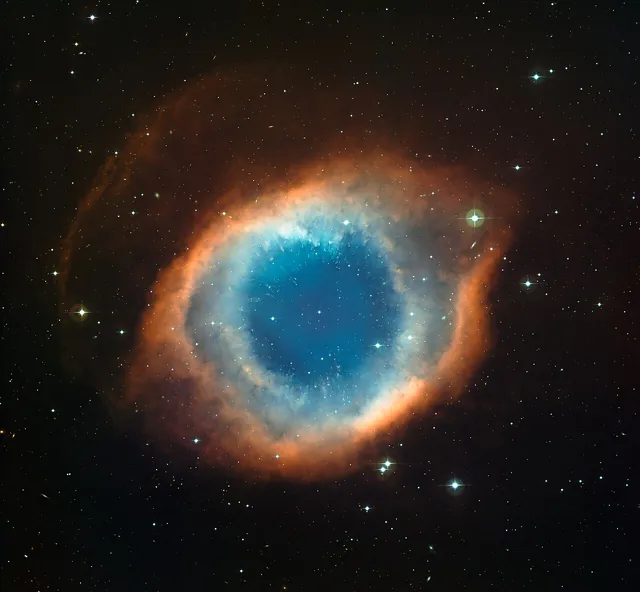
Ultraviolet light from the faint but very hot central star makes the gas glow. The inner disc is filled with doubly ionised helium and, like the outer ring, absorbs all of the star’s ionising radiation. In ESO’s Wide Field Imager picture the blue-green glow near the centre comes from oxygen, while red light from hydrogen and nitrogen dominates farther out.161213
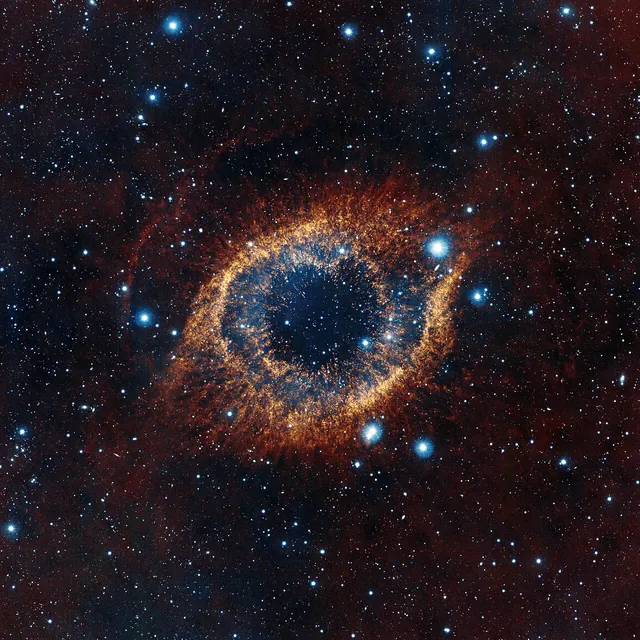
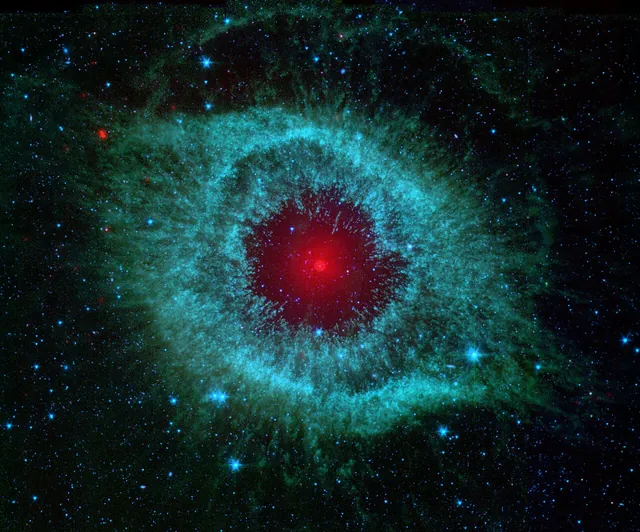
Infrared views look very different. ESO’s VISTA telescope reveals strands of cold molecular gas, mostly hidden in visible light, radiating from the centre like a firework display. Spitzer saw the outer gas layers glowing at shorter infrared wavelengths and, in the middle, a red glow at 24 micrometres from the final layers of gas the star blew out.23
The knots are where the molecules survive. Each is a clump of molecular gas shielded by dust from the star’s radiation. A Hubble infrared survey estimated some 23,000 knots holding a total of 0.35 solar masses of neutral gas, and found the molecular gas much more clumped than the ionised gas. Within the inner ring, molecular hydrogen exists only inside the knots.2914
The star at the centre
The central star, catalogued as the white dwarf WD 2226−210, shines at about 13.5 magnitude, has a temperature of about 120,000 °C and has a spectral type of DAO.5. Hubble parallax measurements give it a mass of 0.60 ± 0.02 solar masses. Like other central stars of planetary nebulae, it is larger than white dwarfs that have settled on their final cooling tracks.4513
In 2007 Spitzer found excess infrared light from the star, most likely from a ring of dust between about 35 and 150 astronomical units out, at 90–130 K. The dust may come from collisions between Kuiper Belt-like bodies or the break-up of comets from an Oort-like cloud that survived the star’s death.315
The star also gives out hard X-rays, which stayed essentially constant between 1992 and 2002. If they come from material falling on to the star, it is accreting about 10⁻¹⁰ solar masses a year. The source of that material is uncertain: it could be the dusty disc or an unseen substellar companion, though the disc alone does not seem enough.16
Notable features
Cometary knots
Thousands of knots line the inner edge of the ring, each with a head facing the central star and a faint tail streaming away. Each is about the size of our Solar System. Near the inner edge they look like tadpoles; in the outer ring, 4.5′ to 6.4′ from the star, they are more fractured.1214
Two tilted discs
Seen from Earth the Helix resembles a doughnut, but its main ring is really an inner disc and an outer torus steeply inclined to each other. Viewed from the side, a 3D model based on Hubble and ground-based observations shows two gaseous discs nearly perpendicular to one another.610
Bow shocks in the outskirts
In 2026 astronomers using the partly built MOTHRA telescope reported 22 compact bow shocks, seen in hydrogen-alpha light, on the Helix’s eastern outskirts. Each belongs to a clump of gas; they appear to be fragments of the star’s old shell being stripped and mixed into interstellar space over about 10,000 years.17
Galaxies seen through the nebula
Because the Helix’s gas is spread so thinly, deep images show many remote galaxies right through it. ESO’s Wide Field Imager picture of 2009 reveals galaxies behind the central part of the nebula, some of them gathered in separate groups scattered across the image.1
Discovery and history
The history of the Helix’s discovery is rather obscure: it first appears in a list of new objects compiled by the German astronomer Karl Ludwig Harding in 1824. The name Helix comes from the rough corkscrew shape seen in early photographs. It also bears the number 7293 in the New General Catalogue.12
Seeing it for yourself
The Helix lies in Aquarius. Its total magnitude of 7.3 sounds easy, but the light is spread over an area of sky about a quarter that of the full Moon, so it is hard to see visually: through a small telescope it appears very large but very faint. Long-exposure photographs, by contrast, show it spectacularly.127
Telescopes on the Helix
The Helix is so large that Hubble’s Advanced Camera for Surveys and the 4-metre telescope at Cerro Tololo were both needed for a complete view; the combined picture was released on 16 December 2004 with a 3D model. ESO followed with a deep Wide Field Imager view from La Silla on 25 February 2009, and an infrared VISTA image on 19 January 2012.1210
Spitzer’s infrared image, released on 12 February 2007, revealed the glowing dust around the central star. Hubble’s NICMOS camera and the Subaru Telescope have mapped the molecular hydrogen knots, Chandra and XMM-Newton have tracked the star’s X-rays, and in 2026 the MOTHRA telescope revealed bow shocks in the far outskirts.3914151617
Quick answers
- What kind of object is the Helix Nebula (NGC 7293)?
- The Helix Nebula (NGC 7293) is a planetary nebula.14
- Which constellation is the Helix Nebula (NGC 7293) in?
- The Helix Nebula (NGC 7293) lies in the constellation Aquarius.1
- How far away is the Helix Nebula (NGC 7293)?
- The Helix Nebula (NGC 7293) is about 700 light-years from Earth (216 parsecs from Hubble parallaxes of the central star).125
- How big is the Helix Nebula (NGC 7293)?
- The Helix Nebula (NGC 7293) is about two light-years across (the main ring; its gas reaches at least four light-years from the star).12
- How big does the Helix Nebula (NGC 7293) look in the sky?
- The Helix Nebula (NGC 7293) covers about 25′ of sky (the outermost ring; the main ring is about 12′).6
- How bright is the Helix Nebula (NGC 7293) in the night sky?
- The Helix Nebula (NGC 7293) has an apparent magnitude of 7.3 (spread over a large area, so hard to see).17
- How old is the Helix Nebula (NGC 7293)?
- The Helix Nebula (NGC 7293) is about 12,000 years old (for the inner disc; another estimate gives about 7,400).18
- When was the Helix Nebula (NGC 7293) discovered?
- The Helix Nebula (NGC 7293) was discovered in 1824, first listed by Karl Ludwig Harding.1
Sources
- Into the Eye of the Helix (eso0907) — European Southern Observatory, 2009
- The Helix in New Colours (eso1205) — European Southern Observatory, 2012
- Comets Kick up Dust in Helix Nebula (PIA09178) — NASA Science (Photojournal), 2007
- SIMBAD astronomical database: NGC 7293 — Centre de Données astronomiques de Strasbourg (CDS)
- Astrometry with the Hubble Space Telescope: Trigonometric Parallaxes of Planetary Nebula Nuclei: NGC 6853, NGC 7293, Abell 31, and DeHt 5 (Benedict et al.) — Astronomical Journal 138, 1969 (arXiv:0909.4281), 2009
- Unraveling the Helix Nebula: Its Structure and Knots (O’Dell, McCullough & Meixner) — Astronomical Journal 128, 2339 (arXiv:astro-ph/0407556), 2004
- Revised NGC Data for NGC 7293 (from W. Steinicke’s Revised NGC and IC Catalog) — SEDS Interactive NGC Catalog
- JWST observations of the Ring Nebula (NGC 6720): I. Imaging of the rings, globules, and arcs (Wesson et al.) — Monthly Notices of the Royal Astronomical Society (arXiv:2308.09027), 2024
- The Multitude of Molecular Hydrogen Knots in the Helix Nebula (Meixner et al.) — arXiv:astro-ph/0509887 (doi:10.1086/444539), 2005
- Helix Nebula (opo0432a) — ESA/Hubble, 2004
- Discovery of a halo around the Helix Nebula NGC 7293 in the WISE all-sky survey (Zhang, Hsia & Kwok) — Astrophysical Journal 755, 53 (arXiv:1207.4606), 2012
- The 3-D Structure of the Helix Nebula (O’Dell) — arXiv:astro-ph/0505539, 2005
- The Helix Nebula (image eso0907a) — European Southern Observatory, 2009
- Knots in the Helix Nebula found in H2 (Matsuura et al.) — Astrophysical Journal 700, 1067 (arXiv:0906.2870), 2009
- A Debris Disk around the Central Star of the Helix Nebula? (Su et al.) — Astrophysical Journal 657, L41 (arXiv:astro-ph/0702296), 2007
- Accretion onto WD 2226−210, the central star of the Helix Nebula (Estrada-Dorado et al.) — arXiv:2412.07863, 2024
- Numerous bow shocks in the outer Helix Nebula (van Dokkum et al.) — arXiv:2608.11443 (preprint), 2026
Figures checked against these sources in November 2026. Where a quantity is not known, it is left out rather than estimated.

