nebula
Dumbbell Nebula (M27)
The Dumbbell Nebula was the first planetary nebula ever found: a cloud of glowing gas shed by an old star near the end of its life. Charles Messier spotted it in 1764 in the constellation Vulpecula. Through a small telescope its two bright lobes give it the dumbbell outline that John Herschel described, and from which it takes its name.12
It is among the brightest planetary nebulae in the sky, at magnitude 7.4, and Hubble measurements of its central star’s parallax place it about 405 parsecs away. That star, an extremely hot remnant of about 0.57 solar masses catalogued as a white dwarf, floods the gas with ultraviolet light. Hubble has also revealed dense knots of gas, each holding about as much mass as three Earths.12345
Shape and size in space
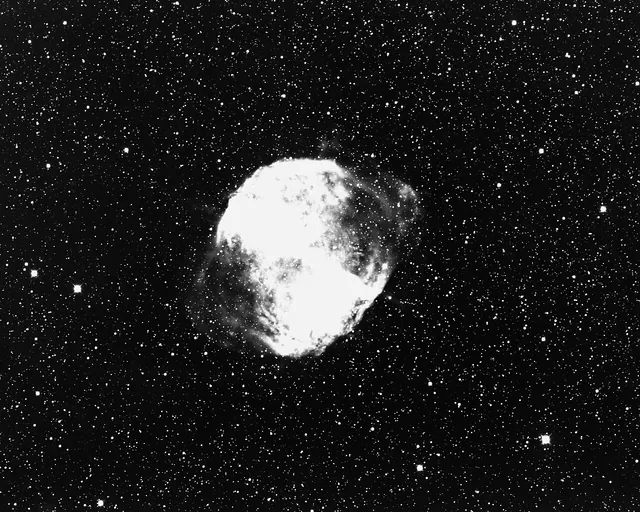
Distances to planetary nebulae are notoriously hard to measure, and published estimates for the Dumbbell once ran from 490 to 3,500 light-years. Hubble’s Fine Guidance Sensors measured the parallax of its central star, giving 405 parsecs (+28/−25) in 2009; NASA describes the nebula as more than 1,200 light-years away. Gaia has since measured a parallax of 2.57 milliarcseconds for the star.1234
The bright body of the nebula spans about 8′ × 5.7′, and a faint halo reaches more than 15′, half the apparent diameter of the Moon. We probably see it roughly from its equatorial plane; viewed from one of its poles it would probably look like a ring, much as the Ring Nebula appears from Earth.2
Its age is uncertain. One measurement of the bright shell’s expansion, 6.8″ per century, suggests 3,000 to 4,000 years; another, of 1.0″ per century, gave about 48,000 years. Both rest on older photographic measurements. The shell’s true size depends on the distance, which until recently was itself poorly known.2
- Distance
- 405 pc (+28 / −25)3Hubble Fine Guidance Sensor parallax, 2009
- Apparent size
- 8.0′ × 5.7′2
- Apparent size (Revised NGC)
- 6.7′6
- Faint halo
- more than 15′ across2
- Expansion of the bright shell
- 6.8″ per century2another measurement gives 1.0″ per century
- Age estimates
- 3,000–4,000 years, or about 48,000 years2from the two expansion rates
What makes it shine
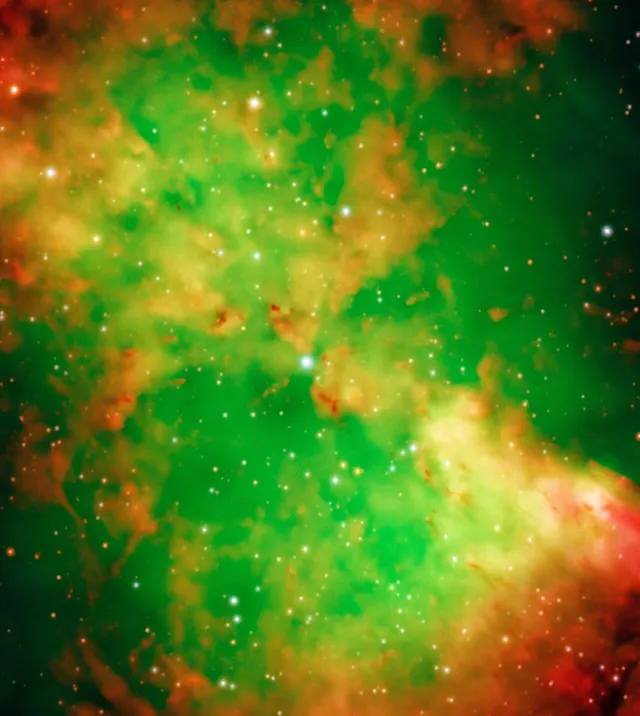
The central star emits mostly high-energy ultraviolet light. The gas absorbs it and re-emits much of the energy as visible light, which is why the nebula is far brighter than its star. As in almost all planetary nebulae, much of the visible light comes out in a single green spectral line at 5007 ångströms, emitted by doubly ionised oxygen.25
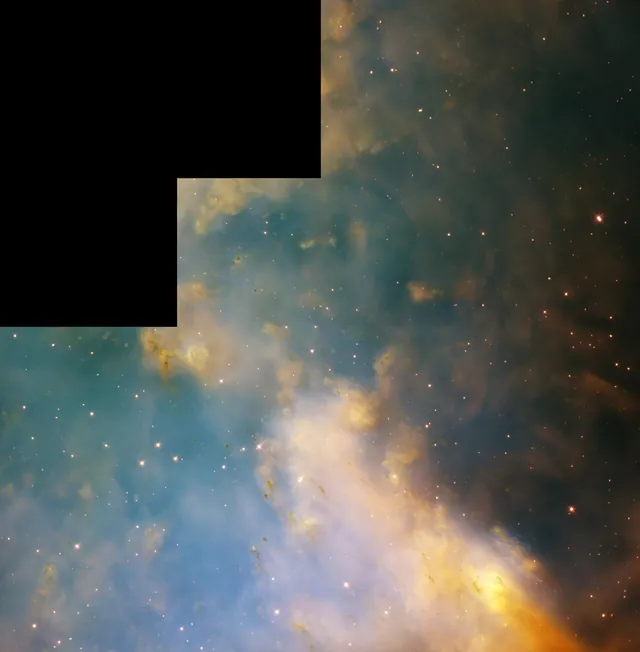
ESO’s Very Large Telescope image of 1998 combines narrow-band exposures in the light of doubly ionised oxygen and of hydrogen with a short blue exposure, giving approximately true colours: green oxygen light fills most of the nebula and red hydrogen light is strongest towards its edges. In Hubble’s close-up, blue represents oxygen, green hydrogen, and red sulphur and nitrogen.15
The star at the centre
The central star is quite bright for such an object, at about magnitude 13.5 to 14. It is extremely hot, about 85,000 K by one older estimate, and is catalogued as the white dwarf WD 1957+225, of spectral type DAO.6. Hubble parallax work gives it a mass of 0.57 ± 0.01 solar masses, close to the peak of the white dwarf mass distribution.234
Its radius is still larger than that of white dwarfs that have settled on their final cooling tracks. K. M. Cudworth of Yerkes Observatory found a probable faint companion, a yellow star of 17th magnitude 6.5″ away. Benedict’s team searched for a closer companion that might have shaped this most lopsided of their nebulae, but found none; any such star must be small and in a tight orbit.23
Notable features
The knots
Hubble shows many knots of gas and dust: some point like fingers towards the central star, others are isolated clouds, with or without tails. They typically measure 17 to 56 billion kilometres across, several times the Sun–Pluto distance, and each holds about three Earth masses. They form where the star’s wind cannot blow away a large clump.1
The two lobes
The brightest gas forms two broad lobes either side of the central star, which give the nebula its dumbbell shape in small telescopes. John Herschel coined the name and also compared it to a double-headed shot.12
The faint halo
Far beyond the bright body, a faint halo extends to more than 15′, half the apparent diameter of the Moon. It was measured in 1974 by A. G. Millikan, who gave the nebula a diameter of 350″ and the halo 907″.2
Goldilocks’ Variable
By comparing images of the Dumbbell, Leos Ondra discovered a variable star in the very outskirts of the nebula, which he named Goldilocks’ Variable. It appears in some photographs of M27 and is missing from others, which shows that its brightness changes.2
Discovery and history
Charles Messier discovered the Dumbbell on 12 July 1764 and described it as an oval nebula without stars. It was the first planetary nebula ever found, the first of a new class of objects. John Herschel later called it the “Dumb-bell” and also likened it to a “double-headed shot”.12
Its distance long remained uncertain, with estimates by different authors ranging from 490 to 3,500 light-years. Hubble’s Fine Guidance Sensors finally measured the central star’s parallax directly: a first result was published in 2003, and a revised value of 405 parsecs, averaged with earlier ground-based measurements, followed in 2009.23
Seeing it for yourself
At magnitude 7.4 the Dumbbell is among the brightest planetary nebulae, only a little fainter than the Helix Nebula, whose light is spread over a far larger area and so has a much lower surface brightness. It shows well even in 10×50 binoculars under moderately good skies. NASA’s observing guide names September as the best month to see it with a small telescope.12
About 2° to the west lies the inconspicuous open cluster NGC 6830, a scattering of 20 to 30 stars some 5,500 light-years away. In the nebula itself, the central star is quite bright for a planetary nebula, at about magnitude 13.5.2
Telescopes on the Dumbbell
During the commissioning of the FORS1 instrument on the first 8.2-metre unit telescope of ESO’s Very Large Telescope, astronomers tested its narrow-band filters on the Dumbbell on 28 September 1998; ESO released the resulting pictures on 7 October 1998. On 10 February 2003 the Hubble Heritage team released a Wide Field and Planetary Camera 2 close-up of the nebula’s knots.578
Hubble’s Fine Guidance Sensors, white-light interferometers on the telescope, measured the parallax of the central star, giving the distance of 405 parsecs published in 2009. The Gaia spacecraft has since measured a parallax of 2.57 milliarcseconds for the same star.34
Quick answers
- Which constellation is the Dumbbell Nebula (M27) in?
- The Dumbbell Nebula (M27) lies in the constellation Vulpecula.1
- How far away is the Dumbbell Nebula (M27)?
- The Dumbbell Nebula (M27) is more than 1,200 light-years from Earth (405 parsecs from Hubble parallaxes of the central star).13
- How big does the Dumbbell Nebula (M27) look in the sky?
- The Dumbbell Nebula (M27) covers 8.0′ × 5.7′ of sky (a faint halo reaches more than 15′).2
Sources
- Messier 27 (The Dumbbell Nebula) — NASA Science, Hubble’s Messier Catalog
- Messier 27 (H. Frommert & C. Kronberg) — SEDS Messier Database (Observatoire de Paris mirror), 2007
- Astrometry with the Hubble Space Telescope: Trigonometric Parallaxes of Planetary Nebula Nuclei: NGC 6853, NGC 7293, Abell 31, and DeHt 5 (Benedict et al.) — Astronomical Journal 138, 1969 (arXiv:0909.4281), 2009
- SIMBAD astronomical database: M 27 — Centre de Données astronomiques de Strasbourg (CDS)
- FORS1 at the VLT UT1: First Spectra Obtained (eso9846) — European Southern Observatory, 1998
- Revised NGC Data for NGC 6853 (from W. Steinicke’s Revised NGC and IC Catalog) — SEDS Interactive NGC Catalog
- Close-up of M27, the Dumbbell Nebula (opo0306a) — ESA/Hubble, 2003
- The Dumbbell Nebula (image eso9846a) — European Southern Observatory, 1998
Figures checked against these sources in November 2026. Where a quantity is not known, it is left out rather than estimated.

