star cluster
47 Tucanae
47 Tucanae, also catalogued as NGC 104, is a globular cluster of hundreds of thousands of ancient stars in the southern constellation Tucana, roughly 15,000 light-years away. After Omega Centauri it is the brightest globular cluster in the night sky, plain to the unaided eye under dark southern skies, and by chance it lies in front of the Small Magellanic Cloud. Nicolas-Louis de Lacaille recorded it as a nebulous object in 1751.1234
Its stars are about 11.75 billion years old and together weigh some 853,000 Suns, making it one of the most massive clusters orbiting the Milky Way. The crowded core is a factory of exotic objects: 42 radio pulsars are known there, more than in any other cluster except Terzan 5, and their motions have been used to argue for a hidden black hole of about 2,300 solar masses at the centre.25678
Size, shape and distance
47 Tucanae is a globular cluster, a dense, roughly spherical swarm of old stars orbiting the Milky Way. Of the more than 150 globular clusters known around our galaxy, ESO ranks it the second most massive, after Omega Centauri. Its stars fill a region about 120 light-years across, so even at its great distance the cluster covers about as much sky as the full Moon.23
Published distances differ: ESO gives about 15,000 light-years, SEDS 13,400 and NASA 16,700. Combining Gaia parallaxes with Hubble and other data, Baumgardt and Vasiliev placed the cluster at 4.52 ± 0.03 kiloparsecs, matching the 4.5 kiloparsecs in William Harris’s catalogue. Computer fits to its stars’ motions give a mass of about 853,000 Suns, with half its light within 4.03 parsecs of the centre.12361011
The cluster is approaching us at about 17 km/s along our line of sight and lies 7.52 kiloparsecs from the centre of the Milky Way. It also spins: a study of its stars’ motions measured a rotation velocity of 5.00 ± 0.32 km/s. More than 27,000 stars with measured proper motions and over 7,000 with radial velocities went into the models.69
- Distance (Harris catalogue)
- 4.5 kpc11
- Distance from the galactic centre
- 7.52 ± 0.01 kpc6
- Mass
- (8.53 ± 0.05) × 10⁵ solar masses6
- Core radius
- 0.61 pc6
- Half-light radius
- 4.03 pc6
- Tidal radius
- 124.63 pc6
- Central velocity dispersion
- 11.9 km/s6
- Central escape velocity
- 47.4 km/s6
- Rotation velocity
- 5.00 ± 0.32 km/s6
- Radial velocity
- −17.2 km/s9approaching
The stars inside
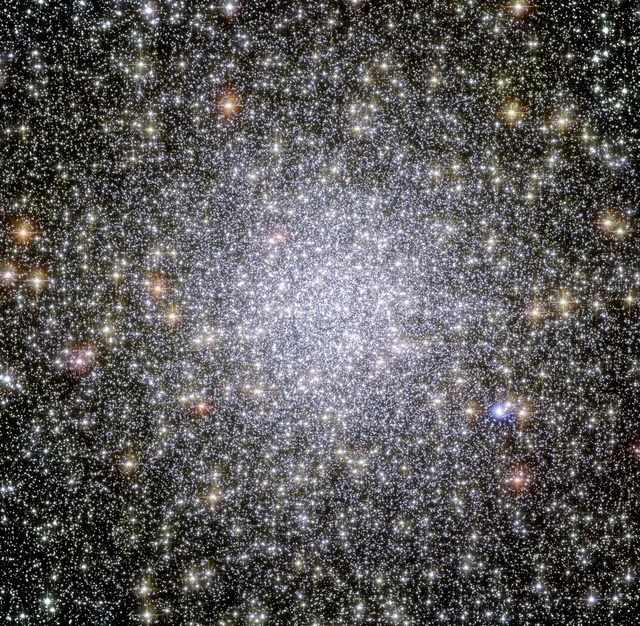
Like other globular clusters, 47 Tucanae is old and poorer in heavy elements than the Sun: Harris’s catalogue gives its iron abundance, written [Fe/H], as −0.72 on the logarithmic scale astronomers use. A 2013 study of 55 globular clusters put its age at 11.75 ± 0.25 billion years. In Hubble’s natural-colour pictures the red stars are bright red giants near the end of their lives, while the more common yellow stars resemble the middle-aged Sun.1511
Inside the cluster, heavy stars sink towards the core and lighter ones drift outwards. Using ultraviolet images from Hubble’s Wide Field Camera 3, astronomers examined 3,000 white dwarfs and caught young ones starting a slow, 40-million-year migration out of the crowded centre. The timing suggests that stars shed 40 to 50 per cent of their bulk just 10 million years before becoming white dwarfs, later than many astronomers had thought.14
In 1999 Hubble watched 35,000 stars in the cluster for eight days, looking for the slight dimming caused when a close-orbiting giant planet crosses the face of its star. Based on the planets known near the Sun, the team expected to find 17 of these hot Jupiters but found none, only 100 variable stars. Suggested reasons include the cluster’s shortage of heavy elements and the crowding of its stars.12
Notable features
Millisecond pulsars
Very rapidly rotating, highly magnetised stellar remnants that emit bursts of radiation as they spin. Paulo Freire’s catalogue of pulsars in globular clusters lists 42 in 47 Tucanae, more than 28 of them in binary systems. Only Terzan 5, with 49, has more; in 2013 ESO counted 23 in 47 Tucanae.27
A possible central black hole
In 2017 Bülent Kızıltan, Holger Baumgardt and Abraham Loeb used the motions of the cluster’s pulsars to argue for an intermediate-mass black hole of about 2,300 solar masses (+1,500 or −850) at the centre. It gives off no detectable X-rays or radio waves, suggesting it is starved of gas.8
In front of a galaxy
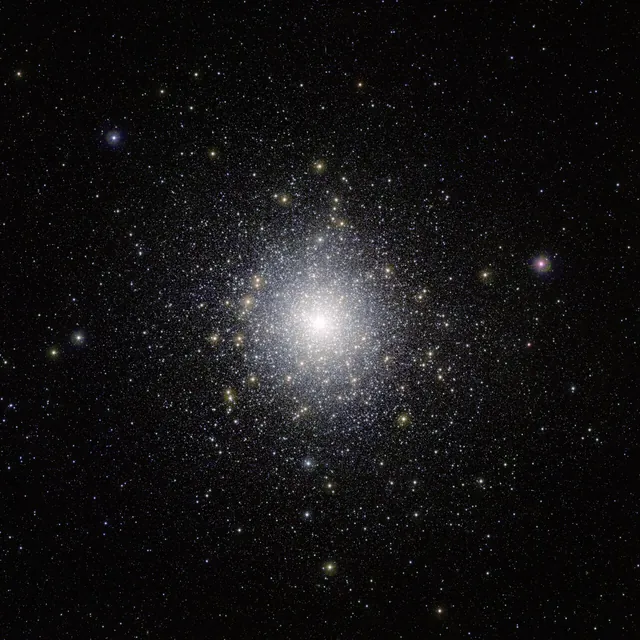
47 Tucanae lies by chance in the foreground of the Small Magellanic Cloud, a nearby dwarf galaxy far beyond the cluster. Deep images show huge numbers of the galaxy’s stars in the background. ESO’s VISTA telescope photographed the cluster while surveying the Magellanic Clouds.12
History
Although it is a conspicuous naked-eye object, 47 Tucanae lies so far south that it was not recognised as a deep-sky object until 1751, when Nicolas-Louis de Lacaille entered it in his list of southern nebulous objects as Lacaille I.1. Its name shows that it was first catalogued as a star, the 47th in Tucana. James Dunlop observed it in 1826 and John Herschel in 1834.13
Seeing it for yourself
At magnitude 4.0, 47 Tucanae is visible to the naked eye under dark skies and easy to see with binoculars, appearing near the Small Magellanic Cloud. At a declination of −72° it is a southern-sky object, standing highest above the horizon in the southern spring. Its stars spread over about 31′ of sky, close to the apparent size of the full Moon.123
Telescopes and discoveries
47 Tucanae is a long-standing Hubble target: comparison images of its core, taken with the Faint Object Camera before and after the COSTAR corrective optics, showed how much sharper the telescope became. In 1999 Hubble’s Wide Field and Planetary Camera 2 spent eight consecutive days on the cluster for the planet search, the most data-intensive Hubble observation to that time, with over 1,300 exposures archived.112
Later Hubble work used the Wide Field Camera 3 in visible, infrared and ultraviolet light to follow white dwarfs leaving the core. On the ground, ESO’s VISTA infrared survey telescope imaged the cluster in detail, and radio telescopes have found dozens of pulsars, whose timing has been used to probe the cluster’s dense centre.12478
- Known pulsars
- 427
Quick answers
- Which constellation is 47 Tucanae in?
- 47 Tucanae lies in the constellation Tucana.1
- How far away is 47 Tucanae?
- 47 Tucanae is about 15,000 light-years from Earth (4.52 ± 0.03 kpc from Gaia, Hubble and other data; NASA gives 16,700 light-years).12610
- How big does 47 Tucanae look in the sky?
- 47 Tucanae covers about 31′ of sky (about the size of the full Moon).23
- How old is 47 Tucanae?
- 47 Tucanae is 11.75 ± 0.25 billion years old.5
- How massive is 47 Tucanae?
- 47 Tucanae has a mass of about 853,000 solar masses ((8.53 ± 0.05) × 10⁵).6
Sources
- Caldwell 106 — NASA Science, Hubble’s Caldwell Catalog
- A Jumble of Exotic Stars: new VISTA snap of star cluster 47 Tucanae (eso1302) — European Southern Observatory, 2013
- NGC 104 (47 Tucanae) (H. Frommert & C. Kronberg) — SEDS Messier Database (Observatoire de Paris mirror), 2006
- Hubble Catches a Stellar Exodus in Action — NASA Science (Hubble news), 2015
- The ages of 55 globular clusters as determined using an improved ΔV(TO,HB) method along with colour–magnitude diagram constraints (VandenBerg et al.) — Astrophysical Journal 775, 134 (arXiv:1308.2257), 2013
- Structural parameters of Galactic globular clusters (H. Baumgardt et al.) — Fundamental parameters of Galactic globular clusters, University of Queensland
- Pulsars in globular clusters (P. Freire) — Max-Planck-Institut für Radioastronomie, 2026
- An intermediate-mass black hole in the centre of the globular cluster 47 Tucanae (Kızıltan, Baumgardt & Loeb) — Nature 542, 203 (arXiv:1702.02149), 2017
- SIMBAD astronomical database: NGC 104 — Centre de Données astronomiques de Strasbourg (CDS)
- Accurate distances to Galactic globular clusters through a combination of Gaia EDR3, HST and literature data (Baumgardt & Vasiliev) — Monthly Notices of the Royal Astronomical Society 505, 5957 (arXiv:2105.09526), 2021
- Catalog of parameters for Milky Way globular clusters (Harris 1996, 2010 edition) — W. E. Harris, McMaster University, 2010
- Astronomers Ponder Lack of Planets in Globular Cluster — NASA Science (Hubble news), 2000
Figures checked against these sources in November 2026. Where a quantity is not known, it is left out rather than estimated.

