galaxy
Small Magellanic Cloud
The Small Magellanic Cloud is a dwarf galaxy about 203,700 light-years away, visible to the unaided eye in the southern constellation Tucana as a hazy patch near the brighter Large Magellanic Cloud. It holds far fewer heavy elements than the Milky Way, so its brightest star-forming region, NGC 346, offers a close look at conditions like those in galaxies billions of years ago.12345
It is not a tidy disc. Its stars are strung out along our line of sight, its eastern side tens of thousands of light-years nearer than its western side, and Gaia shows its two halves moving apart as the Large Magellanic Cloud stretches it. Gas torn from it feeds the Magellanic Bridge and Stream, and in 1912 its Cepheid variable stars gave Henrietta Swan Leavitt the law that opened up cosmic distances.16789
Shape and distance
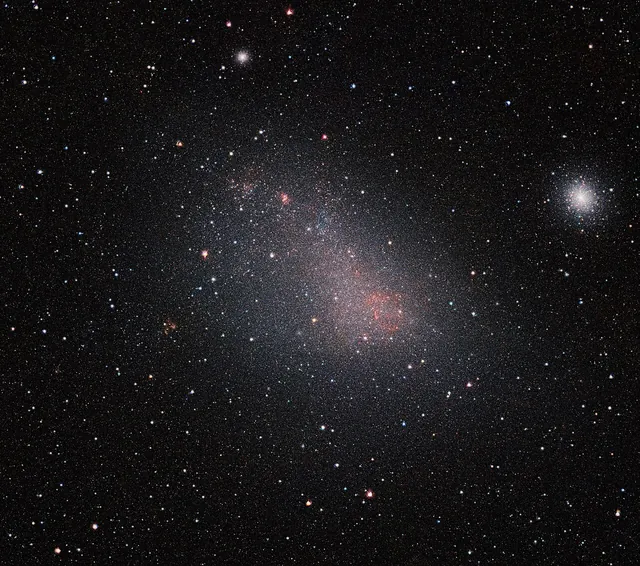
Fifteen eclipsing binary stars put the centre of the Small Magellanic Cloud 62.44 kiloparsecs away, about 203,700 light-years, with an accuracy better than 2 per cent. Spitzer observations of Cepheid variables gave 62 kiloparsecs, about 0.48 magnitudes more distant than the Large Magellanic Cloud. Popular figures of 200,000 and 210,000 light-years are rounder or older values.13610
The galaxy is elongated, cigar-shaped and seen nearly end-on. Cepheids show its eastern side up to 20 kiloparsecs, some 65,000 light-years, closer than its western side. Eclipsing binaries find a line-of-sight depth of about 7 kiloparsecs, and hint at a compact core about 1.5 kiloparsecs in radius that holds some 40 per cent of its young and intermediate-age stars.168
Its neutral hydrogen shows what looks like a bar, arm-like extensions and a ‘Wing’ joined by a bridge of gas, possibly all signs of recent encounters with the Large Cloud. The gas has a large velocity gradient once read as rotation, but a 2025 study of 7,426 massive stars measured by Gaia found its eastern and western parts moving apart, and argued that the galaxy is being stretched rather than rotating.7811
- Distance to the centre
- 62.44 ± 0.47 (statistical) ± 0.81 (systematic) kpc1about 203,700 light-years
- Distance from Cepheids
- 62 ± 0.3 kpc6
- Line-of-sight depth
- about 7 kpc (about 23,000 light-years)1from eclipsing binaries
- Eastern side nearer than the western
- by up to 20 kpc (about 65,000 light-years)6from Cepheids
- Possible core
- about 1.5 kpc in radius1about 40 per cent of young and intermediate-age stars
Mass and motion
From the rotation of its hydrogen gas, which rises to about 60 km/s at 3 kiloparsecs from the centre, Snežana Stanimirović and colleagues derived a dynamical mass of 2.4 billion solar masses in 2004, and found that its stars could explain this without a dark matter halo. Gaia results published in 2025 question whether the gas is truly rotating at all, so that mass remains uncertain.7811
The Small Cloud moves at 217 ± 26 km/s relative to the Galactic centre, and its path is bound up with the Large Cloud’s. If the two have been a bound pair for several billion years, orbit calculations favour their first fall towards the Milky Way. Some simulations have the two Clouds colliding directly 100–300 million years ago, which may have pulled out the Magellanic Bridge.81213
- Dynamical mass
- 2.4 × 10⁹ solar masses11from the gas rotation curve
- Rotation speed of the gas
- about 60 km/s at about 3 kpc11
- Mass in stars
- about 3 × 10⁸ solar masses8
- Neutral hydrogen gas
- about 4.0 × 10⁸ solar masses8for an assumed distance of 55 kpc
- Speed relative to the Galactic centre
- 217 ± 26 km/s12
- Radial velocity
- 145.6 ± 0.6 km/s4away from the Sun
Stars and star birth
The gas and young stars of the Small Magellanic Cloud contain only about a fifth of the Sun’s proportion of heavy elements, and its old red giants about a tenth. Infrared mapping by ESO’s VISTA telescope found that most of its stars formed far more recently than those of larger neighbouring galaxies. It holds open clusters, nebulae, supernova remnants, planetary nebulae and just one globular cluster, NGC 121.3810
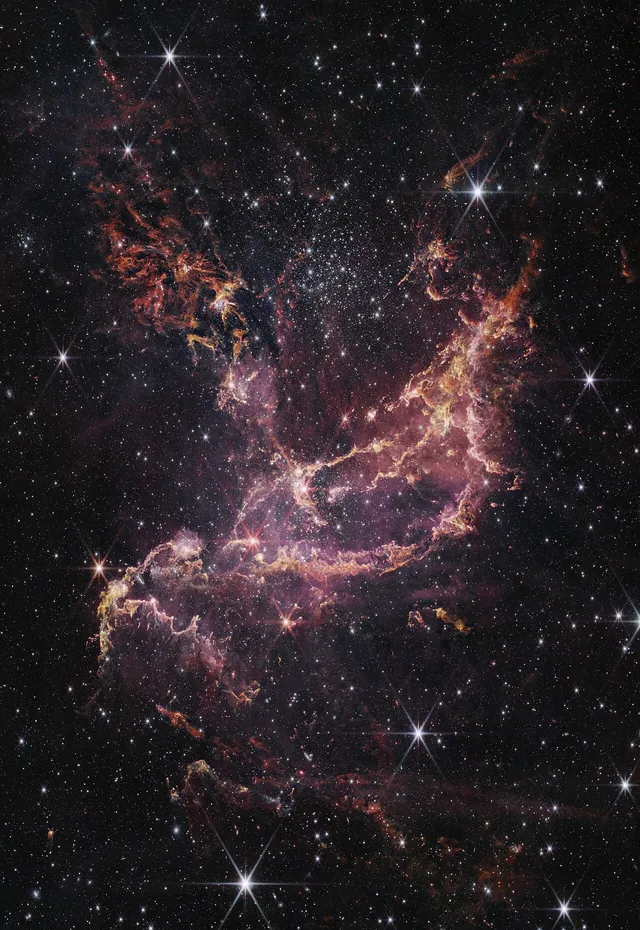
Its brightest and largest star-forming region is NGC 346. Webb found surprising amounts of dust there despite the scarcity of heavy elements, and for the first time detected dust in the discs feeding its young protostars, reaching stars as small as a tenth of the Sun’s mass. A mid-infrared image released in 2023 counted 1,001 point sources, most of them young stars still in dusty cocoons.25
The Bridge and the Stream
Gas torn from the Small Cloud now spans much of the southern sky. The Magellanic Bridge, a band of hydrogen joining the two Clouds, was discovered in 1963. Its low content of heavy elements matches the Small Cloud rather than the Large, so it seems to be made of material that once belonged to the Small Cloud; it also contains stars.8
The Magellanic Stream, trailing behind the pair, was traced to the Clouds and named in 1974. One of its two main filaments leads back to the Large Cloud; the chemistry of the other points to the Small Cloud. With its Leading Arm the Stream stretches over 200° of sky and carries more than a billion solar masses of gas, which could maintain or even raise the Milky Way’s rate of star formation if it reaches the Galactic disc.8
- Magellanic Bridge discovered
- 19638in neutral hydrogen, by Hindman and colleagues
- Neutral hydrogen in the Bridge
- 1.8 × 10⁸ solar masses8for an assumed distance of 55 kpc
- Heavy elements in the Bridge
- [Z/H] = −1.02 ± 0.078from two hot stars embedded in it
- Magellanic Stream named
- 19748by Mathewson and colleagues
- Neutral hydrogen in the Stream
- 2.7 × 10⁸ solar masses8
- Extent of the Stream and Leading Arm
- more than 200° of sky8
Notable features
NGC 346
The brightest and largest star-forming region in the Small Magellanic Cloud, which the research team’s leader called the one massive cluster furiously forming stars in its galaxy. Webb’s images show ribbons of gas and dust feeding protostars, and dust in their discs: the building blocks of stars and perhaps of planets.25
NGC 121
The only globular cluster belonging to the Small Magellanic Cloud. It lies well outside the galaxy’s denser regions, slightly north of the much nearer foreground cluster 47 Tucanae on the sky, among a galaxy otherwise rich in open clusters, nebulae and supernova remnants.3
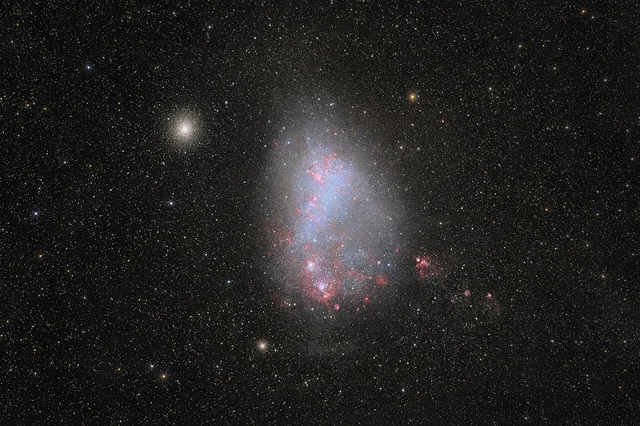
47 Tucanae (in the foreground)
Not part of the Small Cloud at all: a huge, ancient globular cluster of our own Galaxy, about 15,000 light-years away, that by chance lies in front of it on the sky. About 120 light-years across, it looks about as big as the full Moon and is visible to the naked eye.314
The Wing
An extension of the Small Cloud’s gas joined to the rest of the galaxy by a bridge of hydrogen. With the apparent bar and arm-like extensions seen in its neutral hydrogen, it may be a sign of recent tidal interactions with the Large Magellanic Cloud.8
Leavitt’s Cepheids
The 25 variable stars in the Small Cloud from which Henrietta Swan Leavitt and Edward Pickering published the period–luminosity relation in 1912. A 2025 re-analysis with modern data confirmed all 25 as fundamental-mode classical Cepheids and found her results in excellent agreement with today’s measurements.9
Names and history
Like its larger neighbour, the Small Magellanic Cloud was certainly known to the peoples of the southern hemisphere since the earliest times. Amerigo Vespucci probably mentioned it in a letter from his third voyage, around 1503–04, and Ferdinand Magellan’s expedition, which set out in 1519 on the first voyage around the world, brought it to European attention and gave it its name. Its main body was later catalogued as NGC 292.3415
Its greatest gift to science came from Harvard. Cataloguing 1,777 variable stars in the Magellanic Clouds, Henrietta Swan Leavitt noticed that the brighter ones in the Small Cloud had the longer periods. In 1912 she and Edward Pickering published periods and magnitudes for 25 of them, the period–luminosity relation now called the Leavitt law: the first standard candle for measuring distances to other galaxies.9
Seeing it for yourself
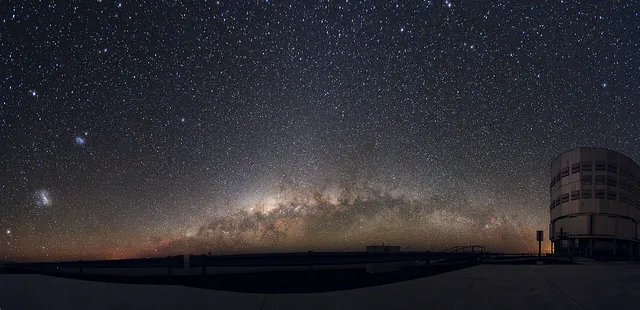
The Small Magellanic Cloud is a striking feature of the southern sky even to the unaided eye, a hazy patch in Tucana that looks like a piece of the Milky Way. At magnitude 2.2 it is fainter than the Large Cloud, and it covers about 4.7° × 2.7° of sky. Near it on the sky shine two foreground globular clusters of our own Galaxy, 47 Tucanae and NGC 362.3410
Telescopes on the Small Cloud
Much of what is known comes from wide surveys. ESO’s VISTA telescope built a 1.6-gigapixel infrared image of the Small Cloud, 43,223 × 38,236 pixels, for the VISTA Magellanic Clouds survey. The OGLE survey’s catalogues of variable stars supplied the eclipsing binaries used for its distance, and Gaia’s measurements of thousands of stellar motions now show how the galaxy is being pulled apart.1710
The James Webb Space Telescope studied NGC 346 early in its mission: a near-infrared NIRCam image was presented on 11 January 2023 at a meeting of the American Astronomical Society, and a mid-infrared MIRI image followed on 10 October 2023. Hubble measured the Small Cloud’s motion across the sky over about seven years, using fields centred on background quasars.2512
- VISTA infrared image released
- 3 May 2017101.6 gigapixels
Quick answers
- What kind of object is the Small Magellanic Cloud?
- The Small Magellanic Cloud is a dwarf irregular galaxy (dIrr).48
- Which constellation is the Small Magellanic Cloud in?
- The Small Magellanic Cloud lies in the constellation Tucana.23
- How far away is the Small Magellanic Cloud?
- The Small Magellanic Cloud is about 203,700 light-years (62.44 kpc) from Earth, to its centre, from eclipsing binary stars; better than 2 per cent.1
- How bright is the Small Magellanic Cloud in the night sky?
- The Small Magellanic Cloud has an apparent magnitude of 2.2 (visible to the unaided eye).410
- How big does the Small Magellanic Cloud look in the sky?
- The Small Magellanic Cloud covers about 4.7° × 2.7° (280′ × 160′) of sky.3
- How massive is the Small Magellanic Cloud?
- The Small Magellanic Cloud has a mass of about 2.4 billion solar masses (dynamical mass from the rotation of its gas).11
Sources
- A Distance Determination to the Small Magellanic Cloud with an Accuracy of Better than 2 Percent Based on Late-type Eclipsing Binary Stars (Graczyk et al.) — Astrophysical Journal 904, 13 (arXiv:2010.08754), 2020
- Webb captures an ethereal view of NGC 346 (weic2324) — ESA/Webb, 2023
- The Small Magellanic Cloud, SMC (H. Frommert & C. Kronberg) — SEDS Messier Database (Observatoire de Paris mirror), 1998
- SIMBAD astronomical database: NAME SMC — Centre de Données astronomiques de Strasbourg (CDS)
- Webb Uncovers Star Formation in Cluster’s Dusty Ribbons (weic2301) — ESA/Webb, 2023
- The Carnegie Hubble Program: The Distance and Structure of the SMC as Revealed by Mid-infrared Observations of Cepheids (Scowcroft et al.) — Astrophysical Journal 816, 49 (arXiv:1502.06995), 2016
- Evidence of Galactic Interaction in the Small Magellanic Cloud Probed by Gaia-selected Massive Star Candidates (Nakano et al.) — Astrophysical Journal Supplement Series 277, 62 (arXiv:2502.12251), 2025
- The Magellanic Stream: Circumnavigating the Galaxy (D’Onghia & Fox) — Annual Review of Astronomy and Astrophysics 54, 363 (arXiv:1511.05853), 2016
- The Legacy of Henrietta Leavitt: A Re-analysis of the First Cepheid Period-Luminosity Relation (Breuval et al.) — Publications of the Astronomical Society of the Pacific 137, 044001 (arXiv:2502.17438), 2025
- VISTA Peeks Through the Small Magellanic Cloud’s Dusty Veil (eso1714) — European Southern Observatory, 2017
- A New Look at the Kinematics of Neutral Hydrogen in the Small Magellanic Cloud (Stanimirović, Staveley-Smith & Jones) — Astrophysical Journal 604, 176 (arXiv:astro-ph/0312223), 2004
- Third-Epoch Magellanic Cloud Proper Motions. I. HST/WFC3 Data and Orbit Implications (Kallivayalil et al.) — Astrophysical Journal 764, 161 (arXiv:1301.0832), 2013
- Are the Magellanic Clouds on Their First Passage about the Milky Way? (Besla et al.) — Astrophysical Journal 668, 949 (arXiv:astro-ph/0703196), 2007
- A Jumble of Exotic Stars (eso1302) — European Southern Observatory, 2013
- VISTA Unveils a New Image of the Large Magellanic Cloud (eso1914) — European Southern Observatory, 2019
Figures checked against these sources in November 2026. Where a quantity is not known, it is left out rather than estimated.

