galaxy
Large Magellanic Cloud
The Large Magellanic Cloud is a dwarf galaxy close to our own, bright enough to see without a telescope from the southern hemisphere, where it looks like a detached piece of the Milky Way. It lies about 161,700 light-years away, a distance now measured to 1 per cent. Within it glows the Tarantula Nebula, the largest and brightest star-forming region among the galaxies of the Local Group.123
Long counted as a minor companion, it now appears to weigh 10–20 per cent as much as the Milky Way, enough to tug on our Galaxy and bend streams of stars around it. Its high speed suggests that it is falling past us for the first time rather than circling on a long-standing orbit. In 1987 one of its stars exploded as Supernova 1987A, the first supernova seen with the naked eye since 1604.45678
Shape, size and distance
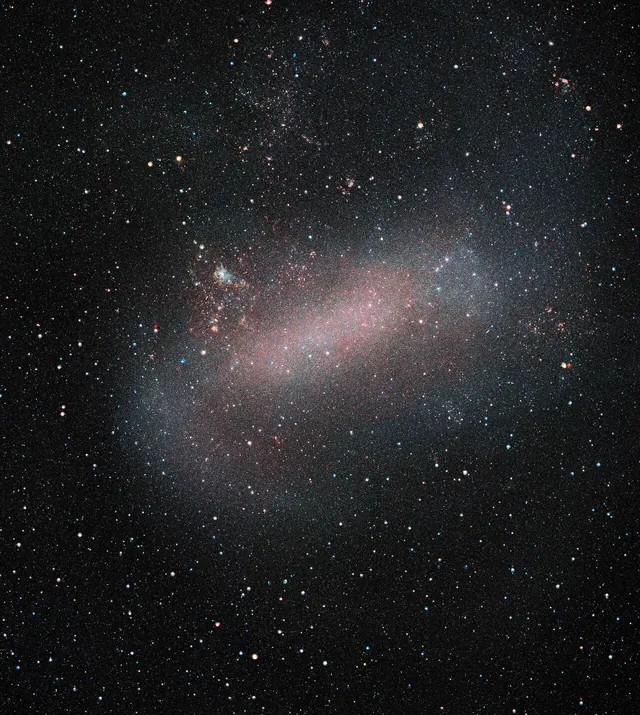
The Large Magellanic Cloud is the prototype of the barred Magellanic spirals, catalogued as type SB(s)m: small galaxies with a lopsided stellar bar, often off-centre, a single looping spiral arm and frequently a giant star-forming complex at one end of the bar. ESO calls it an irregular dwarf galaxy, and suggests that the pull of the Milky Way and the Small Magellanic Cloud distorted it from a classic barred spiral.91011
Infrared images from ESO’s VISTA telescope, which see through its dust, show that its youngest stars trace several spiral arms. ESO puts the galaxy at about 14,000 light-years across, against roughly 100,000 for the Milky Way. It shines with about a tenth of the Milky Way’s luminosity, and its young massive stars hold about half the Sun’s proportion of elements heavier than helium.101113
Its nearness makes the Large Magellanic Cloud the traditional galaxy for calibrating the Cepheid period–luminosity law, and so the best anchor for the cosmic distance scale. In 2019 Grzegorz Pietrzyński and colleagues used 20 eclipsing binary stars to measure a distance of 49.59 kiloparsecs, about 161,700 light-years, precise to 1 per cent. Popular accounts round this to 160,000 or 163,000 light-years.21113
- Distance
- 49.59 ± 0.09 (statistical) ± 0.54 (systematic) kpc2about 161,700 light-years
- Diameter
- about 14,000 light-years11
- Luminosity
- about one-tenth of the Milky Way’s10
- Heavy elements in young stars
- about half the Sun’s proportion10[Z/H] = −0.31 ± 0.04
- Mass in stars
- about 3 × 10⁹ solar masses10
- Neutral hydrogen gas
- about 4.4 × 10⁸ solar masses10for an assumed distance of 55 kpc
- Stars dated by the VISTA survey
- about 10 million13
A first pass by the Milky Way
Hubble measurements of the galaxy’s motion across the sky, first published in 2006 and refined with a third set of images spanning about seven years, show the Large Magellanic Cloud moving at 321 ± 24 km/s relative to the centre of the Milky Way, far faster than once thought. Gurtina Besla and colleagues concluded in 2007 that the Clouds are probably on their first passage around our Galaxy.67
The verdict depends on the uncertain masses of both galaxies. A 2013 analysis ruled out orbital periods shorter than about 4 billion years and favoured a first infall. A 2023 review describes the Large Magellanic Cloud as a fairly massive companion that has just passed the closest point of its orbit, likely for the first time. A 2024 study argues instead that a second passage, after an earlier one 5–10 billion years ago, also fits the evidence.4714
Its mass has been revised sharply upwards. In 2010 ESO described it as less than a tenth of the Milky Way’s mass. Since then its effects on the motions of nearby galaxies and of the Orphan stellar stream have given total masses, dark matter included, of about 2.5 × 10¹¹ and 1.4 × 10¹¹ solar masses, and a 2023 review puts it at 10–20 per cent of the Milky Way. Its pull even displaces the Milky Way’s central regions.451112
- Speed relative to the Galactic centre
- 321 ± 24 km/s7
- Radial velocity
- 262.2 ± 3.4 km/s9away from the Sun
- Orbital periods ruled out
- shorter than about 4 billion years7
- Total mass, from the Orphan stream
- 1.38 (+0.27, −0.24) × 10¹¹ solar masses5
- Total mass, from the timing argument
- 2.5 (+0.9, −0.8) × 10¹¹ solar masses12
- Mass within 8.7 kpc of its centre
- 1.7 × 10¹⁰ solar masses10
- Mass compared with the Milky Way
- 10–20 per cent4
- Milky Way mass within 50 kpc, for comparison
- 3.80 (+0.14, −0.11) × 10¹¹ solar masses5
Stars and star birth
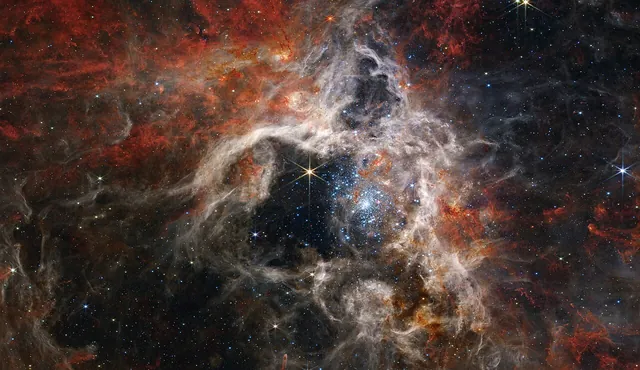
The Large Magellanic Cloud is still forming stars vigorously. Its showpiece is the Tarantula Nebula, or 30 Doradus, the largest and brightest star-forming region in the Local Group; no region in the Milky Way is as large or as prolific. Its chemistry resembles that of the great star-forming regions at ‘cosmic noon’, when the Universe was a few billion years old, making it the closest example of that era’s star formation.315
At its heart lies the cluster NGC 2070, only 2–3 million years old, with roughly 500,000 stars. Its dense core, R136, holds some of the most massive stars known. A 2010 study put the heaviest, R136a1, at about 265 solar masses; sharper Gemini images published in 2022 lowered the estimates for R136a1 and its fellow giants to 150–200 solar masses.151617
Its star clusters show a history unlike our Galaxy’s. The massive globular cluster NGC 1978 is thought to be only about 3.5 billion years old, whereas most globular clusters are over ten billion, so the Large Magellanic Cloud seems to have formed stars more recently than the Milky Way. Many massive stars have already exploded, leaving supernova remnants such as N 49 and N 63A.1118
Companions, Bridge and Stream
The Large and Small Magellanic Clouds are the closest pair of dwarf galaxies to the Milky Way, wrapped in gas they have shed. A bridge of hydrogen joining them was discovered in 1963. Its low content of heavy elements matches the Small Cloud, suggesting it was drawn from there, perhaps in a direct collision of the two Clouds 100–300 million years ago in some models. Stars are also found in the Bridge.10
Trailing the Clouds is the Magellanic Stream, traced back to them with the Parkes radio telescope and named in 1974. With the Leading Arm ahead of the Clouds it spans more than 200° of sky and carries over a billion solar masses of gas, most of it ionised. It is thought to have been pulled out by tidal forces between the Clouds and by pressure from the Milky Way’s hot corona.10
The Large Magellanic Cloud seems to have brought satellites of its own. Motions measured by Gaia, published in 2018, showed that four faint dwarf galaxies, Horologium I, Carina II, Carina III and Hydrus I, arrived with the Clouds: the first confirmation of a satellite group falling in together. Simulations in a 2024 study count 10–11 current satellites of the Large Cloud.1419
- Magellanic Bridge discovered
- 196310in neutral hydrogen, by Hindman and colleagues
- Magellanic Stream named
- 197410by Mathewson and colleagues, with the Parkes radio telescope
- Extent of the Stream and Leading Arm
- more than 200° of sky10
- Neutral hydrogen in the Stream
- 2.7 × 10⁸ solar masses10for an assumed distance of 55 kpc
- Ionised gas in the Stream
- about 10⁹ solar masses10
- Neutral hydrogen in the Bridge
- 1.8 × 10⁸ solar masses10
- Dwarf galaxies confirmed to have arrived with the Clouds
- 4 (Horologium I, Carina II, Carina III, Hydrus I)19from Gaia Data Release 2
Notable features
Tarantula Nebula (30 Doradus)
A giant star-forming cloud named for its spidery filaments of dust, about 161,000 light-years away. Radiation from the massive young cluster at its centre has hollowed out a cavity, and only the densest gas survives, as pillars pointing back at the cluster with new stars forming inside them.3
R136
The dense core of the cluster NGC 2070, packed with some of the heaviest stars known. A 2010 study found four of its stars born with more than 150 solar masses; together they supply nearly half the wind and radiation power of a cluster of about 100,000 stars.1516
Supernova 1987A
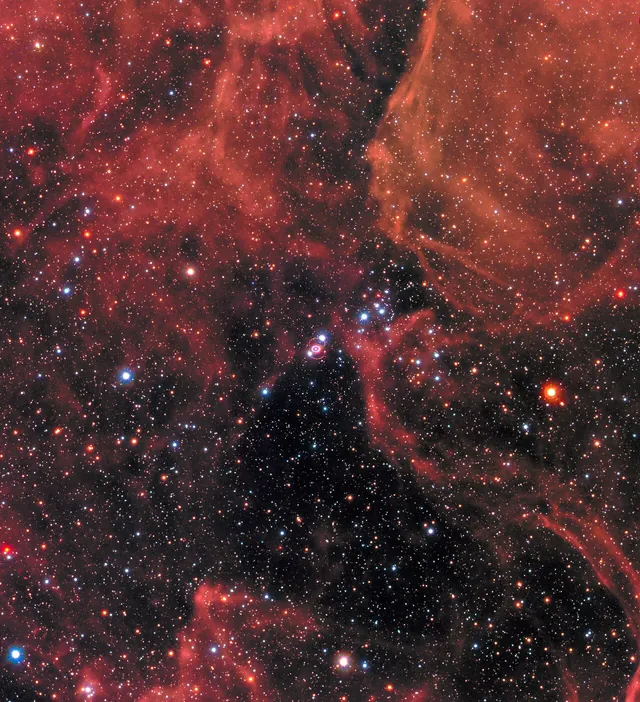
The collapse of a massive star whose light reached Earth on 23 February 1987; about two hours before it was first seen, three observatories caught a brief burst of neutrinos. The first naked-eye supernova since 1604, it peaked in May 1987. In 2024 Webb found the best evidence yet of a neutron star in its remnant.820
N 49 (DEM L 190)
The brightest supernova remnant in the Large Magellanic Cloud, a wispy cloud of glowing gas about 30 light-years across. At its centre lies a magnetar, a neutron star with an extremely powerful magnetic field, which drew attention in 1979 when satellites detected a powerful burst of gamma rays from it.11
NGC 1978
An unusually massive globular cluster that appears as a fuzzy white oval of stars. Most globular clusters are over ten billion years old, but this one is thought to be only about 3.5 billion, a sign that the Large Magellanic Cloud has formed stars more recently than our Galaxy.11
Names and history
People of the southern hemisphere have known both Magellanic Clouds since prehistoric times, though few records of that knowledge survive. The first surviving written mention is by the Persian astronomer al-Sufi, whose Book of Fixed Stars of 964 calls it al-Bakr, the White Ox of the southern Arabs, invisible from Baghdad but seen from the Strait of Bab al-Mandab. Amerigo Vespucci probably described the Clouds around 1503–04.1
The name honours Ferdinand Magellan, whose expedition set out in 1519 on the first voyage around the world and brought the Clouds to European attention. Centuries later the Clouds became a laboratory: from Cepheid variable stars in the Small Magellanic Cloud, Henrietta Swan Leavitt published in 1912 the period–luminosity law that made distances to galaxies measurable. The Large Cloud is now the anchor for calibrating that law.121321
Seeing it for yourself
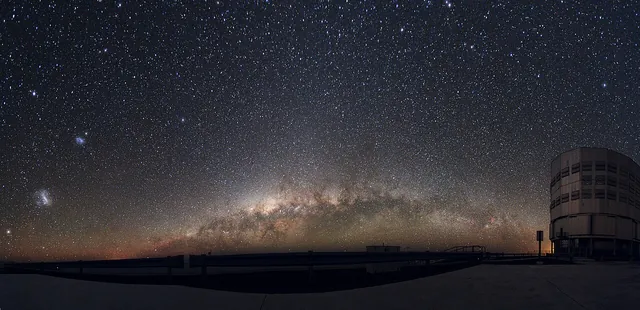
To the unaided eye the Large Magellanic Cloud looks like a separated piece of the Milky Way, deep in the southern sky in the constellation Dorado. At magnitude 0.4 it is bright, but its light is spread over some 10.8° × 9.2° of sky. It is a sight of the southern sky: al-Sufi noted that it was invisible from northern Arabia and Baghdad.1911
Its nearness lets telescopes pick out single stars: Hubble resolves individual stars in the Tarantula, and ESO’s VISTA survey has analysed about 10 million of its stars in detail. Its supernovae can be seen without optical aid: Supernova 1987A, which peaked in May 1987, was the first naked-eye supernova since Kepler’s of 1604.81315
Telescopes on the Large Cloud
Hubble has watched Supernova 1987A since 1990. It discovered two faint outer rings beside the bright inner one and saw the blast wave strike the inner ring in 2001. For its 22nd anniversary in 2012 it released a mosaic of 30 Doradus about 650 light-years across, built from 30 fields observed in October 2011 with two cameras working at once.1520
ESO’s VISTA survey telescope spent a decade mapping both Clouds in infrared light, charting their histories of star formation and their three-dimensional shapes. The James Webb Space Telescope turned to the Large Cloud in its first weeks of science: it observed Supernova 1987A on 16 July 2022, and its view of the Tarantula Nebula was released on 6 September 2022.3813
Measuring motion now drives the study of the Clouds. Three epochs of Hubble images over about seven years fixed the galaxy’s path across the sky with random errors of only 1–2 per cent per field, and Gaia’s second data release gave the motions of faint dwarf galaxies near the Clouds, revealing which of them are the Large Cloud’s own satellites.719
- Hubble observing Supernova 1987A
- since 199020
- Blast wave reached the inner ring
- 200120
- Hubble mosaic of 30 Doradus released
- 17 April 201215about 650 light-years across
- Webb observes Supernova 1987A
- 16 July 20228
Quick answers
- What kind of object is the Large Magellanic Cloud?
- The Large Magellanic Cloud is a barred Magellanic spiral, SB(s)m (also described as an irregular dwarf galaxy).91011
- Which constellation is the Large Magellanic Cloud in?
- The Large Magellanic Cloud lies in the constellation Dorado.11
- How far away is the Large Magellanic Cloud?
- The Large Magellanic Cloud is about 161,700 light-years (49.59 kpc) from Earth, from 20 eclipsing binary stars, precise to 1 per cent.2
- How big is the Large Magellanic Cloud?
- The Large Magellanic Cloud is about 14,000 light-years across.11
- How bright is the Large Magellanic Cloud in the night sky?
- The Large Magellanic Cloud has an apparent magnitude of 0.4 (visible to the unaided eye).19
- How big does the Large Magellanic Cloud look in the sky?
- The Large Magellanic Cloud covers about 10.8° × 9.2° (650′ × 550′) of sky.1
Sources
- The Large Magellanic Cloud, LMC (H. Frommert & C. Kronberg) — SEDS Messier Database (Observatoire de Paris mirror), 2004
- A distance to the Large Magellanic Cloud that is precise to one per cent (Pietrzyński et al.) — Nature 567, 200 (arXiv:1903.08096), 2019
- Webb Captures A Cosmic Tarantula (weic2212) — ESA/Webb, 2022
- The effect of the LMC on the Milky Way system (Vasiliev) — Galaxies 11, 59 (arXiv:2304.09136), 2023
- The total mass of the Large Magellanic Cloud from its perturbation on the Orphan stream (Erkal et al.) — Monthly Notices of the Royal Astronomical Society 487, 2685 (arXiv:1812.08192), 2019
- Are the Magellanic Clouds on Their First Passage about the Milky Way? (Besla et al.) — Astrophysical Journal 668, 949 (arXiv:astro-ph/0703196), 2007
- Third-Epoch Magellanic Cloud Proper Motions. I. HST/WFC3 Data and Orbit Implications (Kallivayalil et al.) — Astrophysical Journal 764, 161 (arXiv:1301.0832), 2013
- Webb finds evidence for a neutron star at heart of young supernova remnant (weic2404) — ESA/Webb, 2024
- SIMBAD astronomical database: NAME LMC — Centre de Données astronomiques de Strasbourg (CDS)
- The Magellanic Stream: Circumnavigating the Galaxy (D’Onghia & Fox) — Annual Review of Astronomy and Astrophysics 54, 363 (arXiv:1511.05853), 2016
- A Cosmic Zoo in the Large Magellanic Cloud (eso1021) — European Southern Observatory, 2010
- A timing constraint on the (total) mass of the Large Magellanic Cloud (Peñarrubia et al.) — Monthly Notices of the Royal Astronomical Society Letters 456, L54 (arXiv:1507.03594), 2016
- VISTA Unveils a New Image of the Large Magellanic Cloud (eso1914) — European Southern Observatory, 2019
- Dear Magellanic Clouds, welcome back! (Vasiliev) — Monthly Notices of the Royal Astronomical Society 527, 437 (arXiv:2306.04837), 2024
- Hubble’s panoramic view of a turbulent star-making region (heic1206) — ESA/Hubble, 2012
- Stars Just Got Bigger (eso1030) — European Southern Observatory, 2010
- Resolving the Core of R136 in the Optical (Kalari et al.) — Astrophysical Journal 935, 162 (arXiv:2207.13078), 2022
- Supernova remnant menagerie (heic0507) — ESA/Hubble, 2005
- The Missing Satellites of the Magellanic Clouds? Gaia Proper Motions of the Recently Discovered Ultra-faint Galaxies (Kallivayalil et al.) — Astrophysical Journal 867, 19 (arXiv:1805.01448), 2018
- Cosmic blast from the past (heic1704) — ESA/Hubble, 2017
- The Legacy of Henrietta Leavitt: A Re-analysis of the First Cepheid Period-Luminosity Relation (Breuval et al.) — Publications of the Astronomical Society of the Pacific 137, 044001 (arXiv:2502.17438), 2025
Figures checked against these sources in November 2026. Where a quantity is not known, it is left out rather than estimated.

