nebula
Supernova 1987A
Supernova 1987A was the explosion of a blue supergiant star in the Large Magellanic Cloud, about 160,000 light-years away. Its light reached Earth on 23 February 1987, and the next night it was spotted from Chile. It was the first supernova visible to the unaided eye since 1604, and it has become the most closely studied supernova of all time.1234
Hours before the light, detectors in Japan, the United States and the Soviet Union caught a brief burst of neutrinos from the collapsing core: the first neutrinos ever detected from beyond the Solar System. Today the expanding debris is lighting up a ring of gas the star shed 20,000 years earlier, and in 2024 the James Webb Space Telescope found the best evidence yet for a neutron star at its centre.1245
Rings and debris
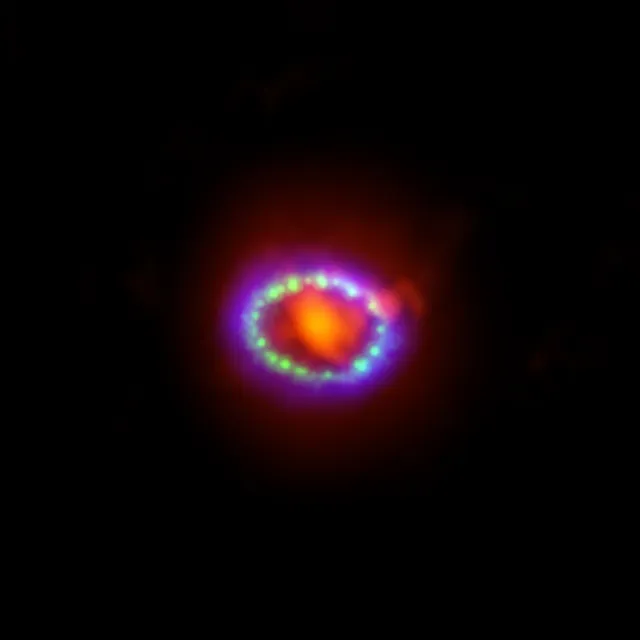
Months after the explosion, three rings of gas lit up around the supernova, ionised by its first flash of ultraviolet light and X-rays. The bright inner, or equatorial, ring is 1.6″ across and tilted 43° to our line of sight; the timing of its appearance gave it a radius of 0.65 light-years. Two fainter outer rings, about twice as wide, make an hourglass.24
The rings are older than the explosion. The inner ring expands at 10.3 km/s, implying it was thrown off about 20,000 years earlier, and the outer rings date from about the same time. Their origin is still not fully understood; one proposal is that two stars of about 14–15 and 7–9 solar masses merged into the single blue supergiant that exploded.24
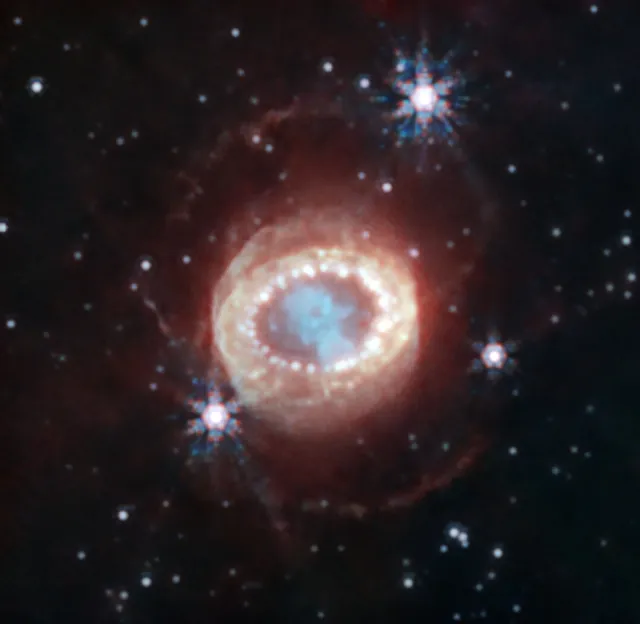
Inside the rings, the star’s own debris is still expanding at thousands of kilometres per second. Its densest part is so dusty that even Webb’s near-infrared light cannot pass through, leaving a dark keyhole at the centre. ALMA has shown that this dust formed in the cold inner ejecta, and its mass is now about half that of the Sun.4101112
What makes it shine
The supernova’s light came not from the blast itself but from radioactive decay. About 0.069 solar masses of nickel-56 was made in the explosion; it decayed to cobalt-56 and then to iron, powering the glow for its first years. Since about seven years after the explosion the ejecta have been lit mainly by the decay of titanium-44, which has a half-life of 59.1 years.4
Its slow climb to maximum, taking three months, was unusual and is attributed to the progenitor being a compact blue supergiant rather than a bloated red one. The rings first shone in the explosion’s flash and faded, until debris began striking the inner ring; by 2003 the whole ring held 26 hot spots, glowing in visible light and X-rays.24
The ring’s visible and near-infrared brightness levelled off in 2009 and has been declining since, as the blast wave passes through it into thinner gas beyond. Fainter spots and a rim of hydrogen emission have appeared outside the ring, and one study projected that the ring’s red-light glow could fade away by 2035.411
- Nickel-56 made in the explosion
- 0.069 ± 0.003 solar masses4
- Titanium-44 made
- about 1.5–1.6 × 10⁻⁴ solar masses4
- Hot spots in the inner ring
- 264complete by 2003
- Blast-wave speed near the ring
- about 4,100–6,700 km/s4from X-ray observations
- Ring brightness peaked
- 20094
- Energy carried by neutrinos
- about 99.6 per cent1typical of core-collapse supernovae
The star and what it left behind
The star that exploded was quickly identified as Sk −69 202, a 12th-magnitude blue supergiant of early B type. Sanduleak’s objective-prism spectrum from the 1960s is the only one ever taken of it. Models in which two stars merged give the progenitor a mass of about 20 Suns. Hydrogen in the supernova’s spectrum marked it as Type II, a collapse of a massive star’s core.4
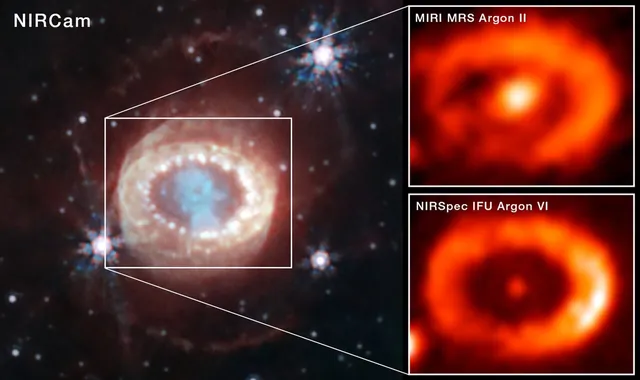
The neutrino burst showed that the core had collapsed, probably into a neutron star, yet for 35 years searches from gamma rays to radio found no sign of one. Webb observations made in 2022 revealed narrow lines of ionised argon and sulphur at the centre of the debris, which only a source of high-energy radiation could produce, such as a cooling neutron star or a pulsar wind nebula.145
Notable features
The equatorial ring
A ring of gas 0.65 light-years in radius, ejected about 20,000 years before the explosion. The fastest debris began hitting it in 1995, raising bright hot spots; ESA/Hubble dates the shock wave’s impact on the ring to 2001. Webb shows it as a ring of pearls.2410
The outer rings
Two fainter rings about twice the size of the inner ring, discovered by Hubble. They extend like mirror images to form an hourglass, and their faster expansion suggests they were ejected at about the same time as the inner ring.24
The dusty ejecta
The debris of the star’s core, at the centre of the rings. ALMA mapped it in 2012, revealing the largest mass of dust yet measured in a supernova remnant, formed in the cold inner ejecta rather than in the ring.412
The hidden compact object
Webb’s spectrographs found emission from argon, sulphur and other elements at the centre of the ejecta, shifted in velocity relative to the supernova. The lines point to ionising radiation from a newborn neutron star, and the shift may be evidence of a kick it received at birth.145
Discovery
At 07:35 UT on 23 February 1987 three underground detectors recorded 25 antineutrinos within seconds: 12 at Kamiokande-II in Japan, 8 at IMB in the United States and 5 at Baksan in the Soviet Union. The first sighting in visible light came about two hours after the burst, and the supernova already appears on films taken at Siding Spring, Australia, that night.134
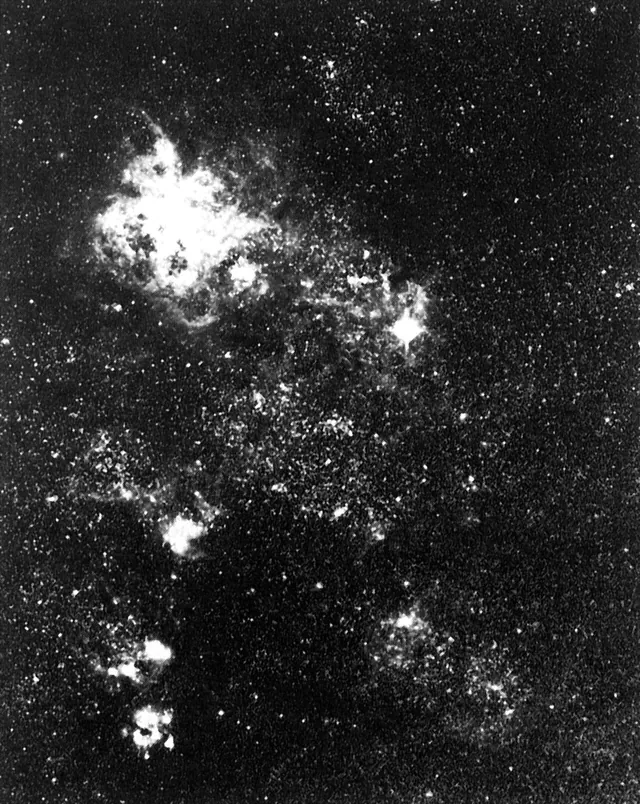
Ian Shelton found it around 24 February at Las Campanas Observatory in Chile, on a three-hour photograph with a 0.25-metre astrograph, as a 5th-magnitude object 18′ west and 10′ south of 30 Doradus. Oscar Duhalde independently spotted it by eye there, and Albert Jones in New Zealand also found it. It brightened slowly, peaking in May 1987.13
- Neutrino burst
- 07:35 UT, 23 February 19874
- Antineutrinos detected
- 12 Kamiokande-II, 8 IMB, 5 Baksan4
- Discovered
- around 24.23 February 1987 UT3Ian Shelton, Las Campanas Observatory
- Independent discoverers
- Oscar Duhalde (Chile); Albert Jones (New Zealand)3
- Brightness at discovery
- magnitude 53about 4.5 a few hours later
- Previous naked-eye supernova
- Kepler’s supernova, 16041
- Peak brightness
- May 19871
Where it is
The supernova lies in the Large Magellanic Cloud in the southern constellation Dorado, on the outskirts of the Tarantula Nebula. It was visible to the unaided eye in 1987, but its remnant is now far too small and faint for amateur telescopes: the whole bright ring is only 1.6″ across, and resolving it took the Hubble Space Telescope.124713
- Right ascension (J2000)
- 05h 35m 27.99s6
- Declination (J2000)
- −69° 16′ 11.1″6
- Galactic coordinates
- l = 279.70°, b = −31.94°6
- Position relative to 30 Doradus
- 18′ west and 10′ south3
Telescopes on Supernova 1987A
Hubble has watched the supernova since 1990, when it was the first to image the main ring sharply and discovered the outer rings. It has returned many times since, including a January 2017 image for the 30th anniversary. Chandra has imaged it in X-rays, and ALMA observations in 2012 showed for the first time that its dust formed in the inner ejecta.27812
The James Webb Space Telescope, launched on 25 December 2021, observed the remnant on 16 July 2022, making it one of Webb’s first targets. Its MIRI and NIRSpec spectrographs found the central argon emission reported in February 2024, and its NIRCam image of the keyhole and rings was released in August 2023.1411
- ALMA dust observations
- 201212
Quick answers
- What kind of object is Supernova 1987A?
- Supernova 1987A is a type II (core-collapse) supernova and its young remnant (classified as peculiar).16
- Which constellation is Supernova 1987A in?
- Supernova 1987A lies in the constellation Dorado (in the Large Magellanic Cloud).78
- How far away is Supernova 1987A?
- Supernova 1987A is about 160,000 light-years from Earth (51.4 ± 1.2 kpc from the size of its ring).19
- When was Supernova 1987A discovered?
- Supernova 1987A was discovered on 24 February 1987, by Ian Shelton at Las Campanas Observatory, Chile.3
- How bright is Supernova 1987A in the night sky?
- Supernova 1987A has an apparent magnitude of about 3 at peak (reached in May 1987, about three months after discovery).14
- How big does Supernova 1987A look in the sky?
- Supernova 1987A covers 1.6″ of sky (diameter of the bright inner ring).4
Sources
- Webb finds evidence for a neutron star at heart of young supernova remnant (weic2404) — ESA/Webb, 2024
- Cosmic blast from the past: Hubble captures 30th anniversary image of supernova 1987A (heic1704) — ESA/Hubble, 2017
- IAU Circular 4316: Supernova 1987A in the Large Magellanic Cloud — Central Bureau for Astronomical Telegrams, International Astronomical Union, 1987
- The Supernova 1987A system and its recent evolution – a review (Barlow) — Contemporary Physics (arXiv:2510.13629), 2025
- Emission lines due to ionizing radiation from a compact object in the remnant of Supernova 1987A (Fransson et al.) — Science 383, 898 (arXiv:2403.04386), 2024
- SIMBAD astronomical database: SN 1987A — Centre de Données astronomiques de Strasbourg (CDS)
- New image of SN 1987A (heic1704a) — ESA/Hubble, 2017
- Supernova 1987A (Chandra Photo Album, 24 February 2017) — Chandra X-ray Center, Harvard-Smithsonian Center for Astrophysics, 2017
- A Geometric Determination of the Distance to SN 1987A and the LMC (Panagia) — arXiv preprint astro-ph/0309416, 2003
- Argon emission in SN1987A (weic2404a) — ESA/Webb, 2024
- SN 1987A (NIRCam image) — ESA/Webb, 2023
- Dust Production and Particle Acceleration in Supernova 1987A Revealed with ALMA (Indebetouw et al.) — Astrophysical Journal Letters (arXiv:1312.4086), 2014
- A Crowded Neighbourhood (eso1816) — European Southern Observatory, 2018
Figures checked against these sources in November 2026. Where a quantity is not known, it is left out rather than estimated.

