nebula
Carina Nebula (NGC 3372)
The Carina Nebula is one of the largest and brightest star-forming clouds in the Milky Way, a glowing region of hydrogen about 7,500 light-years away in the southern constellation Carina. Visible to the unaided eye, it is four times larger than the famous Orion Nebula and far brighter. Dark lanes of cool dust split its glowing gas, which surrounds several young clusters of stars.123
Carina holds the most extreme collection of massive stars within a few kiloparsecs of the Sun: more than a dozen stars of at least 50 to 100 solar masses, among them the unstable giant Eta Carinae. Their ultraviolet light and winds are carving the cloud into pillars and ridges, destroying it while triggering a new generation of star birth around its edges.245
Shape and size in space
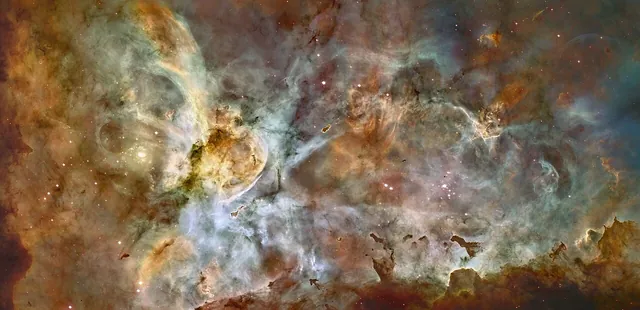
On the sky the Carina Nebula covers about 120′ × 120′, a patch some two degrees across. NASA and ESO give its distance as about 7,500 light-years, matching the 2.3 kiloparsecs adopted in a major review; the SEDS catalogue lists an older 10,000. Its size is quoted differently too: ESO describes the nebula as spanning about 100 light-years, NASA as about 300 light-years.1234
The nebula is one of the largest H II regions in the Milky Way. Within its area lie eight catalogued open clusters, among them Trumpler 14, Trumpler 15 and Trumpler 16, which contains Eta Carinae. The radiation of their stars has blown a hot, expanding bubble in the original cloud; dark clumps scattered across the nebula are the denser pieces that have so far resisted being eaten away.357
What makes it shine
The glow comes mainly from hydrogen gas lit by the strong ultraviolet radiation of hot, young, massive stars; the interaction gives the nebula its characteristic red and purple colours. Today the nebula is powered by 65 O-type stars and 3 hydrogen-rich Wolf–Rayet stars. When Eta Carinae was still on the main sequence, some 70 O stars together produced 150 times the ionising light of the Orion Nebula’s stars.24
Much of the region is hidden behind dust in visible light, although the nebula as a whole suffers little interstellar extinction. Infrared cameras see through the veil: ESO’s VLT HAWK-I mosaic revealed hundreds of thousands of faint stars, and in the nebula’s Cosmic Cliffs Webb exposed young stars and jets invisible to optical telescopes.479
The stars inside
Over the last few million years the region has formed stars in large numbers, both singly and in clusters. More than a dozen have at least 50 to 100 times the Sun’s mass, and such stars last only a few million years. The most famous is Eta Carinae, a double star whose larger member is around 100 solar masses and about 5 million times as luminous as the Sun.1257
Lesser stars vastly outnumber them. The Chandra Carina Complex Project detected 14,368 X-ray sources across 1.4 square degrees, of which 10,714 are very likely young stars in Carina. A deep near-infrared survey with HAWK-I picked up more than 600,000 sources and found counterparts to 88.8 per cent of the Chandra sources in its field.10
Notable features
Eta Carinae and the Homunculus
The nebula’s most massive and luminous star, a highly unstable double star. During its outburst in the 1840s it briefly became the second-brightest star in the night sky, and the gas it threw off now forms the small double-lobed Homunculus Nebula around it.2357
The Keyhole
One of the nebula’s most conspicuous features, formed by its brightest part together with darker material. Hubble revealed never-before-seen detail in this region when its Wide Field and Planetary Camera 2 imaged it in 1999.136
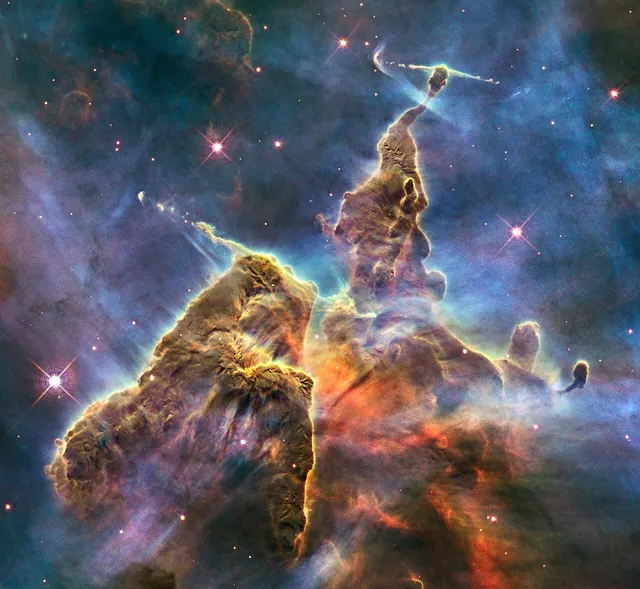
Mystic Mountain
A pillar of cool hydrogen and dust three light-years tall, eaten away by light from nearby bright stars and pushed apart from within by infant stars firing off jets. Hubble imaged it for its 20th anniversary in 2010.111
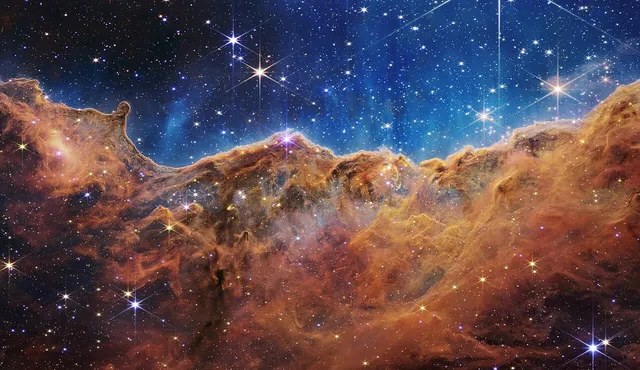
The Cosmic Cliffs
The edge of a giant gaseous cavity in NGC 3324, carved by ultraviolet light and winds from hot young stars at the centre of the bubble. The tallest “peaks” in Webb’s image are about 58 light-years high, and hot gas and dust stream off them like steam.9
Trumpler 14
A bright young star cluster near the centre of ESO’s infrared mosaic. It is well seen in visible light, but the infrared view shows many more of its fainter stars, alongside a small group of yellowish stars that cannot be seen in visible light at all.37
Discovery and history
Nicolas-Louis de Lacaille discovered the nebula during his two-year stay at the Cape of Good Hope in 1751–52. With a refractor only half an inch across, he described a large group of small stars with a slight, widespread nebulosity. Two of his catalogue entries fall in the region, and the older literature identifies both with NGC 3372; one probably matches the small cluster Collinder 228.13
- Lacaille’s catalogue entries
- Lac III.5 and Lac III.63
Seeing it for yourself
At about magnitude 4.8 the Carina Nebula is visible to the unaided eye, and its great size makes it an excellent target for binoculars or a small telescope. It is best seen from the Southern Hemisphere in early autumn. Observers in the Northern Hemisphere near the equator can look for it low above the southern horizon in early spring.1
Telescopes on Carina
For its 17th anniversary on 24 April 2007 Hubble released one of the largest panoramas ever taken with its cameras, a 29,566 × 14,321-pixel mosaic of 48 frames spanning 50 light-years of the nebula’s centre. On 23 April 2010 it marked its 20th anniversary with Mystic Mountain. ESO’s Wide Field Imager at La Silla produced visible-light views released in 2009 and 2010.251112
In infrared light, ESO’s VLT and its HAWK-I camera made the most detailed infrared mosaic of the nebula, released in 2012, from hundreds of individual images. On 12 July 2022 the James Webb Space Telescope’s first images included the Cosmic Cliffs in NGC 3324, revealing stellar nurseries hidden from visible-light telescopes.7910
Quick answers
- What kind of object is the Carina Nebula (NGC 3372)?
- The Carina Nebula (NGC 3372) is an H II region (emission nebula).136
- Which constellation is the Carina Nebula (NGC 3372) in?
- The Carina Nebula (NGC 3372) lies in the constellation Carina.12
- How far away is the Carina Nebula (NGC 3372)?
- The Carina Nebula (NGC 3372) is about 7,500 light-years (2.3 kpc) from Earth.147
- How big does the Carina Nebula (NGC 3372) look in the sky?
- The Carina Nebula (NGC 3372) covers 120′ × 120′ of sky.3
- How big is the Carina Nebula (NGC 3372)?
- The Carina Nebula (NGC 3372) is about 300 light-years across (NASA; ESO describes the bright nebula as spanning about 100 light-years).12
- How bright is the Carina Nebula (NGC 3372) in the night sky?
- The Carina Nebula (NGC 3372) has an apparent magnitude of about 4.8 (visible to the unaided eye).1
- How old is the Carina Nebula (NGC 3372)?
- The Carina Nebula (NGC 3372) is star formation began about 3 million years ago old.5
Sources
- Caldwell 92 (Hubble’s Caldwell Catalog) — NASA Science
- Carina Nebula shown in colourful detail (eso0905) — ESO, 2009
- NGC 3372: The Eta Carinae Nebula (Frommert & Kronberg) — SEDS Messier Database (Observatoire de Paris mirror), 1998
- The Carina Nebula: A Laboratory for Feedback and Triggered Star Formation (Smith & Brooks) — Handbook of Star Forming Regions, Vol. II (arXiv:0809.5081), 2008
- Hubble’s 17th anniversary – extreme star birth in the Carina Nebula (heic0707) — ESA/Hubble, 2007
- SIMBAD astronomical database: NGC 3372 — Centre de Données astronomiques de Strasbourg (CDS)
- VLT Takes Most Detailed Infrared Image of the Carina Nebula (eso1208) — ESO, 2012
- The Structure of the Homunculus: I. Shape and Latitude Dependence from H2 and [Fe II] Velocity Maps of Eta Carinae (Smith) — Astrophysical Journal 644, 1151 (arXiv:astro-ph/0602464), 2006
- Webb Reveals Cosmic Cliffs, Glittering Landscape of Star Birth (weic2205) — ESA/Webb, 2022
- Near-Infrared properties of the X-ray emitting young stellar objects in the Carina Nebula (Preibisch et al.) — Astrophysical Journal Supplement Series 194, 10 (arXiv:1103.2052), 2011
- Starry-eyed Hubble celebrates 20 Years of awe and discovery (heic1007) — ESA/Hubble, 2010
- The Carina Nebula around the Wolf–Rayet star WR 22 (eso1031) — ESO, 2010
Figures checked against these sources in November 2026. Where a quantity is not known, it is left out rather than estimated.

