star
Eta Carinae
Eta Carinae is a double star about 7,500 light-years away in the Carina Nebula, and its larger member is one of the most massive and luminous stars in the Milky Way: around 100 times the Sun’s mass and millions of times as bright. Our galaxy holds hundreds of billions of stars, but only tens of them are in its mass range, and it is expected one day to explode as a supernova.123
In the 1840s it suffered the Great Eruption, a stellar near-death experience that made it the second-brightest star in the night sky, outshone only by Sirius. It threw off more than ten times the Sun’s mass, yet survived. The ejected gas and dust now form the Homunculus Nebula, a billowing pair of lobes that Hubble has imaged with nearly every instrument it has carried.2456
A giant among stars
The primary star’s mass is estimated at around 100 times the Sun’s; ESO puts it above 100 and the Chandra team at no less than 90. Its luminosity is put at about four to five million Suns. Stars this massive are extremely rare. SIMBAD classes it as a luminous blue variable, and it is highly unstable and prone to violent outbursts.1237
The star is losing mass very fast. Its wind streams away at over a million miles per hour, at a rate that will add up to the Sun’s mass in about a thousand years. Spectra of starlight reflected off the Homunculus, which sees the star from different latitudes, show that the wind is not spherical: it is faster and denser towards the poles.211
A double star
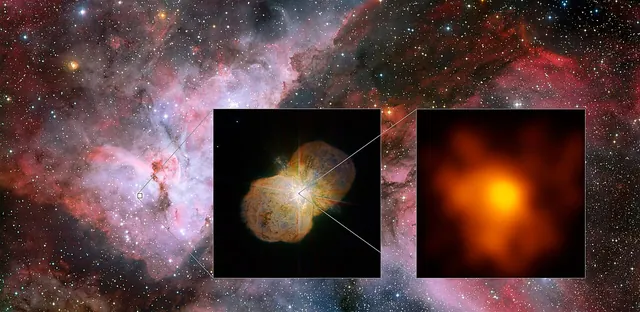
Eta Carinae has a hidden companion of about 30 solar masses on an elliptical orbit. It loses mass about a hundred times more slowly than the primary, but its wind is almost ten times faster. Where the two winds collide they form a bow shock that heats gas to about ten million degrees, producing the X-rays that Chandra has watched since 1999.23
The orbit takes 2,022.7 ± 1.3 days, about 5.54 years. Spectra collected over sixty years show the period has stayed stable since 1948, strong support for the binary picture. Near each closest approach the X-rays dip and spectral lines change; one such event was predicted for 11 January 2009, and another closest approach came in August 2014.239
The Great Eruption
Eta Carinae erupted in 1838, and by April 1844 it was the second-brightest star in the sky, outshone only by Sirius, which is almost a thousand times closer. A revised record of naked-eye estimates shows two brief outbursts, in 1838 and 1843, each lasting about 100 days, before a final brightening in December 1844 that brought its peak and lasted ten years.412
The star produced almost as much visible light as a supernova, yet survived. It ejected more than ten solar masses in an event with about a tenth of the energy of a typical core-collapse supernova. In 2012 astronomers found light from the eruption echoing off distant dust; its spectrum resembles a cool supergiant at about 5,000 K, surprisingly cool for such an outburst.35
A second, smaller eruption followed in 1890: the star began to brighten at a closest approach of the two stars, took over a year to reach maximum, and stayed there for almost ten years. Sources differ on how to date the great outburst; ESO has also described it as a false supernova in 1842.312
Notable features
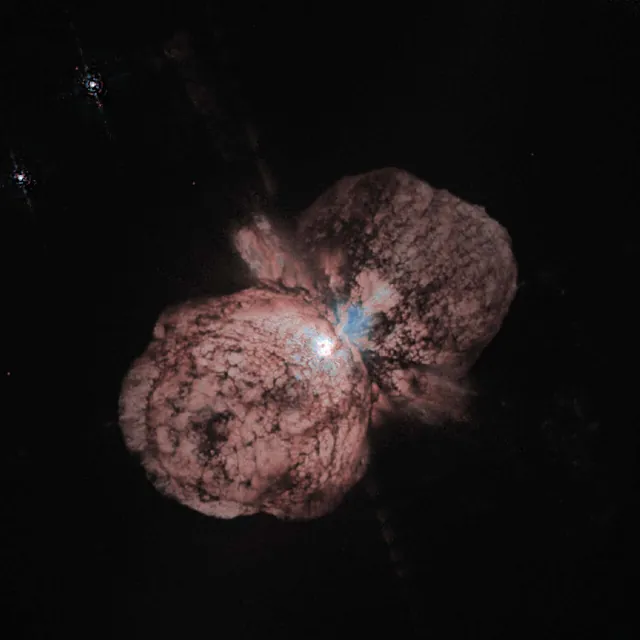
The Homunculus Nebula
The dumbbell-shaped cloud of gas and dust hurled out in the Great Eruption. Its polar axis is tilted 49° from the plane of the sky. A very thin outer skin of molecular hydrogen holds most of its mass, and nearly three-quarters of the mass went out at high latitudes.48
Dust in the Homunculus
Infrared and submillimetre spectra from ISO and Herschel show dust made of iron, silicates, corundum and other minerals consistent with nuclear-processed material. Its dust weighs 0.25–0.44 solar masses, implying a total nebula mass of at least 45 Suns.10
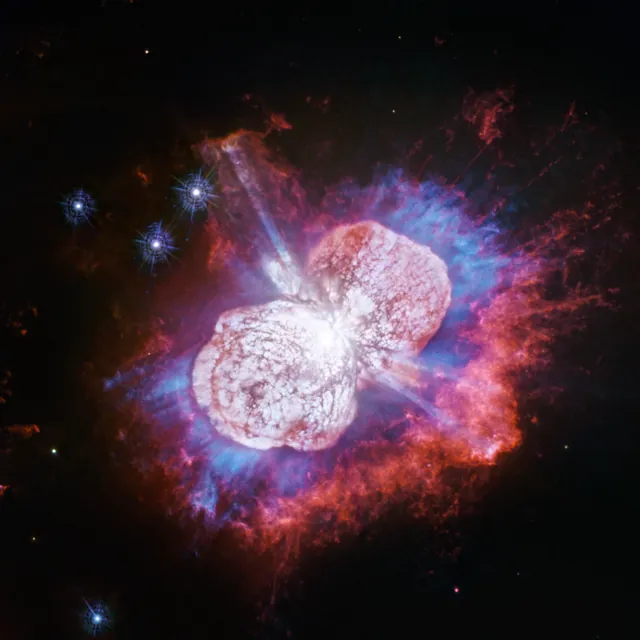
The ultraviolet shell
Hubble’s Wide Field Camera 3 found warm magnesium gas glowing in ultraviolet light between the dusty lobes and the outer nitrogen-rich filaments, where an empty cavity had been expected. Streaks appear where starlight slips through dust clumps on the bubble’s surface.4
The wind-collision zone
The region between the two stars where their winds smash together is a thousand times smaller than the Homunculus. In 2016 the VLT Interferometer imaged it for the first time, finding an unexpected fan-shaped structure where the hotter star’s wind meets the denser wind of the primary.6
Seeing it for yourself
Eta Carinae lies in the heart of the Carina Nebula, in the far southern sky, and today shines at visual magnitude 6.48, far fainter than at its peak. The nebula around it is best seen from the Southern Hemisphere in early autumn; from northern tropical latitudes it can be found low over the southern horizon in early spring.137
Telescopes on Eta Carinae
Hubble has observed Eta Carinae since its launch in 1990 with almost every instrument it has carried. Astronomers have followed the drama in ever higher resolution, and Wide Field Camera 3 produced the telescope’s highest-resolution view, released on 1 July 2019. Chandra has watched the system in X-rays since 1999.24
From the ground, Gemini South spectra mapped the Homunculus in three dimensions and gave its distance as 2,350 ± 50 parsecs. Using the AMBER instrument and three Auxiliary Telescopes, ESO’s VLT Interferometer made the sharpest image of the system so far, released on 19 October 2016, with ten times the resolving power of a single VLT telescope.68
Quick answers
- What kind of object is Eta Carinae?
- Eta Carinae is a double star; the primary is a luminous blue variable.27
- How massive is Eta Carinae?
- Eta Carinae has a mass of about 100 solar masses (primary), estimates range from at least 90 to over 100; the companion is about 30.123
- How far is Eta Carinae from Earth?
- Eta Carinae is about 7,500 light-years (2,350 ± 50 pc) from Earth.248
- How long does Eta Carinae take to complete one orbit?
- Eta Carinae completes one orbit in 2,022.7 ± 1.3 days (about 5.54 years).39
- Which constellation is Eta Carinae in?
- Eta Carinae lies in the constellation Carina.4
Sources
- Caldwell 92 (Hubble’s Caldwell Catalog) — NASA Science
- Eta Carinae: Our Neighboring Superstars — Chandra X-ray Center (NASA/SAO), 2014
- Carina Nebula shown in colourful detail (eso0905) — ESO, 2009
- Hubble Captures Cosmic Fireworks in Ultraviolet (heic1912) — ESA/Hubble, 2019
- Light echoes reveal an unexpectedly cool Eta Carinae during its 19th-century Great Eruption (Rest et al.) — Nature (arXiv:1112.2210), 2012
- Highest Resolution Image of Eta Carinae (eso1637) — ESO, 2016
- SIMBAD astronomical database: eta Car — Centre de Données astronomiques de Strasbourg (CDS)
- The Structure of the Homunculus: I. Shape and Latitude Dependence from H2 and [Fe II] Velocity Maps of Eta Carinae (Smith) — Astrophysical Journal 644, 1151 (arXiv:astro-ph/0602464), 2006
- The periodicity of the eta Carinae events (Damineli et al.) — Monthly Notices of the Royal Astronomical Society (arXiv:0711.4250), 2008
- η Carinae’s Dusty Homunculus Nebula from Near-Infrared to Submillimeter Wavelengths: Mass, Composition, and Evidence for Fading Opacity (Morris et al.) — Astrophysical Journal 842, 79 (arXiv:1706.05112), 2017
- Latitude-dependent effects in the stellar wind of Eta Carinae (Smith et al.) — Astrophysical Journal 586, 432 (arXiv:astro-ph/0301394), 2003
- A Revised Historical Light Curve of Eta Carinae and the Timing of Close Periastron Encounters (Smith & Frew) — Monthly Notices of the Royal Astronomical Society (arXiv:1010.3719), 2011
Figures checked against these sources in November 2026. Where a quantity is not known, it is left out rather than estimated.

