nebula
Cassiopeia A
Cassiopeia A is the expanding wreckage of a massive star that exploded in our galaxy about 11,000 light-years away. Light from the blast reached Earth around 1680, making it the youngest known remnant of an exploded massive star in the Milky Way. Its shell of debris is now about 10 light-years across and, like many young remnants, glows most strongly in X-rays.1234
Whether anyone saw the explosion is uncertain, though John Flamsteed may have recorded it as a sixth-magnitude star in 1680. The remnant was found as an intense radio source in 1948. Since then telescopes from Chandra to Webb have mapped the silicon, iron and oxygen forged in the star, and the young neutron star left at its heart.14567
Shape and size in space
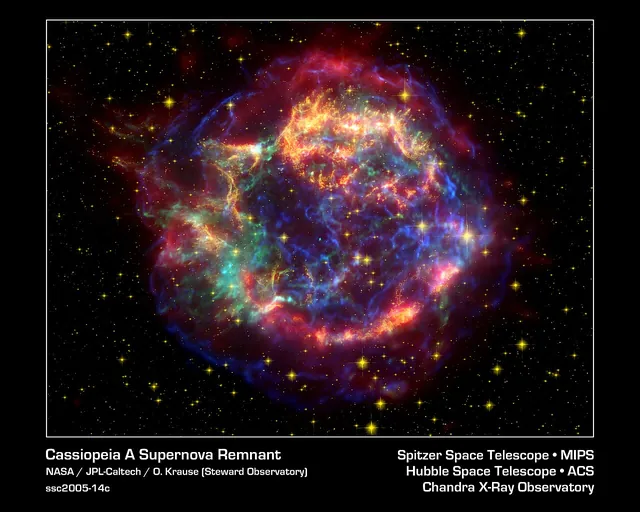
Cassiopeia A lies about 11,000 light-years away in the constellation Cassiopeia, and its shell spans about 10 light-years. Its outer edge is the blast wave, seen in X-rays as a thin bright rim; inside lies a clumpy shell of debris from the star itself. Chandra measured the blast wave racing outwards at about 11 million miles per hour, slower than expected for an explosion of its energy.12611
The explosion was not symmetrical. A jet of silicon-rich debris pokes beyond the shock wave on one side, with a fainter counter-jet opposite. Hubble tracked more than 1,800 outlying knots and found the fastest confined to these two opposing jets, while fingers of almost pure iron point in other directions.612
NuSTAR’s maps of radioactive titanium-44, made deep in the explosion, ruled out both a symmetrical blast and a simple two-sided one, favouring churning, lopsided convection. Webb has resolved unshocked debris into a web of filaments only about 0.01 parsecs wide, the turbulent mixing of material from the star’s oxygen layer.1314
What it is made of
Cassiopeia A is a showcase of the elements stars make. Chandra’s X-ray maps show it has scattered about 20,000 Earth masses of silicon, 10,000 of sulphur and 70,000 of iron. Oxygen is the most abundant element, about one million Earth masses or three times the Sun’s mass, and carbon, nitrogen, phosphorus and hydrogen have also been detected.1
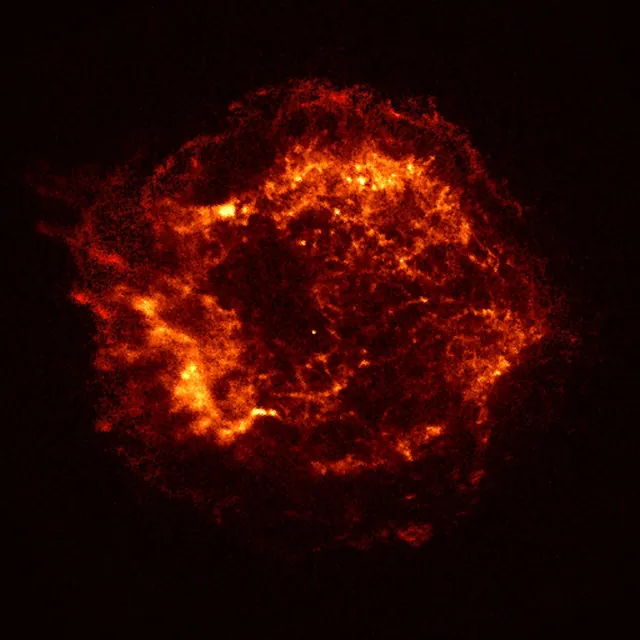
The debris was heated to millions of degrees by shock waves; Chandra’s first image showed a shell at about 50 million degrees. Webb can also see cold, pristine debris that no shock has yet reached. Mid-infrared images reveal warm dust where ejected material rams into gas around the star, which helps astronomers test whether supernovae make the dust seen in very young galaxies.2315
What makes it shine
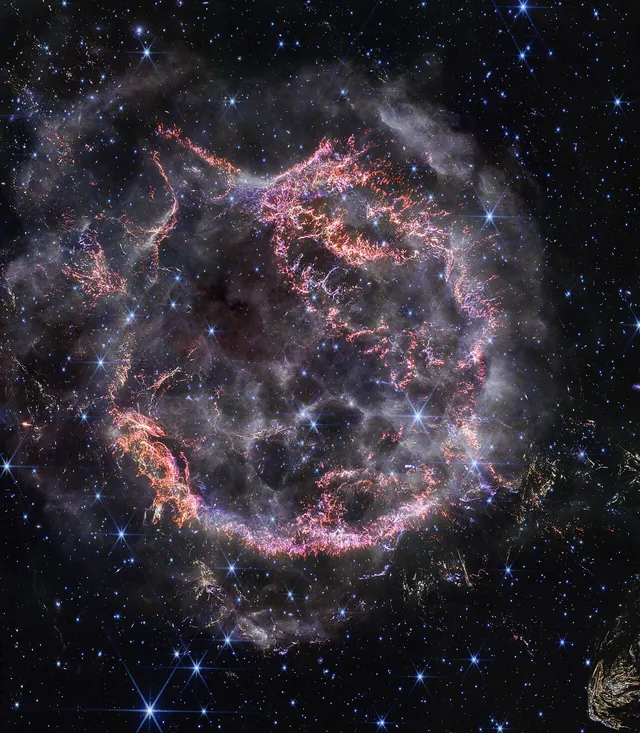
Most of Cassiopeia A’s light comes from shocked gas, which glows most strongly in X-rays. Along the blast wave, electrons spiralling around magnetic field lines give off synchrotron radiation, seen in X-rays as thin arcs and by Webb as smoky white light. Chandra found electrons there accelerated almost to the theoretical limit, evidence that supernova remnants energise cosmic rays.171516
Some light is an echo. Light from the explosion is still reaching and warming dust clouds around the remnant, which glow as they cool. Webb found dozens of these light echoes; the most striking, nicknamed Baby Cas A, lies about 170 light-years behind the remnant. Spectra of other echoes showed in 2008 that the supernova was of Type IIb.7914
The star that died
The star began life at about 16 times the Sun’s mass but lost roughly two-thirds of it in a strong wind, so it weighed about five Suns when it exploded. A spectrum of its 300-year-old light, caught in a light echo, showed a Type IIb supernova: the collapse of the helium core of a red supergiant that had lost most of its hydrogen.19
Near the centre is the neutron star the collapse left behind. It shows no pulsations and no pulsar wind nebula, and lies about 7″ from the centre of expansion, implying a motion of about 350 km/s. Its spectrum fits a carbon atmosphere, and ten years of Chandra data showed its temperature falling 4 per cent, probably because a superfluid is forming in its core.6101217
Notable features
The jets
A large jet-like structure protrudes beyond the shock wave in the north-east, with a counter-jet to the south-west. Chandra found them rich in silicon but poor in iron, so they formed soon after the explosion; Hubble found the remnant’s fastest knots confined to them.612
The Green Monster
A loop of green light inside the remnant in Webb’s mid-infrared image of April 2023, pocked with small round holes. Combining Chandra and Webb data, astronomers concluded in 2024 that it is gas shed by the star before it died, struck by the blast wave and pierced by fast knots of debris.71415
Baby Cas A
A large striated blob at the edge of Webb’s near-infrared view that looks like an offspring of the main remnant. It is a light echo: dust about 170 light-years behind Cassiopeia A, warmed by light from the explosion.7
The central neutron star
The bright point at the centre of Chandra’s first image. Quiet and faint, it shows no pulsed radiation. Fitted with a carbon atmosphere, its emission implies a size consistent with theory for a very young neutron star, about 330 years old.3617
Discovery and history
No certain record of the supernova exists. There is evidence, though not general agreement, that John Flamsteed saw it as a sixth-magnitude star in August 1680; one study argues that at its likely peak, in the winter of 1679–80, it was poorly placed for viewing. Tracing Hubble’s knots back gives explosion dates between about 1662 and 1681, depending on how much the debris has slowed.512
The remnant was found by radio astronomy. In 1948 M. Ryle and F. G. Smith reported a new intense source of radio waves in Cassiopeia, and in 1954 W. Baade and R. Minkowski published its optical identification. On 19 August 1999 it became the first-light target of NASA’s Chandra X-ray Observatory, which revealed the neutron star at its centre.34618
Where it is
Cassiopeia A lies in the northern constellation Cassiopeia. The remnant spans only about 5′ and is studied with large telescopes and spacecraft rather than by eye. It glows most strongly in X-rays, wavelengths undetectable by other kinds of telescope, and it was first found not in visible light but as an intense source of radio waves.148
Telescopes on Cassiopeia A
Chandra has observed Cassiopeia A again and again since its first-light image in 1999. A one-million-second exposure in 2004, nine observations totalling 278 hours, gave the most detailed image of an exploded star made up to then. Hubble photographed the remnant in 2004, and NuSTAR maps of its radioactive titanium were published in 2014.161319
The James Webb Space Telescope looked in 2023. Its MIRI mid-infrared image, released on 7 April, showed warm dust and the Green Monster; its NIRCam image, released on 11 December, showed debris filaments so fine that some are no more than about 100 astronomical units across, and new light echoes. Combined with Chandra, the data explained the Green Monster in 2024.2715
- Finest debris filaments
- 100 astronomical units or less7too fine for Webb to resolve
Quick answers
- What kind of object is Cassiopeia A?
- Cassiopeia A is a supernova remnant (from a Type IIb supernova).89
- Which constellation is Cassiopeia A in?
- Cassiopeia A lies in the constellation Cassiopeia.1
- How big does Cassiopeia A look in the sky?
- Cassiopeia A covers 5′ of sky (in radio maps).8
- How old is Cassiopeia A?
- Cassiopeia A is about 340 years old (as seen from Earth; light of the explosion arrived around 1680).17
- When was Cassiopeia A discovered?
- Cassiopeia A was discovered in 1948, as a radio source, by M. Ryle and F. G. Smith.4
Sources
- Cassiopeia A (Chandra Photo Album, 12 December 2017) — Chandra X-ray Center, Harvard-Smithsonian Center for Astrophysics, 2017
- Webb reveals new details in Cassiopeia A (weic2311) — ESA/Webb, 2023
- Cassiopeia A: First Light (Chandra Photo Album, 26 August 1999) — Chandra X-ray Center, Harvard-Smithsonian Center for Astrophysics, 1999
- A New Intense Source of Radio-Frequency Radiation in the Constellation of Cassiopeia (Ryle & Smith) — Nature 162, 462, 1948
- Visual Observability of the Cassiopeia A Supernova (Morgan) — The Observatory 128, 80 (arXiv:0710.2345), 2008
- Cassiopeia A: Deepest Image of Exploded Star Uncovers Bipolar Jets (Chandra Photo Album) — Chandra X-ray Center, Harvard-Smithsonian Center for Astrophysics, 2004
- Researchers stunned by Webb’s new high-definition look at exploded star (weic2330) — ESA/Webb, 2023
- SIMBAD astronomical database: Cassiopeia A — Centre de Données astronomiques de Strasbourg (CDS)
- The Cassiopeia A Supernova was of Type IIb (Krause et al.) — Science (arXiv:0805.4557), 2008
- Cassiopeia A (Chandra Photo Album, 23 February 2011) — Chandra X-ray Center, Harvard-Smithsonian Center for Astrophysics, 2011
- Cassiopeia A (Chandra Photo Album, 6 January 2009) — Chandra X-ray Center, Harvard-Smithsonian Center for Astrophysics, 2009
- The Expansion Asymmetry and Age of the Cassiopeia A Supernova Remnant (Fesen et al.) — Astrophysical Journal 645, 283 (arXiv:astro-ph/0603371), 2006
- Asymmetries in core-collapse supernovae from maps of radioactive ⁴⁴Ti in Cassiopeia A (Grefenstette et al.) — Nature 506, 339 (arXiv:1403.4978), 2014
- A JWST Survey of the Supernova Remnant Cassiopeia A (Milisavljevic et al.) — Astrophysical Journal Letters 965, L27 (arXiv:2401.02477), 2024
- Cassiopeia A (Chandra Photo Album, 8 January 2024) — Chandra X-ray Center, Harvard-Smithsonian Center for Astrophysics, 2024
- Cassiopeia A: Chandra Discovers Relativistic Pinball Machine (Chandra Photo Album) — Chandra X-ray Center, Harvard-Smithsonian Center for Astrophysics, 2006
- A Neutron Star with a Carbon Atmosphere in the Cassiopeia A Supernova Remnant (Ho & Heinke) — Nature 462, 71 (arXiv:0911.0672), 2009
- Identification of the Radio Sources in Cassiopeia, Cygnus A, and Puppis A (Baade & Minkowski) — Astrophysical Journal 119, 206, 1954
- Hubble’s view of Cassiopeia A (weic2311c) — ESA/Webb, 2023
Figures checked against these sources in November 2026. Where a quantity is not known, it is left out rather than estimated.

