nebula
Crab Nebula
The Crab Nebula is the shattered remains of a star whose explosion was seen from Earth in 1054, when Chinese astronomers recorded a “guest star” bright enough to see in daylight for 23 days. About 6,500 light-years away in Taurus, the expanding cloud is now some six light-years wide: a cage of glowing filaments around a pale blue haze.123
At its centre spins the Crab Pulsar, a neutron star left by the explosion that turns about 30 times a second. Its wind of particles and magnetic field keeps the whole nebula shining, from radio waves to gamma rays of more than a petaelectronvolt. Few objects have been studied so closely, yet astronomers still debate what kind of star exploded.1245
Shape and size in space
Radio measurements of the pulsar’s parallax with the European VLBI Network place the Crab 1.90 kiloparsecs away, consistent with the Gaia spacecraft’s value; NASA and ESA quote about 6,500 light-years. The nebula is about six light-years wide and covers roughly 6′ × 4′ of sky in visible light, slightly more in radio maps. An older account gives about ten light-years.123678
Seen in three dimensions, the Crab is not the simple ellipsoid often assumed. A map built in 2021 from 310,000 spectra taken with the SITELLE instrument on the Canada-France-Hawaii Telescope shows a heart-shaped volume, symmetrical about the plane of the pulsar’s wind torus. Dark bays and a band of helium-rich filaments mark places where the expansion seems to be held back.10
The nebula is still expanding, at about 1,800 km/s. Tracing the filaments’ motions back points to a start somewhat later than 1054, so the expansion must have sped up. Nearly 20,000 motions measured between 2007 and 2019 converge on 1105.5 CE on average, and radio maps show the synchrotron cloud accelerating more strongly than the filaments.11112
- Distance (radio parallax)
- 1.90 kpc (+0.22 / −0.18)7European VLBI Network, published 2023
- Diameter
- about six light-years3
- Apparent size (visible light)
- 6′ × 4′8
- Apparent size (radio)
- 7′ × 5′6
- Expansion speed
- about 1,800 km/s1
- Convergence date of the filaments
- 1105.5 ± 0.5 CE11average of 19,974 proper motions, 2007–2019
- Convergence date of the radio nebula
- 1255 ± 27 CE12evidence that it has accelerated
- Spectra in the 3D map
- 310,00010SITELLE, Canada-France-Hawaii Telescope
What makes it shine
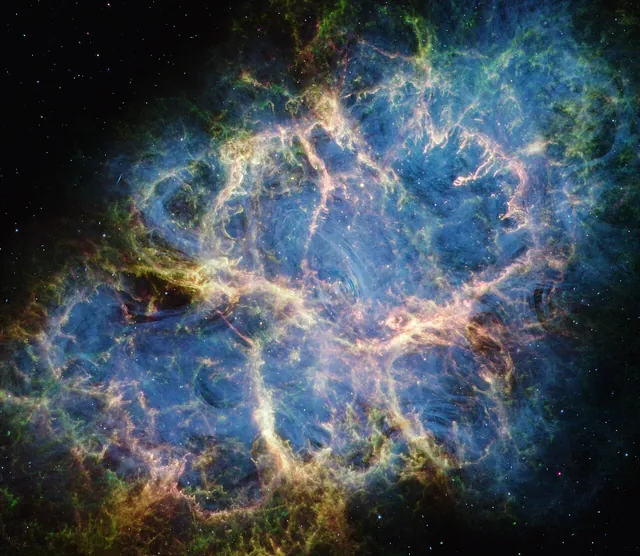
Two kinds of light mix in the Crab. The filaments glow in emission lines from gas thrown off by the star, mostly hydrogen with oxygen and sulphur. Inside them lies a diffuse bluish glow with a continuous spectrum, which Roscoe Sanford first distinguished from the filaments in 1919. Walter Baade and Rudolph Minkowski confirmed the two components photographically.123
That blue glow is synchrotron radiation from electrons moving at nearly the speed of light around magnetic field lines fed by the pulsar. Josif Shklovsky proposed the explanation in 1953, and polarisation measurements by Jan Oort and T. Walraven supported it in 1956. In X-rays the nebula gives out about 100 times more energy than in visible light.12
The James Webb Space Telescope mapped the Crab’s warm dust in detail for the first time. The grains are concentrated in the densest inner filaments, which form a cage around the synchrotron cloud. Spectra of two filaments gave a nickel-to-iron ratio three to eight times the Sun’s, far below earlier optical estimates once updated atomic data and dust were taken into account.41314
- Filament colours in Hubble’s mosaic
- orange hydrogen, blue neutral oxygen, green singly ionised sulphur, red doubly ionised oxygen23
- Energy in X-rays
- about 100 times that in visible light1
- Total luminosity
- about 100,000 Suns (5 × 10³⁸ erg/s)1an estimate over all wavelengths
- Nickel-to-iron ratio
- 3–8 times the solar ratio13from Webb MIRI spectra
- Highest-energy gamma rays
- 1.1 PeV5LHAASO, 2021
The pulsar at its heart
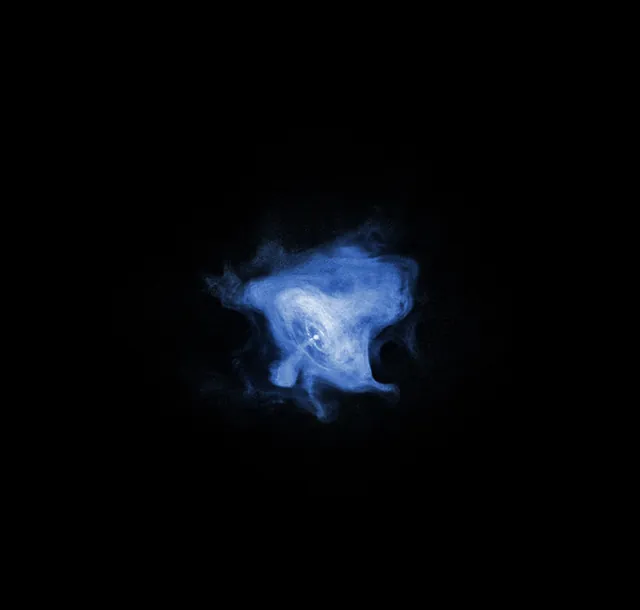
The Crab Pulsar is a neutron star, the crushed core of the exploded star, holding more than the Sun’s mass in a ball about 30 kilometres across. It is the right-hand star of the pair near the nebula’s centre. Its beams sweep past Earth as it rotates, so it flashes about 30 times a second in nearly every part of the spectrum.123
Its rotation is slowly winding down as the pulsar hands energy to the nebula, and that energy is what keeps the Crab shining. In visible light the pulsar is only of about 16th magnitude. Radio parallax measurements show it moving across the sky at about 104 km/s, towards the side of the nebula where the filaments are longest.17914
Close to the pulsar, Hubble has filmed bright wisps moving outwards at half the speed of light. Chandra’s first images of the Crab revealed an X-ray inner ring within a larger torus, with knots and a jet. The LHAASO observatory detected gamma rays up to 1.1 petaelectronvolts, which it attributes to a particle accelerator where the pulsar’s wind ends.2515
- Rotation frequency
- 29.946923 turns per second9ATNF catalogue value at epoch MJD 48442.5 (1991)
- Pulse period measured in 1969
- 33.085 milliseconds1
- Mass and size
- more than one solar mass within about 30 km1
- Visual magnitude
- about 161
- Speed across the sky
- 104 km/s (+13 / −11)7
- Speed of the wisps
- about half the speed of light2
Notable features
The pulsar wind nebula
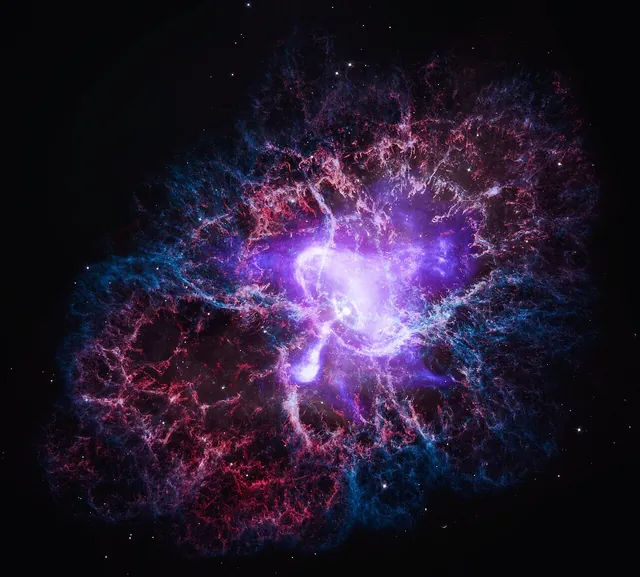
The Crab’s bluish heart is a bubble of fast electrons and magnetic field blown by the pulsar into the debris of the star. In X-rays it shows a torus, an inner ring and a jet. Webb found the densest dusty filaments lining a series of bays around its edge.41315
The filaments
The cage of filaments holds the former outer layers of the star, mostly hydrogen. They are thought to form where the expanding pulsar wind pushes into heavier debris, a Rayleigh–Taylor instability, and they have been only slightly accelerated since 1054, while the synchrotron cloud has sped up strongly.1312
Wisps and the inner knot
A time-lapse series of Hubble images shows ripples of light, the wisps, running outwards from the pulsar to form an expanding ring. They trace magnetic field lines in the pulsar’s particle wind. Webb measured small changes in the spectrum of the wisps and of the well-known knot beside the pulsar.213
The bays
Indentations on the east and west sides, the bays, pinch the nebula’s waist, and a band of helium-rich filaments runs between them. The expansion is slowest along this line. Several studies suggest the debris ran into a disc or belt of gas that the star had shed before it exploded.101114
Supernova 1054
Chinese astronomers noted the “guest star” on 4 July 1054, about four times brighter than Venus, and Japanese astronomers saw it too. It stayed visible in daylight for 23 days and to the unaided eye at night for 653 days. It was later given the variable-star name CM Tauri.13
Discovery and history
The supernova behind the Crab was recorded by Chinese astronomers on 4 July 1054, and by Japanese astronomers too. The nebula itself was found in 1731 by the English amateur John Bevis, who added it to his atlas Uranographia Britannica. Charles Messier came across it on 28 August 1758 while hunting for Halley’s Comet, and the mix-up led him to start his famous catalogue.123
Lord Rosse’s drawing of about 1844 gave the nebula its name. In 1921 John Duncan found that it was expanding, and Knut Lundmark pointed out that it lay close to the position of the 1054 star. It was identified as the strong radio source Taurus A in 1949, a rocket detected its X-rays in 1963, and pulsating radio signals revealed the pulsar in 1968.1316
On 16 January 1969 (Universal Time) W. J. Cocke, M. J. Disney and D. J. Taylor of Steward Observatory saw the pulsar flashing in visible light with the same 33-millisecond period, the first pulsar found optically. Only in 2007 did it emerge that a US Air Force radar operator, Charles Schisler, had logged its pulsing radio signal in Alaska in summer 1967.1
- Supernova recorded
- 4 July 10541
- Nebula discovered
- 1731, John Bevis1
- Found by Messier
- 28 August 17581catalogued on 12 September 1758
- Expansion discovered
- 1921, John C. Duncan1
- Identified as radio source Taurus A
- 19491
- X-rays first detected
- April 19631by an Aerobee rocket
- Pulsar detected
- 9 November 19681at the Arecibo Observatory
- First published reports of the pulsar
- Staelin & Reifenstein (Science, December 1968); Comella et al. (Nature, February 1969)1617
- Optical pulses found
- 16 January 19691
Seeing it for yourself
The Crab lies about 1° north and 1° west of Zeta Tauri, the star marking the southern horn of Taurus. At magnitude 8.4 it needs a dark sky: 7×50 or 10×50 binoculars show a dim patch, and small telescopes an oval glow much like a faint comet without a tail, which is exactly what misled Messier. NASA’s observing guide names January as the best month.12
Hints of the filaments need a telescope of about 16 inches aperture and excellent conditions. Because the nebula lies only 1.5° from the ecliptic, planets pass close by and the Moon sometimes hides it; lunar occultations in 1964, 1974 and 1975 showed that its X-rays come from a region at least 2′ across.1
Telescopes on the Crab
Hubble’s largest picture of the Crab, released on 1 December 2005, joins 24 exposures from the Wide Field and Planetary Camera 2 taken between October 1999 and December 2000, laid over images from ESO’s Very Large Telescope. It was the largest image ever made with that camera and the sharpest view of the whole nebula at the time.3
Chandra’s first X-ray images of the Crab, taken during its calibration, showed structure as sharp as the best ground-based visible-light pictures. In 2021 the LHAASO collaboration reported gamma rays reaching 1.1 petaelectronvolts, the sign of a natural particle accelerator, a pevatron, working at more than 15 per cent of the theoretical limit.515
The James Webb Space Telescope imaged the Crab with its NIRCam and MIRI instruments; ESA released a first picture on 30 October 2023 and the results of Tea Temim’s team on 17 June 2024. Their measurements favour the collapse of a low-mass iron core over a rarer electron-capture supernova, though the latter cannot be ruled out.41314
- Explosion energy
- less than a tenth of a normal supernova’s4from earlier studies of the ejecta
Quick answers
- What kind of object is the Crab Nebula?
- The Crab Nebula is a supernova remnant with a pulsar wind nebula.46
- Which constellation is the Crab Nebula in?
- The Crab Nebula lies in the constellation Taurus.2
- How far away is the Crab Nebula?
- The Crab Nebula is about 6,500 light-years from Earth (a radio parallax of the pulsar gives 1.90 kiloparsecs).247
Sources
- Messier 1 (H. Frommert & C. Kronberg) — SEDS Messier Database (Observatoire de Paris mirror), 2007
- Messier 1 (The Crab Nebula) — NASA Science, Hubble’s Messier Catalog
- Most detailed image of the Crab Nebula (heic0515) — ESA/Hubble, 2005
- Investigating the origins of the Crab Nebula with Webb (weic2417) — ESA/Webb, 2024
- Peta-electron volt gamma-ray emission from the Crab Nebula (The LHAASO Collaboration) — Science 373, 425 (arXiv:2111.06545), 2021
- SIMBAD astronomical database: M 1 — Centre de Données astronomiques de Strasbourg (CDS)
- The Radio Parallax of the Crab Pulsar: A First VLBI Measurement Calibrated with Giant Pulses (Lin et al.) — Astrophysical Journal (doi:10.3847/1538-4357/acdc98; arXiv:2306.01617), 2023
- Revised NGC Data for NGC 1952 (from W. Steinicke’s Revised NGC and IC Catalog) — SEDS Interactive NGC Catalog
- ATNF Pulsar Catalogue, version 2.6.1: PSR J0534+2200 — CSIRO Australia Telescope National Facility
- 3D mapping of the Crab Nebula with SITELLE. I. Deconvolution and kinematic reconstruction (Martin, Milisavljevic & Drissen) — Monthly Notices of the Royal Astronomical Society (doi:10.1093/mnras/staa4046; arXiv:2101.02709), 2021
- The Non-Uniform Expansion of the Crab Nebula (Martin et al.) — Monthly Notices of the Royal Astronomical Society (doi:10.1093/mnras/staf1597; arXiv:2502.19632), 2025
- New expansion rate measurements of the Crab Nebula in radio and optical (Bietenholz & Nugent) — Monthly Notices of the Royal Astronomical Society (doi:10.1093/mnras/stv2112; arXiv:1509.04687), 2015
- Dissecting the Crab Nebula with JWST: Pulsar wind, dusty filaments, and Ni/Fe abundance constraints on the explosion mechanism (Temim et al.) — arXiv:2406.00172, 2024
- The Crab Nebula Seen in New Light by Webb (weic2326) — ESA/Webb, 2023
- Discovery of Spatial and Spectral Structure in the X-Ray Emission from the Crab Nebula (Weisskopf et al.) — arXiv:astro-ph/0003216 (doi:10.1086/312733), 2000
- Pulsating Radio Sources near the Crab Nebula (Staelin & Reifenstein) — Science 162, 1481, 1968
- Crab Nebula Pulsar NP 0532 (Comella, Craft, Lovelace, Sutton & Tyler) — Nature 221, 453, 1969
- The Crab Nebula’s Composition and Precursor Star Mass (MacAlpine & Satterfield) — Astronomical Journal 136, 2152 (arXiv:0806.1342), 2008
Figures checked against these sources in November 2026. Where a quantity is not known, it is left out rather than estimated.

