nebula
Cygnus Loop
The Cygnus Loop is the expanding remains of a massive star that exploded thousands of years ago in the constellation Cygnus. Its brightest arcs, the Eastern and Western Veil, make it one of the most spectacular supernova remnants in the sky. The whole loop covers almost 3° × 3.7° of sky, about six times the area of the full Moon, and lies roughly 725 parsecs from Earth.1234
What we see are glowing shock fronts where the supernova’s blast wave, still racing outwards at hundreds of kilometres per second, slams into clouds of interstellar gas. Hydrogen, oxygen and sulphur light up in delicate, rope-like filaments. William Herschel found the Veil in 1784, and Hubble has since watched its filaments move across the sky.1235
Shape and size in space
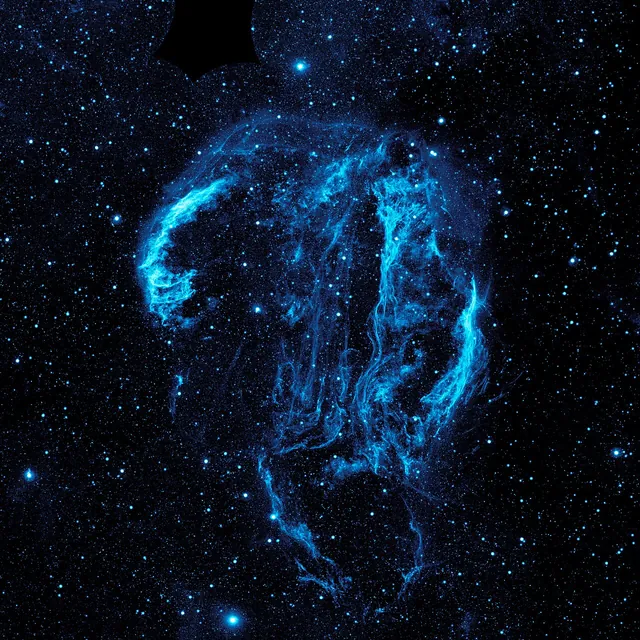
The distance to the Cygnus Loop was long uncertain, with estimates from 440 parsecs to about 1 kiloparsec. Gaia parallaxes of stars whose spectra show absorption by the remnant’s expanding shell now place its centre at 725 ± 15 parsecs. At that distance its 2.88° by 3.65° extent means about 37 parsecs east to west and 47 north to south.14910
The loop is far from a perfect sphere. Its northern part is dominated by the nearly opposite bright nebulae NGC 6960 in the west and NGC 6992 and NGC 6995 in the east, and a broad blowout region extends to the south. The eastern limb appears nearer to us than the north-western one.1
Why it looks this way is debated. Many studies modelled the explosion inside a cavity blown by the progenitor star’s wind, with bright filaments marking the cavity walls. A 2018 study argued instead that the remnant sits in an extended low-density region, and that its shape comes from the separate interstellar clouds it is striking.1511
What makes it shine
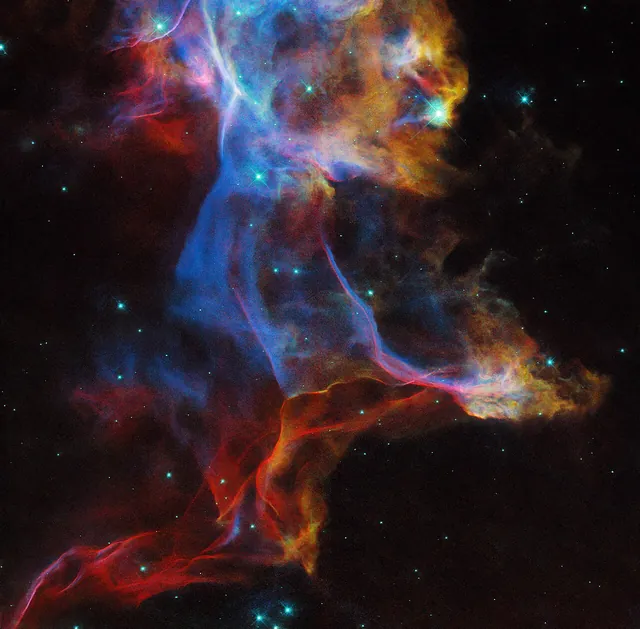
The Cygnus Loop shines where its blast wave runs into interstellar gas, heating it until it glows. Sharp filaments are shock fronts seen edge-on; diffuse ones are seen face-on. Hubble pictures map oxygen in blue, which outlines gas only recently shocked, while red and green trace hydrogen, nitrogen and sulphur in gas that has had longer to cool and spread.2512
A few thin red hydrogen filaments are different: they glow where gas is swept into the shock itself, giving a snapshot of the shock front. Combining the 735-parsec distance with the motions of such filaments gives a blast-wave speed of about 350 km/s. Where the shock hits denser clouds it slows, and in X-rays the remnant’s shape is set by these cloud collisions.1511
The loop also glows in ultraviolet light, which NASA’s GALEX satellite imaged in full, and in X-rays, which a ROSAT campaign set out to map across the whole remnant. A 2018 study estimated the explosion energy at 0.7 × 10⁵¹ erg from the remnant’s size and the density of the gas around it.11113
The star that exploded
ESA and NASA describe the progenitor as a star about 20 times the Sun’s mass. No neutron star has been confirmed. In 2012 the Suzaku and XMM-Newton X-ray satellites found a candidate pulsar wind nebula with a point source in the southern blowout, but if it belongs to the Cygnus Loop it must be moving very fast, above 1,200 km/s at the 735-parsec distance.13514
The age is uncertain too. A Sedov blast-wave model with the newer distance gives about 21,000 ± 4,000 years, consistent with the long-quoted range of 10,000–20,000 years. ESA/Hubble pages give about 8,000 or 10,000 years, NASA’s GALEX page 5,000 to 8,000 years, and NASA’s Caldwell pages simply several thousand years.1351213
Notable features
Western Veil (NGC 6960, Caldwell 34)
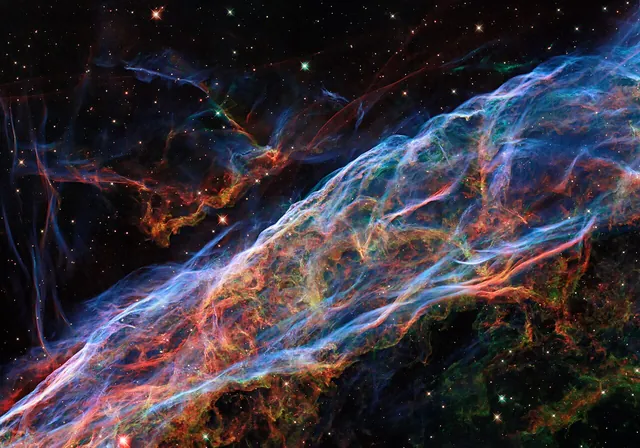
The western arc, about 70′ long, which runs past a bright star. Its brightest part is nicknamed the Witch’s Broom. Hubble imaged it in 1997 and again in 2015 with six fields of Wide Field Camera 3, and the comparison reveals how its filaments have moved.358
Eastern Veil (NGC 6992 and NGC 6995, Caldwell 33)
The bright eastern arc, catalogued in two parts: NGC 6992, about 60′ long, and NGC 6995, about 12′. Hubble close-ups show rope-like filaments where debris ploughs into the surrounding gas, and comparison with a 1953 photograph has been used to estimate the nebula’s age.21516
Pickering’s Triangle
A fainter wedge of filaments on the western side of the loop, near NGC 6960, discovered in 1904 by Williamina Fleming at Harvard College Observatory and named after the observatory’s director, Pickering.317
NGC 6974 and NGC 6979
Two smaller entries in the New General Catalogue: NGC 6974 is listed as a knot in the Veil Nebula, and NGC 6979, about 7′ × 3′, as part of it.1819
The southern blowout
A broad region where the remnant bulges south beyond its main shell, with a secondary blowout off to its west. A candidate pulsar wind nebula found by X-ray satellites lies here, about 2° from the loop’s geometric centre.114
Discovery and history
William Herschel found the Veil Nebula in 1784, and the brightest parts of the loop entered the New General Catalogue as NGC 6960, 6974, 6979, 6992 and 6995. In 1904 Williamina Fleming discovered the fainter Pickering’s Triangle. Today they are known as parts of one extensive supernova remnant, often called the Cygnus Loop because of its arced shapes.23815161819
In 1937 Edwin Hubble measured the bright nebulae moving outwards by 0.03″ a year. Rudolph Minkowski combined this with the filaments’ speeds to estimate a distance of 770 parsecs in 1958, for decades the most often adopted value. Gaia parallaxes have since shown it was nearly right: the 2018 estimate of 735 parsecs is only a little less.1
Seeing it for yourself
The Veil is best viewed in early autumn from the northern hemisphere, or early spring from the southern hemisphere. Its brightest arcs are around magnitude 7–8, too faint for the unaided eye, but they show in binoculars or a telescope under a dark sky. A nebula filter makes it easier to spot and helps bring out its wispy filaments.238
Telescopes on the Cygnus Loop
Hubble’s Wide Field and Planetary Camera 2 photographed parts of the Veil in 1994 and 1997. In 2015 its Wide Field Camera 3 returned to the Witch’s Broom, and comparing the two sets of images showed how far the filaments had moved in 18 years. A further Hubble image, released in 2025, was taken to compare with the 1994 data.2357
Other wavelengths fill in the rest. ROSAT’s High Resolution Imager mapped the X-ray emission from the entire remnant in a joint American and German campaign in the 1990s, and NASA’s GALEX imaged it in ultraviolet light. Gaia’s parallaxes of nearby stars finally pinned down its distance.41113
Quick answers
- What kind of object is the Cygnus Loop?
- The Cygnus Loop is a supernova remnant (a prototypical middle-aged remnant).26
- Which constellation is the Cygnus Loop in?
- The Cygnus Loop lies in the constellation Cygnus.2
- How far away is the Cygnus Loop?
- The Cygnus Loop is 725 ± 15 parsecs from Earth (from Gaia parallaxes of stars inside and behind it; NASA and ESA pages give 2,000–2,400 light-years).247
- How big is the Cygnus Loop?
- The Cygnus Loop is 37 × 47 parsecs across (east–west by north–south, for a distance of 735 pc).1
- How big does the Cygnus Loop look in the sky?
- The Cygnus Loop covers 2.88° × 3.65° of sky.1
- How bright is the Cygnus Loop in the night sky?
- The Cygnus Loop has an apparent magnitude of about 7–8 (for its brightest parts; needs binoculars or a telescope).38
Sources
- The Cygnus Loop’s Distance, Properties, and Environment Driven Morphology (Fesen et al.) — Monthly Notices of the Royal Astronomical Society 481, 1786 (arXiv:1809.01713), 2018
- Caldwell 33 — NASA Science, Hubble’s Caldwell Catalog
- Caldwell 34 — NASA Science, Hubble’s Caldwell Catalog
- An Updated Distance to the Cygnus Loop based on Gaia Early DR3 (Fesen et al.) — Monthly Notices of the Royal Astronomical Society 507, 244 (arXiv:2109.05368), 2021
- Revisiting the Veil Nebula (heic1520) — ESA/Hubble, 2015
- SIMBAD astronomical database: Cygnus Loop — Centre de Données astronomiques de Strasbourg (CDS)
- Lifting the veil (potw2508a) — ESA/Hubble, 2025
- Revised NGC Data for NGC 6960 (from W. Steinicke’s Revised NGC and IC Catalog) — SEDS Interactive NGC Catalog
- The Distance to the Cygnus Loop from Hubble Space Telescope Imaging of the Primary Shock Front (Blair et al.) — Astronomical Journal (arXiv:astro-ph/9906015), 1999
- A Distance Estimate to the Cygnus Loop Based on the Distances to Two Stars Located Within the Remnant (Fesen et al.) — Monthly Notices of the Royal Astronomical Society (arXiv:1711.02174), 2018
- The ROSAT-HRI X-Ray Survey of the Cygnus Loop (Levenson et al.) — Astrophysical Journal (arXiv:astro-ph/9703092), 1997
- Return to the Veil Nebula (potw2113a) — ESA/Hubble, 2021
- PIA15415: Cygnus Loop Nebula — NASA/JPL Photojournal, 2012
- Discovery of a Pulsar Wind Nebula Candidate in the Cygnus Loop (Katsuda et al.) — Astrophysical Journal Letters (arXiv:1206.4367), 2012
- Revised NGC Data for NGC 6992 (from W. Steinicke’s Revised NGC and IC Catalog) — SEDS Interactive NGC Catalog
- Revised NGC Data for NGC 6995 (from W. Steinicke’s Revised NGC and IC Catalog) — SEDS Interactive NGC Catalog
- Panoramic Loop in Cygnus (noao1209a) — NOIRLab, 2012
- Revised NGC Data for NGC 6974 (from W. Steinicke’s Revised NGC and IC Catalog) — SEDS Interactive NGC Catalog
- Revised NGC Data for NGC 6979 (from W. Steinicke’s Revised NGC and IC Catalog) — SEDS Interactive NGC Catalog
Figures checked against these sources in November 2026. Where a quantity is not known, it is left out rather than estimated.

