star cluster
Double Cluster
The Double Cluster is a pair of bright open star clusters, h and χ Persei, lying side by side in the northern constellation Perseus. From a dark site the unaided eye sees them as one hazy patch between Perseus and Cassiopeia, and binoculars split it into two glittering swarms. The Greek astronomer Hipparchus catalogued the pair around 130 BC, and it may have been noticed long before that.12
Both clusters lie about 7,500 light-years away in the Perseus spiral arm of our galaxy, close to each other in space as well as on the sky. They are young, roughly 13 to 14 million years old, and full of hot blue giant stars, with a few red supergiants among them. With their surroundings they hold at least 20,000 times the mass of the Sun in stars.1345
Two clusters, one family
h Persei (NGC 869) and χ Persei (NGC 884) are separated by about 30′ on the sky, which at their distance corresponds to about 20 parsecs, and both lie about 140 parsecs out of the plane of the galaxy. Careful fits to their stars give the two clusters identical reddening, distance and age within the errors, consistent with the stars having formed in a single episode.3
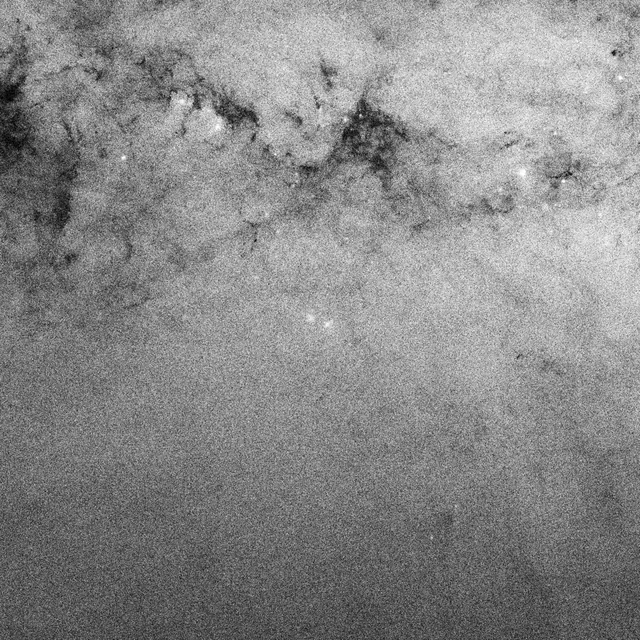
Distances from the brightness of their stars put both clusters near 2,344 parsecs, with h Persei perhaps very slightly nearer than χ Persei. A looser halo of stars at the same distance surrounds both cores, and with it the whole region spans roughly 52 parsecs. Both clusters belong to the Perseus OB1 association, a scattered group of massive young stars; whether the pair is the core of that association is still debated.234
- Distance
- 2,344 pc (+55 / −53)3distance modulus 11.85 ± 0.05
- Distance (popular figure)
- about 7,500 light-years1
- Separation of the two clusters
- about 30′, or 20 pc3
- Height above the galactic plane
- about 140 pc3
- Size of the whole region
- about 52.5 pc across4including the surrounding halo
- Mass of h Persei core
- about 3,700 solar masses3stars of 1 to 120 solar masses
- Mass of χ Persei core
- about 2,800 solar masses3stars of 1 to 120 solar masses
- Mass within 10′ of the centres
- about 8,400 solar masses4
- Total mass
- at least 20,000 solar masses4
The stars inside
A survey that took spectra of about 11,000 stars found at least 5,000 cluster members within 10′ of the two centres, and at least 13,000 in the wider region. The clusters’ main-sequence turnoff, the brightness of their red supergiants and the youngest, still-contracting stars all point to an age of about 14 million years. An earlier study gave 12.8 ± 1.0 million years for both clusters.34
The light is dominated by hot blue stars of spectral types O and B; the hottest still on the main sequence are of type B0. Be stars, hot stars surrounded by discs of gas, are abundant. Red supergiants are found in χ Persei and the halo, but none lie within 10′ of the centre of h Persei. The mix of stars matches a normal mass distribution, and the heaviest stars are slightly concentrated towards the centres.2348
- Age
- about 14 million years4
- Age (earlier study)
- 12.8 ± 1.0 million years3
- Members within 10′ of the centres
- at least about 5,0004
- Members in the whole region
- at least 13,000, perhaps 20,0004
- Reddening E(B−V)
- 0.56 ± 0.013dimming and reddening by dust on the way to us
- Hottest main-sequence stars
- spectral type B02
History and names
The pair was known in antiquity and was catalogued by Hipparchus around 130 BC. Its names are confused: since the 1840s ‘χ’ has meant NGC 884 and ‘h’ NGC 869, but O’Meara and Green argued in 2003 that Tycho Brahe measured a single position for the whole ‘nebulous star’, which Johann Bayer then labelled χ, while ‘h Persei’ was probably a fainter nearby star.2
Philippe Loys de Chéseaux listed the clusters as numbers 6 and 7 in his list of nebulae, and William Herschel numbered them H VI.33 and H VI.34. The pair is not in Charles Messier’s catalogue. Patrick Moore later made it number 14 in his Caldwell list, and the Royal Astronomical Society of Canada includes it among its finest NGC objects.29
Seeing it for yourself
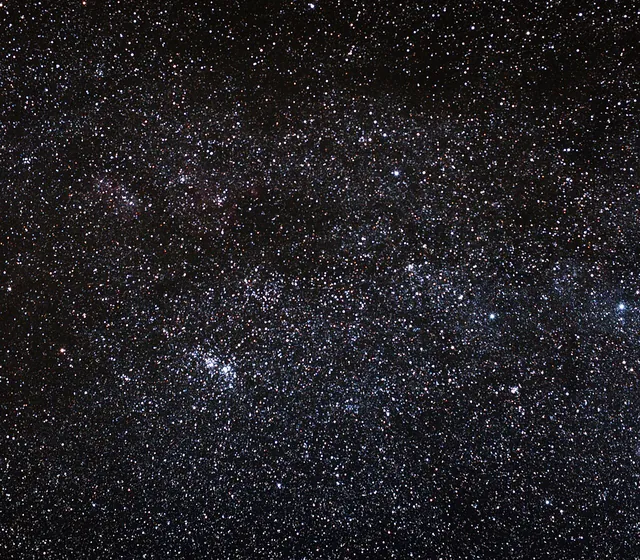
The Double Cluster lies about halfway between the bright stars of Perseus and Cassiopeia. From a dark location it is visible to the unaided eye as a single hazy patch, and binoculars or a small telescope at low power split it into its two clusters, a favourite sight for amateur astronomers. It stands highest for northern observers in late autumn and early winter.110
Telescopes and surveys
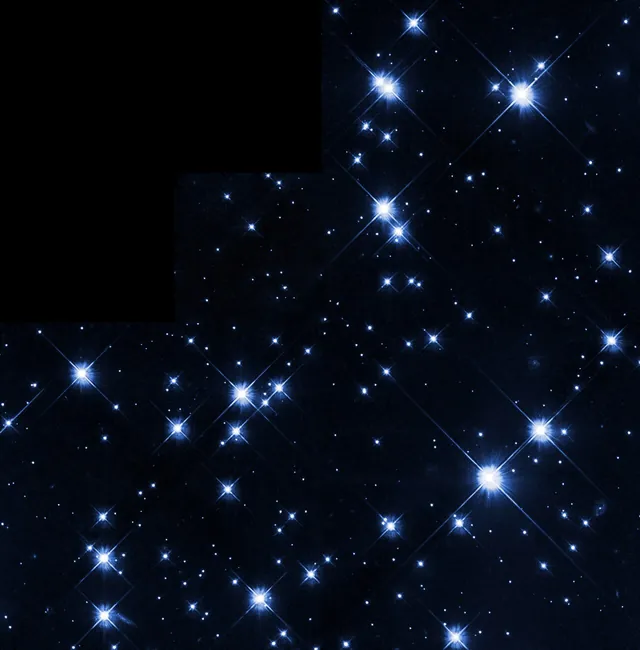
Because the clusters are rich, young and fairly close, they are a natural laboratory for star and planet formation. A large ground-based survey combined photometry of about 47,000 stars with spectra of about 11,000. The Hubble Space Telescope imaged part of NGC 884 in a ‘parallel’ observation, taken while another of its instruments was pointed at a nearby target.14
Infrared images from NASA’s Spitzer Space Telescope found 17 faint stars glowing at 24 microns, probably from dusty debris left over from planet formation. The clusters’ stars move across the sky so slowly that ground-based studies could not confirm which belong to them; Currie and colleagues looked to space missions such as Gaia, whose 2018 star-density map shows the pair standing out against the Milky Way.4511
Quick answers
- Which constellation is the Double Cluster in?
- The Double Cluster lies in the constellation Perseus.12
- How far away is the Double Cluster?
- The Double Cluster is about 7,500 light-years from Earth (2,344 pc from fits to the clusters’ stars).134
- How bright is the Double Cluster in the night sky?
- The Double Cluster has an apparent magnitude of 5.3 and 6.1 (visible to the unaided eye from a dark site).1
- How big does the Double Cluster look in the sky?
- The Double Cluster covers about 30′ each of sky (the two centres are about 30′ apart).23
Sources
- Caldwell 14 — NASA Science, Hubble’s Caldwell Catalog
- NGC 869 and NGC 884, the Double Cluster (H. Frommert & C. Kronberg) — SEDS Messier Database (Observatoire de Paris mirror), 1998
- The star formation history and mass function of the double cluster h and χ Persei (Slesnick, Hillenbrand & Massey) — Astrophysical Journal 576, 880 (arXiv:astro-ph/0205130), 2002
- The stellar population of h and χ Persei: cluster properties, membership, and the intrinsic colors and temperatures of stars (Currie et al.) — Astrophysical Journal Supplement Series 186, 191 (arXiv:0911.5514), 2010
- Double Cluster in Perseus — ESA, 2018
- SIMBAD astronomical database: NGC 869 — Centre de Données astronomiques de Strasbourg (CDS)
- SIMBAD astronomical database: NGC 884 — Centre de Données astronomiques de Strasbourg (CDS)
- h and chi Persei (image noao-hcper) — NOIRLab/NSF/AURA, via Wikimedia Commons
- Non-Messier NGC, IC, and other objects in this database — SEDS Messier Database (Observatoire de Paris mirror)
- The double cluster in Perseus (image b02) — ESO, 2009
- The rise and fall of debris disks: MIPS observations of h and χ Persei and the evolution of mid-IR emission from planet formation (Currie et al.) — Astrophysical Journal 672, 558 (arXiv:0709.2510), 2008
Figures checked against these sources in November 2026. Where a quantity is not known, it is left out rather than estimated.

