star cluster
Hyades
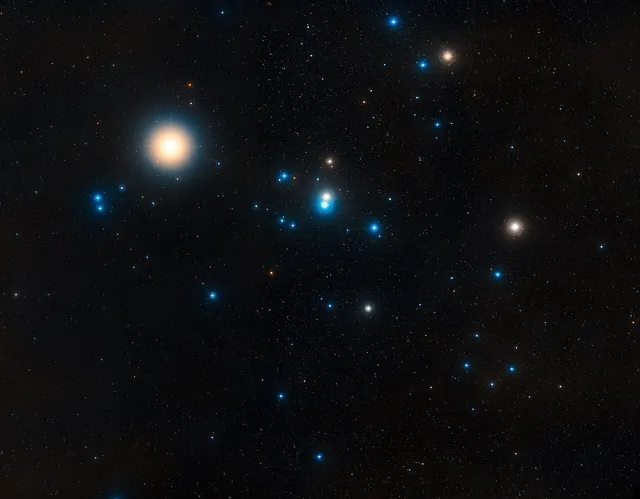
The Hyades are the nearest star cluster to the Sun, a loose group of hundreds of stars just over 150 light-years away in the constellation Taurus. Their brightest members form a conspicuous V of stars marking the head of the bull, visible to the naked eye from both hemispheres. Known since prehistoric times, they were mentioned by Homer and Hesiod. The bright red giant Aldebaran appears among them but is not a member.12
Because they are so close, the Hyades have been mapped star by star, first by the Hipparcos satellite and now by Gaia, down to its faint brown dwarfs. Their stars formed together roughly 600 to 800 million years ago. Gaia has shown that the cluster is slowly dissolving, shedding stars into two enormous tidal tails that stretch for thousands of light-years across the galaxy.13456
Size, shape and distance
The Hyades are an open cluster, a loose group of stars that formed together and travel through space together. Beyond the bright stars visible to the eye, telescopes reveal a hundred or so fainter members in a roughly spherical region about 60 light-years across. A 2019 Gaia study found 710 candidate members within 30 parsecs of the centre, 385 of them inside the tidal radius.14
All the members move together towards a point in the sky slightly east of Betelgeuse, and this shared motion long allowed astronomers to work out the cluster’s distance. Hipparcos measured the distance to its centre of mass as 46.34 ± 0.27 parsecs; Gaia’s second data release placed the centre at 47.03 ± 0.20 parsecs. ESA gives just over 153 light-years.1234
Inside the cluster, Hipparcos found the stars moving in parallel with an internal velocity dispersion of only about 0.3 km/s, and heavier stars concentrated towards the centre. The whole cluster is receding from the Sun at about 38 km/s along our line of sight.347
The stars inside
Age estimates for the Hyades depend on the stellar models used. Fitting the Hipparcos data with models including convective overshooting gave 625 ± 50 million years; the cooling of its white dwarfs suggests 640 million years. Brandt and Huang found that including the rapid rotation of the more massive stars brings the age up to about 800 million years. The stars are slightly richer in heavy elements than the Sun.345
The cluster spans the full range from massive stars down to brown dwarfs: Gaia and ground-based parallaxes confirmed eight brown dwarf members, while the core is notably short of them. Four red giants, ageing stars that have swollen and cooled, belong to the cluster. One of them, epsilon Tauri, hosts a planet, and its oscillations have been measured by the Kepler spacecraft’s K2 mission and the ground-based SONG network.49
- Age (Hipparcos isochrones)
- 625 ± 50 million years3
- Age (white dwarfs)
- 640 million years4+67 / −49 million years
- Age (rotating models)
- about 800 million years5
- Iron abundance [Fe/H]
- +0.125spectroscopic value adopted by Brandt and Huang
- Helium abundance Y
- 0.26 ± 0.023
- Red giant members
- 49
- Confirmed brown dwarf members
- 84
Notable features
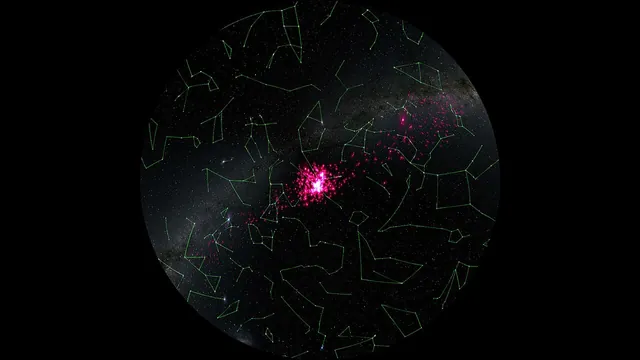
Tidal tails
Stars that have escaped the cluster and now trail ahead of and behind it along its orbit. Gaia data first revealed tails reaching 170 and 70 parsecs from the centre; a 2021 study traced candidate members over almost a kiloparsec and found the trailing tail strangely short of stars.1610
A hidden clump?
Simulations by Tereza Jerabkova and colleagues reproduced the lopsided tails if the cluster had met a lump of matter of about 10 million solar masses. No gas cloud or star cluster that massive is seen nearby, so it could be a clump of dark matter, though this remains unconfirmed.16
Polluted white dwarfs
In 2013 Hubble’s Cosmic Origins Spectrograph found silicon and low levels of carbon in the atmospheres of two Hyades white dwarfs. The material appears to come from shredded asteroids less than 160 kilometres across, a sign that rocky planets may have formed around these stars.11
Aldebaran
The brightest star in the field, the red giant Aldebaran, is not a member of the cluster. It lies much closer to us, at about 60 light-years, a factor of about 2.5 nearer than the Hyades, and simply appears in front of them.2
History
The Hyades have been known since prehistoric times. Like the Pleiades, they were mentioned by Homer around 750 BC and Hesiod around 700 BC, and later by Pliny, Virgil, Ovid and other ancient writers. Hodierna may have been first to catalogue them, in 1654, and Melotte listed them in 1915 as Melotte 25.2
In 1908 Lewis Boss showed that the Hyades and a number of other stars share a common motion, proving they are physically connected. In 1998 a team working with Hipparcos data used the satellite’s parallaxes to map its three-dimensional structure and identify 13 new candidate members within 20 parsecs of the centre.23
Seeing it for yourself
The Hyades are easy to find with the naked eye from both hemispheres: look for the V-shaped group of bright stars forming the head of Taurus, the Bull, with the bright red giant Aldebaran among them, although it is not a member. The cluster spreads over about 330′ of sky, and its combined brightness is about magnitude 0.5.12
Telescopes and discoveries
ESA’s Hipparcos satellite measured parallaxes for individual Hyades stars in the 1990s, and its successor Gaia has transformed the picture: Gaia’s second data release gave the cluster a mean parallax of 21.052 ± 0.065 milliarcseconds, and its early third release, with the second, let astronomers trace thousands of former members in the tidal tails. Hubble’s Cosmic Origins Spectrograph probed the white dwarfs in ultraviolet light.13811
Quick answers
- How far away is the Hyades?
- The Hyades is just over 153 light-years from Earth (cluster centre 47.03 ± 0.20 pc from Gaia DR2).14
- How big is the Hyades?
- The Hyades is about 60 light-years across (the main body of the cluster; tidal tails extend far beyond).1
- How bright is the Hyades in the night sky?
- The Hyades has an apparent magnitude of 0.5.2
- How big does the Hyades look in the sky?
- The Hyades covers 330′ of sky.2
Sources
- Is the nearest star cluster to the Sun being destroyed? — European Space Agency, 2021
- The Hyades, Melotte 25 (H. Frommert & C. Kronberg) — SEDS Messier Database (Observatoire de Paris mirror), 2001
- The Hyades: distance, structure, dynamics, and age (Perryman et al.) — Astronomy & Astrophysics 331, 81 (arXiv:astro-ph/9707253), 1998
- A 3D view of the Hyades stellar and sub-stellar population (Lodieu et al.) — Astronomy & Astrophysics 623, A35 (arXiv:1901.07534), 2019
- The age and age spread of the Praesepe and Hyades clusters: a consistent, ~800 Myr picture from rotating stellar models (Brandt & Huang) — Astrophysical Journal 807, 24 (arXiv:1504.00004), 2015
- The 800 pc long tidal tails of the Hyades star cluster: possible discovery of candidate epicyclic overdensities from an open star cluster (Jerabkova et al.) — Astronomy & Astrophysics 647, A137 (arXiv:2103.12080), 2021
- SIMBAD astronomical database: Hyades (Cl Melotte 25) — Centre de Données astronomiques de Strasbourg (CDS)
- Gaia Data Release 2: Observational Hertzsprung–Russell diagrams (Gaia Collaboration, Babusiaux et al.) — Astronomy & Astrophysics 616, A10 (arXiv:1804.09378), 2018
- Asteroseismology of the Hyades red giant and planet host epsilon Tauri (Arentoft et al.) — Astronomy & Astrophysics 622, A190 (arXiv:1901.06187), 2019
- The Hyades tidal tails revealed by Gaia DR2 (Röser, Schilbach & Goldman) — Astronomy & Astrophysics 621, L2 (arXiv:1811.03845), 2019
- Hubble finds dead stars “polluted” with planetary debris (heic1309) — ESA/Hubble, 2013
Figures checked against these sources in November 2026. Where a quantity is not known, it is left out rather than estimated.

