star cluster
Pleiades
The Pleiades, or Seven Sisters, is the best-known star cluster in the sky: a tight little dipper of blue-white stars in Taurus that is easy to see without a telescope. It is a young open cluster of more than a thousand stars, born together and still loosely bound by gravity, lying about 445 light-years away. Its stars are only about 125 million years old.12
Long-exposure photographs show the brightest stars wrapped in blue haze. That glow is starlight reflected by dust in an unrelated cloud that the cluster happens to be passing through. The Pleiades also gave astronomers a famous puzzle: the Hipparcos satellite put it about 10 per cent closer than other methods did, a dispute that radio astronomy and the Gaia mission have since settled against Hipparcos.3456
Size, shape and distance
The Pleiades is an open cluster: a loose family of stars that formed together and still drift through space as a group. A census using the Gaia satellite found 1,248 likely members inside the cluster’s tidal radius of 11.6 parsecs, the distance beyond which the Milky Way’s pull wins over the cluster’s own gravity. Half of them lie within 4.5 parsecs of the centre, and the core radius is 2.0 parsecs.6
Its distance became one of astronomy’s most argued-over numbers. In 1997 the Hipparcos satellite measured it about 10 per cent closer than earlier estimates, and a 2009 reanalysis still gave 120.2 parsecs. Hubble’s Fine Guidance Sensors then found about 440 light-years, and a 2014 radio measurement gave 136.2 ± 1.2 parsecs, incompatible with Hipparcos. Gaia data put it at 135.15 ± 0.43 parsecs.4568
Its stars are spread thinly compared with many other open clusters, and the cluster will not last. One estimate gives it only about another 250 million years before its members are scattered along their orbit around the galaxy as individual stars and multiples.3
The stars inside
A handful of hot blue stars dominate the view, but most members are faint. The brightest are named after the seven daughters of Atlas and Pleione in Greek myth: Alcyone, Asterope, Electra, Maia, Merope, Taygeta and Celaeno. Several spin very fast, at 150 to 300 km/s at their surfaces, which flattens them into slightly squashed spheres.13
The cluster’s age comes from its faintest members. Very low-mass stars slowly destroy their lithium, and a 1998 study with the Keck telescope found where lithium reappears among the faintest members, giving an age of 125 million years. That is older than the 60 to 80 million years once quoted. The cluster’s single undisputed white dwarf, LB 1497, gives a compatible age of about 132 million years.236
At the bottom of the mass scale the Pleiades holds brown dwarfs, objects too small to sustain hydrogen fusion; candidates have been found since 1995 and studied with spectra from the Keck telescope. The Gaia census traced members from the most massive stars down to the hydrogen-burning limit.236
The blue haze
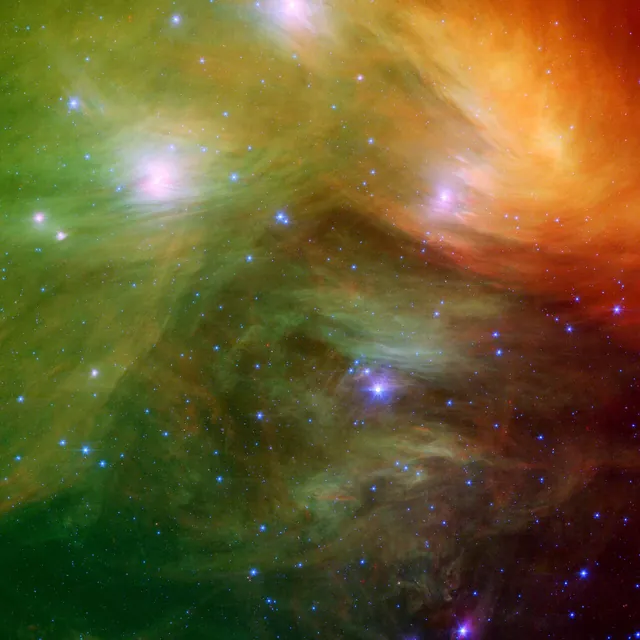
The nebulosity around the brightest stars is blue because it is reflection nebula: dust scattering the light of nearby stars. Vesto Slipher showed this in 1912, finding that the nebulae’s spectra were copies of the stars’ own. It is probably dust in a molecular cloud unrelated to the cluster, crossing its path at a relative speed of about 11 km/s, rather than leftover material from the cluster’s birth.3
Close to the star Merope, the Hubble Space Telescope caught a small cloud, IC 349, being sorted and eroded by the star’s light: radiation pressure slows the smaller dust grains more than the larger ones, so the larger grains stream on towards the star while the fine dust lags behind.19
Notable features
Merope Nebula (NGC 1435)
The brightest patch of the cluster’s reflection nebula, around the star Merope. Wilhelm Tempel discovered it at Venice on 19 October 1859 with a 4-inch refractor. An extension towards Maia was found in 1875, and the nebulae around Alcyone, Electra, Celaeno and Taygeta followed in 1880.3
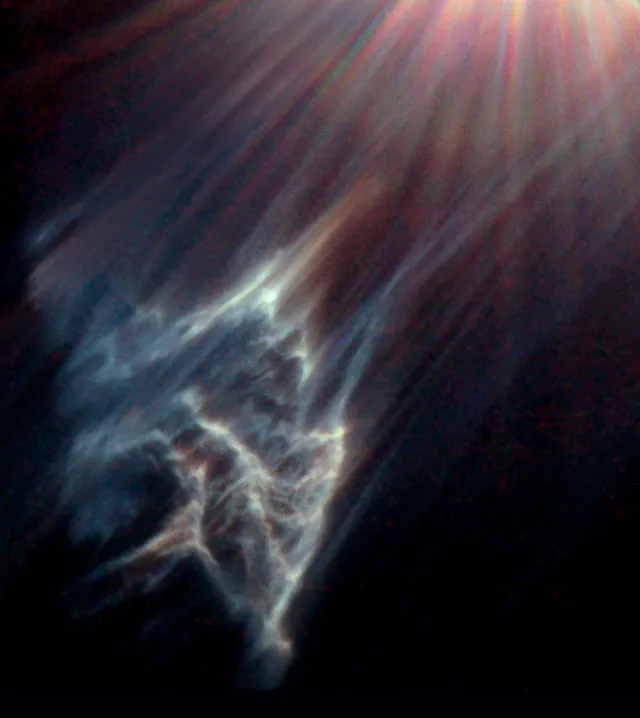
IC 349, Barnard’s Merope Nebula
A small, bright knot of nebulosity very close to Merope, discovered by E. E. Barnard in 1890. Hubble shows it as a cloud being destroyed by Merope’s radiation, with long straight streamers of larger dust grains pointing towards the star.139
Pleione
One of the brighter stars, named after the mother in the myth. It rotates very fast and varies in brightness between magnitudes 4.77 and 5.50. Spectra showed that between 1938 and 1952 it threw off a shell of gas, as O. Struve had predicted.3
Maia
Monitored with NASA’s Kepler space telescope during its K2 mission, Maia turned out not to be a so-called Maia variable after all. Its brightness changes come instead from a large chemical spot carried round as the star rotates, roughly every 10 days.10
History
The Pleiades has been known since prehistory and has no discoverer. Homer and Hesiod mention it in the 8th and 7th centuries BC, and the Bible names it three times. Its Japanese name is Subaru. Before the telescope, the astronomer Moestlin drew 11 of its stars correctly in 1579, and Galileo was the first to look at it through a telescope.13
In 1767 John Michell calculated that the chance of so tight a group appearing by accident was about 1 in 496,000, and concluded correctly that clusters are real physical groups. Charles Messier added it to his catalogue as number 45 on 4 March 1769. Around 1846 the German astronomer Mädler noticed that its stars share the same motion across the sky, more evidence that they travel together.3
Seeing it for yourself
The Pleiades lies about 10° north-west of the orange star Aldebaran in Taurus, and NASA names December as the best month to see it. At least six stars are visible to the unaided eye, about nine under moderate skies and more than a dozen under dark ones. Binoculars show more than 100 stars, and the cluster is often too large for a telescope’s lowest-power field.13
Because it lies only about 4° from the ecliptic, the Moon often passes in front of the cluster, hiding its stars one by one, and planets sometimes pass close by. The Merope Nebula needs a dark sky and is best seen in a wide-field telescope.3
Measuring the Pleiades
Soderblom’s team used Hubble’s Fine Guidance Sensors to measure the parallax of three cluster stars, taking measurements six months apart over two and a half years; the result, about 440 light-years, was presented in June 2004. Interferometer measurements from Mount Wilson and Palomar observatories gave 434 to 446 light-years.4
Melis and colleagues then linked radio telescopes across continents, including Arecibo, the Green Bank Telescope and Effelsberg, and tracked four Pleiades star systems for about a year and a half. Their 2014 distance of 136.2 ± 1.2 parsecs matched other methods, and Gaia’s second data release later gave the same answer.56
NASA’s Kepler telescope, in its K2 mission, watched the cluster too. A special technique called halo photometry let it follow the seven brightest stars, which are normally too bright for its camera: all of them vary, six most likely pulsating as slowly pulsating B stars. K2 also measured rotation periods for many cool dwarf members.1011
Quick answers
- Which constellation is the Pleiades in?
- The Pleiades lies in the constellation Taurus.1
- How far away is the Pleiades?
- The Pleiades is about 445 light-years from Earth (radio parallax 136.2 ± 1.2 pc; Gaia 135.15 ± 0.43 pc).156
- How bright is the Pleiades in the night sky?
- The Pleiades has an apparent magnitude of 1.6 (easily seen with the unaided eye).13
- How big does the Pleiades look in the sky?
- The Pleiades covers 110′ of sky (members spread over about 2°).3
- How old is the Pleiades?
- The Pleiades is about 125 million years old (from the lithium depletion boundary).2
Sources
- Messier 45 (The Pleiades) — NASA Science, Hubble’s Messier Catalog
- Keck spectra of Pleiades brown dwarf candidates and a precise determination of the lithium depletion edge in the Pleiades (Stauffer et al.) — Astrophysical Journal Letters 499, L199 (arXiv:astro-ph/9804005), 1998
- Messier 45 (H. Frommert & C. Kronberg) — SEDS Messier Database (Observatoire de Paris mirror), 2007
- Hubble Refines Distance to Pleiades Star Cluster — NASA Science (Hubble news release), 2004
- A VLBI resolution of the Pleiades distance controversy (Melis et al.) — Science 345, 1029 (arXiv:1408.6544), 2014
- A 5D view of the α Per, Pleiades, and Praesepe clusters (Lodieu et al.) — Astronomy & Astrophysics 628, A66 (arXiv:1906.03924), 2019
- SIMBAD astronomical database: M 45 — Centre de Données astronomiques de Strasbourg (CDS)
- Parallaxes and proper motions for 20 open clusters as based on the new Hipparcos catalogue (van Leeuwen) — Astronomy & Astrophysics 497, 209 (arXiv:0902.1039), 2009
- Ghostly Reflections in the Pleiades — NASA Science (Hubble news release), 2000
- Beyond the Kepler/K2 bright limit: variability in the seven brightest members of the Pleiades (White et al.) — Monthly Notices of the Royal Astronomical Society 471, 2882 (arXiv:1708.07462), 2017
- The lithium-rotation connection in the 125 Myr-old Pleiades cluster (Bouvier et al.) — Astronomy & Astrophysics 613, A63 (arXiv:1712.06525), 2018
Figures checked against these sources in November 2026. Where a quantity is not known, it is left out rather than estimated.

