star cluster
Beehive Cluster
The Beehive Cluster, also called Praesepe or Messier 44, is a swarm of about a thousand stars in the constellation Cancer. At around 600 light-years it is one of the closest open clusters to Earth, and from a dark site it shows to the unaided eye as a small misty patch, which ancient astronomers called the Little Cloud. Binoculars break it into a sparkling crowd of stars.12
Its stars formed together roughly 600 to 800 million years ago, making the cluster middle-aged among open clusters. Gaia data show long tidal tails of stars streaming away from it, stripped off by the Milky Way. In 2012 the Beehive became the first open cluster known to host hot Jupiters, giant planets that orbit Sun-like stars in just a few days.13456
Size, shape and distance
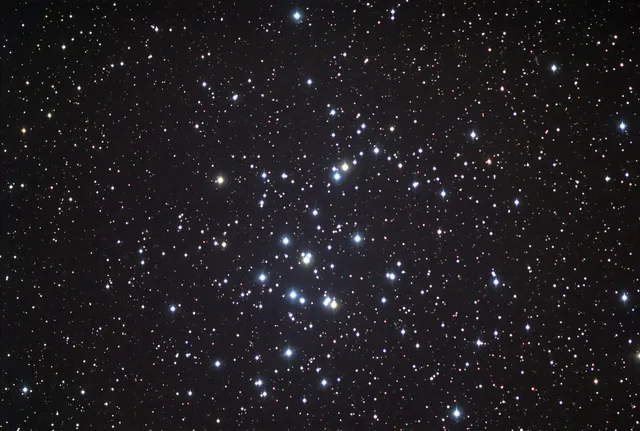
The Beehive is a loose open cluster held together by its own gravity out to a tidal radius of about 10.7 parsecs. A 2019 Gaia study counted 721 likely members inside that radius, with half of them within 5.9 parsecs of the centre and a core radius of 2.6 parsecs. Its heavier stars have sunk towards the middle, a sign of mass segregation.45
The cluster is slowly dissolving. Searching Gaia data within 400 parsecs of the Sun, Siegfried Röser and Elena Schilbach found two tidal tails of stars stretching up to 165 parsecs from the centre. Together the cluster and its tails hold 1,393 stars with a total mass of about 794 solar masses; 389 of those stars lie in the tails beyond twice the tidal radius.5
Distances have shifted as instruments improved. The 2009 reduction of Hipparcos data gave 181.5 ± 6.0 parsecs, while Gaia’s second data release gave 187.35 ± 3.89 parsecs from the cluster members. An earlier Hipparcos estimate had been 577 light-years, itself up from 522 light-years before the satellite flew. NASA now rounds the distance to about 600 light-years.1248
The stars inside
Most of the bright members are blue-white main-sequence stars, but the cluster is old enough to contain red giants, at least five of them, and several white dwarfs, the cooled cores of stars that have already died. Among its members are the eclipsing binary TX Cancri, the metallic-line star Epsilon Cancri and several Delta Scuti variables of magnitude 7 to 8.12
Its age depends on the stellar models used. NASA quotes 600 to 700 million years. Fitting models of rotating stars, Timothy Brandt and Chelsea Huang found about 800 million years for both the Beehive and the Hyades, while ages from the cluster’s white dwarfs come out near 700 million years. Three further white dwarfs have been found in its tidal tails.1345
The Beehive and the Hyades in Taurus share similar ages, motions through space and stellar populations, so they probably formed in the same great gas cloud, even though they now lie hundreds of light-years apart. Both clusters contain red giants and some white dwarfs, and both were once thought much younger, at 400 to 660 million years.23
Notable features
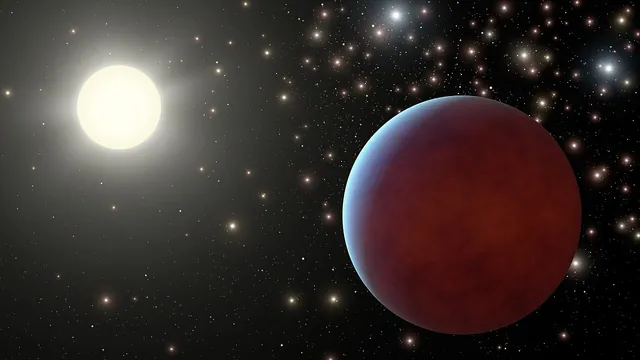
Pr0201 b
A hot Jupiter found in 2012 orbiting a late F-type dwarf of magnitude 10.52 every 4.4264 days. It has at least 0.54 times the mass of Jupiter, and with Pr0211 b it was the first planet known around a Sun-like main-sequence star in any star cluster.6
The Pr0211 system
Pr0211 b, at least 1.844 Jupiter masses, circles its late G-type star every 2.1451 days. Follow-up measurements from 2012 to 2015 revealed a second, outer giant, Pr0211 c, of at least 7.9 Jupiter masses on a very eccentric orbit longer than 3,500 days: the first multi-planet system found in an open cluster.69
The tidal tails
Two long streams of stars that have escaped the cluster, each reaching up to 165 parsecs from its centre and holding 389 stars between them beyond twice the tidal radius. They were mapped in Gaia’s second data release and match an N-body computer model of the cluster remarkably well.5
Asellus Borealis and Asellus Australis
Two stars flanking the cluster, both far closer to us at about 155 light-years: Gamma Cancri, of spectral type A1 V, and Delta Cancri, of type K0 III. Greeks and Romans saw them as two donkeys feeding at the manger, Praesepe, which gives the cluster its Latin name.2
History
The Beehive has been known since prehistory as a faint patch of light. Aratos called it the Little Mist around 260 BC, Hipparchus listed it as the Little Cloud, and Ptolemy included it among the nebulae in his Almagest. On Johann Bayer’s chart of about 1600 it appeared as Nubilum, the cloudy object.2
Galileo was the first to resolve it, reporting not a single star but a mass of more than 40 small stars. Peiresc probably saw it in 1611 and Simon Marius observed it as a cluster in 1612. Charles Messier added it to his catalogue on 4 March 1769. Later observers confirmed more than 200 of the 350 stars in the area as members by their shared motion.12
Seeing it for yourself
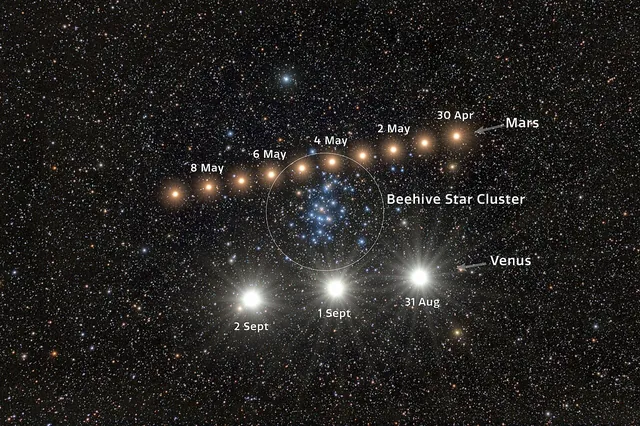
The Beehive is best seen in the Northern Hemisphere’s spring sky and reaches its highest point in March. To the unaided eye it is a blur just above the point where the three branches of Cancer’s upside-down Y meet. In light-polluted skies, look midway along a line from Regulus in Leo to Pollux in Gemini, slightly to the south and west.1
Binoculars resolve about 20 stars, and a telescope shows scores to hundreds more. Because the cluster is about 1.5° across, binoculars or a low-power wide field often frame it better than a telescope. In 2025 both Mars and Venus passed close to it in the sky.110
Telescopes on the Beehive
The planets Pr0201 b and Pr0211 b were found by measuring tiny Doppler shifts in their stars’ light. Of 53 single cluster stars surveyed, two had hot Jupiters, so at least 3.8 per cent of such stars host one. Because the cluster’s age is well known, the discovery also showed that giant planets can migrate inwards within 600 million years.6
The Hubble Space Telescope has photographed small patches at the cluster’s edge with its Advanced Camera for Surveys and Wide Field Camera 3. Those pictures were aimed past the cluster: they studied distant background galaxies, their magnetic fields and how much ionising radiation escapes from them.1
Quick answers
- Which constellation is the Beehive Cluster in?
- The Beehive Cluster lies in the constellation Cancer.1
- How far away is the Beehive Cluster?
- The Beehive Cluster is about 600 light-years from Earth (Gaia DR2: 187.35 ± 3.89 pc).14
- How bright is the Beehive Cluster in the night sky?
- The Beehive Cluster has an apparent magnitude of 3.7 (visible to the unaided eye).12
- How big does the Beehive Cluster look in the sky?
- The Beehive Cluster covers about 1.5° of sky (roughly three full Moons across).1
- How old is the Beehive Cluster?
- The Beehive Cluster is about 600–800 million years old (estimates differ with the stellar models used).134
- How massive is the Beehive Cluster?
- The Beehive Cluster has a mass of about 794 solar masses (cluster plus tidal tails, Gaia DR2 census).5
Sources
- Messier 44 (The Beehive Cluster) — NASA Science, Hubble’s Messier Catalog
- Messier 44 (H. Frommert & C. Kronberg) — SEDS Messier Database (Observatoire de Paris mirror), 2007
- The age and age spread of the Praesepe and Hyades clusters: a consistent, ~800 Myr picture from rotating stellar models (Brandt & Huang) — Astrophysical Journal 807, 24 (arXiv:1504.00004), 2015
- A 5D view of the α Per, Pleiades, and Praesepe clusters (Lodieu et al.) — Astronomy & Astrophysics 628, A66 (arXiv:1906.03924), 2019
- Praesepe (NGC 2632) and its tidal tails (Röser & Schilbach) — Astronomy & Astrophysics 627, A4 (arXiv:1903.08610), 2019
- Two ‘b’s in the Beehive: the discovery of the first hot Jupiters in an open cluster (Quinn et al.) — Astrophysical Journal Letters 756, L33 (arXiv:1207.0818), 2012
- SIMBAD astronomical database: M 44 — Centre de Données astronomiques de Strasbourg (CDS)
- Parallaxes and proper motions for 20 open clusters as based on the new Hipparcos catalogue (van Leeuwen) — Astronomy & Astrophysics 497, 209 (arXiv:0902.1039), 2009
- The GAPS programme with HARPS-N at TNG XI. Pr 0211 in M 44: the first multi-planet system in an open cluster (Malavolta et al.) — Astronomy & Astrophysics 588, A118 (arXiv:1602.00009), 2016
- Warning: Planets Crossing! (Image of the Week iotw2553b) — NSF NOIRLab, 2025
Figures checked against these sources in November 2026. Where a quantity is not known, it is left out rather than estimated.

