nebula
Orion Nebula
The Orion Nebula is the nearest region to Earth where massive stars are being born, and one of the brightest nebulae in the sky. It lies about 1,265 light-years away in Orion’s Sword, where the unaided eye sees it as a fuzzy patch. A telescope reveals a glowing cloud some 24 light-years across, lit from within by a tight knot of hot young stars called the Trapezium.1234
What we see is only the lit surface of something far larger. Ultraviolet light and a powerful wind from the most massive star, θ¹ Orionis C, have opened a glowing blister on the face of a dark molecular cloud. Inside it Hubble has recorded more than 3,000 young stars, many still wrapped in the dusty discs from which planets may form.5678910
Shape and size in space
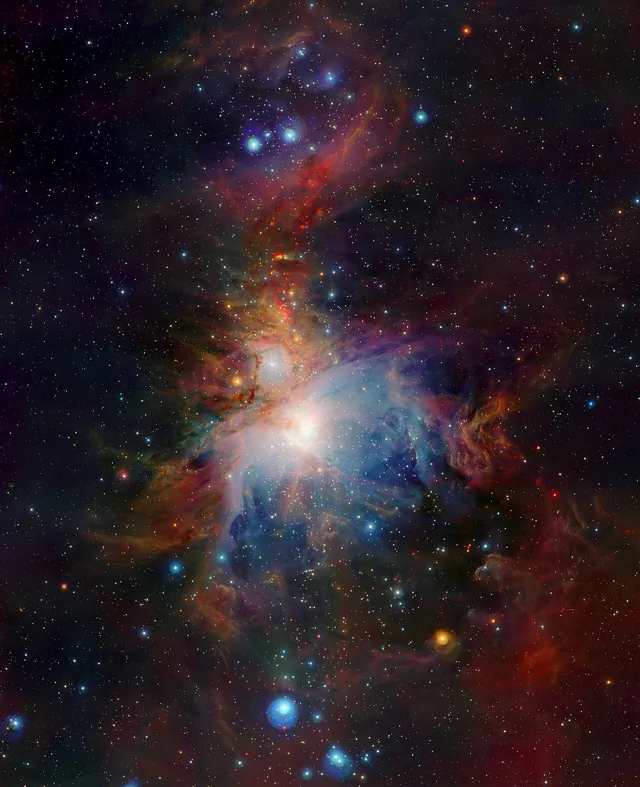
Radio telescopes of the Very Long Baseline Array have measured the parallaxes of young stars in the nebula’s cluster, placing it 388 ± 5 parsecs away, about 1,265 light-years. An earlier measurement by the same method gave 414 ± 7 parsecs, and many popular accounts still quote 1,350 or 1,500 light-years. On the sky the nebula covers about 65′ × 60′, which makes it roughly 24 light-years across.3412131819
The glowing gas is not a ball but a thin blister of ionised gas on the near face of a giant molecular cloud, Orion A, and we happen to view it almost face-on. The Trapezium stars sit at the cloud’s surface and have carved a cavity in it; behind them lies the dense cloud core called OMC-1. Orion A itself is a comet-shaped cloud about 90 parsecs long.2581720
In front of the bright nebula hangs the Veil, layers of atomic and molecular gas 1–3 parsecs nearer to us. It belongs to a bubble about 4 parsecs across, swept up by the wind of θ¹ Orionis C: a shell of roughly 2,600 solar masses expanding at 13 km/s. To the south the cavity ends at the Orion Bar, M43 lies just to the north, and an older group of stars, NGC 1980, stands in the foreground.61721
- Distance
- 388 ± 5 pc (1,265 light-years)3VLBA radio parallaxes
- Apparent size
- 65′ × 60′12
- Diameter
- about 24 light-years4
- Wind-blown bubble
- about 4 pc (13 light-years) across6blown by θ¹ Orionis C
- Mass of the bubble’s shell
- about 2,600 solar masses6
- Expansion speed of the shell
- 13 km/s6
- The Veil
- 1–3 pc in front of the ionised blister17
- Orion Bar to θ¹ Orionis C
- 0.228 pc1projected separation, for an adopted distance of 414 pc
- Length of the Orion A cloud
- about 90 pc20
- Foreground cluster NGC 1980
- about 2,000 stars, 4–5 million years old21
What makes it shine
The nebula is an H II region: a cloud whose hydrogen has been ionised and heated by ultraviolet light from hot, massive young stars. Chief among them is θ¹ Orionis C, the O-type star of the Trapezium. The ionised gas glows in sharp emission lines, above all hydrogen’s red Hα line at 656.3 nm, joined by a strong green pair from doubly ionised oxygen at 495.9 and 500.7 nm.471722
Those lines also act as thermometers and pressure gauges. One deep spectrum from ESO’s Very Large Telescope gave electron temperatures of about 8,300 K from oxygen lines and 10,150 K from nitrogen lines, with some 8,900 electrons in every cubic centimetre. At the edge of the Orion Bar the ionised gas is at about 9,000 K with roughly 5,000 electrons per cubic centimetre.123
Not all the light comes from glowing gas. Dust reflects starlight as well, so catalogues class M42 as both an emission and a reflection nebula, and light scattered from its bright core has been detected across neighbouring M43. In Hubble’s famous mosaic the colours are assigned rather than natural: orange for hydrogen, green for oxygen, red for sulphur and infrared light.2121324
- Main ionising star
- θ¹ Orionis C (O7 Vp)16
- Hydrogen Hα line
- 656.28 nm22red
- Oxygen [O III] lines
- 495.9 nm and 500.7 nm22green
- Electron temperature
- 8,300 ± 40 K ([O III]); 10,150 ± 350 K ([N II])23at one position in the bright nebula
- Electron density
- 8,900 ± 200 per cm³23at the same position
- At the Orion Bar’s ionisation front
- about 9,000 K; about 5,000 electrons per cm³1
The stars inside
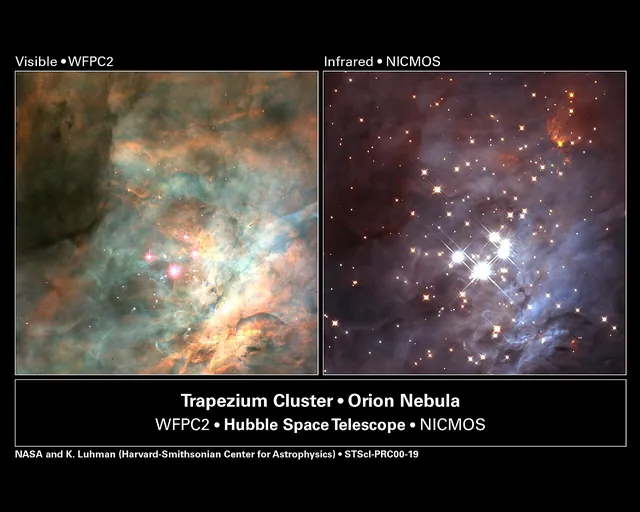
At the nebula’s heart four bright stars, θ¹ Orionis A, B, C and D, mark out the Trapezium. All are hot O- and B-type stars. The brightest, θ¹ Orionis C, is really a close pair circling every 11.3 years with a combined mass of 44 ± 7 Suns. The VLT’s GRAVITY instrument found that eleven of the sixteen massive stars it studied in the cluster are multiple systems.71625262728
Around them spreads the Orion Nebula Cluster. Hubble’s 2006 survey recorded more than 3,000 stars, and a long Chandra exposure catalogued over 1,600 X-ray sources. The cluster is very young: its ages peak at 2–3 million years, and one study found three generations of stars formed within less than three million years. Members range from massive O stars down to brown dwarfs of 0.02 solar masses.8914152930
Infrared surveys keep adding fainter members. In 2016 ESO’s HAWK-I camera revealed about ten times as many brown dwarfs and isolated planetary-mass objects as were known before. Some stars have left altogether: the runaways AE Aurigae and μ Columbae were traced back to the young Trapezium region about 2.5 million years ago. And part of what was once counted as the cluster is a separate foreground group, NGC 1980.42131
- θ¹ Orionis A
- spectral type B0 V; magnitude 6.7325
- θ¹ Orionis B
- spectral type B1 V; magnitude 7.9626
- θ¹ Orionis C
- spectral type O7 Vp; magnitude 5.1316
- θ¹ Orionis D
- spectral type B1.5 Vp; magnitude 6.7027
- Mass of the θ¹ Orionis C pair
- 44 ± 7 solar masses7
- Orbital period of the θ¹ Orionis C pair
- 11.3 years7
- Mass of the θ¹ Orionis D system
- 21.7 solar masses28
- Typical age
- 2–3 million years15peak of the age distribution
- Lowest masses in the 2012 optical census
- 0.02 solar masses30
Notable features
The Trapezium
Four hot stars, θ¹ Orionis A to D, packed into the nebula’s brightest patch. Galileo saw three of them on 4 February 1617; Jean Picard found the fourth in 1673. Their ultraviolet light, above all from θ¹ Orionis C, carves the cavity and sets the gas glowing.29
The Orion Bar
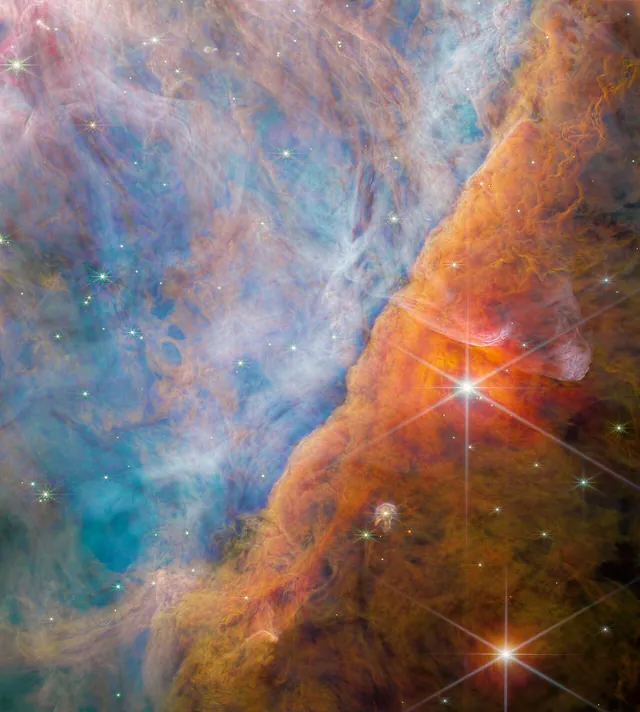
A ridge of dense gas where the glowing cavity meets the dark molecular cloud, seen almost edge-on about 0.23 parsecs from θ¹ Orionis C. Here starlight first strips atoms of electrons and then, deeper in, breaks molecules apart. JWST resolves its layers down to 40–400 astronomical units.117
Proplyds
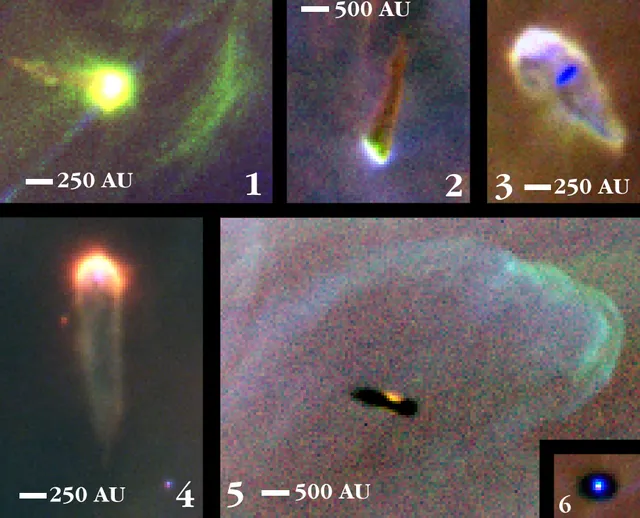
Protoplanetary discs around newborn stars, discovered by Hubble in 1992 and named by C. Robert O’Dell. Near the Trapezium they glow and trail comet-like tails as radiation boils them away; farther out they show as dark silhouettes. A 1994 survey found discs around 56 of 110 stars, and a 1995 mosaic showed 153 glowing discs.10323334
The Kleinmann–Low Nebula and BN object
Hidden behind the visible nebula, about 1′ north-west of the Trapezium, an infrared nebula holds the Becklin–Neugebauer object. ALMA has mapped more than a hundred streamers of carbon monoxide flying outwards from an explosion about 500 years ago, the same event that flung out BN at about 29 km/s.35
M43, De Mairan’s Nebula
A smaller, rounder glow just north of the main nebula, cut off from it by a dark lane. First reported by Jean-Jacques d’Ortous de Mairan in 1731 and about 20′ × 15′ in size, it is lit by a single star, NU Orionis, of type B0.5 V.172436
Jupiter-mass binary objects (JuMBOs)
In 2023 a JWST survey reported 540 planetary-mass candidates near the Trapezium, with 9% of them in wide pairs. They remain candidates whose nature is debated: a 2024 reanalysis found that most of the pairs have the colours of reddened background sources, or are too faint to judge.3738
Discovery and history
Although the nebula can be seen without a telescope, no certain record of its cloudy nature survives from before the telescope. Nicolas-Claude Fabri de Peiresc probably discovered it in late 1610, but his note stayed unpublished. The Jesuit astronomer Johann Baptist Cysat found it independently in 1611 and described it in a 1619 book on the comet of 1618. Christiaan Huygens rediscovered it in 1656 and was long given the credit.2
Charles Messier added it to his catalogue as number 42 on 4 March 1769, giving the detached patch to its north-east a number of its own, 43. In 1865 William Huggins used a spectroscope to show that the nebula is glowing gas. On 30 September 1880 Henry Draper made it the first nebula ever photographed, and on 14 March 1882 he took a deeper 137-minute exposure.2
- Probable discovery
- late 1610, Nicolas-Claude Fabri de Peiresc2
- Independent discovery
- 1611, Johann Baptist Cysat2published in 1619
- Trapezium first seen as a triple star
- 4 February 1617, Galileo Galilei2
- Rediscovery
- 1656, Christiaan Huygens2
- Catalogued as M42
- 4 March 1769, Charles Messier2
- Shown to be gaseous
- 1865, William Huggins2by spectroscopy
- First photograph of a nebula
- 30 September 1880, Henry Draper2
Seeing it for yourself
The Orion Nebula is among the easiest deep-sky objects to find. It surrounds the star θ Orionis in the middle of Orion’s Sword, just below the hunter’s Belt. At magnitude 4.0 it shows to the unaided eye from a dark site as a fuzzy patch, and NASA’s Hubble observing guide names January as the best month to look.2413
The nebula spans about 65′ × 60′, more than four times the area of the full Moon. Telescopes of every size reward a look: the Trapezium sits at the end of a dark lane, nicknamed the Fish’s Mouth, that reaches in from the direction of M43. Early telescopic observers described a small cluster of blue-white stars wrapped in a grey-green mist.21219
Telescopes on Orion
Hubble has returned to Orion throughout its life. Its largest survey, the Orion Treasury Project led by Massimo Robberto, used 104 orbits in 2004 and 2005 with three cameras working at once. The mosaic released on 11 January 2006 joins 520 images in five colours into a billion-pixel picture about as wide as the full Moon, and the survey measured the brightness of 3,399 stars.28939
Other telescopes look through the dust. In January 2003 Chandra watched the cluster for 13.2 days, the Chandra Orion Ultradeep Project, catching violent X-ray flares from its young stars. Spitzer’s infrared survey of the wider Orion clouds, released in 2006, found nearly 2,300 planet-forming discs. From the ground, ESO’s VISTA telescope in 2010 and HAWK-I camera in 2016 mapped the region in near-infrared light.419294041
The James Webb Space Telescope imaged the inner nebula on 11 September 2022 for PDRs4All, a programme centred on the Orion Bar. A second NIRCam survey covered 10.9′ × 7.5′ around the Trapezium in twelve filters. ESA released its two mosaics on 2 October 2023, built from 2,400 short-wavelength and 712 long-wavelength images.1424344
Quick answers
- What kind of object is the Orion Nebula?
- The Orion Nebula is an H II region (emission and reflection nebula).1112
- Which constellation is the Orion Nebula in?
- The Orion Nebula lies in the constellation Orion.13
- How far away is the Orion Nebula?
- The Orion Nebula is 1,265 light-years (388 ± 5 pc) from Earth, from radio parallaxes of stars in its cluster.3
- How big does the Orion Nebula look in the sky?
- The Orion Nebula covers 65′ × 60′ of sky (more than four times the area of the full Moon).212
- How big is the Orion Nebula?
- The Orion Nebula is about 24 light-years across.4
Sources
- PDRs4All II: JWST’s NIR and MIR imaging view of the Orion Nebula (Habart et al.) — Astronomy & Astrophysics 685, A73 (arXiv:2308.16732), 2024
- Messier 42 (H. Frommert & C. Kronberg) — SEDS Messier Database (Observatoire de Paris mirror), 2007
- The Gould’s Belt Distances Survey (GOBELINS). II. Distances and Structure toward the Orion Molecular Clouds (Kounkel et al.) — Astrophysical Journal 834, 142 (arXiv:1609.04041), 2017
- Deepest Ever Look into Orion (eso1625) — European Southern Observatory, 2016
- The Orion Nebula and Its Associated Population (O’Dell) — Annual Review of Astronomy and Astrophysics 39, 99, 2001
- Disruption of the Orion molecular core 1 by wind from the massive star θ¹ Orionis C (Pabst et al.) — Nature 565, 618 (arXiv:1901.04221), 2019
- Tracing the young massive high-eccentricity binary system θ¹ Orionis C through periastron passage (Kraus et al.) — Astronomy & Astrophysics 497, 195 (arXiv:0902.0365), 2009
- Hubble panoramic view of Orion Nebula reveals thousands of stars (heic0601) — ESA/Hubble, 2006
- Hubble’s sharpest view of the Orion Nebula (image heic0601a) — ESA/Hubble, 2006
- Born in beauty: proplyds in the Orion Nebula (heic0917) — ESA/Hubble, 2009
- SIMBAD astronomical database: M 42 — Centre de Données astronomiques de Strasbourg (CDS)
- Revised NGC Data for NGC 1976 (from W. Steinicke’s Revised NGC and IC Catalog) — SEDS Interactive NGC Catalog
- Messier 42 (The Orion Nebula) — NASA Science, Hubble’s Messier Catalog
- A Tale of Three Stellar Cities (eso1723) — European Southern Observatory, 2017
- A Multi-color Optical Survey of the Orion Nebula Cluster. II. The H-R Diagram (Da Rio et al.) — Astrophysical Journal 722, 1092 (arXiv:1008.1265), 2010
- SIMBAD astronomical database: * tet01 Ori C — Centre de Données astronomiques de Strasbourg (CDS)
- Expanding bubbles in Orion A: [C II] observations of M42, M43, and NGC 1977 (Pabst et al.) — Astronomy & Astrophysics 639, A2 (arXiv:2005.03917), 2020
- The distance to the Orion Nebula (Menten, Reid, Forbrich & Brunthaler) — Astronomy & Astrophysics 474, 515 (arXiv:0709.0485), 2007
- Orion in a New Light (eso1006) — European Southern Observatory, 2010
- 3D shape of Orion A from Gaia DR2 (Großschedl et al.) — Astronomy & Astrophysics 619, A106 (arXiv:1808.05952), 2018
- Orion revisited. I. The massive cluster in front of the Orion Nebula Cluster (Alves & Bouy) — Astronomy & Astrophysics 547, A97 (arXiv:1209.3787), 2012
- A MUSE map of the central Orion Nebula (M 42) (Weilbacher et al.) — Astronomy & Astrophysics 582, A114 (arXiv:1507.00006), 2015
- A reappraisal of the chemical composition of the Orion nebula based on VLT echelle spectrophotometry (Esteban et al.) — Monthly Notices of the Royal Astronomical Society 355, 229 (arXiv:astro-ph/0408249), 2004
- A detailed study of the H II region M 43 and its ionizing star (Simón-Díaz et al.) — Astronomy & Astrophysics 530, A57 (arXiv:1103.3628), 2011
- SIMBAD astronomical database: * tet01 Ori A — Centre de Données astronomiques de Strasbourg (CDS)
- SIMBAD astronomical database: * tet01 Ori B — Centre de Données astronomiques de Strasbourg (CDS)
- SIMBAD astronomical database: * tet01 Ori D — Centre de Données astronomiques de Strasbourg (CDS)
- Multiple star systems in the Orion nebula (GRAVITY Collaboration) — Astronomy & Astrophysics 620, A116 (arXiv:1809.10376), 2018
- Chandra Orion Ultradeep Project: Observations and Source Lists (Getman et al.) — Astrophysical Journal Supplement Series 160, 319 (arXiv:astro-ph/0410136), 2005
- The Initial Mass Function of the Orion Nebula Cluster across the H-burning Limit (Da Rio et al.) — Astrophysical Journal 748, 14 (arXiv:1112.2711), 2012
- On the origin of the O and B-type stars with high velocities. II. Runaway stars and pulsars ejected from the nearby young stellar groups (Hoogerwerf, de Bruijne & de Zeeuw) — Astronomy & Astrophysics 365, 49 (arXiv:astro-ph/0010057), 2001
- NASA’s Hubble Space Telescope Discovers Protoplanetary Disks Around Newly Formed Stars — NASA Science (Hubble news release), 1992
- Hubble Confirms Abundance of Protoplanetary Disks around Newborn Stars — NASA Science (Hubble news release), 1994
- Panoramic Hubble Picture Surveys Star Birth, Proto-Planetary Systems in the Great Orion Nebula — NASA Science (Hubble news release), 1995
- The ALMA View of the OMC1 Explosion in Orion (Bally et al.) — Astrophysical Journal 837, 60 (arXiv:1701.01906), 2017
- Messier 43 (H. Frommert & C. Kronberg) — SEDS Messier Database (Observatoire de Paris mirror), 2007
- Jupiter Mass Binary Objects in the Trapezium Cluster (Pearson & McCaughrean) — arXiv preprint arXiv:2310.01231, 2023
- Candidates for Substellar Members of the Orion Nebula Cluster from JWST/NIRCam (Luhman) — Astronomical Journal 168, 230 (arXiv:2410.10406), 2024
- The Hubble Space Telescope Treasury Program on the Orion Nebula Cluster (Robberto et al.) — Astrophysical Journal Supplement Series 207, 10 (arXiv:1304.4866), 2013
- Orion Nebula Cluster (Chandra Photo Album, 10 May 2005) — Chandra X-ray Center, Harvard-Smithsonian Center for Astrophysics, 2005
- NASA’s Spitzer Digs Up Troves of Possible Solar Systems in Orion (ssc2006-16) — NASA Spitzer Science Center, Caltech, 2006
- Western researchers among first to capture James Webb Space Telescope images — Western University (Western News), 2022
- A JWST survey of the Trapezium Cluster & inner Orion Nebula. I. Observations & overview (McCaughrean & Pearson) — arXiv preprint arXiv:2310.03552, 2023
- Webb’s wide-angle view of the Orion Nebula is released in ESASky — European Space Agency, 2023
Figures checked against these sources in November 2026. Where a quantity is not known, it is left out rather than estimated.

