nebula
Horsehead and Flame Nebulae
The Horsehead Nebula is a cold, dark cloud of gas and dust whose outline really does look like the head of a horse. Catalogued as Barnard 33, it juts out from a larger dark cloud in Orion, just south of Alnitak, the easternmost star of Orion’s Belt. We see it in silhouette because a glowing sheet of hydrogen, the H II region IC 434, lies behind it.1234
The nebula lies roughly 1,300 to 1,400 light-years away, in the Orion B molecular cloud. Ultraviolet light from the hot star σ Orionis is slowly eating into it, but its dense clumps resist erosion: astronomers estimate the pillar has about five million years left. Its sharp, almost edge-on boundary makes it one of the best places in the sky to study how starlight works on interstellar matter.23567
Shape and size in space
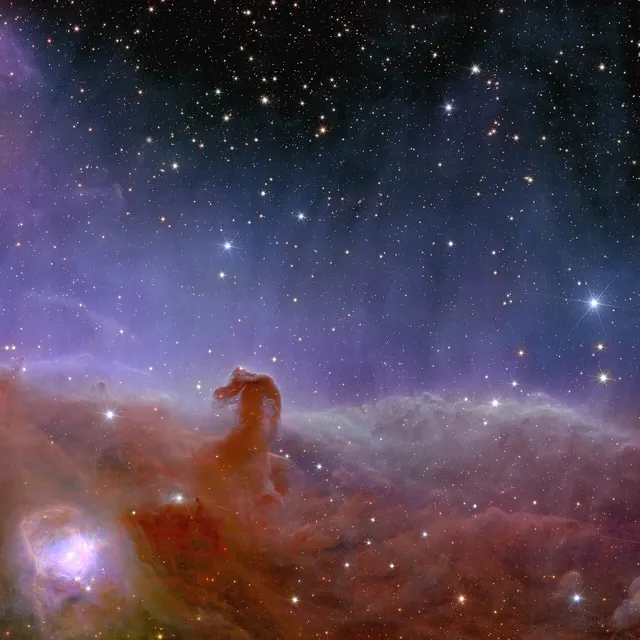
The Horsehead is a dust protrusion on the southern part of the dense dark cloud Lynds 1630, part of the Orion molecular cloud complex. It sits on the edge of IC 434, a region of glowing ionised hydrogen. Pillars like this, common on the borders of H II regions, are called elephant trunks; the Pillars of Creation in the Eagle Nebula are another example.12
Distances quoted for the nebula differ a little. ESO gives about 1,400 light-years (430 parsecs), ESA’s Euclid team about 1,375 light-years, the Webb team roughly 1,300, and an infrared study of its stars about 400 parsecs. Molecular-line maps show a filament of gas and dust 0.15–0.30 parsecs wide, the “neck”, linking the head to its parent cloud, with the material in it rotating.2351011
Dense cores lie inside the pillar. Submillimetre observations found one behind the bright upper edge, SMM1, which is not bound by its own gravity but is squeezed by the pressure of IC 434, and a second clump in the horse’s “throat”, SMM2, which is close to gravitational balance and may be starless or pre-stellar. Ordered magnetic fields thread both.1213
Why it looks dark
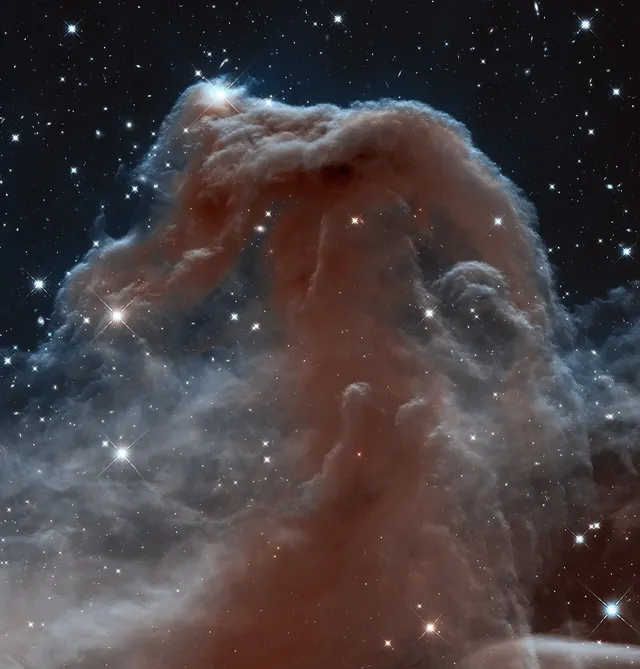
The Horsehead does not shine by itself. Ultraviolet light from σ Orionis, an O9.5 V star above the nebula, makes the hydrogen behind it glow red, while the thick dust of the head blocks that light from reaching us. The cloud itself is mostly cold molecular hydrogen, which gives off very little heat and no visible light.236
Along the top of the head runs a bright rim, an ionisation front where ultraviolet photons push into the cloud, destroying dust and molecules and heating the gas. Behind it lies a photodissociation region, viewed nearly edge-on, where starlight breaks molecules apart. Here the gas density climbs steeply over about 0.02 parsecs, from about 10,000 to 100,000 hydrogen atoms per cubic centimetre.256
In visible light the blue-green patches are dust ridges facing the stars, scattering their light towards us, while the horse’s “mane” is thinner dust through which background hydrogen glow shows. Infrared light passes through much of the dust, which is why Hubble’s and Webb’s infrared images show delicate folds of gas instead of a black silhouette.27
Stars forming in the pillar
Star formation in the Horsehead itself is modest. A deep near- and mid-infrared survey of a 7′ × 7′ field found three definite and five candidate young stars. Two of the definite ones sit at the western tip of the pillar, the edge that faces σ Orionis, consistent with star birth triggered by the compression of the cloud, although no sequence of star formation was seen behind the front.10
To the east, in the main body of Lynds 1630, star formation is more active: the reflection nebula NGC 2023 surrounds the hot B-type star HD 37903, and Herbig–Haro objects mark fast outflows from young stars of about one solar mass. σ Orionis itself belongs to a cluster of more than a hundred stars, whose fainter members Euclid is helping to find.23
Notable features
The illuminated edge
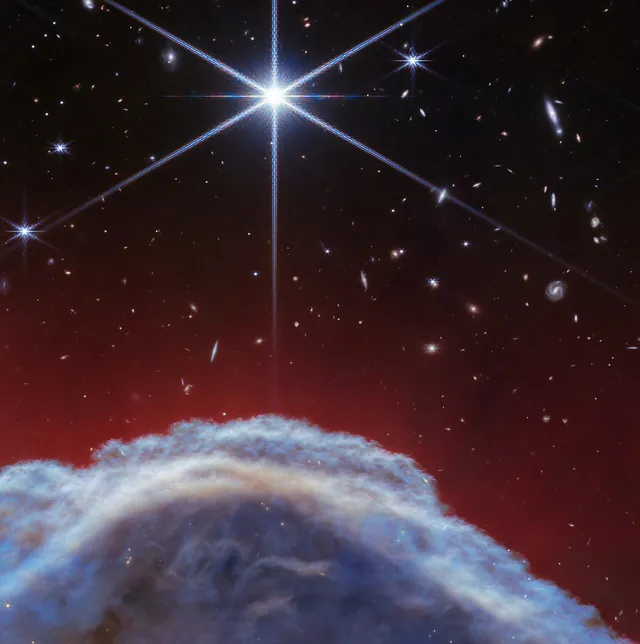
The top of the head is a sharp photodissociation front facing σ Orionis. JWST resolved it in detail and found the ionisation and dissociation fronts lying 1–2″ behind the edge and almost together, so the layer of neutral atomic gas between them is thinner than about 100 astronomical units.515
Evaporating streamers
Webb’s images show a network of faint striations reaching from the front out into the H II region, perpendicular to the edge. They contain dust and ionised gas carried off in the flow of material evaporating from the cloud, possibly the first detection of dust entrained in such a flow.515
SMM1 and SMM2
Two dense cores seen at submillimetre wavelengths. SMM1 lies behind the bright upper rim and is held together by outside pressure; SMM2, a lozenge-shaped clump in the horse’s throat, appears dark against infrared emission and is roughly in gravitational balance.1213
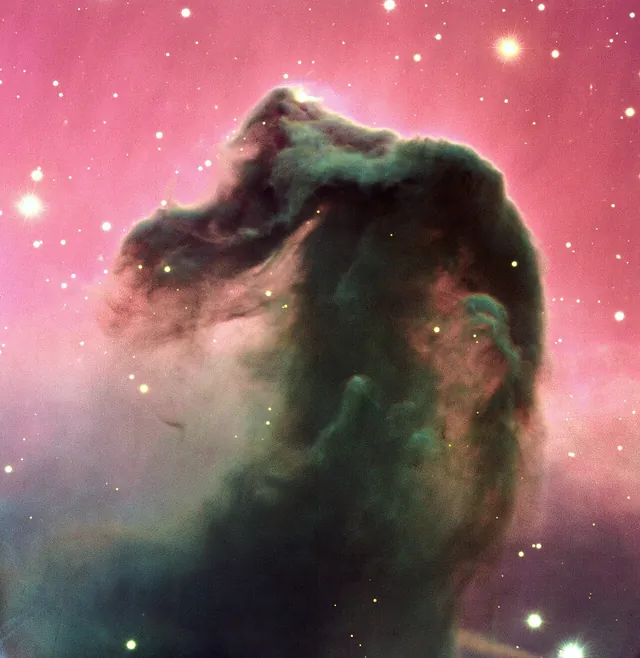
The mane
A region where there is less dust along our line of sight, so the red glow of ionised hydrogen in IC 434 behind the nebula shows through the foreground dust. In visible-light images it gives the head its wispy, feathered outline.2
Discovery and history
The nebula’s distinctive shape was first noticed on a photographic plate in the late 1800s. In 1888 Williamina Fleming, who examined and catalogued the glass plates at the Harvard College Observatory, picked out the horse’s head on one of them; it was one of some fifty gaseous and planetary nebulae she detected. It is catalogued as Barnard 33.149
Seeing it for yourself
The Horsehead lies just south of ζ Orionis, Alnitak, the left-hand star of the three in Orion’s Belt, which is easy to see with the unaided eye. The nebula itself is another matter: amateur astronomers treat it as a test of skill, because it is one of the more difficult objects to see visually with an amateur-sized telescope.13
Telescopes on the Horsehead
More than 5,000 internet voters chose the Horsehead as a target for Hubble, which released the resulting visible-light portrait on 24 April 2001 for its eleventh anniversary. On 19 April 2013 Hubble marked its 23rd anniversary with a new picture taken in infrared light with Wide Field Camera 3. ESO built a colour image from archive VLT data taken on 1 February 2000.127
Euclid imaged a wide field around the nebula; the picture was released on 7 November 2023. On 29 April 2024 the James Webb Space Telescope team published the sharpest infrared images of the nebula so far, made with NIRCam and MIRI in 17 broad and 6 narrow filters from 0.7 to 28 μm in guaranteed-time programme 1192.3515
Quick answers
- What kind of object is Horsehead and Flame Nebulae?
- Horsehead and Flame Nebulae is a dark nebula (a dust pillar at the edge of an H II region).24
- Which constellation is Horsehead and Flame Nebulae in?
- Horsehead and Flame Nebulae lies in the constellation Orion.57
- How far away is Horsehead and Flame Nebulae?
- Horsehead and Flame Nebulae is about 1,300–1,400 light-years from Earth (published estimates range from about 1,300 to 1,400 light-years).235
- How big does Horsehead and Flame Nebulae look in the sky?
- Horsehead and Flame Nebulae covers 6′ × 4′ of sky.4
Sources
- Eleven years in orbit: Hubble observes the popular Horsehead nebula (heic0105) — ESA/Hubble, 2001
- VLT Images the Horsehead Nebula (eso0202) — ESO, 2002
- Euclid’s view of the Horsehead Nebula — ESA, 2023
- SIMBAD astronomical database: Barnard 33 — Centre de Données astronomiques de Strasbourg (CDS)
- Webb captures iconic Horsehead Nebula in unprecedented detail (weic2411) — ESA/Webb, 2024
- Density structure of the Horsehead nebula photo-dissociation region (Habart et al.) — Astronomy & Astrophysics (arXiv:astro-ph/0501536), 2005
- A fresh take on the Horsehead Nebula (heic1307) — ESA/Hubble, 2013
- SIMBAD astronomical database: IC 434 — Centre de Données astronomiques de Strasbourg (CDS)
- Scientist of the Day: Williamina Fleming — Linda Hall Library
- An Infrared Census of Star Formation in the Horsehead Nebula (Bowler et al.) — Astronomical Journal 137, 3685 (arXiv:0901.0564), 2009
- Velocity field and star formation in the Horsehead nebula (Hily-Blant et al.) — Astronomy & Astrophysics (arXiv:astro-ph/0601605)
- SCUBA observations of the Horsehead Nebula – what did the horse swallow? (Ward-Thompson et al.) — Monthly Notices of the Royal Astronomical Society 369, 1201 (arXiv:astro-ph/0603604), 2006
- Magnetic fields in the Horsehead Nebula (Hwang et al.) — Astronomical Journal (arXiv:2303.07628), 2023
- The extremely sharp transition between molecular and ionized gas in the Horsehead nebula (Hernández-Vera et al.) — Astronomy & Astrophysics 677, A152 (arXiv:2307.09540), 2023
- JWST observations of the Horsehead photon-dominated region I. First results from multi-band near- and mid-infrared imaging (Abergel et al.) — Astronomy & Astrophysics (arXiv:2404.15816), 2024
Figures checked against these sources in November 2026. Where a quantity is not known, it is left out rather than estimated.

