nebula
Eagle Nebula (M16)
The Eagle Nebula is a vast star-forming cloud in Serpens, home to the young star cluster NGC 6611 and to the Pillars of Creation, the towering columns of cold gas and dust made famous by the Hubble Space Telescope in 1995. NASA gives the whole nebula as about 70 by 55 light-years. Gaia measurements place its cluster about 1,740 parsecs away; NASA and ESO quote 6,500–7,000 light-years.123456
Ultraviolet light and winds from the cluster’s hot, massive stars make the gas glow and slowly eat it away. The pillars survive only because their dense tips shade the gas behind them. New stars are still forming inside, but the columns are evaporating: ESO’s MUSE instrument measured a loss of about 70 solar masses every million years, which gives them perhaps three million years more.6789
Shape and size in space
Estimates of the Eagle’s distance vary. NASA’s Hubble guide and ESO give about 7,000 light-years, while Hubble and Webb releases give 6,500. Gaia parallaxes of the cluster NGC 6611 point to about 1,740 parsecs, and a Chandra X-ray study adopted 1,750 parsecs. The nebula lies in the Sagittarius–Carina arm of the Milky Way, the next spiral arm inward from the Sun’s.12456912
NASA gives the nebula’s extent as about 70 by 55 light-years. On the sky the glowing cloud spans more than 30′, while the cluster covers about 7′. ESO notes that the nebula’s outline is vaguely reminiscent of an eagle, with the central pillars as its talons. The cluster, NGC 6611, and the nebula, IC 4703, are catalogued separately, but both carry the name Messier 16.125
Observations with ESO’s MUSE instrument gave the first complete three-dimensional view of the Pillars of Creation in 2015. The tip of the left-hand pillar faces us and sits atop a column lying behind NGC 6611, so it takes the brunt of the cluster’s radiation and looks brighter; the tips of the other pillars point away from us. The left pillar, about four light-years long, is roughly twice the height of the right one.78
What makes it shine
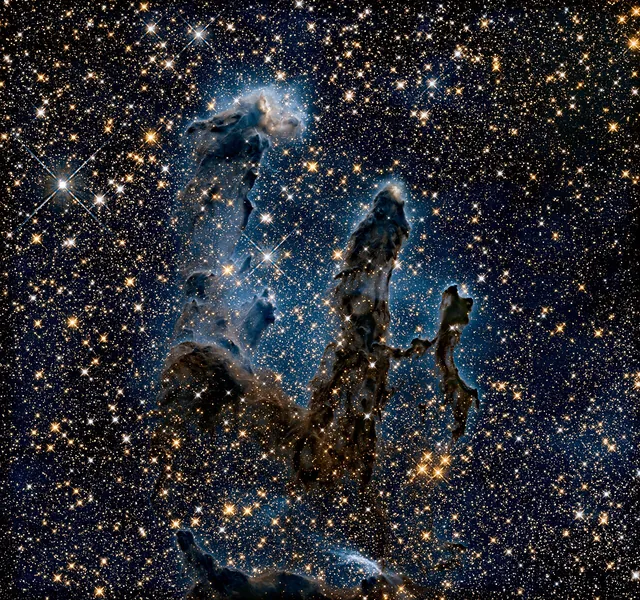
The Eagle is an emission nebula: its gas shines because the high-energy radiation of the massive young stars in NGC 6611 excites it. The same ultraviolet light heats the surfaces of the pillars and boils gas off into space, a process called photoevaporation. In Hubble’s images the escaping gas shows as ghostly streamers, and as a bluish haze around the pillars’ dense edges.236
The colours in Hubble’s pictures are chosen to map elements: in its 2014 view blue represents oxygen, red sulphur, and green both nitrogen and hydrogen. In infrared light the pillars turn into thin, wispy silhouettes against a background crowded with stars, because infrared light passes through much of the dust that blocks visible light and reveals newborn stars inside the columns.16
Infrared surveys by the Spitzer Space Telescope found a shell of unusually warm dust inside the nebula. A 2011 study offered two explanations: dust ground down in shocks as the cluster’s winds push against gas evaporating from the clouds, or the remnant of a supernova cooling through its dust. The study left both possibilities open.13
- Present mass of the pillars
- about 200 solar masses7
The stars inside
NGC 6611 is a young, massive cluster. A Chandra X-ray study of the region found 93 OB stars and 1,755 X-ray sources, of which 1,183 are candidate members, with ages up to about three million years. Star formation has moved across the nebula from the south-east, where stars are about 2.6 million years old, to the north-west, where they are about 0.3 million years old.1112
The cluster’s O-type stars often come in pairs. A spectroscopic campaign on nine of them, run from 2003 to 2009, found that at least 44 per cent, and perhaps 67 per cent, are binaries, and that up to three-quarters belong to a system pairing an O star with another O or B star. The SEDS catalogue gives the cluster’s brightest star as visual magnitude 8.24.214
Gaia proper motions show NGC 6611 expanding at about 1 km/s, and its core may stay bound while outer stars escape. The study of the nebula’s star-formation history found no sign that the cluster’s OB stars triggered star formation on a large scale; its authors suggested instead an encounter, about three million years ago, with a giant molecular shell created some six million years ago.411
Notable features
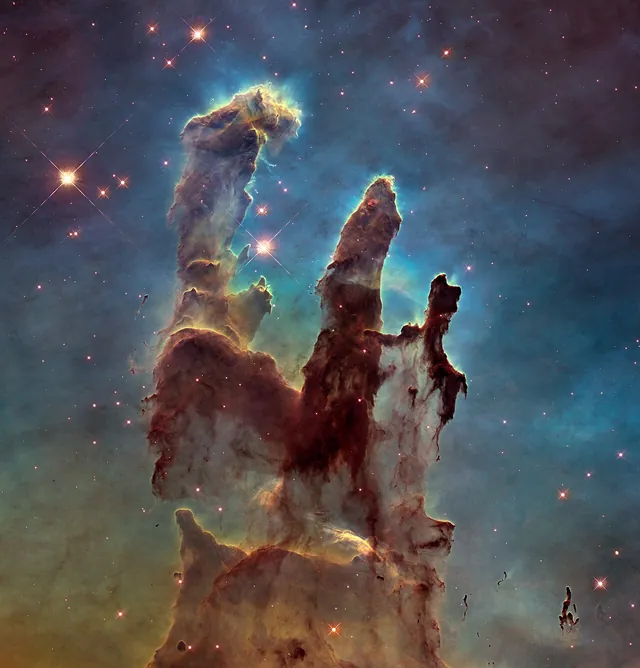
The Pillars of Creation
Three towering columns of cold gas and dust near the cluster, imaged by Hubble in 1995 and again in 2014. They exist because their dense tips shade the gas behind them from the cluster’s radiation. MUSE puts their mass at about 200 Suns and gives them perhaps three million years before they evaporate.678
Evaporating gaseous globules (EGGs)
Dense pockets of gas discovered by Hubble in 1995 at the tips of finger-like features on the pillars. As ultraviolet light boils away the thinner gas around them, the EGGs are left behind, some still attached and others pinched off like teardrops. Some hold stars that were still forming when they were uncovered.315
The Spire
Another tower of cold gas and dust in the nebula, captured by Hubble’s Advanced Camera for Surveys for the telescope’s 15th anniversary in 2005. NASA gives its length as 9.5 light-years, more than twice the distance from the Sun to its nearest star; hot young stars are lighting and eroding it.1516
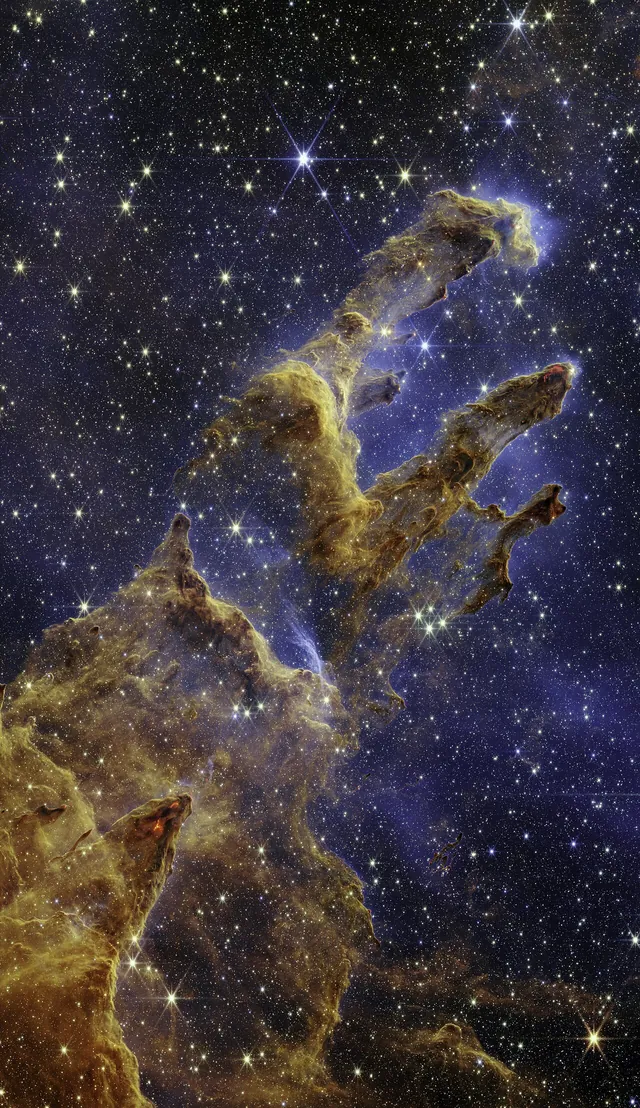
Stars forming in the pillars
Infrared views see inside. ESO’s Very Large Telescope found very young, relatively massive stars in the tips of two of the three pillars in 2001; MUSE revealed a previously unknown jet at the tip of the middle pillar in 2015; and Webb shows newborn stars only a few hundred thousand years old.78915
Discovery and history
Philippe Loys de Chéseaux discovered the star cluster in 1745–46 but described only its stars. Charles Messier rediscovered it independently on 3 June 1764 and noted that the stars seemed enmeshed in a faint glow, probably the first hint of the nebula. The Herschels apparently did not see the nebula, so their catalogues, and the New General Catalogue after them, list only the cluster.25
The nebula was probably first photographed by E. E. Barnard in 1895 and by Isaac Roberts in 1897, and Roberts’s work brought it into the Index Catalogue of 1908 as IC 4703. It became world-famous on 2 November 1995, when NASA released Hubble’s images of the pillars, a picture that has since appeared in films, on clothing and on postage stamps.236
Seeing it for yourself
M16 lies in Serpens Cauda, near the borders with Scutum and Sagittarius. One way to find it is from the star Gamma Scuti, about 2.5° to its east; another, with binoculars, is to hop north from the star cloud M24 through the small cluster M18 and the Omega Nebula. At magnitude 6 the cluster shows in a small telescope, and NASA names August as the best month.12
The nebula itself shows best on photographs. A 4-inch telescope reveals about 20 stars against an uneven glow, nebula filters such as O III help to trace detail, and the dark pillars can be seen in large amateur instruments of 12 inches and up. Seeing them well takes a large telescope and very good conditions.12
Telescopes on the Eagle
Hubble has made the Eagle one of its signature targets. Jeff Hester’s team imaged the pillars with the Wide Field and Planetary Camera 2 for the 1995 release; the Advanced Camera for Surveys captured the Spire for the 15th anniversary in 2005; and in 2014 Wide Field Camera 3 revisited the pillars in visible and infrared light, in images released on 5 January 2015.3616
ESO’s Very Large Telescope imaged the region in near-infrared light with its ISAAC instrument in 2001, and in 2009 the Wide Field Imager at La Silla took a picture covering an area as large as the full Moon. Chandra has mapped the cluster’s young stars in X-rays. On 19 October 2022 NASA released the James Webb Space Telescope’s near-infrared view of the pillars from its NIRCam camera.591215
Quick answers
- What kind of object is the Eagle Nebula (M16)?
- The Eagle Nebula (M16) is an emission nebula (H II region) with the young open cluster NGC 6611.12
- Which constellation is the Eagle Nebula (M16) in?
- The Eagle Nebula (M16) lies in the constellation Serpens (Serpens Cauda).12
- How far away is the Eagle Nebula (M16)?
- The Eagle Nebula (M16) is about 1,740 parsecs from Earth (Gaia parallaxes of NGC 6611; NASA and ESO quote 6,500–7,000 light-years).146
- How big is the Eagle Nebula (M16)?
- The Eagle Nebula (M16) is about 70 × 55 light-years across.1
- How bright is the Eagle Nebula (M16) in the night sky?
- The Eagle Nebula (M16) has an apparent magnitude of 6.0 (of the star cluster).1
- How big does the Eagle Nebula (M16) look in the sky?
- The Eagle Nebula (M16) covers nebula over 30′; cluster about 7′ of sky.2
- When was the Eagle Nebula (M16) discovered?
- The Eagle Nebula (M16) was discovered 1745–46, cluster by Philippe Loys de Chéseaux; glow first noted by Charles Messier in 1764.2
Sources
- Messier 16 (The Eagle Nebula) — NASA Science, Hubble’s Messier Catalog
- Messier 16 (H. Frommert & C. Kronberg) — SEDS Messier Database (Observatoire de Paris mirror), 2007
- Embryonic Stars Emerge from Interstellar “Eggs” — NASA Science (Hubble news release), 1995
- Kinematics in Young Star Clusters and Associations with Gaia DR2 (Kuhn et al.) — Astrophysical Journal 870, 32 (arXiv:1807.02115), 2019
- An Eagle of Cosmic Proportions (eso0926) — European Southern Observatory, 2009
- Revisiting an icon: Hubble captures the Pillars of Creation twenty years on (heic1501) — ESA/Hubble, 2015
- The Pillars of Creation Revealed in 3D (eso1518) — European Southern Observatory, 2015
- The Pillars of Creation revisited with MUSE: gas kinematics and high-mass stellar feedback traced by optical spectroscopy (McLeod et al.) — Monthly Notices of the Royal Astronomical Society (arXiv:1504.03323), 2015
- NASA’s Webb Takes Star-Filled Portrait of Pillars of Creation — NASA Science (Webb news release), 2022
- SIMBAD astronomical database: M 16 — Centre de Données astronomiques de Strasbourg (CDS)
- Chronology of star formation and disk evolution in the Eagle Nebula (Guarcello et al.) — Astronomy & Astrophysics (arXiv:1008.0422), 2010
- Chandra/ACIS-I study of the X-ray properties of the NGC 6611 and M16 stellar population (Guarcello et al.) — Astrophysical Journal 753, 117 (arXiv:1205.2111), 2012
- Tracing the Energetics and Evolution of Dust with Spitzer: a Chapter in the History of the Eagle Nebula (Flagey et al.) — Astronomy & Astrophysics (arXiv:1103.2495), 2011
- The massive star binary fraction in young open clusters – II. NGC 6611 (Eagle Nebula) (Sana et al.) — Monthly Notices of the Royal Astronomical Society (arXiv:0909.0486), 2009
- The Eagle’s EGGs (eso0142) — European Southern Observatory, 2001
- Hubble celebrates 15th anniversary with spectacular new images (heic0506) — ESA/Hubble, 2005
Figures checked against these sources in November 2026. Where a quantity is not known, it is left out rather than estimated.

