planetary nebula
Ring Nebula (M57)
The Ring Nebula is a glowing shell of gas cast off by a dying star, and the archetype of the objects called planetary nebulae. It lies in Lyra, about 2,500 light-years away; a telescope magnifying about 100 times shows a small ring with a darker middle. The star at its centre, once much like the Sun, is on its way to becoming a white dwarf.123
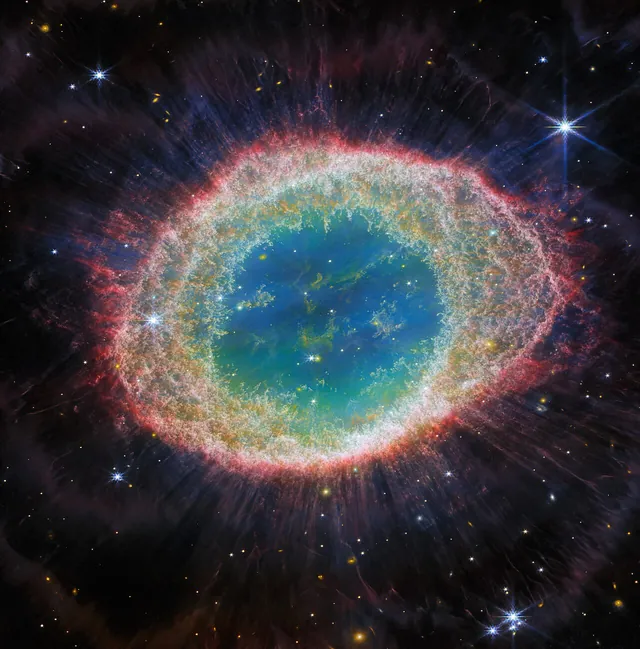
Its simple look hides a complicated shape. Hubble and Webb show a distorted doughnut seen almost end-on, with thinner gas filling its hole, some 20,000 dense clumps in the ring and faint arcs beyond it. Those arcs hint that the dying star has a small companion, and with a second, more distant one the system appears to be a triple star.124
Shape and size in space
Gaia measured a parallax of 1.2696 ± 0.0438 milliarcseconds for the central star, which puts the nebula 790 ± 30 parsecs away, about 2,500 light-years. Older estimates ranged from about 1,000 to 5,000 light-years. Including its faint halo the nebula is about 4′ across, equivalent to about one parsec, while the bright ring spans about 1.4′ × 1.0′.2345
Hubble images analysed in 2013 show that the main ring is an irregular, lopsided disc with a central cavity, crossed by lobes of thinner gas pointing almost towards us. ESA likens it to a distorted doughnut with a rugby ball slotted into its hole. A 2025 radio map of carbon monoxide shows a thin ellipsoidal molecular shell seen close to pole-on, punctured by fast polar outflows.178
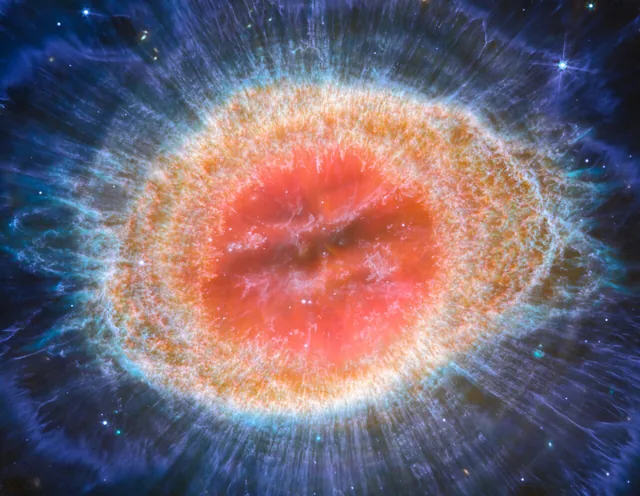
Beyond the ring lies a faint halo, discovered by John Duncan in 1935, which glows with light from gas ionised at an earlier stage of the nebula’s life. Molecular hydrogen runs through the shell and the halo. Webb found about ten faint, evenly spaced arcs just outside the bright ring, and some 300 to 400 narrow spikes pointing away from the star.348
What makes it shine
Ultraviolet light from the central star ionises the gas, and the level of ionisation falls with distance from the star. The innermost region emits mainly ultraviolet light, the inner ring glows greenish in light from ionised oxygen and nitrogen, and only red hydrogen light comes from the outer region. Because most of the light emerges in a few spectral lines, the nebula looks brighter to the eye than on photographs.3
In Hubble’s colour-coded image, deep blue marks helium in the centre, light blue the hydrogen and oxygen of the inner ring, and red the nitrogen and sulphur of the outer ring. Calibrated Hubble images show the electron temperature rising slightly towards the star, to as high as about 13,000 K in the central region.69
Not all of the nebula is ionised gas. Dense globules in the ring shine in the infrared light of molecular hydrogen, and Webb found a thin ring of polycyclic aromatic hydrocarbons, carbon-rich molecules, within the shell. In 2026 the WEAVE spectrograph on the William Herschel Telescope revealed a narrow bar of glowing iron ions across the centre, whose origin is unknown.2410
The star at the centre
The central star has reached the white dwarf cooling track, with a surface temperature of about 135,000 K and a luminosity of about 310 Suns. Its present mass is estimated at 0.58 solar masses, from a star that began with about 1.5. Friedrich von Hahn first saw it in 1800; at about 15th magnitude it is hard to spot.3412
It may not be alone. The evenly spaced arcs beyond the ring suggest a low-mass companion circling it roughly every 280 years. A much wider companion, a red dwarf of type M2 to M4, lies about 15,000 astronomical units away, which would make the system a triple star. Webb also found a cloud of fine silicate dust about 2,600 au across around the central star.412
Even the star’s exact position is debated. In Webb’s images it lies about 2″ from the centre of the cavity, but a 2025 radio map places it at the precise geometric centre of the molecular shell. Its brightness also varies, which might be caused by a close dwarf companion of less than a tenth of the Sun’s mass.4712
Notable features
The globules
Webb counted some 20,000 dense globules in the ring, each about 0.2″ across and glowing in molecular hydrogen, with 100,000 to a million atoms in every cubic centimetre. Together they may hold up to a tenth of a solar mass. Unlike the knots of the Helix Nebula, most lack tails.24
The concentric arcs
About ten faint, regularly spaced arcs lie just beyond the bright ring and show best in Webb’s MIRI images. Their spacing suggests material shed in pulses as a low-mass companion circled the central star every 280 years or so, at roughly the distance of Pluto from the Sun.24
The spikes
Some 300 to 400 narrow spikes radiate outwards beyond the ring, all pointing away from the central star. Seen in molecular hydrogen, they are probably lit by radiation passing through the clumpy shell. Similar spikes surround the Southern Ring Nebula and the Helix Nebula.4
The iron bar
A narrow bar glowing in light from highly ionised iron crosses the central regions of the nebula. Found with the WEAVE instrument on the William Herschel Telescope on La Palma, it matches no other element in shape or speed, and where it lies and how it formed are unknown.10
The halo
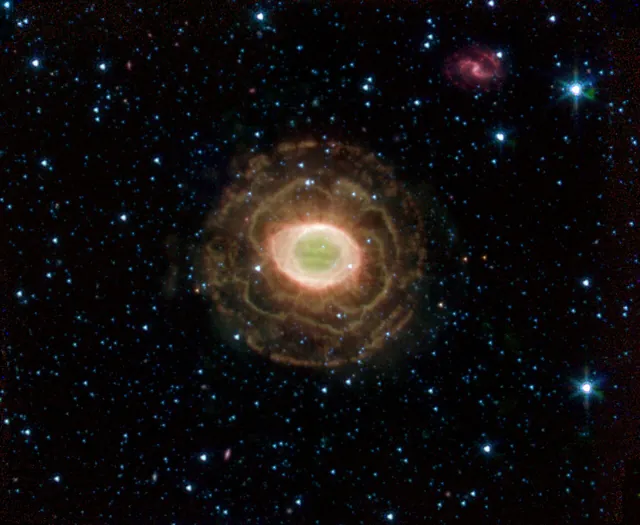
A faint halo more than 3.5′ across surrounds the bright ring. John Duncan discovered it in 1935. Hubble studies suggest it shines with fossil radiation from gas ionised earlier in the nebula’s life, and Spitzer showed its petal-like outer shell glowing in the infrared light of hydrogen molecules.3813
Discovery and history
Antoine Darquier de Pellepoix discovered the Ring Nebula in January 1779 while following a comet through Lyra, and Charles Messier found it later that month, cataloguing it as number 57. Darquier described a dull but perfectly outlined nebula, as large as Jupiter and looking like a fading planet. It was the second planetary nebula to be discovered, after M27.13
William Herschel called it “a perforated nebula, or ring of stars”, the first mention of its ring shape, and Darquier’s comparison with a planet may have inspired Herschel’s term “planetary nebula”. Friedrich von Hahn spotted the central star in 1800 with a 20-foot reflector, and John Duncan found the faint halo in 1935.3
Seeing it for yourself
The Ring Nebula is easy to find between the 3rd-magnitude stars Sheliak and Sulafat, Beta and Gamma Lyrae, at the base of Lyra’s lyre. At magnitude 8.8 it shows in binoculars only as an almost star-like point, but at about 100 times magnification a small telescope reveals the ring and its darker middle, slightly oval and sometimes faintly greenish.36
The 15th-magnitude central star shows only in large telescopes under exceptionally good conditions, or with filters. Several faint foreground and background stars can be glimpsed within the nebula, and the small galaxy IC 1296, of magnitude 14.4, lies just 4′ to the north-west for those with large instruments.3
Telescopes on the Ring
Spitzer revealed the petal-like outer shell in infrared light in an image released on 11 February 2005. Hubble’s Wide Field Camera 3 then imaged the nebula for a study led by C. Robert O’Dell, and ESA released the resulting picture on 23 May 2013, together with a 3D model of the nebula’s shape built from Hubble and ground-based data.1813
The James Webb Space Telescope imaged the Ring with NIRCam on 4 August 2022 and MIRI on 20 August 2022, and ESA published the pictures on 21 August 2023. Follow-up papers describe its globules, its ring of carbon-rich molecules and the dust cloud around its central star. In 2025 a carbon-monoxide map from the Submillimeter Array traced the molecular shell in three dimensions.24712
Quick answers
- Which constellation is the Ring Nebula (M57) in?
- The Ring Nebula (M57) lies in the constellation Lyra.6
- How far away is the Ring Nebula (M57)?
- The Ring Nebula (M57) is about 2,500 light-years from Earth (790 ± 30 parsecs, from the Gaia parallax of its central star).24
- How big is the Ring Nebula (M57)?
- The Ring Nebula (M57) is about 1 parsec (200,000 au) across, including the faint halo.4
- How big does the Ring Nebula (M57) look in the sky?
- The Ring Nebula (M57) covers 1.4′ × 1.0′ of sky (the bright ring; the faint halo reaches more than 3.5′).3
- How bright is the Ring Nebula (M57) in the night sky?
- The Ring Nebula (M57) has an apparent magnitude of 8.8.36
Sources
- Most detailed observations ever of the Ring Nebula (heic1310) — ESA/Hubble, 2013
- Webb captures detailed beauty of Ring Nebula (weic2320) — ESA/Webb, 2023
- Messier 57 (H. Frommert & C. Kronberg) — SEDS Messier Database (Observatoire de Paris mirror), 2007
- JWST observations of the Ring Nebula (NGC 6720): I. Imaging of the rings, globules, and arcs (Wesson et al.) — Monthly Notices of the Royal Astronomical Society (arXiv:2308.09027), 2024
- SIMBAD astronomical database: M 57 — Centre de Données astronomiques de Strasbourg (CDS)
- Messier 57 (The Ring Nebula) — NASA Science, Hubble’s Messier Catalog
- The Structure of the Molecular Envelope of the Ring Nebula (NGC 6720) (Kastner et al.) — arXiv:2501.12223, 2025
- Studies of NGC 6720 with Calibrated HST WFC3 Emission-Line Filter Images. I. Structure and Evolution (O’Dell, Ferland, Henney & Peimbert) — Astronomical Journal 145, 92 (arXiv:1301.6636), 2013
- Studies of NGC 6720 with Calibrated HST WFC3 Emission-Line Filter Images. II. Physical Conditions (O’Dell, Ferland, Henney & Peimbert) — Astronomical Journal 145, 93 (arXiv:1301.6642), 2013
- WEAVE imaging spectroscopy of NGC 6720: an iron bar in the Ring (Wesson et al.) — Monthly Notices of the Royal Astronomical Society (doi:10.1093/mnras/staf2139; arXiv:2601.10635), 2026
- Revised NGC Data for NGC 6720 (from W. Steinicke’s Revised NGC and IC Catalog) — SEDS Interactive NGC Catalog
- JWST observations of the Ring Nebula (NGC 6720): III. A dusty disk around its Central Star (Sahai et al.) — arXiv:2504.01188, 2025
- Infrared Ring Nebula (ssc2005-07a1) — NASA/JPL-Caltech Spitzer Space Telescope, 2005
Figures checked against these sources in November 2026. Where a quantity is not known, it is left out rather than estimated.

