nebula
Southern Ring Nebula (NGC 3132)
The Southern Ring Nebula, NGC 3132, is a planetary nebula in the southern constellation Vela: an expanding cloud of gas cast off by a dying star. Gaia measurements of a companion star place it about 754 parsecs away; ESA quotes roughly 2,500 light-years. A bright oval ring encloses its glowing central cavity, wrapped in a ragged halo of molecular hydrogen.123
The bright star near its centre is not the one that made the nebula. That honour belongs to a faint, hot pre-white dwarf just beside it, which the James Webb Space Telescope revealed in 2022 to be wrapped in dust. Patterns in the gas point to at least two more companions, so the original star system must have held at least four stars.12
Shape and size in space
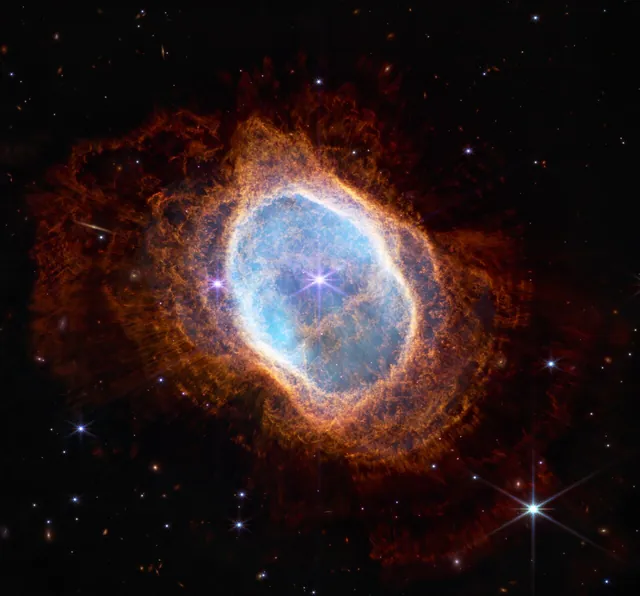
The ionised inner cavity is elliptical, with a major axis of 40″, or 0.15 parsecs at the adopted distance. Around it, JWST traced a halo of molecular hydrogen out to 60″ from the central star, 0.22 parsecs, patterned with arcs and radial spikes. The bright rings of hydrogen around the core are typically 1–2″ thick, about 750–1,500 astronomical units.1
Its three-dimensional shape has long been debated. A 2000 model proposed a diabolo, and ESA describes it as two bowls placed together, opening away from each other. Submillimeter Array maps published in 2024 show that the main ring is a real expanding ring, suggesting a bipolar nebula seen nearly pole-on, tilted 15–30°, with a second molecular ring at almost right angles.279
Distances have ranged from 540 to 1,240 parsecs, and Gaia DR2 gave 824–904 parsecs. The 2022 JWST study adopted 754 parsecs from Gaia DR3 measurements of the A-type companion, because the faint central star’s own measurement is poor, probably spoiled by its bright neighbour. ESA quotes about 2,500 light-years; older Hubble and ESO pages say 2,000.125710
- Distance
- 754 (+15/−18) pc1Gaia DR3, A-type companion
- Range of published distances
- 540–1,240 pc7
- Ionised cavity
- 40″ major axis (0.15 pc)1
- Molecular hydrogen halo
- out to 60″ (0.22 pc) from the central star1
- Thickness of the bright H₂ rings
- 1–2″ (750–1,500 au)1
- Main CO ring
- semi-axes 25″ and 18″9
- Inclination
- about 15–30°9seen nearly pole-on
What makes it shine
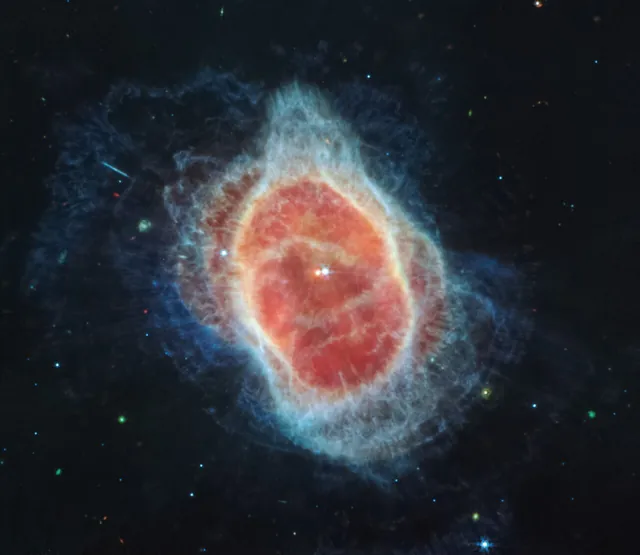
The glowing gas is ionised by the hot central star, with a temperature of about 100,000 K. MUSE spectroscopy at ESO’s Very Large Telescope found densities near 1,000 electrons per cubic centimetre in the inner high-ionisation gas and about 700 at the rim, and a helium-to-hydrogen ratio of 0.124. Two faint arcs to the north and south may be traces of precessing jets.7
In infrared light, JWST cleanly separates the ionised gas from the molecular gas around it. Molecular hydrogen glows in more than 10,000 dense knots, with a total mass of about 0.1 solar masses in the central ring region. Radial spikes in the halo mark where ultraviolet light leaks between the knots, streaming out like sunlight through gaps in a cloud.12
The stars inside
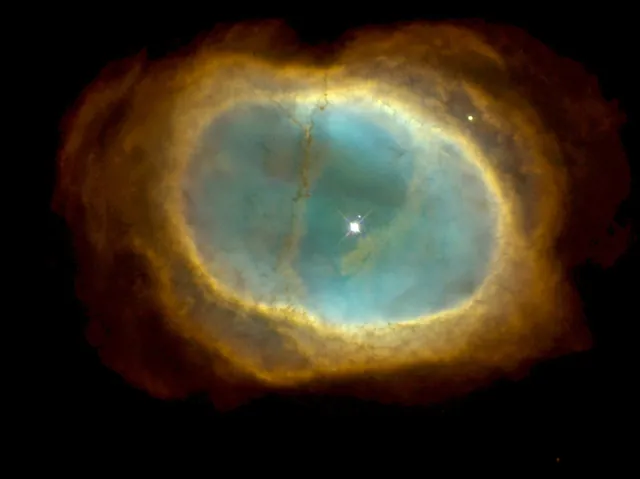
The bright star at the centre is an A-type star of about 2.4 solar masses, too cool to ionise the nebula. Evans recognised this in 1968, and in 1977 Kohoutek and Laustsen found that the centre holds a binary. The true central star is much fainter and 1.7″ south-west of the A star; the pair move together, about 1,300 astronomical units apart in projection.17
Beyond 10 μm, JWST showed the faint central star as bright as its companion, revealing a dusty disc around it that points to interaction with a close companion. Arcs in the halo about 2″ apart suggest another companion orbiting at 40–60 astronomical units every 290–480 years. Counting the A star, the original system was at least a quartet.1
Because the A star is slightly evolved, its age pins the central star’s original mass at 2.86 ± 0.06 Suns, perhaps the most precise initial mass yet for any planetary nebula nucleus. A 2025 photoionisation model found 2.7 ± 0.2 Suns and a carbon-to-oxygen ratio of about 2, whereas the JWST team argued the envelope held less carbon than oxygen.18
- Mass of the A-type companion
- 2.40 ± 0.15 solar masses1
- Separation
- 1.7″; about 1,300 au in projection1
- Central star
- about 100,000 K; log L/L☉ = 2.197Frew 2008
- Initial mass of the central star
- 2.86 ± 0.06 solar masses1
- Predicted present mass
- about 0.66 ± 0.05 solar masses1photoionisation models prefer 0.58 ± 0.03
- Dusty disc
- radius 55–140 au; dust about 2 × 10⁻⁷ solar masses1best-fit model
- Inferred close companion
- orbit of 40–60 au, period 290–480 years1
Notable features
The molecular halo
A flocculent halo of molecular hydrogen surrounding the ionised bubble, seen in detail for the first time by JWST at 2.12, 4.7 and 7.7 μm. It is much clumpier than the ionised gas, with up to 20 knots per square arcsecond around the bright inner ring.1
Searchlight spikes
Hundreds of straight, bright lines radiate through the rings in JWST’s NIRCam image. They are starlight escaping through holes between dense knots, which then excites the hydrogen in the outer halo. Where the halo looks dark, east-north-east and west-south-west of the star, it is probably unlit rather than empty.16
Concentric arcs
Broken arcs in the hydrogen halo, about 2″ apart, like those seen around many ageing giant stars and other planetary nebulae. They are thought to form when a companion star modulates the outflowing wind, winding it into a spiral, here pointing to a companion of up to 0.2 solar masses hidden in the central star’s glare.1
The second molecular ring
Submillimeter Array maps of carbon monoxide revealed a second expanding ring of molecular gas, almost at right angles to the bright main ring. The authors propose both rings are what remains of an envelope ejected at the end of the star’s giant phase, then disrupted by misaligned jets driven by companions.9
Discovery and history
NGC 3132 appears in Dreyer’s New General Catalogue with a double exclamation mark, and southern amateur astronomers know it as the Eight-Burst or Southern Ring Nebula. In 1968 Evans showed that its bright central star was an A-type star, too cool to light the nebula, and in 1977 Kohoutek and Laustsen confirmed a binary system at its centre.5711
Hubble’s Heritage team released a visible-light portrait on 5 November 1998. NGC 3132 was then one of the targets of the James Webb Space Telescope’s first images, released on 12 July 2022 alongside the galaxy cluster SMACS J0723.3−7327, Stephan’s Quintet, NGC 3324 in Carina and the planet WASP-96b. Those images prompted a 2022 study in Nature Astronomy.1512
Seeing it for yourself
NGC 3132 lies in Vela, in the southern sky, and is known to amateur astronomers in the southern hemisphere. It is one of the nearest planetary nebulae. At visual magnitude 9.2 and about 1.5′ across it needs a telescope, which shows the oval glow around its tenth-magnitude central star, the A-type companion rather than the nebula’s true parent.134510
Telescopes on the Southern Ring
JWST observed NGC 3132 for its Early Release Observations with two instruments. NIRCam showed at least eight layers of gas and dust ejected over thousands of years and hundreds of radial rays, and MIRI revealed the dust around the central star. Most of the multicoloured points of light in the background of these images are distant galaxies, not stars.2612
Ground-based work continues. ESO’s MUSE spectrograph mapped the whole nebula in two-dimensional spectroscopy, the Submillimeter Array mapped carbon monoxide and CN, and a 2025 three-dimensional photoionisation model combined MUSE, JWST and other data. A further 2025 study of the MUSE, JWST and Spitzer data found new clumps glowing in lines of nickel and iron.78913
Quick answers
- What kind of object is the Southern Ring Nebula (NGC 3132)?
- The Southern Ring Nebula (NGC 3132) is a planetary nebula.34
- Which constellation is the Southern Ring Nebula (NGC 3132) in?
- The Southern Ring Nebula (NGC 3132) lies in the constellation Vela.36
- How far away is the Southern Ring Nebula (NGC 3132)?
- The Southern Ring Nebula (NGC 3132) is 754 parsecs from Earth (+15/−18 pc, Gaia DR3 distance of the A-type companion; ESA gives about 2,500 light-years).12
- How bright is the Southern Ring Nebula (NGC 3132) in the night sky?
- The Southern Ring Nebula (NGC 3132) has an apparent magnitude of 9.2 (visual, Revised NGC).3
- How big does the Southern Ring Nebula (NGC 3132) look in the sky?
- The Southern Ring Nebula (NGC 3132) covers 1.47′ of sky (Revised NGC).3
- How big is the Southern Ring Nebula (NGC 3132)?
- The Southern Ring Nebula (NGC 3132) is about 0.15 parsecs across (major axis of the ionised cavity; the molecular halo reaches 0.22 pc from the central star).1
Sources
- The messy death of a multiple star system and the resulting planetary nebula as observed by JWST (De Marco et al.) — Nature Astronomy 6, 1421 (arXiv:2301.02775), 2022
- Webb Captures Dying Star’s Final ‘Performance’ in Fine Detail (weic2207) — ESA/Webb, 2022
- Revised NGC Data for NGC 3132 (from W. Steinicke’s Revised NGC and IC Catalog) — SEDS Interactive NGC Catalog
- SIMBAD astronomical database: NGC 3132 — Centre de Données astronomiques de Strasbourg (CDS)
- A glowing pool of light (opo9839a) — ESA/Hubble, 1998
- Southern Ring Nebula (NIRCam Image) (weic2207b) — ESA/Webb, 2022
- The MUSE view of the planetary nebula NGC 3132 (Monreal-Ibero & Walsh) — Astronomy & Astrophysics 634, A47 (arXiv:1912.02847), 2020
- The planetary nebula NGC 3132 revisited: high definition 3D photoionization model (Monteiro et al.) — arXiv preprint arXiv:2503.20640, 2025
- The Molecular Exoskeleton of the Ring-like Planetary Nebula NGC 3132 (Kastner et al.) — arXiv preprint arXiv:2402.11850, 2024
- A cosmic bubble: NGC 3132 (image ngc3132-cc) — European Southern Observatory, 2009
- NGC 3132 — SEDS Interactive NGC Catalog
- The JWST Early Release Observations (Pontoppidan et al.) — Astrophysical Journal Letters 936, L14 (arXiv:2207.13067), 2022
- Dissecting NGC 3132: Tracing the mass-loss history of the southern ring planetary nebula (Bouvis et al.) — Monthly Notices of the Royal Astronomical Society (arXiv:2507.08079), 2025
Figures checked against these sources in November 2026. Where a quantity is not known, it is left out rather than estimated.

