galaxy group
Stephan’s Quintet
Stephan’s Quintet is a tight knot of five galaxies in the constellation Pegasus, found by the French astronomer Édouard Stephan in 1877: the first compact group of galaxies ever discovered. Only four of them truly belong together, about 290 million light-years away. The fifth and brightest, NGC 7320, is a foreground galaxy just 40 million light-years from Earth that happens to lie in the same direction.123
The four distant galaxies are locked in a slow gravitational dance that has torn out tails of gas and stars and set off bursts of star formation. One of them, NGC 7318B, is plunging through the group at roughly 1,000 km/s, driving a shock front some 45 kiloparsecs long that glows in X-rays and infrared light. The James Webb Space Telescope made the group one of its first images in July 2022.12456
Four neighbours and a stranger
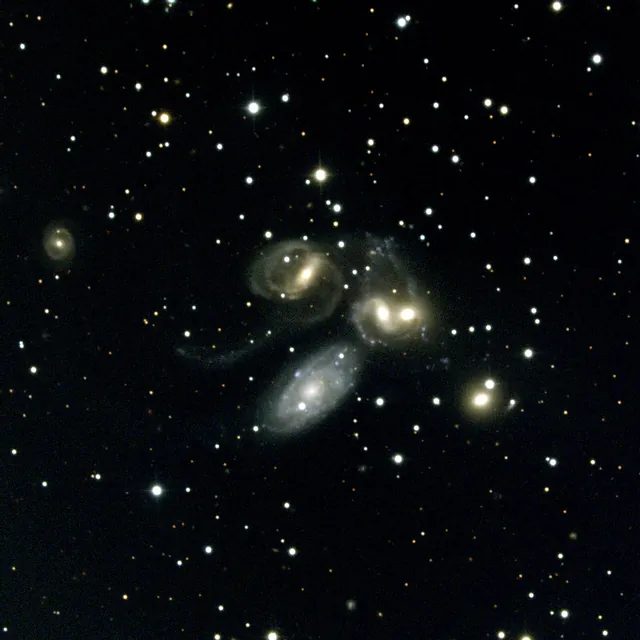
Although called a quintet, only four of the galaxies, NGC 7317, NGC 7318A, NGC 7318B and NGC 7319, are truly close together, about 290 million light-years away. The fifth, NGC 7320, lies in the foreground at about 40 million light-years, some seven times nearer. It belongs to a nearby group, the NGC 7331 group, and only by coincidence appears projected against the distant group.1211
Three of the distant galaxies have distorted shapes, stretched spiral arms and long gaseous tidal tails full of star clusters, proof of close encounters. NGC 7317, a smooth elliptical, looks less affected, but deep images reveal a lopsided halo of old stars around it, hinting that the group formed earlier than once thought. A sixth, fainter galaxy at the same distance may have passed through the group’s centre at least twice.2612
The group is wrapped in much larger structures. Hot gas fills the space between the galaxies, too extended to have been heated by the present collision alone. Sensitive radio observations published in 2022 found atomic hydrogen spread across about 0.6 megaparsecs, including a faint curved tail some 0.5 megaparsecs long that was probably pulled out more than a billion years ago.1314
- Distance of the four interacting galaxies
- about 290 million light-years1
- Distance in a 2022 radio study
- 85 ± 6 Mpc (about 277 million light-years)14
- NGC 7317
- elliptical galaxy (E4)9
- NGC 7318A
- elliptical galaxy (E2, peculiar)10
- NGC 7318B
- barred spiral galaxy (SBbc)10
- NGC 7319
- barred spiral galaxy (SBbc)7
- Extent of the surrounding hydrogen
- about 0.6 Mpc (about 2 million light-years)14
The giant shock wave
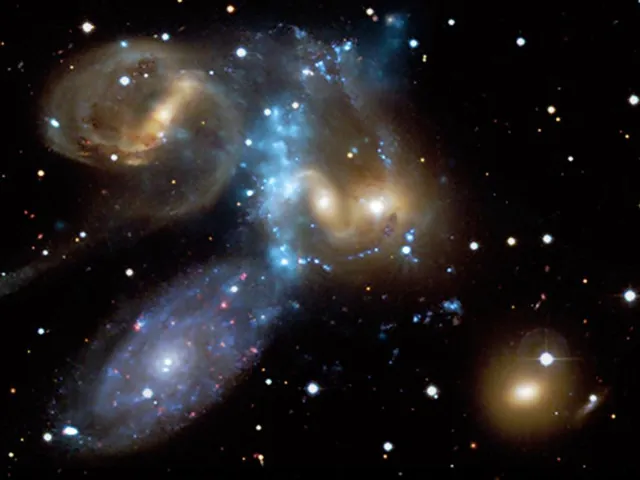
The group’s most remarkable feature lies between the galaxies. NGC 7318B, an intruder, is ploughing into gas stripped from the other members at some 850 to 1,000 km/s. The collision has driven a group-wide shock: a ridge of gas heated to about 6 million °C that Chandra sees in X-rays and that also shines in radio waves.4613
The Spitzer Space Telescope found that the same ridge glows intensely in infrared light from warm molecular hydrogen. The main shock alone holds about 500 million solar masses of warm hydrogen, and its emission outshines the X-rays from the hot gas three times over, making it the main way the shocked gas cools. The ridge itself forms few stars; star birth appears in the intruder and at either end of the shock.4
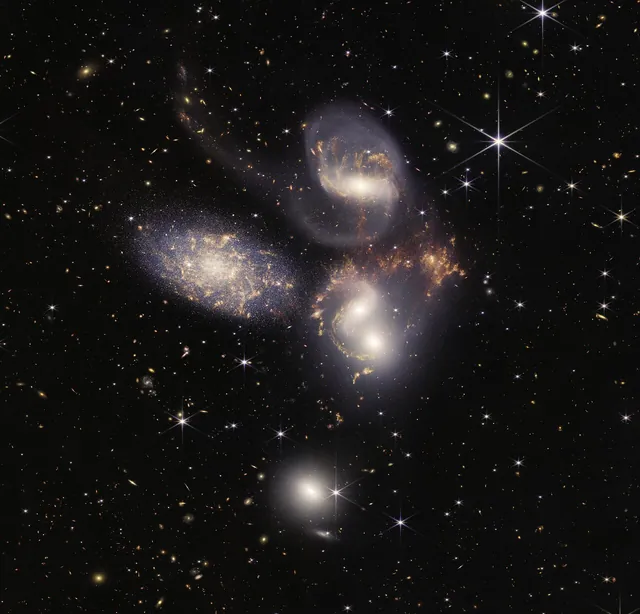
JWST and ALMA have resolved the shocked gas on scales of 25 to 150 parsecs. Their images show cold molecular clouds being shattered, stripped and turned into warm gas, including what appears to be a collision between two clouds. The team suggests that a fog of warm hydrogen, created as dense clouds break apart and mix behind the shock, makes the infrared glow.5
- Length of the shocked hydrogen filament
- 45 kpc (nearly 150,000 light-years)5
- Warm molecular hydrogen in the main shock
- 5.0 × 10⁸ solar masses4spread over about 480 kpc²
- Total hydrogen line power of the group
- more than 10⁴² erg/s4
- Shock speeds in the gas
- 100–300 km/s4from comparison with shock models
- Hot gas in the shock ridge
- about 2 per cent of the group’s hot gas13
Stars and a black hole
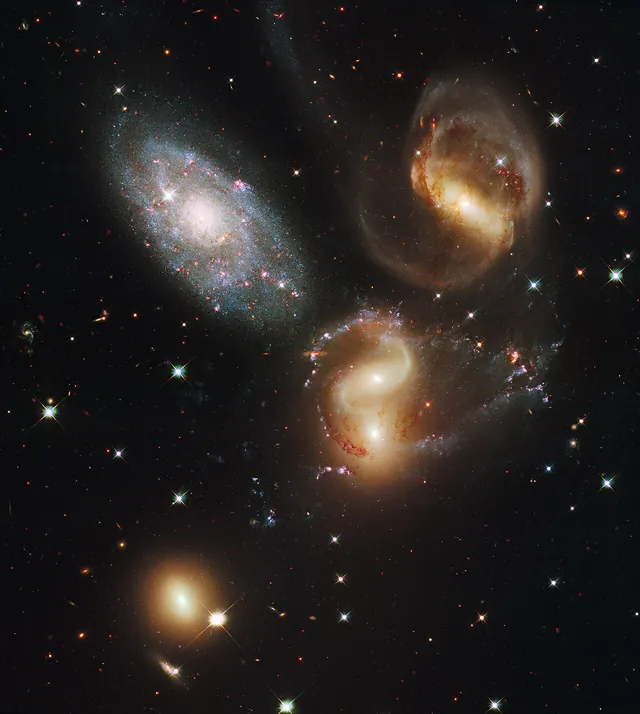
Hubble’s colours trace the ages of the stars and show that star birth has happened at different times over hundreds of millions of years. Bright blue clusters and pink clouds of glowing hydrogen ring the NGC 7318 pair; their stars are less than 10 million years old. Far from any galaxy, a patch of intergalactic space is forming star clusters of its own. The distant galaxies are too far for Hubble to resolve single stars.2
At the heart of NGC 7319 lies an active galactic nucleus: a supermassive black hole of 24 million solar masses that is pulling in material and shining with the energy of 40 billion Suns. Webb’s NIRSpec and MIRI spectrographs looked through the surrounding dust to the hot gas near the black hole and measured the speed of the bright outflows it drives.1
The galaxies
NGC 7319
The topmost galaxy in Hubble’s and Webb’s views is a barred spiral whose arms wind nearly 180° back to the bar. Blue clusters dot its upper arm. Its active nucleus, powered by a black hole of 24 million solar masses, has been studied in detail by Webb.127
NGC 7318A and NGC 7318B
What looks like one galaxy with two cores is really two galaxies seen close together, circled by young blue clusters and pink star-forming clouds. NGC 7318B, a barred spiral, is the intruder whose high-speed passage through the group drives the great shock wave.121013
NGC 7317
A normal-looking elliptical galaxy at the lower left of Hubble’s view, less affected by the interactions than its neighbours. Deep images from the Canada-France-Hawaii Telescope reveal an extended, reddish, lopsided halo of old stars around it, a sign that the group may have formed earlier than thought.212
NGC 7320
The large bluish spiral at upper left is not part of the group at all. At about 40 million light-years it lies seven times nearer, close enough for Hubble and Webb to pick out individual stars. Bursts of star formation show as blue and pink dots across its disc.12
Discovery and history
Édouard Stephan discovered the group in 1877, making it the first compact group of galaxies ever found. Its galaxies entered the New General Catalogue as NGC 7317 to 7320, all identified as Stephan VIII; NGC 7318 is itself a pair, catalogued as 7318A and 7318B. The five also became Hickson Compact Group 92 and number 319 in the Arp catalogue of peculiar galaxies, and the group features in the film It’s a Wonderful Life.12715
Because four galaxies share a large redshift while NGC 7320’s is much smaller, the quintet was long cited by a few astronomers as evidence that redshift does not measure distance. The conventional explanation is a chance alignment, and observations bear it out: Hubble resolves individual stars in NGC 7320, evidence that it is far nearer, but not in the others.211
Seeing it for yourself
Stephan’s Quintet lies in Pegasus, in the same field of sky as the nearer galaxy NGC 7331. Its members are faint, between magnitudes 12.5 and 13.6, and none spans much more than two arcminutes, so the whole group covers about 3′ of sky. The foreground NGC 7320 is the brightest of the five.37891012
Telescopes on the quintet
Chandra first observed the group for six hours on 9 July 2000, revealing the shock-heated gas; a deeper Chandra study followed in 2009. The Spitzer Space Telescope mapped the mid-infrared spectrum of the whole group and uncovered its enormous output of warm molecular hydrogen. In July and August 2009 Hubble’s new Wide Field Camera 3, installed by astronauts that May, imaged the quintet as one of its first targets.24613
Stephan’s Quintet was among the James Webb Space Telescope’s first images, released on 12 July 2022. The NIRCam and MIRI mosaic covers about a fifth of the Moon’s diameter, contains over 150 million pixels and was built from almost 1,000 image files. Webb also took spectra of NGC 7319’s nucleus and revealed thousands of distant background galaxies.116
Quick answers
- What kind of object is Stephan’s Quintet?
- Stephan’s Quintet is a compact group of galaxies (four interacting galaxies and one foreground galaxy).12
- Which constellation is Stephan’s Quintet in?
- Stephan’s Quintet lies in the constellation Pegasus.1
- How far away is Stephan’s Quintet?
- Stephan’s Quintet is about 290 million light-years from Earth (the four interacting galaxies; NGC 7320 is about 40 million light-years away).1
- How big does Stephan’s Quintet look in the sky?
- Stephan’s Quintet covers 3.2′ of sky (the whole group).8
Sources
- Webb Sheds Light on Galaxy Evolution, Black Holes (weic2208) — ESA/Webb, 2022
- Galactic wreckage in Stephan’s Quintet (heic0910i) — ESA/Hubble, 2009
- Revised NGC Data for NGC 7320 (from W. Steinicke’s Revised NGC and IC Catalog) — SEDS Interactive NGC Catalog
- Powerful H₂ Line-cooling in Stephan’s Quintet. I. Mapping the Significant Cooling Pathways in Group-wide Shocks (Cluver et al.) — Astrophysical Journal 710, 248 (arXiv:0912.0282), 2010
- Multi-phase gas interactions on subarcsec scales in the shocked IGM of Stephan’s Quintet with JWST and ALMA (Appleton et al.) — Astrophysical Journal 951, 104 (arXiv:2301.02928), 2023
- Stephan’s Quintet: Intruder Galaxy Shocks Tightly-Knit Group (Chandra Photo Album, 8 May 2003) — Chandra X-ray Center, Harvard-Smithsonian Center for Astrophysics, 2003
- Revised NGC Data for NGC 7319 (from W. Steinicke’s Revised NGC and IC Catalog) — SEDS Interactive NGC Catalog
- SIMBAD astronomical database: HCG 92 (Stephan’s Quintet) — Centre de Données astronomiques de Strasbourg (CDS)
- Revised NGC Data for NGC 7317 (from W. Steinicke’s Revised NGC and IC Catalog) — SEDS Interactive NGC Catalog
- Revised NGC Data for NGC 7318 (from W. Steinicke’s Revised NGC and IC Catalog) — SEDS Interactive NGC Catalog
- Stephan’s Quintet (NGC 7317, NGC 7318A, NGC 7318B, NGC 7319, NGC 7320) (image noao-sq2) — NSF NOIRLab, 2020
- Revisiting Stephan’s Quintet with deep optical images (Duc et al.) — Monthly Notices of the Royal Astronomical Society: Letters 475, L40 (arXiv:1712.07145), 2018
- A Chandra X-ray view of Stephan’s Quintet: Shocks and Star-formation (O’Sullivan et al.) — Astrophysical Journal 701, 1560 (arXiv:0812.0383), 2009
- A 0.6 Mpc H I structure associated with Stephan’s Quintet (Xu et al.) — Nature 610, 461 (arXiv:2208.04870), 2022
- NGC 7318 — SEDS Interactive NGC Catalog
- NASA’s Webb Sheds Light on Galaxy Evolution, Black Holes — NASA Science, 2022
Figures checked against these sources in November 2026. Where a quantity is not known, it is left out rather than estimated.

