galaxy
Whirlpool Galaxy (M51)
The Whirlpool Galaxy, Messier 51, is probably the best-known spiral galaxy in the sky and a textbook grand-design spiral, with two sweeping, sharply drawn arms. It lies in Canes Venatici, about 28 million light-years away by the most precise measurement, and is caught up in a slow encounter with a smaller companion, NGC 5195, which hangs at the tip of one of its arms.1234
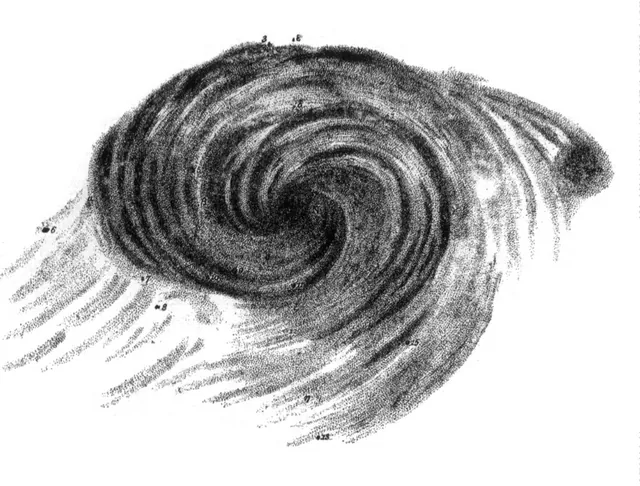
The Whirlpool also holds a special place in history. In the spring of 1845 Lord Rosse drew it as a spiral, the first galaxy in which spiral structure was ever seen. Because we view it almost face-on, it is a natural laboratory for star birth: its arms compress gas into bright clusters of new stars, and it has hosted supernovae in 1994, 2005 and 2011.1256
Shape and size in space
M51 is a grand-design spiral: instead of many loose, ragged arms it has two long, well-defined ones that wind out from a yellowish core. We see the disc almost face-on, which shows the whole spiral pattern at once. Its smaller companion, NGC 5195, lies at the end of one arm; Hubble images show that it is passing behind the Whirlpool, not in front of it.249
Its distance has long been uncertain. In 2016 Hubble images of the galaxy’s old red giant stars gave 8.58 ± 0.10 megaparsecs, about 28 million light-years, the figure used here. Agency pages still quote 25, 27 or 31 million light-years, and older photometric estimates reached 37 million.123479
The Whirlpool is the dominant member of a small group of galaxies that also includes M63. It is receding from us at about 523 km/s. Halton Arp listed the pair as number 85 in his Atlas of Peculiar Galaxies, describing it as a spiral with a large, high-surface-brightness companion.18
- Distance
- 8.58 ± 0.10 Mpc (about 28 million light-years)3tip of the red giant branch, Hubble, 2016
- Distance modulus
- 29.67 ± 0.02 mag3
- Other distances quoted
- 25, 27, 31 and 37 million light-years1249ESA/Hubble 2005, ESA 2023, NASA, SEDS
- Apparent size
- 11.2′ × 6.9′7
- Radial velocity
- 523 ± 2 km/s8receding
- Arp catalogue
- Arp 851spiral with large high-surface-brightness companion
What makes it shine
Most of the Whirlpool’s light comes from its stars: older, yellowish stars crowd the central bulge, while hot young blue stars trace the arms. In the arms, pink patches mark giant star-forming regions where hydrogen gas glows. In Hubble’s visible-light portrait, red marks infrared light and glowing hydrogen, blue the hot young stars and yellow the older stellar population.29
Dust tells a different story in infrared light. In the James Webb Space Telescope’s 2023 view, dark red traces filaments of warm dust, red the light re-emitted by complex molecules on dust grains, and orange and yellow the ionised gas around young star clusters. Energy pouring out of those stars has blown dark bubbles in the gas and lit up a network of bright knots.4
The very centre hosts a compact active nucleus. SIMBAD classes M51 as a Seyfert 2 galaxy, and SEDS describes the nucleus as Seyfert type 2.5. The Hubble Space Telescope has examined this central region in particular detail, and later Hubble studies turned to the inner spiral arms and dust clouds where massive, luminous stars are born.18
Star birth in the arms
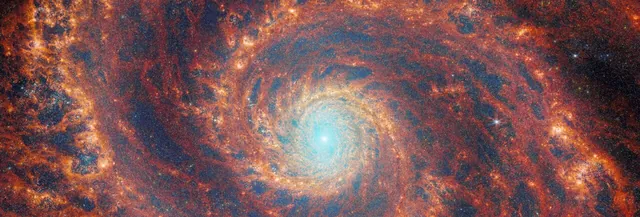
The spiral arms act as star-formation factories. As NGC 5195 drifts past, its gravity raises waves in the Whirlpool’s disc. Where these pass through gas clouds they squeeze the gas along each arm’s inner edge, so the sequence runs across an arm: dark dust clouds on the inside, then pink star-forming regions, then brilliant blue clusters along the outer edge.29
Hubble’s near-infrared camera, peering through the dust in December 2005, found hundreds of small clumps of stars, each about 65 light-years wide, that visible light cannot reach. Astronomers had expected large dust clouds 100 to 300 light-years across; instead most of the dust lies in smooth, diffuse lanes, perhaps because the encounter with another galaxy stopped giant clouds from forming.9
Webb’s observations of M51 belong to the FEAST programme, Feedback in Emerging extrAgalactic Star clusTers. It studies how the energy of young stars, called stellar feedback, regulates star formation, and catches star clusters emerging from their birth clouds in galaxies beyond the Local Group for the first time.4
- Hidden star clumps
- about 65 light-years wide9seen by Hubble’s NICMOS camera
Notable features
NGC 5195
The small yellowish companion at the outer tip of one arm, of type SB0-a and magnitude 9.6. Pierre Méchain found it on 21 March 1781. It is passing behind the Whirlpool and has been gliding past it for hundreds of millions of years; its gravity is thought to have sharpened M51’s spiral arms.12410
SN 1994I
A supernova discovered on 2 April 1994 by Atlanta amateur astronomers Jerry Armstrong and Tim Puckett, 14″ east and 12″ south of the nucleus. It reached magnitude 12.8 and was classified as Type Ic. Both the Hubble Space Telescope and amateur astronomers imaged it.1
SN 2005cs
Found on 27 June 2005 by German amateur Wolfgang Kloehr at magnitude 13.5. A year-long campaign made it one of the best-observed core-collapse supernovae: a faint Type II-plateau event with slow ejecta of about 1,000 km/s, only about 0.003 solar masses of radioactive nickel and 8–13 solar masses of material thrown out.111
SN 2011dh
A supernova that exploded on 31 May 2011, caught by small telescopes and the Palomar Transient Factory. Early spectra showed hydrogen with first hints of helium, pointing to a Type IIb explosion of a fairly compact star. The star seen there in earlier Hubble images may be a companion or a blend, not the star that exploded.6
Lord Rosse’s drawing
In the spring of 1845 William Parsons, third Earl of Rosse, saw spiral structure in M51 and made a careful drawing of it, the first time such structure was recognised in any galaxy. For this reason M51 is sometimes called Rosse’s Galaxy or Lord Rosse’s Question Mark.15
Discovery and history
Charles Messier discovered the Whirlpool on 13 October 1773 while observing a comet, describing a very faint nebula without stars. His friend Pierre Méchain found the companion on 21 March 1781, and Messier’s catalogue of that year notes that the object is double, each part with a bright centre. Messier even sketched the pair in his own copy, one of his few surviving drawings.1
William Herschel gave the companion its own number, H I.186, and it later became NGC 5195. In the spring of 1845 Lord Rosse resolved the main galaxy into a spiral, the first object of its kind to be seen that way. Today the name M51 can mean either the pair or the larger galaxy alone, which is then called M51a, with NGC 5195 as M51b.15
Seeing it for yourself
At magnitude 8.4 the Whirlpool is a showpiece for small telescopes under a dark sky, but light pollution easily washes it out. Under very good conditions, hints of the spiral arms show in telescopes from about 4 inches (10 cm) aperture, and low magnification works best for seeing both galaxies together. NASA’s Hubble observing guide names May as the best month.19
The pair lies in the northern constellation Canes Venatici, the Hunting Dogs, where its face-on view and closeness have made it one of the most studied galaxies. The two galaxies’ bright centres are 4′ 35″ apart on the sky, as Messier recorded in 1781.129
Telescopes on the Whirlpool
The Hubble Space Telescope photographed the Whirlpool with its Advanced Camera for Surveys between 18 and 22 January 2005. The result, released on 25 April 2005 to mark Hubble’s 15th anniversary, was among the largest and sharpest images Hubble had taken. Later that year its NICMOS infrared camera mapped the galaxy’s dust skeleton. Earlier Hubble studies, published in 2001, examined the core and inner dust clouds.1259
Other observatories have viewed M51 across the spectrum: ESA’s Infrared Space Observatory studied it in infrared light, and NASA’s GALEX in ultraviolet. On 29 August 2023 ESA released a James Webb Space Telescope image of M51 combining its NIRCam and MIRI cameras, made for the FEAST star-cluster programme.14
Quick answers
- What kind of object is the Whirlpool Galaxy (M51)?
- The Whirlpool Galaxy (M51) is a grand-design spiral galaxy (type Sbc).27
- Which constellation is the Whirlpool Galaxy (M51) in?
- The Whirlpool Galaxy (M51) lies in the constellation Canes Venatici.9
- How far away is the Whirlpool Galaxy (M51)?
- The Whirlpool Galaxy (M51) is about 28 million light-years (8.58 ± 0.10 Mpc) from Earth, from the tip of the red giant branch; other published figures run from 25 to 37 million light-years.1239
- How bright is the Whirlpool Galaxy (M51) in the night sky?
- The Whirlpool Galaxy (M51) has an apparent magnitude of 8.4 (a small telescope shows it).19
- How big does the Whirlpool Galaxy (M51) look in the sky?
- The Whirlpool Galaxy (M51) covers 11.2′ × 6.9′ of sky.7
- When was the Whirlpool Galaxy (M51) discovered?
- The Whirlpool Galaxy (M51) was discovered on 13 October 1773, by Charles Messier.1
Sources
- Messier 51 (H. Frommert & C. Kronberg) — SEDS Messier Database (Observatoire de Paris mirror), 2007
- Out of this whirl: The Whirlpool Galaxy (M51) and companion galaxy (image heic0506a) — ESA/Hubble, 2005
- The Distance to M51 (McQuinn et al.) — Astrophysical Journal 826, 21 (arXiv:1606.04120), 2016
- Webb captures a cosmic Whirlpool — European Space Agency, 2023
- Hubble celebrates 15th anniversary with spectacular new images (heic0506) — ESA/Hubble, 2005
- PTF11eon/SN2011dh: Discovery of a Type IIb Supernova From a Compact Progenitor in the Nearby Galaxy M51 (Arcavi et al.) — Astrophysical Journal Letters 742, L18 (arXiv:1106.3551), 2011
- Revised NGC Data for NGC 5194 (from W. Steinicke’s Revised NGC and IC Catalog) — SEDS Interactive NGC Catalog
- SIMBAD astronomical database: M 51 — Centre de Données astronomiques de Strasbourg (CDS)
- Messier 51 (The Whirlpool Galaxy) — NASA Science, Hubble’s Messier Catalog
- Revised NGC Data for NGC 5195 (from W. Steinicke’s Revised NGC and IC Catalog) — SEDS Interactive NGC Catalog
- SN 2005cs in M51 II. Complete evolution in the optical and the near-infrared (Pastorello et al.) — Monthly Notices of the Royal Astronomical Society (arXiv:0901.2075), 2009
Figures checked against these sources in November 2026. Where a quantity is not known, it is left out rather than estimated.

