galaxy
Sunflower Galaxy (M63)
The Sunflower Galaxy, Messier 63, is a spiral galaxy in the northern constellation Canes Venatici, about 29 million light-years away. Instead of a few long, sweeping arms it shows a mass of short, patchy arm segments studded with young blue stars, recalling the pattern at the centre of a sunflower. Galaxies built this way are called flocculent spirals. M63 belongs to the group of galaxies led by the Whirlpool Galaxy, M51.123
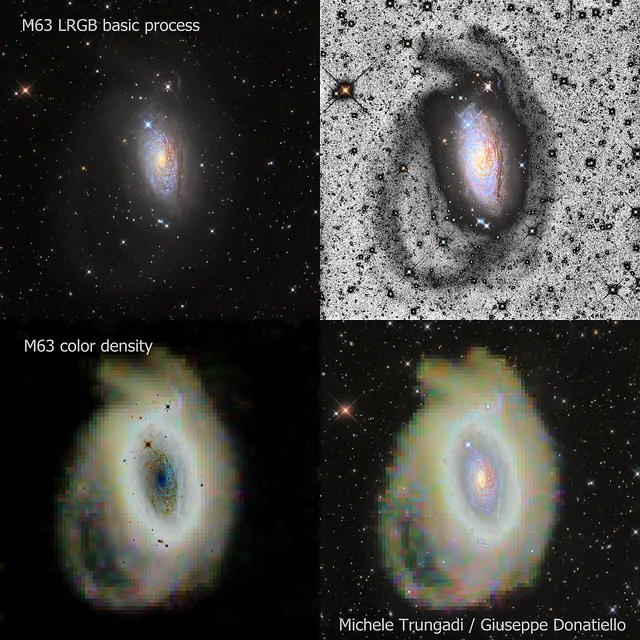
Around its bright disc lies a much fainter secret. Deep images, some taken with telescopes only 14–16 cm across, reveal giant loops of stars arcing far out into the galaxy’s halo. They are the remains of a small satellite galaxy that M63 pulled apart within the last few billion years, and they show that even a calm-looking spiral is still growing by swallowing its neighbours.456
Shape and size
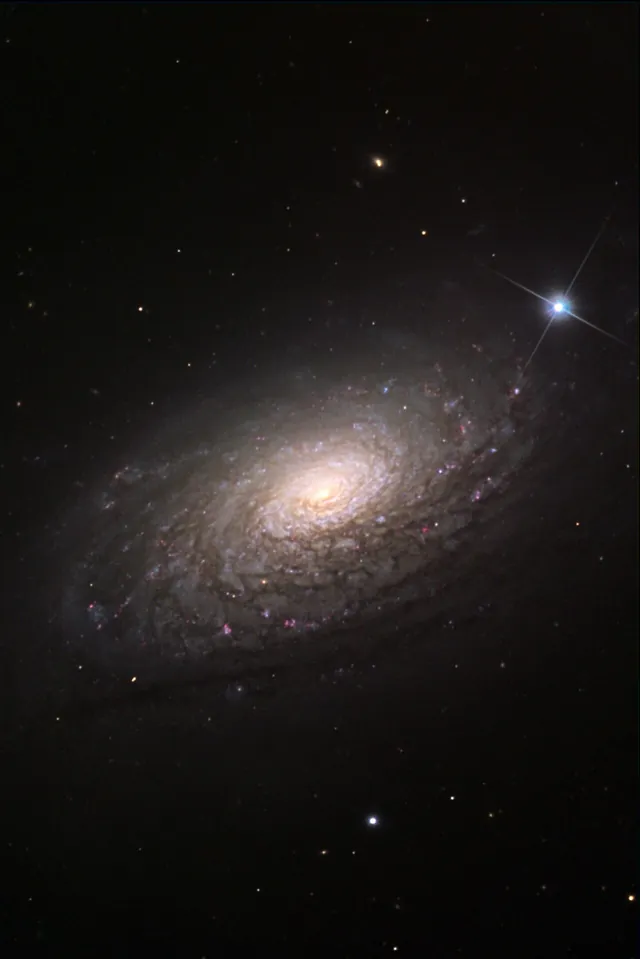
M63 is a flocculent spiral. Unlike grand-design spirals, it has no well-defined arms; instead many discontinuous arm segments wind around its yellowish core. Its patchy pattern can be traced from the outskirts right in to a smooth central region only 6″ across. Classifications range between Hubble types Sb and Sc, and SIMBAD lists it as an unbarred spiral.378
Measured from the brightest red giant stars with Hubble, M63 lies 8.87 megaparsecs away, about 29 million light-years. Earlier estimates spread from 5.0 to 10.9 megaparsecs. The galaxy’s rotation curve declines with distance from the centre, and the motions of its satellites give it a mass of about 510 billion Suns within 216 kiloparsecs, low for its infrared luminosity.15
M63 belongs to the M51 Group, named after its brightest member, the Whirlpool Galaxy, although it lies some 6° away from M51 on the sky. Its outer disc of atomic hydrogen is strongly warped, by about 20°, and ultraviolet images from the GALEX satellite show one of the most extended star-forming discs known around any spiral.24710
- Distance
- 8.87 ± 0.10 ± 0.29 Mpc (about 29 million light-years)1tip of the red giant branch
- Earlier distance estimates
- 5.0–10.9 Mpc1
- Smooth central region
- about 6″ across7
- Orbital mass
- (5.1 ± 1.8) × 10¹¹ solar masses5on a scale of about 216 kpc
- Warp of the hydrogen disc
- about 20°4
- Recession velocity
- 500 km/s8
What makes it shine
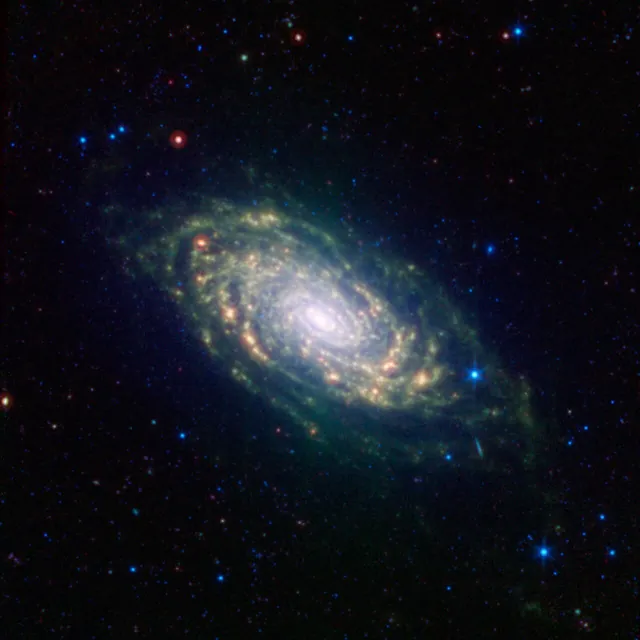
M63’s arm segments shine because they are lined with recently formed blue-white giant stars. In infrared light from the Spitzer Space Telescope the dust in the arms glows instead, and it can be traced all the way into the nucleus, where it forms a ring around the densest concentration of stars. The dusty patches are where new stars are being born.2311
Star formation fades in the outer disc. Carbon monoxide, which traces molecular gas, is detected along the major axis out to the optical edge of the disc, but beyond it only faint ultraviolet light and atomic hydrogen remain. In one bright ultraviolet patch outside that edge, stars form with very low efficiency. The nucleus itself is classed as a LINER, a weakly active type.810
Stars and stellar halo
A deep Spitzer mosaic at 3.6 microns traced M63’s light down to 29 magnitudes per square arcsecond. The brightness profile bends upwards beyond about 8′ from the centre, a sign of an inner stellar halo. Its authors found it the most massive such halo yet measured in a single galaxy, and estimated that several accretion events like the visible stream are needed to build it.6
At the very centre, adaptive-optics spectroscopy with the Keck telescope found stars moving faster towards the middle, revealing a black hole of about 4.6 million solar masses. The study found no evidence of a classical bulge and called M63 a remarkable local analogue of the Milky Way in its black hole, nuclear star cluster and total mass of stars.9
Notable features
Flocculent arms
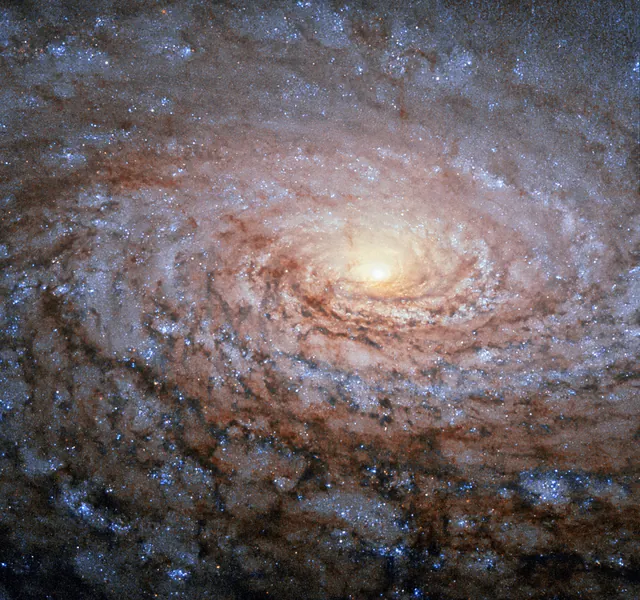
Although M63 has only two underlying arms, many short segments appear to wind around its core, giving the sunflower look. They show more clearly in infrared light. Astronomers image such galaxies to learn what drives star formation when there is no strong spiral pattern to trigger it.3
The giant tidal loop
A very faint arc of stars curves through the halo, reaching about 29 kiloparsecs from the centre with a width of 3.3 kiloparsecs. Its shape matches a stream from a dwarf galaxy of about 100 million solar masses, torn apart within the last few billion years.412
A family of faint satellites
A 50-hour exposure with a 0.14 m telescope traced M63’s system of stellar streams across 110 kiloparsecs and found five very faint dwarf galaxies around it. If they are satellites, they lie a median of 93 kiloparsecs from M63 in projection and are about 1.3 kiloparsecs across.5
Supernova 1971I
The SEDS Messier catalogue records one supernova in M63, Supernova 1971I, which appeared on 25 May 1971. It was a Type I supernova, the explosion of a star, and at its peak it reached magnitude 11.8.7
Discovery and history
M63 was Pierre Méchain’s very first discovery of a deep-sky object. He found it on 14 June 1779, and Charles Messier added it to his catalogue the same day; it was the first of 24 objects Méchain contributed. In the mid-19th century Lord Rosse listed it among the 14 “spiral nebulae” discovered by 1850, making it one of the first known spirals.37
The faint loop in its halo was first glimpsed in photographic studies by van der Kruit in 1979. It was recognised as the remains of a recent minor merger from 2010 onwards, from deep images taken with telescopes as small as 0.16 m and confirmed with 0.5 m and 0.8 m instruments.4
Seeing it for yourself
M63 appears as a faint oval patch of light in small telescopes. Through the eyepiece its arms show as a grainy glow that brightens slowly inwards and then rapidly towards a still-grainy nucleus. NASA’s observing guide names May as the best month to look. Its brightness is quoted as magnitude 8.6 by the SEDS catalogue and 9.3 by NASA.37
Telescopes on M63
M63 is one of the galaxies of the Spitzer Infrared Nearby Galaxies Survey, and NASA released Spitzer’s view of it on 3 March 2011. The Hubble Space Telescope has imaged its inner disc, released as an ESA/Hubble Picture of the Week on 7 September 2015, and in 2017 Hubble images of its red giant stars gave a precise new distance.1211
Much of what is known about its halo comes from very deep imaging rather than big telescopes: telescopes of just 0.14–0.16 m aperture found its tidal debris, and Spitzer’s Extended Disk Galaxy Exploration Science survey followed it in infrared light. In 2026 the Keck telescope’s OSIRIS spectrograph, sharpened by laser-guide-star adaptive optics, made the first stellar-dynamical measurement of its central black hole.4569
- Keck black-hole measurement
- 2026, angular resolution 0.045″9
Quick answers
- What kind of object is the Sunflower Galaxy (M63)?
- The Sunflower Galaxy (M63) is a flocculent spiral galaxy (Hubble type Sb or Sc; SIMBAD lists SA).378
- Which constellation is the Sunflower Galaxy (M63) in?
- The Sunflower Galaxy (M63) lies in the constellation Canes Venatici.37
- How far away is the Sunflower Galaxy (M63)?
- The Sunflower Galaxy (M63) is about 29 million light-years (8.87 ± 0.10 ± 0.29 Mpc) from Earth, tip of the red giant branch; NASA quotes about 27 million light-years.13
- How bright is the Sunflower Galaxy (M63) in the night sky?
- The Sunflower Galaxy (M63) has an apparent magnitude of 8.6 (visual; NASA quotes 9.3).378
- How big does the Sunflower Galaxy (M63) look in the sky?
- The Sunflower Galaxy (M63) covers 10′ × 6′ of sky (SIMBAD: 13.2′ × 7.9′).78
- How massive is the Sunflower Galaxy (M63)?
- The Sunflower Galaxy (M63) has a mass of (5.1 ± 1.8) × 10¹¹ solar masses (from the motions of its satellites, within about 216 kpc).5
- When was the Sunflower Galaxy (M63) discovered?
- The Sunflower Galaxy (M63) was discovered on 14 June 1779, by Pierre Méchain.7
Sources
- Accurate Distances to Important Spiral Galaxies: M63, M74, NGC 1291, NGC 4559, NGC 4625, NGC 5398 (McQuinn et al.) — arXiv:1706.06586, 2017
- A galactic sunflower (potw1536a) — ESA/Hubble, 2015
- Messier 63 (The Sunflower Galaxy) — NASA Science, Hubble’s Messier Catalog
- A Petal of the Sunflower: Photometry of the Stellar Tidal Stream in the Halo of Messier 63 (NGC 5055) (Chonis et al.) — Astronomical Journal 142, 166 (arXiv:1109.0019), 2011
- New dwarfs around the curly spiral galaxy M63 (Karachentsev et al.) — Astronomische Nachrichten (arXiv:2011.04984), 2020
- The Stellar Halo and Tidal Streams of Messier 63 (Staudaher et al.) — Monthly Notices of the Royal Astronomical Society (arXiv:1510.05707), 2015
- Messier 63 (H. Frommert & C. Kronberg) — SEDS Messier Database (Observatoire de Paris mirror), 2007
- SIMBAD astronomical database: M 63 — Centre de Données astronomiques de Strasbourg (CDS)
- The Black Hole Mass of the Sunflower Galaxy NGC 5055: Direct Measurement via Stellar Kinematics with Keck/OSIRIS Laser Guide Star Adaptive Optics (Ho et al.) — Astrophysical Journal, accepted (arXiv:2611.16490), 2026
- CO map and steep Kennicutt-Schmidt relation in the extended UV disk of M63 (Dessauges-Zavadsky et al.) — Astronomy & Astrophysics (arXiv:1406.0310), 2014
- Sunflower Galaxy Glows with Infrared Light (sig11-001) — NASA Spitzer Space Telescope, Caltech, 2011
- Photometry of the Stellar Tidal Stream in the Halo of Messier 63 (Chonis et al.) — arXiv:1207.2115, 2012
Figures checked against these sources in November 2026. Where a quantity is not known, it is left out rather than estimated.

