galaxy
Centaurus A (NGC 5128)
Centaurus A, also catalogued as NGC 5128, is the nearest giant galaxy with an active black hole at its heart, about 12 million light-years away in the southern constellation Centaurus. A broad, patchy lane of dark dust cuts across its glowing ball of stars: the mangled remains of a spiral galaxy that it swallowed, a merger that has also lit up bursts of new star formation.1234
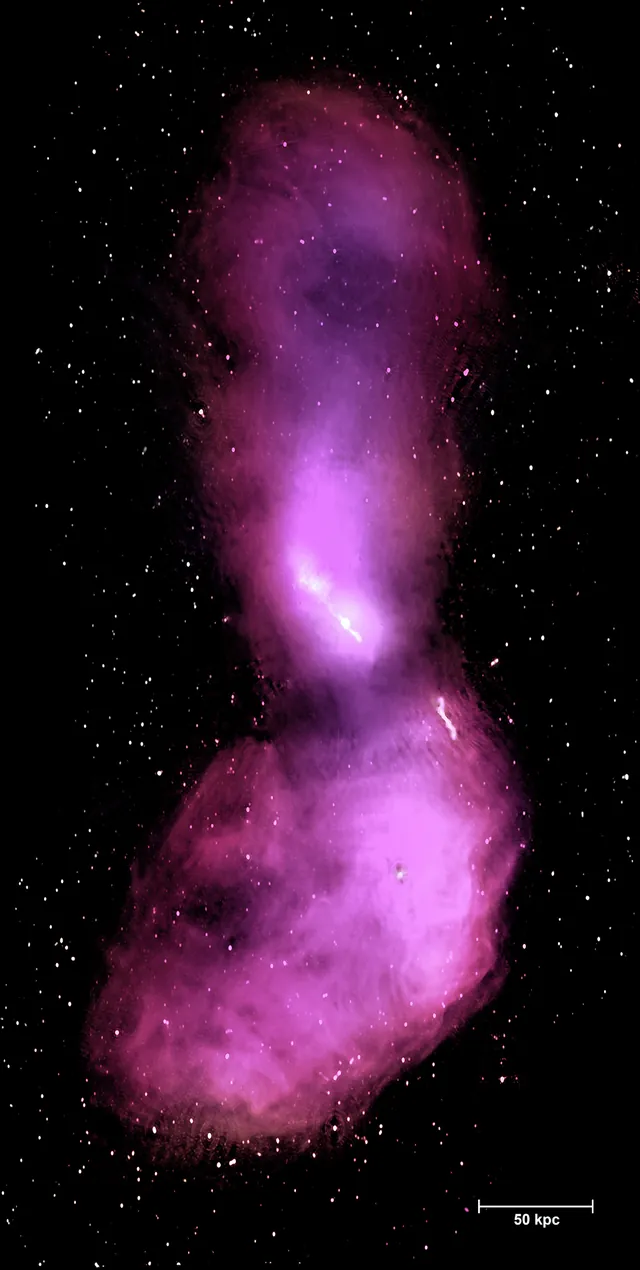
It is also one of the brightest radio sources in the sky. Jets from its central black hole, some 55 million times the mass of the Sun, have blown two vast radio lobes that together stretch more than a million light-years and would look nearly twenty times as wide as the full Moon if our eyes could see radio waves. Chandra has traced one jet in X-rays for 13,000 light-years.2456
Shape and size in space
Centaurus A is a massive galaxy whose smooth, elongated outer glow, the light of hundreds of billions of older stars, marks it as an elliptical. Across its centre lies a broad band of gas, dust and young stars. SIMBAD classes it as a peculiar lenticular galaxy, NASA as a peculiar elliptical, and the SEDS database calls it intermediate between elliptical and disc galaxies. The visible galaxy is about 60,000 light-years wide.2789
A 2010 review of Cepheids, the tip of the red-giant branch, planetary nebulae, surface-brightness fluctuations and Mira variables gave a best distance of 3.8 ± 0.1 megaparsecs, about 12.4 million light-years. Popular sources quote 11, 12 or 13 million light-years. It belongs to the Centaurus A/M83 group of galaxies, and its spectrum is shifted to the red by about 560 km/s.123789
The radio galaxy is far bigger than the optical one. Two giant plumes of magnetised gas, puffed out by its jets over tens of millions of years, extend on either side; Fermi’s team describes each as nearly a million light-years long, and with radio data they stretch more than 1.4 million light-years in total.6
What makes it shine
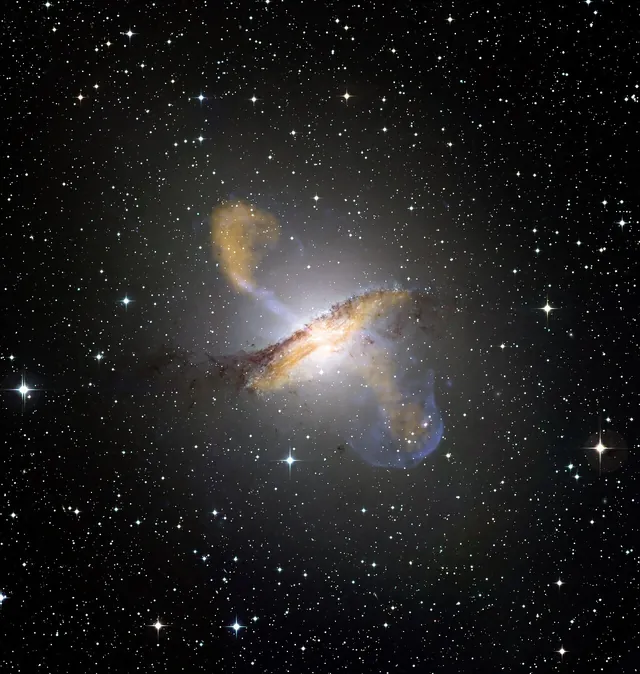
Starlight gives Centaurus A its visible glow, but its central region is very active and highly luminous. Matter falling towards the central black hole releases vast amounts of energy, and some is diverted into two opposite jets of particles moving close to the speed of light. Bursts of radio waves, X-rays and gamma rays come from this feeding. Submillimetre measurements with APEX show material in the inner jet travelling at about half the speed of light.2368
The radio waves come from fast electrons spiralling through tangled magnetic fields in the lobes. In 2010 NASA’s Fermi telescope found that the lobes also shine in gamma rays, more than ten times as strongly as in radio waves: microwave background photons are boosted to gamma-ray energies when they strike the fastest particles. ESO calls it the most prominent radio galaxy in the sky.26
Stars and the merger
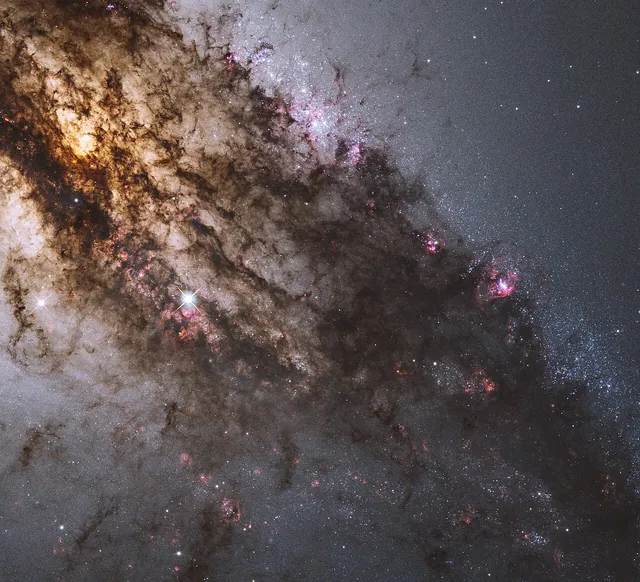
Most of the galaxy’s light comes from hundreds of billions of cool, old stars. The dark band is different: it harbours gas, dust and young stars, with bright young clusters at its edges and the red glow of star-forming hydrogen clouds. ESO describes it as probably the mangled remains of a spiral galaxy being torn apart by the giant elliptical, and Chandra’s team dates the merger to perhaps 100 million years ago.24
Hubble’s infrared camera has seen through the dust to young blue star clusters, and found that the galaxy’s halo of stars stretches much farther out than once thought. Two supernovae have been recorded: SN 1986G, found by the amateur astronomer Robert Evans on 3 May 1986 and peaking at magnitude 12.5, and a second in 2016. More than 200 variable stars were found in ESO’s deep images.289
Notable features
The dust lane
A broad, patchy band of dark material obscures the centre, full of gas, dust, young star clusters and pink star-forming clouds. It is probably what remains of a spiral galaxy being ripped apart by the elliptical’s gravity, and it absorbs X-rays as well as visible light.24
The central black hole
Motions of stars measured with the SINFONI instrument on ESO’s Very Large Telescope give a mass of 55 ± 30 million Suns; gas motions in the same data give 45 million. Hubble found a tilted disc of hot gas 130 light-years across around it, probably feeding a smaller accretion disc.5810
The X-ray jet
In a Chandra exposure of more than seven days a jet extends 13,000 light-years in one direction, with a shorter counterjet opposite. Knots near the black hole, probably shock waves, mark where particles are being accelerated to near light speed. Hundreds of X-ray binaries containing stellar black holes are also seen.4
The radio lobes
Two giant bubbles of magnetic field and energetic particles, inflated by the jets over tens of millions of years. Together they stretch more than 1.4 million light-years, and in 2010 Fermi found them glowing in gamma rays, the first case of microwave photons boosted to gamma-ray energies.6
The shock front
Below and to the right of the galaxy, Chandra sees X-rays glowing where the expanding southern lobe ploughs into the surrounding gas and drives a shock wave through it. In ESO’s 2009 composite this glow appears as a faint blue arc around the lobe.3
The filaments
Two groups of reddish filaments, roughly lined up with the radio jets, lie about 30,000 and 65,000 light-years from the nucleus. Both are stellar nurseries with hot young stars; whether radiation from the nucleus or shocks light them up is still debated.2
Discovery and history
The British astronomer James Dunlop discovered the galaxy at Parramatta Observatory in Australia on 4 August 1826 and listed it as number 482 in his catalogue. John Herschel saw it next, on 1 June 1834 from South Africa. It became number 3525 in Herschel’s General Catalogue of 1864 and NGC 5128 in Dreyer’s New General Catalogue.29
Its common name comes from radio astronomy: it was the first major source of radio waves discovered in Centaurus, and one of the first radio sources anywhere identified with a galaxy. Halton Arp listed it as number 153 in his catalogue of peculiar galaxies, and Patrick Moore as Caldwell 77. Its black hole mass was long debated; NASA and ESO pages still quote estimates of 100 million Suns or more.268910
Seeing it for yourself
Centaurus A is the fifth brightest galaxy in the sky, at visual magnitude 6.8, and shows in binoculars, though a telescope is better. Through a telescope it looks nearly round, crossed by its dark dust lane. It is best seen from the Southern Hemisphere in autumn; northern observers need to be as far south as possible and look low in the southern sky in late spring.78
Telescopes on Centaurus A
Chandra’s ultra-deep look, equivalent to more than seven days of continuous observing and released in January 2008, mapped the X-ray jet and hundreds of X-ray binaries. In January 2009 ESO combined the first submillimetre images of the jets and inner lobes, from the APEX telescope, with Chandra X-rays and visible light. In 2012 ESO released a Wide Field Imager view built from more than 50 hours of exposures.234
Hubble has imaged the dust lane with several cameras, most recently Wide Field Camera 3 in 2010. Fermi’s first ten months of data revealed the gamma-ray lobes. In 2021 the Event Horizon Telescope imaged the jet at 228 GHz with sixteen times sharper resolution than before, revealing a tightly collimated, edge-brightened jet and a fainter counterjet that resemble M87’s jet.6811
Quick answers
- What kind of object is Centaurus A (NGC 5128)?
- Centaurus A (NGC 5128) is a peculiar elliptical or lenticular galaxy (S0 pec) with an active nucleus.789
- Which constellation is Centaurus A (NGC 5128) in?
- Centaurus A (NGC 5128) lies in the constellation Centaurus.8
- How far away is Centaurus A (NGC 5128)?
- Centaurus A (NGC 5128) is about 12.4 million light-years (3.8 ± 0.1 Mpc) from Earth, average of five independent methods.1
- How big is Centaurus A (NGC 5128)?
- Centaurus A (NGC 5128) is about 60,000 light-years across (the visible galaxy; its radio lobes are far larger).8
- How bright is Centaurus A (NGC 5128) in the night sky?
- Centaurus A (NGC 5128) has an apparent magnitude of 6.8 (visual (V band); visible in binoculars).78
Sources
- The Distance to NGC 5128 (Centaurus A) (Harris, Rejkuba & Harris) — Publications of the Astronomical Society of Australia (doi:10.1071/AS09061; arXiv:0911.3180), 2010
- A Deeper Look at Centaurus A (eso1221) — European Southern Observatory, 2012
- Black hole outflows from Centaurus A detected with APEX (eso0903) — European Southern Observatory, 2009
- Centaurus A (Chandra Photo Album, 9 January 2008) — Chandra X-ray Center, Harvard-Smithsonian Center for Astrophysics, 2008
- The mass of the black hole in Centaurus A from SINFONI AO-assisted integral-field observations of stellar kinematics (Cappellari et al.) — Monthly Notices of the Royal Astronomical Society 394, 660 (arXiv:0812.1000), 2009
- Fermi Maps an Active Galaxy’s ‘Smokestack Plumes’ — NASA, 2010
- SIMBAD astronomical database: NAME Centaurus A (NGC 5128) — Centre de Données astronomiques de Strasbourg (CDS)
- Caldwell 77 — NASA Science, Hubble’s Caldwell Catalog
- NGC 5128 (Centaurus A) (H. Frommert & C. Kronberg) — SEDS Messier Database (Observatoire de Paris mirror), 2007
- The Supermassive Black Hole at the Heart of Centaurus A: Revealed by Gas- and Stellar Kinematics (Neumayer) — Publications of the Astronomical Society of Australia (doi:10.1071/AS09080; arXiv:1002.0965), 2010
- Event Horizon Telescope observations of the jet launching and collimation in Centaurus A (Janssen et al.) — Nature Astronomy 5, 1017 (arXiv:2111.03356), 2021
Figures checked against these sources in November 2026. Where a quantity is not known, it is left out rather than estimated.

