galaxy
Southern Pinwheel (M83)
The Southern Pinwheel, Messier 83, is one of the largest and closest barred spiral galaxies to us and one of the brightest in the sky, visible even in binoculars. It lies about 15 million light-years away in Hydra, close to the border with Centaurus, and in its spiral shape and central bar it is in many ways a smaller cousin of the Milky Way.12345
M83 is forming stars faster than our own galaxy, most fiercely in its crowded centre, and its arms glow with red clouds of hydrogen lit by young stars. It is also a supernova factory: six exploding stars have been seen in it since 1923, and Hubble has found nearly 300 remnants of older explosions. At its heart sits a puzzling double nucleus.14567
Shape and size in space
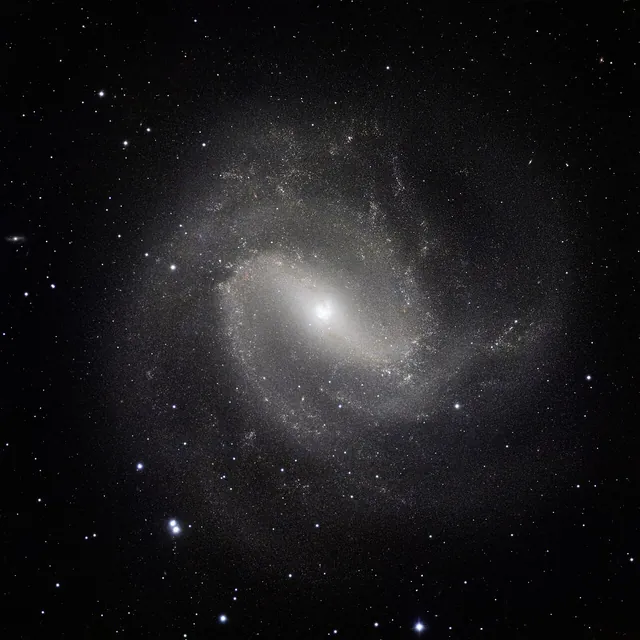
M83 is a barred spiral: a bar of stars, gas and dust slices across its centre, as in the Milky Way. G. de Vaucouleurs classified it as SAB(s)c, intermediate between ordinary and barred spirals. The bar acts like a funnel, channelling gas inwards to feed star formation in the core. The spiral arms are well defined, and dark dust lanes can be followed right into the nucleus.1410
Cepheid variable stars observed with ESO’s Very Large Telescope put M83 at 4.5 ± 0.3 megaparsecs, about 15 million light-years, the distance NASA, ESA and ESO all quote. ESO gives its diameter as over 40,000 light-years, and ESA/Hubble calls it just under half the size of the Milky Way. Older estimates ranged from 10 to 25 million light-years.123457
M83 leads the Centaurus A/M83 Group of galaxies, together with the dusty radio galaxy Centaurus A and the irregular NGC 5253, plus several dwarfs. NGC 5253 lies only about half a megaparsec from M83, and the two may once have interacted. M83’s own outer disc is disturbed and its nucleus off-centre, presumably after some past interaction.13411
What makes it shine
Billions of stars give M83 its glow, older yellowish stars near the hub and young blue ones in the arms. The ruby-red knots along the arms are huge clouds of hydrogen, ionised by ultraviolet light from newly born massive stars. In infrared light most of the dust becomes transparent and the glowing gas fades, revealing the hordes of stars behind them.245
X-ray observations show the centre as a hive of vigorous star formation held within a cloud of gas superheated to about 7 million °C. Ultraviolet and radio observations have found young stars even in the faint outer regions of the disc, far beyond the bright spiral seen in ordinary photographs.5
- Temperature of the central hot gas
- about 7 million °C5
The stars inside
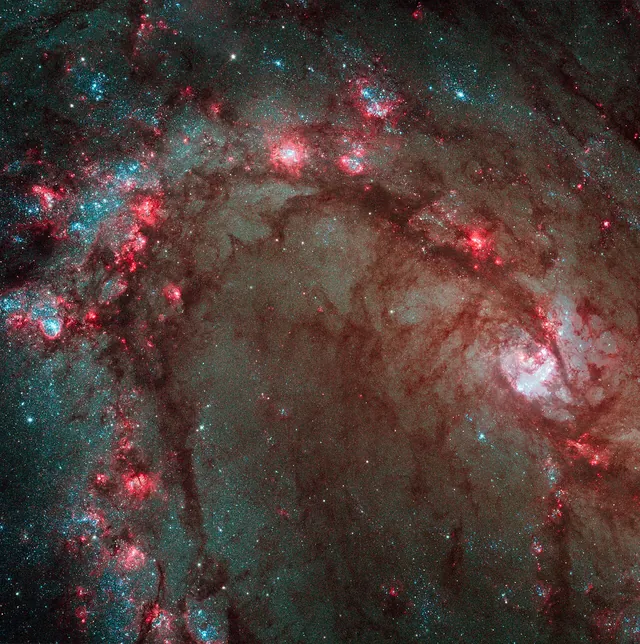
M83 is forming stars faster than the Milky Way. Hubble’s Wide Field Camera 3 captured hundreds of young star clusters, ancient globular clusters and hundreds of thousands of individual stars, mostly blue and red supergiants. New stars form largely in clusters along the dark dust lanes; their winds blow away the gas to reveal blue clusters 1 to 10 million years old.610
Some 3,000 star clusters have been identified in M83, some younger than 5 million years. The richest crop lies in the nuclear starburst: Hubble catalogued 45 massive clusters there, and more than three-quarters of those above 20,000 solar masses within the central 300 parsecs are under 10 million years old. They lie in a semicircular arc 50 to 130 parsecs from the optical centre.112
Notable features
The starburst core
Gas flowing in along the bar feeds intense star formation around the centre. Much of it is hidden by dust and seen only in near- and mid-infrared light, to the north of the visible nucleus, where the youngest stars lie; ages increase gradually southwards along the well-known star-forming arc.111
The double nucleus
The visible nucleus sits about 3″, some 60 parsecs, from the galaxy’s photometric and kinematic centre. A second nucleus is inferred from how mass is distributed rather than seen directly; it may be a lopsided disc of stars around a single central black hole. The offset may date from a past interaction.111
Six supernovae
SN 1923A, SN 1945B, SN 1950B, SN 1957D, SN 1968L and SN 1983N. SN 1945B was found only in 1990 on old photographic plates, and SN 1968L was spotted by South African amateur Jack Bennett while sweeping for comets. ESA/Hubble says only Messier 61 and NGC 6946 have as many or more.14
SN 1957D
Discovered by H. S. Gates on 13 December 1957 about 3′ north-north-east of the nucleus, it peaked at only magnitude 15.0. Yet its glow lingered: ESO notes that it remained observable for 30 years, unusually long for a supernova.45
Supernova remnants
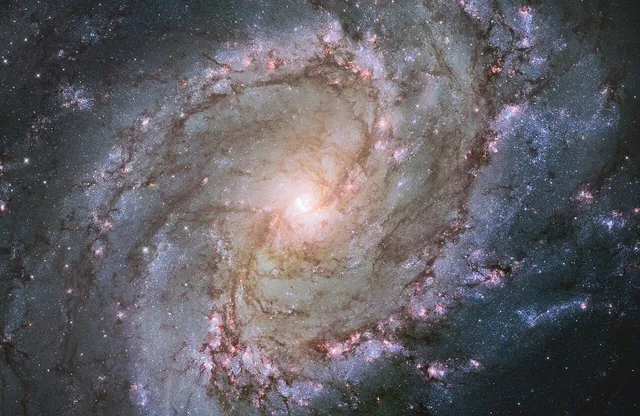
Hubble’s 2009 image alone showed about 60 remnants, five times more than previously known in that region. Altogether almost 300 have been found in the survey data, including 26 new remnants picked out by targeting soft X-ray sources from a deep Chandra survey. Their spectra suggest shocks in dense gas rather than fresh ejecta.11013
Discovery and history
Nicolas-Louis de Lacaille discovered M83 at the Cape of Good Hope on 23 February 1752, listing it as Lacaille I.6. It was the first galaxy found beyond the Local Group and only the third galaxy discovered at all, after M31 and M32. Charles Messier catalogued it on 17 February 1781, noting that from Paris it could be seen only with the greatest concentration.47
James Dunlop listed it as number 628 in his early 19th-century southern catalogue, and William Lassell sketched its spiral, calling it a three-branched spiral. Because it rises so low for northern observers, older catalogues compiled in the north underestimated its brightness badly; one gave magnitude 10.1. It remains the southernmost galaxy in Messier’s catalogue.4
Seeing it for yourself
With an apparent magnitude of 7.5, M83 is one of the brightest spiral galaxies in the night sky and can be picked out with binoculars. NASA’s Hubble observing guide names June as the best month. For southern-hemisphere observers it is a showpiece, but from mid-northern latitudes it stays low and is one of the hardest Messier objects to see.247
It sits in Hydra just north of the border with Centaurus. One route is to star-hop from Gamma Hydrae, a magnitude 3.0 star about 6.5° to the north; southern observers can use the stars i and g Centauri, near the head of Centaurus, which point straight towards it.4
Telescopes on the Southern Pinwheel
Between January 2000 and July 2001 ESO’s Very Large Telescope observed M83 at 34 epochs to find its Cepheid variables. In 2008 ESO released a Wide Field Imager portrait made from about 100 minutes of exposures, and in 2010 a near-infrared view from the VLT’s HAWK-I camera built from eight and a half hours of exposures, one of the sharpest pictures of M83 ever taken from the ground.235
Hubble’s Wide Field Camera 3, installed in May 2009, observed M83 that August; the image was released on 5 November 2009. A seven-field survey in nine filters followed, alongside a deep Chandra X-ray survey, and its full mosaic was released on 9 January 2014. Infrared studies with Gemini-South and Spitzer have probed the dusty core.16101113
Quick answers
- What kind of object is Southern Pinwheel (M83)?
- Southern Pinwheel (M83) is a barred spiral galaxy (SAB(s)c), with a starburst nucleus (classed between normal and barred spirals).148
- Which constellation is Southern Pinwheel (M83) in?
- Southern Pinwheel (M83) lies in the constellation Hydra (near the border with Centaurus).47
- How far away is Southern Pinwheel (M83)?
- Southern Pinwheel (M83) is about 15 million light-years (4.5 ± 0.3 Mpc) from Earth, from Cepheid variable stars.237
- How big is Southern Pinwheel (M83)?
- Southern Pinwheel (M83) is over 40,000 light-years across (under half the size of the Milky Way).125
- How bright is Southern Pinwheel (M83) in the night sky?
- Southern Pinwheel (M83) has an apparent magnitude of 7.5 (visible in binoculars).78
- How big does Southern Pinwheel (M83) look in the sky?
- Southern Pinwheel (M83) covers 12.9′ × 11.5′ of sky.9
Sources
- A galaxy with two hearts (heic1403) — ESA/Hubble, 2014
- Clear New View of a Classic Spiral (eso1020) — European Southern Observatory, 2010
- The Cepheid Distance to NGC 5236 (M 83) with the VLT (Thim et al.) — Astrophysical Journal 590, 256 (arXiv:astro-ph/0303101), 2003
- Messier 83 (H. Frommert & C. Kronberg) — SEDS Messier Database (Observatoire de Paris mirror), 2007
- The Thousand-Ruby Galaxy (eso0825) — European Southern Observatory, 2008
- Hubble Image Showcases Star Birth in M83, the Southern Pinwheel — NASA Science (Hubble news release), 2009
- Messier 83 (The Southern Pinwheel) — NASA Science, Hubble’s Messier Catalog
- SIMBAD astronomical database: M 83 — Centre de Données astronomiques de Strasbourg (CDS)
- Revised NGC Data for NGC 5236 (from W. Steinicke’s Revised NGC and IC Catalog) — SEDS Interactive NGC Catalog
- Hubble Wide Field Camera 3 image details star birth in galaxy M83 (image opo0929b) — ESA/Hubble, 2009
- The central region of M83: Massive star formation, kinematics, and the location and origin of the nucleus (Knapen et al.) — Monthly Notices of the Royal Astronomical Society (arXiv:1006.2698), 2010
- Young Clusters in the Nuclear Starburst of M 83 (Harris et al.) — arXiv:astro-ph/0109076 (doi:10.1086/324230), 2001
- An Expanded HST/WFC3 Survey of M83: Project Overview and Targeted Supernova Remnant Search (Blair et al.) — Astrophysical Journal 788, 55 (arXiv:1404.7179), 2014
- The classic spiral Messier 83 seen in the infrared with HAWK-I (image eso1020a) — European Southern Observatory, 2010
Figures checked against these sources in November 2026. Where a quantity is not known, it is left out rather than estimated.

