galaxy
Sombrero Galaxy (M104)
The Sombrero Galaxy looks like a broad-brimmed hat: a brilliant white bulge of old stars ringed by a sharp lane of dark dust. It lies about 31 million light-years away in Virgo, and we see it from just six degrees off its equator, so the dusty disc appears almost edge-on. At eighth magnitude it is too faint for the unaided eye but easy in a small telescope.1234
It is also something of a puzzle. Its thin disc looks like a spiral galaxy’s, yet its huge, round bulge and halo look like those of an elliptical, and infrared images suggest one galaxy nested inside the other. Around it swarm some 2,000 globular clusters, and at its heart sits a quiet black hole of several hundred million solar masses.14567
Shape and size in space
Hubble measurements of the brightest red giant stars in the Sombrero’s halo put it 9.55 ± 0.13 ± 0.31 megaparsecs away, about 31 million light-years. Older estimates scatter more widely, and NASA and ESA pages quote 28 or 30 million light-years. At that distance the galaxy is about 50,000 light-years across, and it lies at the southern edge of the rich Virgo cluster of galaxies.123
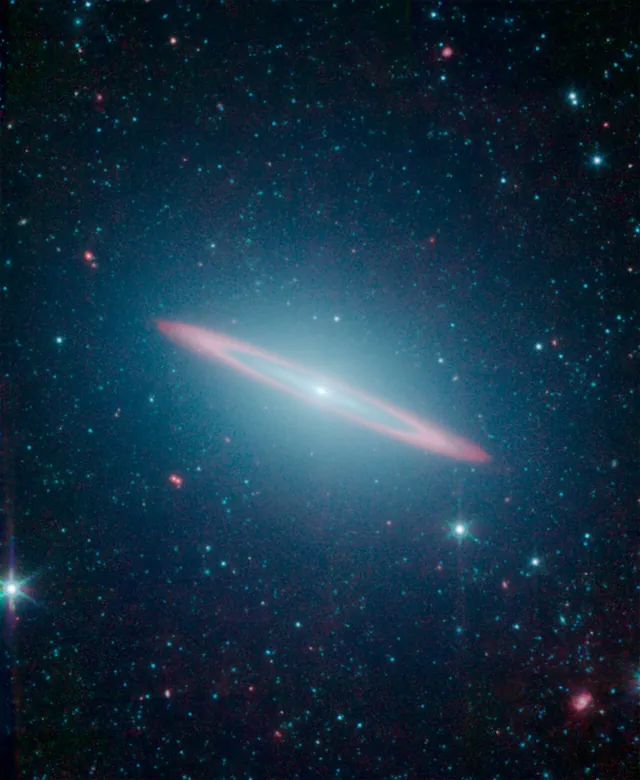
We view the galaxy from only about six degrees off the plane of its disc, which makes its structure hard to read. The disc looks like that of a typical spiral, but the round bulge and halo look like an elliptical galaxy’s. Spitzer’s infrared images showed a large elliptical-like halo of stars with a thin disc embedded inside it, so astronomers have described the Sombrero as two galaxies in one.3458
The Sombrero is one of the most massive objects in the Virgo cluster region, with a mass of about 800 billion Suns. Orbit-based models of its stars and globular clusters show that dark matter makes up about half of the mass inside the radius that contains half of its light; the models give a circular speed of 376 ± 12 km/s far from the centre.137
What makes it shine
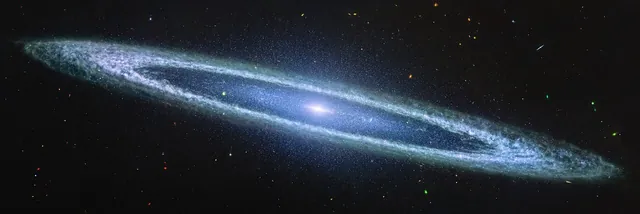
In visible light the Sombrero’s glow comes mostly from the countless old stars of its bulge and halo, crossed by the dark dust lane of the disc. Despite all those stars it forms very few new ones: its dusty ring turns less than one solar mass of gas into stars each year, compared with roughly two for the Milky Way.146
In the mid-infrared the picture flips. The bright core fades, a smooth inner disc appears, and the dust ring itself glows, broken into clumps where carbon-rich molecules called polycyclic aromatic hydrocarbons mark young star-forming regions. Spitzer had already shown that the inner disc is almost all stars with no dust, separated by a slight gap from the outer ring of mingled dust and stars.56
The nucleus is faintly active. Spectra show a Seyfert-like emission spectrum with hydrogen lines about 5,200 km/s wide, and SIMBAD classes the nucleus as a LINER. ESA describes it as a low-luminosity active galactic nucleus that slowly feeds on infalling material while sending out a small, bright jet, and X-rays suggest material is falling into the core.16910
- Width of the Hα line
- about 5,200 km/s at zero intensity10
The stars inside
The Sombrero’s halo holds a rich system of globular clusters, estimated at nearly 2,000, about ten times as many as the Milky Way has. Hubble resolves them easily around the bulge. Their ages, 10–13 billion years, are similar to those of the Milky Way’s globular clusters, and each holds hundreds of thousands of old stars of a single age but differing masses.16
A Hubble study measured the sizes of 652 of these clusters and found the same distribution of sizes seen in other large galaxies. Their colours split clearly into two groups, blue and red, as in giant elliptical galaxies. Hubble has also found extremely metal-rich stars in the halo, which point to a possible merger with a massive galaxy several billion years ago.411
Notable features
The dust ring
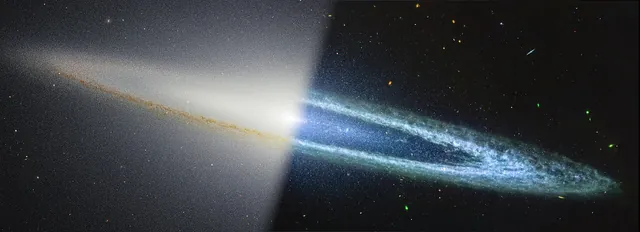
The hat’s ‘brim’ is a thick lane of dust outlining the disc, where what little star formation the galaxy has takes place. Webb’s mid-infrared camera showed for the first time that the outer ring is broken into intricate clumps, rich in polycyclic aromatic hydrocarbons, separated by a gap from a dust-free inner disc.156
The bulge and halo
The hat’s ‘crown’ is a brilliant, bulbous core of old stars inside a vast halo. In Spitzer’s infrared view this halo is the right size and mass for a large elliptical galaxy, which is why the Sombrero has been called two galaxies in one.15
The central black hole
Hubble spectra of stars near the centre confirmed a dark mass of about a billion Suns in 1996. Later orbit-based models gave 660 ± 40 million solar masses. Recent ESA releases quote 9 billion, a figure we could not trace to a measurement. Whatever its mass, the black hole is quiet, feeding only slowly.46710
A tilted inner disc
Hidden within the bright core is a smaller disc of its own, tilted relative to the large disc that carries the dust lane. It is not visible in Hubble’s famous picture. X-ray emission suggests that material is falling into the compact core around it, where a massive black hole resides.1
Discovery and history
Pierre Méchain discovered the galaxy in 1781, and Charles Messier added it by hand to his own copy of his catalogue on 11 May 1781, calling it a very faint nebula. It was not in the published list, so M104 is the first object numbered after Messier’s original catalogue. In 1921 Camille Flammarion matched it with William Herschel’s H I.43, found independently on 9 May 1784, and added it officially.18
Herschel’s great reflector probably gave the first view of its dust lane. In 1912 Vesto Slipher at Lowell Observatory found that the Sombrero is receding at about 1,000 km/s, the first large redshift found for any galaxy and far too fast for an object inside the Milky Way. Slipher also detected that the galaxy rotates.8
Seeing it for yourself
At magnitude 8 the Sombrero is just beyond naked-eye visibility but easy to find in a small telescope; NASA names May as the best month. It spans roughly a third of the full Moon’s width. Lying about 11.6° south of the celestial equator, it is placed for observers in both hemispheres, and NASA’s guide gives star charts for mid-northern and mid-southern latitudes.1349
Telescopes on the Sombrero
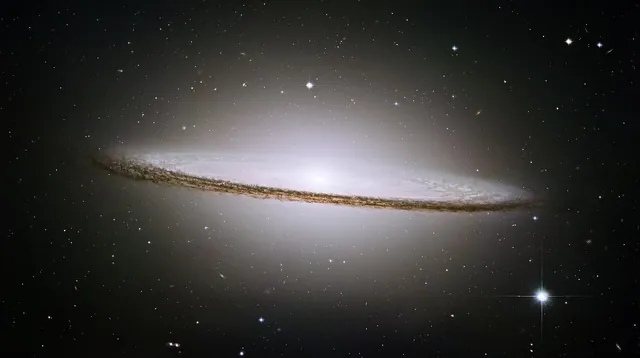
Hubble’s October 2003 portrait of the Sombrero is one of the largest mosaics ever assembled from its observations, because the galaxy is too big for the telescope’s narrow field of view. In April 2025, for its 35th anniversary, ESA/Hubble released a reprocessed version with newer data that shows finer detail in the disc and more background galaxies.14
Infrared telescopes see past the dust. Spitzer’s images, released on 24 April 2012, revealed the disc nested inside an elliptical-like halo. The James Webb Space Telescope imaged it with its MIRI camera, released on 25 November 2024, and added a NIRCam view released on 3 June 2025, in which the dust ring blocks starlight in the near-infrared and glows in the mid-infrared.5612
Quick answers
- What kind of object is the Sombrero Galaxy (M104)?
- The Sombrero Galaxy (M104) is a disc galaxy with a giant bulge, seen nearly edge-on (classed as a spiral (Sa), but its bulge and halo resemble an elliptical galaxy).458
- Which constellation is the Sombrero Galaxy (M104) in?
- The Sombrero Galaxy (M104) lies in the constellation Virgo.1
- How far away is the Sombrero Galaxy (M104)?
- The Sombrero Galaxy (M104) is about 31 million light-years (9.55 Mpc) from Earth, from the tip of the red giant branch; NASA quotes 28 million light-years.12
- How big is the Sombrero Galaxy (M104)?
- The Sombrero Galaxy (M104) is about 50,000 light-years across.3
- How bright is the Sombrero Galaxy (M104) in the night sky?
- The Sombrero Galaxy (M104) has an apparent magnitude of 8.0 (beyond the limit of naked-eye visibility).19
- How big does the Sombrero Galaxy (M104) look in the sky?
- The Sombrero Galaxy (M104) covers 8.5′ × 5.0′ of sky (roughly a third of the full Moon’s width).49
Sources
- Messier 104 (The Sombrero Galaxy) — NASA Science, Hubble’s Messier Catalog
- The Distance to M104 (McQuinn et al.) — arXiv:1610.03857, 2016
- Sombrero galaxy (image opo0328a) — ESA/Hubble
- Hubble Provides New View of Galactic Favorite — NASA Science (Hubble news), 2025
- The Sombrero Galaxy’s Split Personality (ssc2012-06a) — NASA Spitzer Science Center, Caltech, 2012
- Sombrero Galaxy dazzles in new Webb image (weic2427) — ESA/Webb, 2024
- Orbit-Based Dynamical Models of the Sombrero Galaxy (NGC 4594) (Jardel et al.) — Astrophysical Journal 739, 21 (arXiv:1107.1238), 2011
- Messier 104 (H. Frommert & C. Kronberg) — SEDS Messier Database (Observatoire de Paris mirror), 2007
- SIMBAD astronomical database: M 104 — Centre de Données astronomiques de Strasbourg (CDS)
- Hubble Space Telescope Spectroscopic Evidence for a 1 × 10⁹ solar-mass Black Hole in NGC 4594 (Kormendy et al.) — Astrophysical Journal 473, L91 (record at IPAC), 1996
- Diamonds on the Hat: Globular Clusters in the Sombrero Galaxy (M104) (Harris et al.) — Monthly Notices of the Royal Astronomical Society (arXiv:0909.4805)
- Sombrero galaxy (NIRCam and MIRI image) — ESA/Webb, 2025
Figures checked against these sources in November 2026. Where a quantity is not known, it is left out rather than estimated.

