galaxy
M87 (Virgo A)
Messier 87 is a giant elliptical galaxy at the heart of the Virgo Cluster, about 55 million light-years away. It holds several trillion stars and some 15,000 globular clusters, against about 150 in the Milky Way. From its core a jet of particles moving at nearly the speed of light streams out for at least 5,000 light-years, first noticed in 1918.1234
That jet is powered by a black hole of about 6.5 billion solar masses. On 10 April 2019 the Event Horizon Telescope, a network of radio dishes as wide as the Earth, released the first image ever made of a black hole: a glowing ring around its dark shadow. Later images have shown the ring in polarised light and watched it change from year to year.35678
Shape and size in space
M87 is a giant elliptical galaxy, a nearly round ball of stars of type E0 to E1 with no spiral arms. It is the dominant member of the Virgo Cluster, which holds some 2,000 galaxies, and it lies well within the cluster’s heart. The Event Horizon Telescope team adopted a distance of 16.8 megaparsecs, about 55 million light-years.124610
Its bright body spans about 7′ of sky, which corresponds to roughly 120,000 light-years. Deep photographs by David Malin show a much larger, elongated halo more than half a degree long, over half a million light-years across, distorted by encounters with other cluster galaxies and swollen with stars from galaxies it has absorbed. Being round, it fills far more volume than the Milky Way’s disc and holds several trillion stars.24
Published distances differ. NASA’s Hubble pages give 54 million light-years, the SEDS Messier database 60 million, and a 1995 Hubble study of its globular clusters about 55 million. Its spectrum is shifted to the red by 1,256 km/s, the speed at which it recedes from us.249
What makes it shine
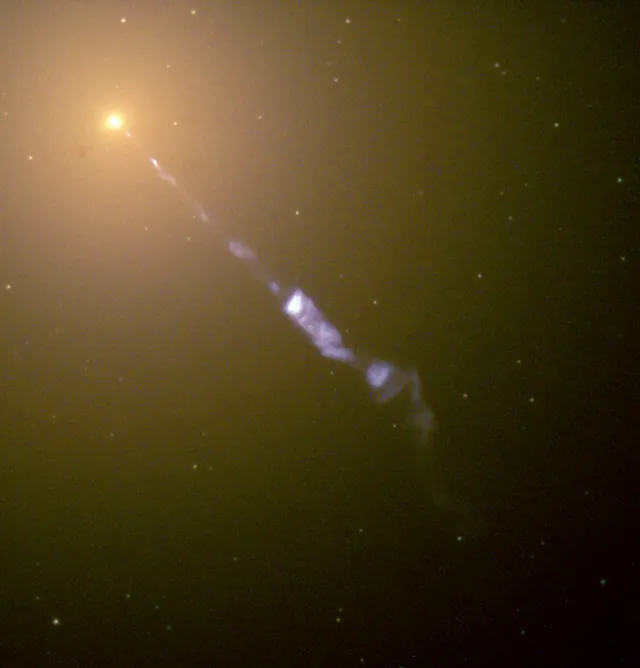
In visible light most of M87’s glow is the combined light of billions of old stars too distant for Hubble to separate. Its nucleus is also an active galactic nucleus. Gas spiralling towards the central black hole releases energy that launches a jet of electrons and other particles at nearly the speed of light. The jet’s light is strongly polarised, the signature of synchrotron radiation from fast electrons spiralling in magnetic fields.2411
M87 is the radio source Virgo A, also catalogued as 3C 274, identified with the galaxy by Walter Baade and Rudolph Minkowski in 1954. Radio images show plumes of gas from the jets rising into the cluster’s hot gas. In X-rays the galaxy sits near the centre of a hot cloud spread across much of the Virgo Cluster, carved with loops and bubbles left by repeated outbursts from the black hole.4912
Stars and star clusters
M87 holds several trillion stars, mostly old and yellow, compared with a few hundred billion in the Milky Way. J. C. Brandt and R. G. Roosen estimated its total mass at 2.7 trillion Suns, and other estimates run to several trillion. Around it swarms one of the richest families of globular clusters known: NASA gives roughly 15,000, an ESA/Hubble release 13,000.2410
Older counts were lower: a 1976 study quoted by Burnham gave at least 4,000. The clusters show in Hubble pictures as countless faint points in the galaxy’s glow. Sitting at the centre of the cluster, M87 may have collected some of them by pulling them away from nearby dwarf galaxies that now seem to have none.2411
Notable features
The black hole M87*
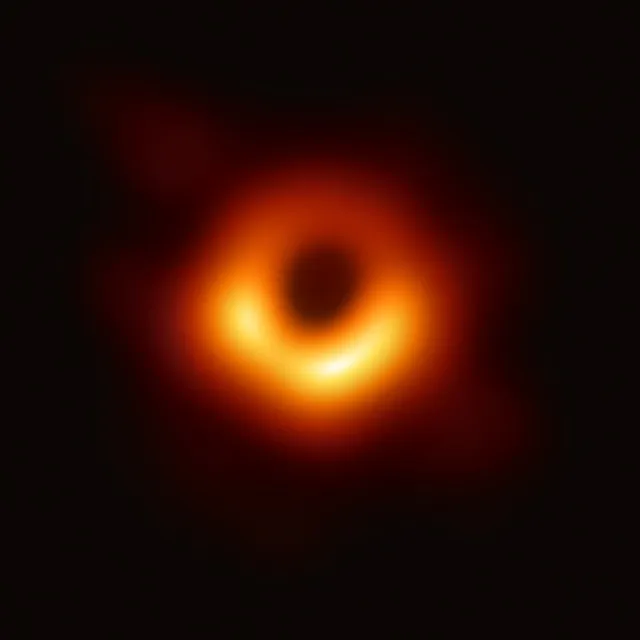
The black hole at M87’s centre has a mass of 6.5 billion Suns. Its event horizon measures just under 40 billion km across, and the shadow it casts is about 2.5 times larger. In 2019 it became the first black hole ever imaged, as a ring 42 microarcseconds wide around a dark centre.156
The relativistic jet
Heber Curtis of Lick Observatory first saw the jet in 1918. It stretches at least 5,000 light-years, breaks into a string of knots, and shows apparent faster-than-light motion, an illusion because it points partly towards us. A fainter counterjet pointing the other way was reported by Halton Arp in 1966.34
Magnetised ring
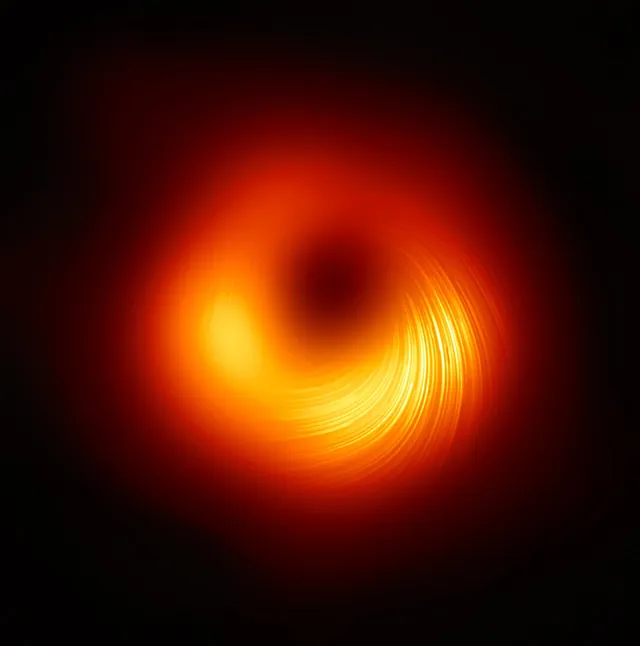
In polarised light the ring around M87* shows a spiral pattern traced by magnetic fields at the black hole’s edge. Only models with strongly magnetised gas explain it: the field seems strong enough to push back on the hot gas, so only gas that slips through spirals inwards to the event horizon.3
Globular cluster system
M87 is surrounded by roughly 13,000 to 15,000 globular clusters, about a hundred times as many as the Milky Way. Their brightness distribution has been used to measure the galaxy’s distance, with a 1995 Hubble study giving about 55 million light-years.2410
Hot gas and X-ray bubbles
Chandra shows M87 sitting near the centre of hot, X-ray-emitting gas that fills much of the Virgo Cluster. Loops and bubbles in the gas are relics of outbursts from the black hole, and narrow filaments, one over 100,000 light-years long, may be hot gas trapped by magnetic fields.12
Discovery and history
Charles Messier discovered and catalogued M87 on 18 March 1781, the same night he recorded seven more nebulous patches in the region, all of them galaxies of the Virgo Cluster. In 1918 Heber Curtis of Lick Observatory found its jet. After its 1993 repair, Hubble looked into the nucleus and revealed a rapidly rotating disc of gas around a central mass of 2–3 billion Suns.4
Baade and Minkowski identified M87 with the radio source Virgo A in 1954, and Halton Arp listed it as number 152 in his Catalogue of Peculiar Galaxies because of its jet. Mass estimates for the black hole long disagreed: stellar motions gave 6.6 ± 0.4 billion Suns in 2011, while gas motions gave 3.5 billion in 2013. The Event Horizon Telescope’s 6.5 billion matches the stellar value.1491314
- Discovered
- 18 March 1781, Charles Messier4
- Jet discovered
- 1918, Heber D. Curtis4Lick Observatory
- Identified as Virgo A
- 1954, Walter Baade and Rudolph Minkowski4
- Black hole mass from stars
- 6.6 ± 0.4 billion solar masses13Gemini telescope, 2011
- Black hole mass from gas
- 3.5 billion solar masses14+0.9 / −0.7 billion; Hubble, 2013
Seeing it for yourself
M87 lies in the constellation Virgo, among the many galaxies of the Virgo Cluster. With a visual magnitude of about 8.6 it is out of reach of the unaided eye, but it can be picked up with a small telescope. NASA’s Hubble observing guide names May as the best month to look.249
Sources quote its brightness differently: NASA gives magnitude 9.6, close to the blue-light value of 9.59 in SIMBAD, while its visual brightness is 8.6. Its neighbours in the heart of the cluster include the galaxies M84 and M86, and several small companion galaxies sit close beside it.249
Imaging the black hole
The Event Horizon Telescope links radio dishes across the globe into one Earth-sized telescope working at a wavelength of 1.3 mm, with a resolution of about 20 microarcseconds. Eight observatories, from Hawaii and Chile to the South Pole, observed M87 in 2017. On 10 April 2019 the collaboration published six papers and the first image of a black hole’s shadow.56
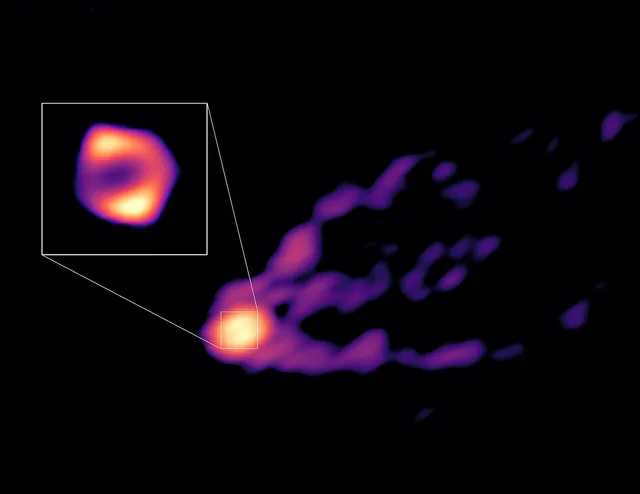
On 24 March 2021 the team released the ring in polarised light, mapping magnetic fields at the black hole’s edge. Data from April 2018, with the Greenland Telescope added, showed a ring the same size as in 2017 but with its brightest part shifted by about 30°. A 3.5 mm image from 2018, released in 2023, showed the ring and the base of the jet together.3715
Comparing 2017, 2018 and 2021, the collaboration reported in September 2025 that the spiral pattern of polarisation had reversed direction while the ring kept its size. The 2021 array added Kitt Peak and NOEMA, and its data showed the first signs of extended jet emission near the jet’s base at 1.3 mm.8
- Angular resolution
- about 20 microarcseconds6
- First image released
- 10 April 20196from observations made in 2017
- Polarised image released
- 24 March 20213
- 2018 image released
- 18 January 20247brightest part shifted about 30°
- Ring at 3.5 mm
- 64 microarcseconds15about 50 per cent larger than at 1.3 mm
- Polarisation reversal reported
- 16 September 20258from 2017–2021 data
Quick answers
- What kind of object is M87 (Virgo A)?
- M87 (Virgo A) is a giant elliptical galaxy (type E0–E1) with an active nucleus.49
- Which constellation is M87 (Virgo A) in?
- M87 (Virgo A) lies in the constellation Virgo.2
- How far away is M87 (Virgo A)?
- M87 (Virgo A) is about 55 million light-years (16.8 Mpc) from Earth, distance adopted by the Event Horizon Telescope team.16
- How bright is M87 (Virgo A) in the night sky?
- M87 (Virgo A) has an apparent magnitude of 8.6 (visual (V band); a small telescope shows it).49
- How big does M87 (Virgo A) look in the sky?
- M87 (Virgo A) covers about 7′ of sky (the faint outer halo spans more than half a degree on deep plates).49
- How big is M87 (Virgo A)?
- M87 (Virgo A) is about 120,000 light-years across (for its bright 7′ body, at a distance of 60 million light-years).4
Sources
- First M87 Event Horizon Telescope Results. VI. The Shadow and Mass of the Central Black Hole (EHT Collaboration) — Astrophysical Journal Letters 875, L6 (arXiv:1906.11243), 2019
- Messier 87 — NASA Science, Hubble’s Messier Catalog
- Astronomers image magnetic fields at the edge of M87’s black hole (eso2105) — European Southern Observatory, 2021
- Messier 87 (H. Frommert & C. Kronberg) — SEDS Messier Database (Observatoire de Paris mirror), 2007
- First M87 Event Horizon Telescope Results. I. The Shadow of the Supermassive Black Hole (EHT Collaboration) — Astrophysical Journal Letters 875, L1 (arXiv:1906.11238), 2019
- Astronomers Capture First Image of a Black Hole (eso1907) — European Southern Observatory, 2019
- New Images of M87*: Proof of a Persistent Black Hole Shadow — Academia Sinica Institute of Astronomy and Astrophysics (EHT press release), 2024
- New EHT Images Reveal Unexpected Polarization Flips at M87* — Academia Sinica Institute of Astronomy and Astrophysics (EHT press release), 2025
- SIMBAD astronomical database: M 87 — Centre de Données astronomiques de Strasbourg (CDS)
- Lord of the stars (image heic0815f) — ESA/Hubble, 2008
- A cosmic searchlight (image opo0020a) — ESA/Hubble, 2000
- M87 (Chandra Photo Album, 5 August 2008) — Chandra X-ray Center, Harvard-Smithsonian Center for Astrophysics, 2008
- The Black-Hole Mass in M87 from Gemini/NIFS Adaptive Optics Observations (Gebhardt et al.) — Astrophysical Journal 729, 119 (arXiv:1101.1954), 2011
- The M87 Black Hole Mass from Gas-dynamical Models of Space Telescope Imaging Spectrograph Observations (Walsh et al.) — Astrophysical Journal 770, 86 (arXiv:1304.7273), 2013
- Astronomers image for the first time the accretion flow with a jet — Academia Sinica Institute of Astronomy and Astrophysics (EHT/GMVA press release), 2023
Figures checked against these sources in November 2026. Where a quantity is not known, it is left out rather than estimated.

