galaxy
Pinwheel Galaxy (M101)
The Pinwheel Galaxy, Messier 101, is a giant spiral that we see face-on, its arms opening out like a firework in the constellation Ursa Major. About 21 million light-years away, it is one of the best-known grand-design spirals. Its disc spans some 170,000 light-years, far larger than the Milky Way, and is thought to hold at least a trillion stars.1234
The Pinwheel is unusually lopsided, and its arms are studded with giant clouds of glowing hydrogen where stars are being born, some bright enough to have their own catalogue numbers. Its nearness makes its supernovae prized events: SN 2011fe was the closest Type Ia explosion in 25 years, and in May 2023 SN 2023ixf became the closest supernova of the decade.14567
Shape and size in space
M101 is one of the most prominent grand-design spirals in the sky, and we see its disc face-on. Short exposures make it look symmetrical, but deeper photographs show a remarkably lopsided galaxy whose core sits well off the centre of its disc. Halton Arp listed it as number 26 in his Atlas of Peculiar Galaxies, a spiral with one heavy arm.14
The galaxy is huge. ESA/Hubble gives a diameter of 170,000 light-years, nearly twice that of the Milky Way; NASA’s Chandra team calls it about 70% larger. The disc is so thin that Hubble can see many more distant galaxies shining through it. M101 is the brightest of a group of at least nine galaxies, among them NGC 5474 and NGC 5585.134
Distances have narrowed over the years. Hubble’s Key Project found Cepheid variable stars in 1994–95 and put M101 at about 24 million light-years. In 2019 the Carnegie-Chicago Hubble Program measured the brightest old red giants in its halo and found 6.52 megaparsecs, about 21 million light-years, the figure used here; a recent Cepheid calibration gives 6.9 megaparsecs.2411
- Distance
- 6.52 ± 0.12 (stat) ± 0.15 (sys) Mpc2about 21 million light-years; tip of the red giant branch, 2019
- Distance modulus
- 29.07 ± 0.04 ± 0.05 mag2
- Cepheid distance
- 6.9 ± 0.1 Mpc (about 22 million light-years)11as adopted in a 2023 supernova study
- Other distances quoted
- 21, 24, 25 and 27 million light-years13410Chandra; Hubble Key Project (1996); ESA/Hubble and NASA; SEDS
- Radial velocity
- 243 ± 5 km/s9receding
- Arp catalogue
- Arp 264spiral with one heavy arm
- M101 Group
- at least 9 galaxies4brightest companions NGC 5474 and NGC 5585
What makes it shine
Starlight dominates. Brilliant young clusters of hot blue stars trace the spiral arms, sprinkled with large nebulae where intense star formation is under way inside clouds of molecular hydrogen, and Hubble resolves millions of the galaxy’s individual stars. At an absolute magnitude of −21.6, SEDS reckons it shines like about 30 billion Suns.1410
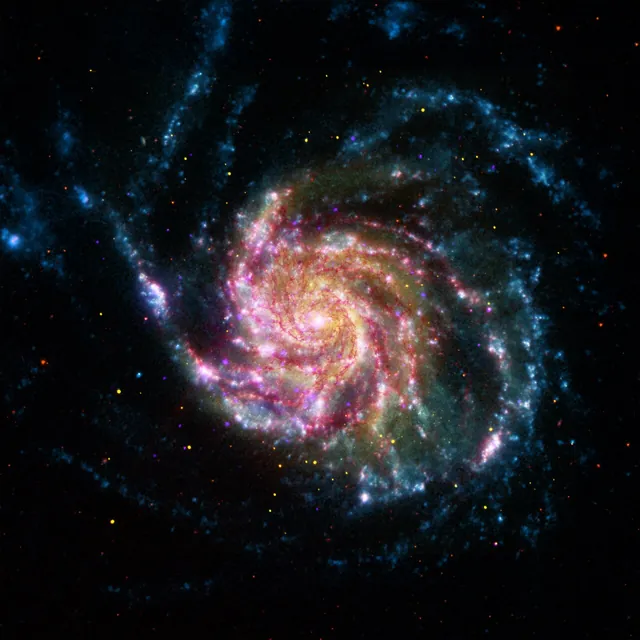
Other wavelengths reveal other parts. In a 2012 composite from four NASA observatories, Chandra’s X-rays show exploded stars, million-degree gas and matter falling onto black holes; Spitzer’s infrared traces heat from dusty, star-forming lanes; and GALEX’s ultraviolet picks out hot stars about a million years old. Webb’s infrared light tracks polycyclic aromatic hydrocarbons, complex carbon molecules among the smallest dust grains.310
The glowing gas also records the galaxy’s chemistry. Spectra of 20 H II regions spread from 6 to 41 kiloparsecs from the centre show oxygen falling steadily outwards, from about 1.3 times the Sun’s abundance in the middle to about one-fifteenth of it in the outermost region studied. The decline follows a smooth exponential curve across six disc scale lengths.12
The stars inside
Astronomers estimate that the Pinwheel holds at least a trillion stars, perhaps 100 billion of them similar to the Sun in temperature and lifetime. Hubble’s sharp eye resolves millions of individual stars across the disc, and a team led by K. D. Kuntz catalogued nearly 3,000 previously unknown star clusters in the 2006 mosaic.1
The largest star-forming regions are giants. Radio observations of NGC 5461 found an association of molecular clouds holding about 30 million solar masses of gas, with individual clouds of 200,000 to 800,000 solar masses, much like our galaxy’s giant molecular clouds. The study concluded that unusually efficient star formation, not unusually massive clouds, builds these giant regions.5
Notable features
NGC 5461 and NGC 5462
Giant H II regions in the spiral arms, bright enough that William Herschel catalogued them separately on 14 April 1789 as H III.788 and H III.789. NGC 5461 is rich in molecular gas, about 30 million solar masses, and shows carbon monoxide emission ten times stronger than NGC 5462.45
NGC 5471
A giant H II region, one of the knots in the spiral arms that later observers gave its own NGC number. Molecular gas could not be detected there with the James Clerk Maxwell Telescope, and its large ratio of atomic to molecular gas may reflect efficient conversion of molecules into atoms.45
SN 2023ixf
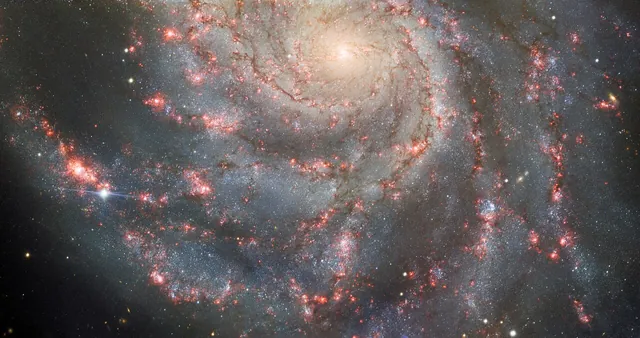
Discovered by Koichi Itagaki on 19 May 2023 at magnitude 14.9, within a day of its first light. This Type II supernova, the closest of the decade, came from a red supergiant that had shed dense gas in its final years. Its light rose for about five days to a peak absolute magnitude of about −18.2.711
SN 2011fe
Catalogued by the Palomar Transient Factory as PTF11kly, this was the closest Type Ia supernova in 25 years. Early observations showed that the exploding star was a carbon–oxygen white dwarf, and the lack of an early shock suggested its companion was most likely a main-sequence star.26
Earlier supernovae
SN 1909A, discovered by Max Wolf on 26 January 1909, reached magnitude 12.1. SN 1951H, of Type II, reached only magnitude 17.5. SN 1970G, also Type II, was found by Michael Lovas on 30 July 1970 at magnitude 11.5; its remnant was later detected in X-rays, including by Chandra.4
Discovery and history
Pierre Méchain, a colleague of Charles Messier, discovered the galaxy on 27 March 1781, and it became one of the last entries in Messier’s catalogue. In 1851 William Parsons, third Earl of Rosse, identified it as one of the first “spiral nebulae”. William Herschel had already catalogued three of its brightest knots separately on 14 April 1789.410
Several patches of the spiral arms ended up with numbers of their own in the New General Catalogue, from NGC 5447 to NGC 5471, though the revised catalogue regards five of them as non-existent. A long-running puzzle is Messier’s object 102: one view holds that it was a mistaken re-observation of M101, though it may well be the galaxy NGC 5866.4
Seeing it for yourself
At magnitude 7.9 the Pinwheel is bright for a galaxy, but its light is spread over an area about one-fifth that of the full Moon, a low surface brightness of 14.6 magnitudes per square arcminute. Small telescopes at low power show mainly the central region; hints of the spiral arms appear as nebulous patches in telescopes from about 4 inches (10 cm) aperture. NASA’s Hubble observing guide names June as the best month.14810
It lies in Ursa Major, the Great Bear, a northern circumpolar constellation. Photographs show it 22′ across, but because only the central region shows in smaller telescopes, it looks much smaller at the eyepiece than in pictures. The brightest arm patches that do show were long ago given catalogue numbers of their own.14
Telescopes on the Pinwheel
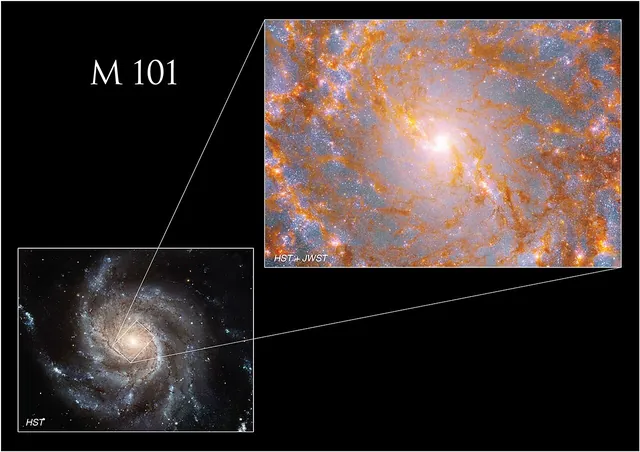
Hubble has studied M101 since its early years. The mosaic released on 28 February 2006 combines 51 exposures from the Advanced Camera for Surveys and the Wide Field and Planetary Camera 2, taken between March 1994 and January 2003, with ground-based images filling the edges. At 16,000 × 12,000 pixels it was the largest Hubble portrait of a spiral galaxy then released.110
In 2012 NASA combined Chandra’s 274 hours of X-ray observations, made between 2000 and 2005, with Spitzer, Hubble and GALEX data in one picture. More recently Hubble and the James Webb Space Telescope have looked together at the galaxy’s core. SN 2023ixf drew telescopes worldwide, from X-rays to radio; Gemini North imaged it on returning to service in June 2023, and over 80 studies appeared within its first year.37101314
- Studies of SN 2023ixf in its first year
- more than 807
Quick answers
- What kind of object is the Pinwheel Galaxy (M101)?
- The Pinwheel Galaxy (M101) is a face-on grand-design spiral galaxy (type Sc).148
- Which constellation is the Pinwheel Galaxy (M101) in?
- The Pinwheel Galaxy (M101) lies in the constellation Ursa Major.110
- How far away is the Pinwheel Galaxy (M101)?
- The Pinwheel Galaxy (M101) is about 21 million light-years (6.52 Mpc) from Earth, from the tip of the red giant branch; Cepheid stars give about 22 million.211
- How big is the Pinwheel Galaxy (M101)?
- The Pinwheel Galaxy (M101) is about 170,000 light-years across (about 70% larger than the Milky Way, or nearly twice its diameter, depending on the source).1310
- How bright is the Pinwheel Galaxy (M101) in the night sky?
- The Pinwheel Galaxy (M101) has an apparent magnitude of 7.9.410
- How big does the Pinwheel Galaxy (M101) look in the sky?
- The Pinwheel Galaxy (M101) covers 28.8′ × 26.9′ of sky (about one-fifth the area of the full Moon).18
- When was the Pinwheel Galaxy (M101) discovered?
- The Pinwheel Galaxy (M101) was discovered on 27 March 1781, by Pierre Méchain.4
Sources
- Largest ever Hubble galaxy portrait – stunning HD image of Pinwheel Galaxy (heic0602) — ESA/Hubble, 2006
- The Carnegie-Chicago Hubble Program. VII. The Distance to M101 via the Optical Tip of the Red Giant Branch Method (Beaton et al.) — Astrophysical Journal 885, 141 (arXiv:1908.06120), 2019
- M101: A Pinwheel in Many Colors (Chandra Photo Album, 24 May 2012) — Chandra X-ray Center, Harvard-Smithsonian Center for Astrophysics, 2012
- Messier 101 (H. Frommert & C. Kronberg) — SEDS Messier Database (Observatoire de Paris mirror), 2007
- Star formation in the giant H II regions of M101 (Giannakopoulou-Creighton et al.) — arXiv:astro-ph/9903334 (doi:10.1086/307619), 1999
- Supernova SN 2011fe from an exploding carbon–oxygen white dwarf star (Nugent et al.) — Nature (arXiv:1110.6201; doi:10.1038/nature10644), 2011
- SN 2023ixf: The Closest Supernova of the Decade (Jacobson-Galán) — arXiv preprint arXiv:2507.08078, 2025
- Revised NGC Data for NGC 5457 (from W. Steinicke’s Revised NGC and IC Catalog) — SEDS Interactive NGC Catalog
- SIMBAD astronomical database: M 101 — Centre de Données astronomiques de Strasbourg (CDS)
- Messier 101 (The Pinwheel Galaxy) — NASA Science, Hubble’s Messier Catalog
- From Discovery to the First Month of the Type II Supernova 2023ixf: High and Variable Mass Loss in the Final Year before Explosion (Hiramatsu et al.) — Astrophysical Journal Letters 955, L8 (arXiv:2307.03165), 2023
- The Composition Gradient in M101 Revisited. II. Electron Temperatures and Implications for the Nebular Abundance Scale (Kennicutt, Bresolin & Garnett) — Astrophysical Journal 591, 801 (arXiv:astro-ph/0303452), 2003
- Closest supernova in a decade reveals how exploding stars evolve — University of California, Berkeley, Department of Physics, 2023
- Gemini North Back On Sky With Dazzling Image of Supernova in the Pinwheel Galaxy (image noirlab2315a) — NSF NOIRLab, 2023
Figures checked against these sources in November 2026. Where a quantity is not known, it is left out rather than estimated.

