galaxy
Bode’s Galaxy (M81)
Bode’s Galaxy is a textbook grand-design spiral: arms of young blue stars and dust winding all the way down to a large bulge of older, redder stars. It lies about 11.6 million light-years away in Ursa Major and, at magnitude 6.9, is one of the brightest galaxies in the night sky. Binoculars show it as a faint patch in the same field as its neighbour, the Cigar Galaxy.123
M81 is the brightest galaxy of a nearby group, and it is not alone. Radio maps of hydrogen reveal streamers of gas many tens of kiloparsecs long tying it to M82 and NGC 3077, the debris of past close encounters. At its centre sits a black hole of about 70 million solar masses, and in 1993 one of its stars exploded as the bright supernova SN 1993J.1345
Shape and size in space
M81 is tilted at an oblique angle to our line of sight, giving a bird’s-eye view of its spiral pattern. It resembles our own Milky Way, but its central bulge is significantly larger. A Hubble study of 32 Cepheid variable stars in 1993 gave a distance of 11.0 million light-years; a later recalibration suggests about 12 million, and NASA quotes 11.6 million.123
M81, one of the nearest galaxies beyond our Local Group, is the brightest member of the M81 Group. With M82 and NGC 3077 it forms a close triplet, surrounded by at least 20 dwarf galaxies. M81 and M82 are still near each other, their centres only about 150,000 light-years apart, and the gravity of the encounters has shaped them both.14
The stars inside
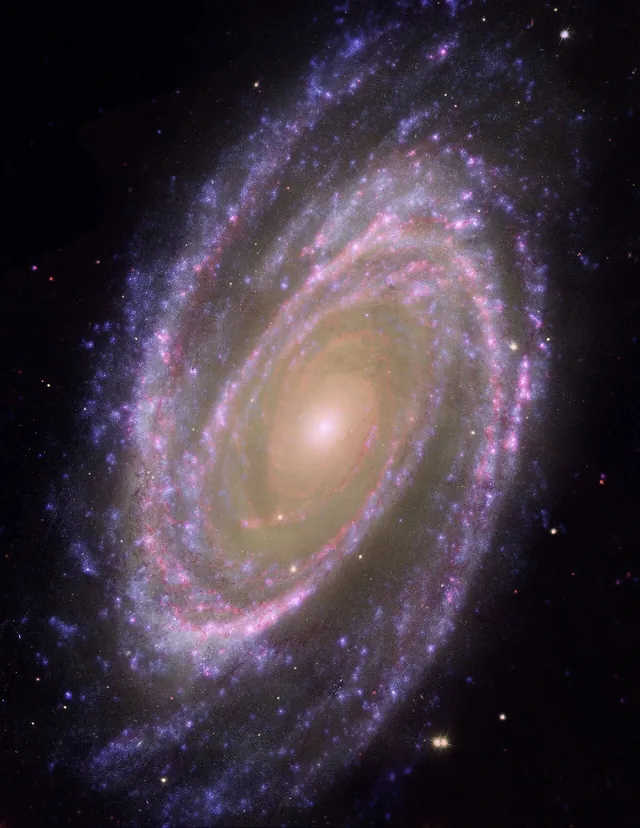
M81’s spiral arms, which wind all the way into the nucleus, are lined with young, hot, bluish stars formed in the past few million years. Their ultraviolet light makes surrounding hydrogen clouds glow, and sinuous dust lanes follow the arms inwards. The arms also hold stars from a burst of star formation that began about 600 million years ago.23
The central bulge is made of much older, redder stars. Hubble’s sharp view resolves individual stars, open and globular star clusters and glowing gas in M81 even at its distance. A 1995 survey found about 70 candidate globular clusters and estimated the galaxy’s total population at 210 ± 30 globular clusters.12
Notable features
The central black hole
M81’s nucleus holds a black hole of about 70 million solar masses, some 15 times the mass of the Milky Way’s. Earlier Hubble research showed that a central black hole’s mass is proportional to the mass of its galaxy’s bulge, and M81’s bulge is much larger than the Milky Way’s. SIMBAD classes the nucleus as a Seyfert 2 active nucleus.236
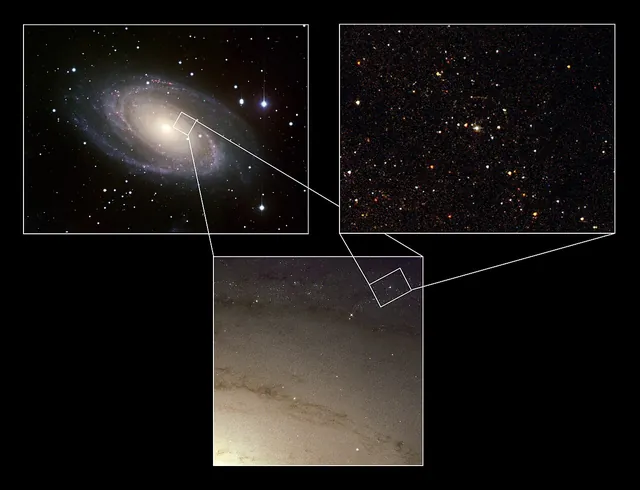
Supernova 1993J
On 28 March 1993 the Spanish amateur astronomer Francisco García Díaz discovered a supernova in M81 that peaked near magnitude 10.5. Its red supergiant progenitor had lost almost all of its hydrogen to a companion star, making it a Type IIb supernova. Ten years later Hubble and the Keck telescope found the surviving companion.157
Hydrogen bridges
Radio maps of neutral hydrogen show filaments many tens of kiloparsecs long connecting M81, M82 and NGC 3077 and holding most of the group’s hydrogen. They are mostly the work of tidal interactions. NGC 3077 has been stripped of most of its own hydrogen, now in a feature called the Garland.4
Encounters with its neighbours
A close pass with M82 and NGC 3077 may have triggered a surge of star formation in M81’s arms. ESA/Hubble dates it to about 300 million years ago; the SEDS database says a few tens of millions. The encounter deformed the smaller M82 and left a dark linear feature near M81’s nucleus.12
Discovery and history
Johann Elert Bode found M81 and its neighbour M82 on 31 December 1774. He described a nebulous patch, mostly round with a dense nucleus, and listed it as number 17 in his catalogue. Pierre Méchain rediscovered both galaxies independently in August 1779 and reported them to Charles Messier, who added them to his catalogue after measuring their positions on 9 February 1781.13
Seeing it for yourself
M81 is one of the easiest galaxies for northern observers. At magnitude 6.9 it shows in binoculars as a faint patch in the same field as M82, and a small telescope reveals its core. NASA names April as the best month to look. Under exceptionally dark skies at least seven observers have reported seeing M81 with the unaided eye.13
Telescopes on M81
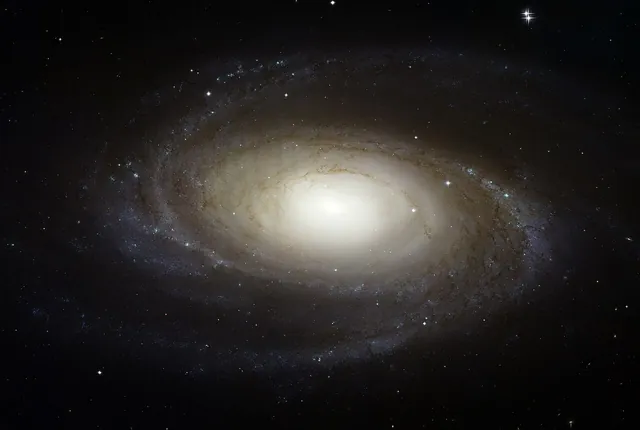
Hubble’s Advanced Camera for Surveys imaged M81 from 2004 to 2006, and on 28 May 2007 NASA and ESA released a mosaic of 22,620 × 15,200 pixels in blue, visible and infrared light, among the largest Hubble images ever released. Hubble came back to SN 1993J in 2014 and picked up the ultraviolet glow of its hot companion star as the supernova faded.28
Radio telescopes trace the gas between the galaxies. The Very Large Array has mapped the neutral hydrogen of the M81 triplet across a 3° × 3° field in 105 pointings, resolving features about 420 parsecs across, and the Green Bank Telescope found five previously unknown hydrogen clouds in the group, most likely relics of the ongoing interactions.49
Quick answers
- What kind of object is the Bode’s Galaxy (M81)?
- The Bode’s Galaxy (M81) is a grand-design spiral galaxy.12
- Which constellation is the Bode’s Galaxy (M81) in?
- The Bode’s Galaxy (M81) lies in the constellation Ursa Major.3
- How far away is the Bode’s Galaxy (M81)?
- The Bode’s Galaxy (M81) is about 11.6 million light-years from Earth (other estimates range from 11 to 12 million light-years).123
- How bright is the Bode’s Galaxy (M81) in the night sky?
- The Bode’s Galaxy (M81) has an apparent magnitude of 6.9 (at the limit of naked-eye visibility).236
- How big does the Bode’s Galaxy (M81) look in the sky?
- The Bode’s Galaxy (M81) covers 21′ × 10′ of sky (about the same angular size as the full Moon).126
- When was the Bode’s Galaxy (M81) discovered?
- The Bode’s Galaxy (M81) was discovered on 31 December 1774, by Johann Elert Bode.1
Sources
- Messier 81 (H. Frommert & C. Kronberg) — SEDS Messier Database (Observatoire de Paris mirror), 2007
- Hubble photographs grand spiral galaxy Messier 81 (heic0710) — ESA/Hubble, 2007
- Messier 81 — NASA Science, Hubble’s Messier Catalog
- A high-resolution mosaic of the neutral hydrogen in the M81 triplet (de Blok et al.) — Astrophysical Journal (arXiv:1808.02840), 2018
- First supernova companion star found (heic0401) — ESA/Hubble, 2004
- SIMBAD astronomical database: M 81 — Centre de Données astronomiques de Strasbourg (CDS)
- The massive binary companion star to the progenitor of supernova 1993J (Maund et al.) — Nature 427, 129 (arXiv:astro-ph/0401090), 2004
- Supernova 1993J in Spiral Galaxy M81 — NASA Science (Hubble image release), 2014
- Neutral Hydrogen Clouds in the M81/M82 Group (Chynoweth et al.) — Astronomical Journal 135, 1983 (arXiv:0803.3631), 2008
Figures checked against these sources in November 2026. Where a quantity is not known, it is left out rather than estimated.

