galaxy
Cigar Galaxy (M82)
The Cigar Galaxy is the prototype starburst galaxy. In its central regions young stars are being born ten times faster than in the whole Milky Way, a frenzy set off by close encounters with its larger neighbour, Bode’s Galaxy. We see its disc tilted nearly edge-on, which stretches it into the elongated shape behind its nickname. It lies about 12 million light-years away in Ursa Major.1234
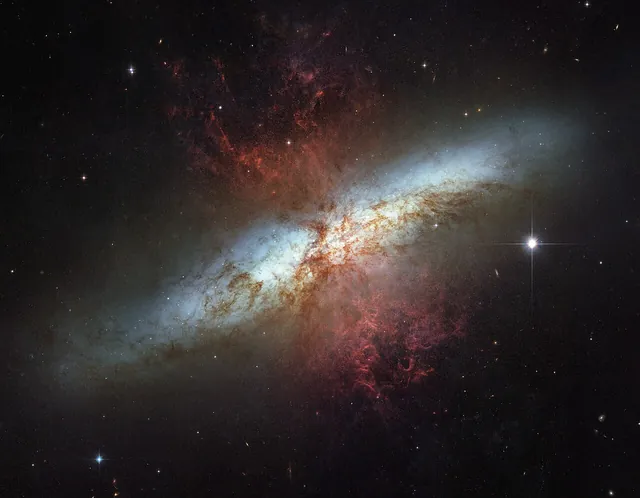
All those massive young stars drive a galactic superwind. Hubble images show plumes of glowing hydrogen blasting out above and below the disc, Spitzer sees cool dust carried out with them, and Chandra finds gas heated to millions of degrees. In January 2014 the galaxy also hosted SN 2014J, the closest Type Ia supernova seen in at least four decades.3456
Shape and size in space
M82 is usually classified as an irregular galaxy, but it is probably a distorted disc galaxy. Its disc is tilted obliquely to our line of sight, so it looks like a narrow, elongated ellipse, hence the name Cigar Galaxy. Its core seems to have suffered dramatically in a close encounter with M81, which left it in a heavy starburst and crossed by conspicuous dark lanes.13
M82 belongs to the M81 Group, about 12 million light-years away; a NASA release on its 2014 supernova gives 11.4 million. Radio maps of neutral hydrogen show it joined to M81 and NGC 3077 by tidal filaments many tens of kiloparsecs long, and a large reservoir of thin hydrogen in the northern part of the group is probably associated with M82.1349
What makes it shine
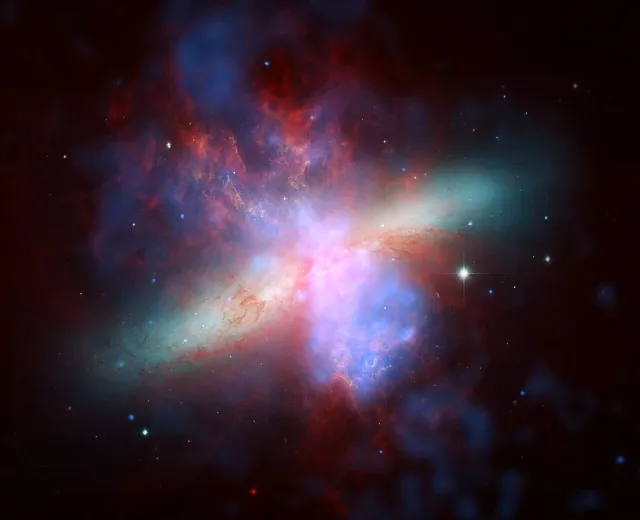
M82 is remarkable in the infrared: it is the brightest galaxy in the infrared sky and shows a so-called infrared excess, shining far more strongly at infrared wavelengths than in visible light, a sign of its intense star formation. It is also a strong radio source, found by Robert Hanbury Brown in 1953 and first called Ursa Major A, catalogued later as 3C 231.12
The starburst powers a superwind. Stellar winds and supernovae from the hot young stars combine into a galactic outflow that blasts plumes of ionised hydrogen above and below the disc. Hubble sees that gas at about 10,000 °C, Spitzer sees cool gas and dust carried out with it, and Chandra sees gas heated to millions of degrees. Such outflows help spread elements like carbon and oxygen through the universe.35
The stars inside
M82’s young stars are crammed into small but massive star clusters, which gather by the dozen into the bright starburst clumps of its centre. Many of the pale, fuzzy objects scattered around the galaxy are star clusters about 20 light-years across, each holding up to a million stars, and Hubble has found more than 100 young globular clusters, probably another effect of the encounter with M81.13
Estimates of when the encounter began differ. Chandra’s team puts the trigger about 100 million years ago; SEDS cites a period of strong interaction starting about 600 million years ago. Either way the starburst cannot last: as it uses up or blows away its gas it will subside, within a few tens of millions of years according to Hubble’s team, or about 100 million according to Chandra’s.1235
Notable features
The superwind
Plumes of hydrogen, shown red in Hubble’s mosaic, tower above and below the disc. They are driven by the combined winds and supernovae of the starburst, and carry cool dust and million-degree X-ray gas with them, which makes M82 a key place to study how galaxies expel matter.359
SN 2014J
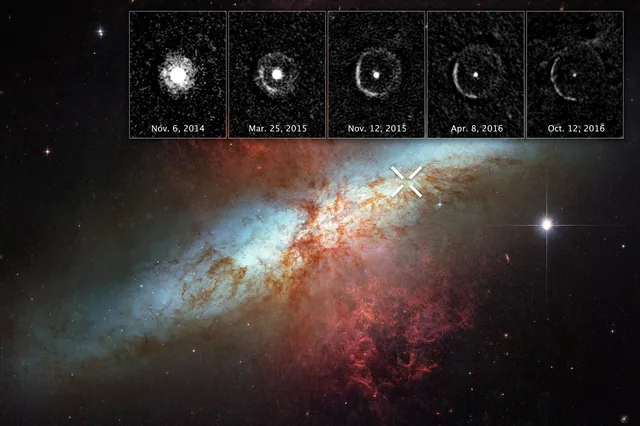
A Type Ia supernova discovered on 21 January 2014 by S. Fossey’s group, the nearest of its kind since at least SN 1986G. It was spectroscopically normal but heavily reddened by dust in M82. Hubble later watched its light echo off a dust cloud 300 to 1,600 light-years from the explosion.4610
M82 X-2, a pulsar that breaks the limit
Broadband X-ray observations found pulses every 1.37 seconds from an ultraluminous X-ray source near M82’s centre, modulated by a 2.5-day orbit. The source is a magnetised neutron star, shining about 100 times brighter than the theoretical limit for an object of 1.4 solar masses.11
A false supernova
In 1986 a supernova, 1986D, was reported in M82 and entered some books, but it was a false alarm: a slightly variable source at a wavelength of 2 micrometres had fooled the discoverers. A genuine supernova, 2004am, was later found on Lick Observatory images taken on 21 November 2003.1
Discovery and history
Johann Elert Bode discovered M82 together with M81 on 31 December 1774, describing a very pale, elongated nebulous patch, number 18 in his list. Pierre Méchain found both again in August 1779, and Charles Messier catalogued them after measuring their positions on 9 February 1781. William Herschel gave M82 his own number, H IV.79, from an observation on 30 September 1802.12
William Parsons, the third Earl of Rosse, was the first to remark on the dark dust lanes in its centre. Halton Arp included it as number 337 in his Catalogue of Peculiar Galaxies, and its radio emission, detected in 1953, made it the strongest radio source in Ursa Major.1
Seeing it for yourself
M82 sits about 0.75° from M81, so binoculars show both galaxies in the same field, M82 as a pale, elongated patch of light. At magnitude 8.4 it is fainter than its neighbour, and larger telescopes are needed to show detail in its core. NASA names April as the best month to look, when it stands high in the northern spring sky.123
Telescopes on M82
To mark Hubble’s 16th anniversary, NASA and ESA released on 24 April 2006 the sharpest wide-angle view of M82 yet, a six-image mosaic taken in March 2006 with the Advanced Camera for Surveys through four filters. The same day a composite combined it with Spitzer infrared and Chandra X-ray images to show the outflow in three kinds of light.35
SN 2014J drew many telescopes. The intermediate Palomar Transient Factory followed it from hours after the fitted explosion time, and pre-discovery images pin its first light to 14.75 January 2014. Hubble watched its light echo from November 2014 to October 2016. In 2014 X-ray observations revealed that the ultraluminous source M82 X-2 is a pulsar.461011
Quick answers
- What kind of object is the Cigar Galaxy (M82)?
- The Cigar Galaxy (M82) is a starburst galaxy (a disturbed disc galaxy, often classed as irregular).12
- Which constellation is the Cigar Galaxy (M82) in?
- The Cigar Galaxy (M82) lies in the constellation Ursa Major.2
- How far away is the Cigar Galaxy (M82)?
- The Cigar Galaxy (M82) is about 12 million light-years from Earth (NASA’s 2017 SN 2014J release gives 11.4 million).234
- How bright is the Cigar Galaxy (M82) in the night sky?
- The Cigar Galaxy (M82) has an apparent magnitude of 8.4.27
- How big does the Cigar Galaxy (M82) look in the sky?
- The Cigar Galaxy (M82) covers 9′ × 4′ of sky.1
- How far is the Cigar Galaxy (M82) from M81?
- The Cigar Galaxy (M82) is about 150,000 light-years from M81 (between the centres).8
- When was the Cigar Galaxy (M82) discovered?
- The Cigar Galaxy (M82) was discovered on 31 December 1774, by Johann Elert Bode.1
Sources
- Messier 82 (H. Frommert & C. Kronberg) — SEDS Messier Database (Observatoire de Paris mirror), 2007
- Messier 82 (The Cigar Galaxy) — NASA Science, Hubble’s Messier Catalog
- Happy sweet sixteen, Hubble Space Telescope (heic0604) — ESA/Hubble, 2006
- Hubble Shows Light Echo Expanding from Exploded Star — NASA Science (Hubble news release), 2017
- M82: Images From Space Telescopes Produce Stunning View of Starburst Galaxy — Chandra X-ray Center, Harvard-Smithsonian Center for Astrophysics, 2006
- Estimating the First-Light Time of the Type Ia Supernova 2014J in M82 (Zheng et al.) — Astrophysical Journal Letters 783, L24 (arXiv:1401.7968), 2014
- SIMBAD astronomical database: M 82 — Centre de Données astronomiques de Strasbourg (CDS)
- Messier 81 (H. Frommert & C. Kronberg) — SEDS Messier Database (Observatoire de Paris mirror), 2007
- A high-resolution mosaic of the neutral hydrogen in the M81 triplet (de Blok et al.) — Astrophysical Journal (arXiv:1808.02840), 2018
- The rise of SN2014J in the nearby galaxy M82 (Goobar et al.) — Astrophysical Journal Letters 784, L12 (arXiv:1402.0849), 2014
- An ultraluminous X-ray source powered by an accreting neutron star (Bachetti et al.) — Nature 514, 202 (arXiv:1410.3590), 2014
Figures checked against these sources in November 2026. Where a quantity is not known, it is left out rather than estimated.

