galaxy
M32
Messier 32 is a small, dense elliptical galaxy that orbits the Andromeda Galaxy. It lies about 2.5 million light-years away in the constellation Andromeda and appears just 22′ south of Andromeda’s centre, laid over the outskirts of the great spiral’s disc. Though only some 8,000 light-years across, it packs its stars so tightly that its core resembles that of a far larger galaxy.123
At its heart sits a black hole of about 2.5 million solar masses. M32 has no gas, no dust and no globular clusters, and its stars are mostly old. One idea, put forward in 2018, is that it is the stripped core of a much larger galaxy that merged with Andromeda about 2 billion years ago, but that remains a hypothesis rather than an established fact.245
Shape and size in space
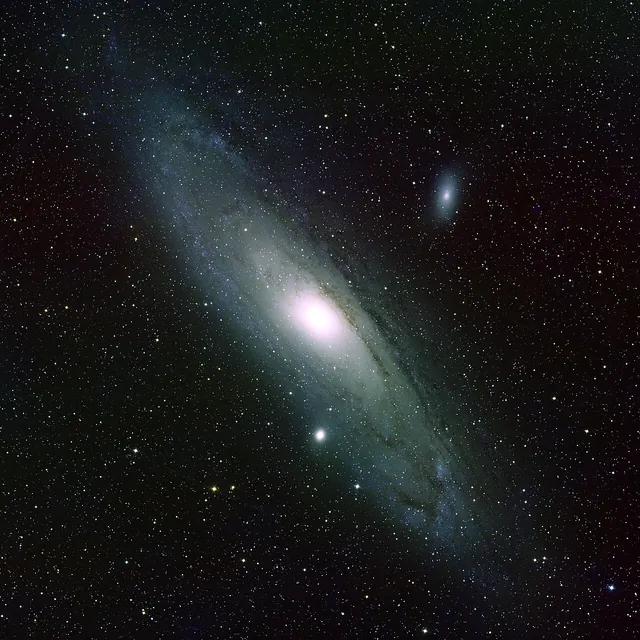
M32 is a compact elliptical galaxy of type cE2: its outline on the sky is about 20 per cent shorter along one axis than the other. Dynamical models show that we view it at an inclination of about 70°, which makes its true shape a flattened spheroid. Measured with RR Lyrae variable stars, it lies about 773 kiloparsecs from us, some 2.52 million light-years.2346
It sits very close to Andromeda. The same survey places it only about 21 kiloparsecs from that galaxy’s centre, though with a large uncertainty. Its spectrum shows none of the absorption that Andromeda’s dusty disc would imprint if M32 lay behind it, which suggests that it is on the near side. Along our line of sight it is moving towards Andromeda at roughly 100 km/s.23
- Distance
- 772.7 kpc, +22/−21 (2.52 million light-years)3RR Lyrae stars
- Distance from Andromeda’s centre
- 20.6 kpc, +21/−13 (about 67,000 light-years)3
- Effective radius
- 106 ± 12 pc (about 350 light-years)3of a Sérsic profile with index 4
- Diameter
- about 8,000 light-years2
- Absolute magnitude
- −16.8 ± 0.1 (V)3
- Mass
- about 3 billion solar masses2
- Inclination
- 70 ± 5°4
- Intrinsic flattening
- about 0.68 ± 0.034
- Radial velocity
- −199 km/s6approaching the Sun
The black hole at its heart
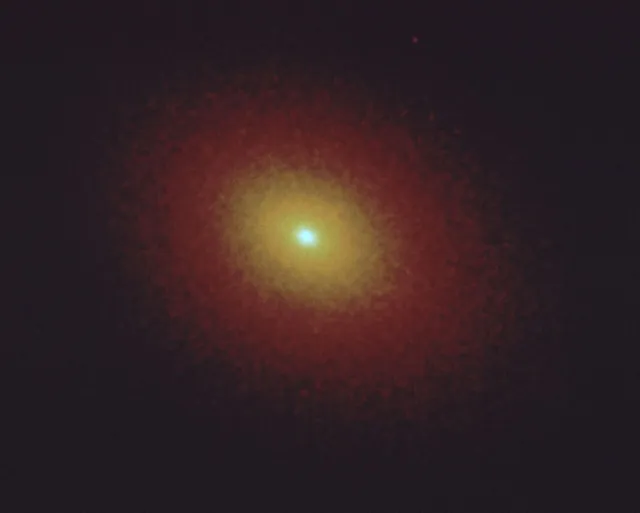
For so small a galaxy, M32 has a remarkable nucleus, in which stars move rapidly around a central dark mass. Because of this dense core it is often classed as cE2, a compact elliptical, rather than a plain E2. Models built on integral-field spectra from the SAURON instrument and on Hubble STIS spectra give a black hole of 2.5 ± 0.5 million solar masses.24
Those models also measured the mass-to-light ratio of M32’s stars and, for the first time, the angle at which we see the galaxy. In 2010 a study using fully general triaxial models, which drop the usual assumption of a symmetric shape, found that M32 is best described as axisymmetric and returned a black hole mass identical to the earlier result.47
The stars inside
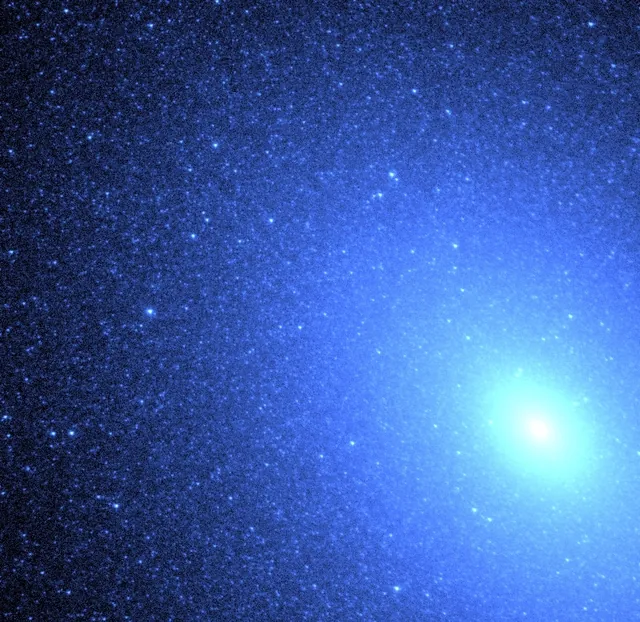
Like most elliptical galaxies, M32 is made mainly of old stars, whose more massive members have long since burned out. Mixed among them is a minority of younger stars, richer in heavy elements and only 2–3 billion years old. Planetary nebulae have been found, but no gas clouds, dust lanes, neutral hydrogen or open clusters, so M32 appears no longer able to form stars.2
M32 also glows in ultraviolet light. Hubble images showed that this comes from extremely hot stars late in their lives, which have exhausted the hydrogen in their cores and now fuse helium into heavier elements. Novae flare up there from time to time; one discovered on 31 August 1998 reached magnitude 16.5.12
A stripped galaxy?
M32 looks like a scaled-down giant. Its stellar population, dense nucleus and compactness resemble those of a much larger elliptical galaxy rather than those of typical dwarfs its size. That has long suggested it was once bigger and lost its outer stars, and any globular clusters it had, to Andromeda’s tides in one or more close encounters.2
In 2018 Richard D’Souza and Eric Bell used cosmological models to argue that Andromeda’s massive, metal-rich stellar halo requires one dominant merger about 2 billion years ago, with a galaxy holding some 25 billion solar masses of stars. They proposed that M32 is likely the stripped core of that galaxy and that the merger threw out Andromeda’s Giant Stellar Stream. It remains a hypothesis.5
Discovery and history
M32 was the first elliptical galaxy ever discovered. Guillaume Le Gentil found it on 29 October 1749. Charles Messier first saw it in 1757, catalogued it on 3 August 1764 and drew it, together with M110, beside the Great Nebula in Andromeda. Halton Arp later included it as number 168 in his Catalogue of Peculiar Galaxies.12
In 1944 Walter Baade, using the 100-inch Hooker Telescope on Mount Wilson, resolved M32 and its neighbour M110 into stars for the first time. He recognised that their stars were mostly old and about as bright as Andromeda’s, confirming that both little galaxies lie at roughly the same distance as the great spiral.2
Seeing it for yourself
M32 is easy to find, because it lies in the same telescope field as the Andromeda Galaxy, 22′ due south of its central region. At magnitude 8.1 it shows in small telescopes as a remarkably bright, slightly oval patch, although a large telescope is needed to see any detail beyond a spot of light. NASA names November as the best month to look.12
Telescopes on M32
Hubble has returned to M32 many times. Its Advanced Camera for Surveys and Wide Field and Planetary Camera 2 imaged crowded stars in the core and the outer galaxy, used to study gravitational microlensing and variable stars that measure distances. Ultraviolet images traced the galaxy’s ultraviolet glow to hot helium-burning stars, and the PHAST survey of Andromeda’s southern half imaged M32 in visible and near-ultraviolet light.1
A Hubble Treasury survey of Andromeda’s satellites identified 145 RRab-type and 49 RRc-type RR Lyrae variables in M32. Because these stars have predictable brightnesses, they gave a distance for M32 measured on the same scale as Andromeda and its other companions, and showed how close it lies to the great spiral.3
- RR Lyrae stars identified
- 145 RRab and 49 RRc3
Quick answers
- Which constellation is M32 in?
- M32 lies in the constellation Andromeda.1
- How far away is M32?
- M32 is 2.52 million light-years (773 kpc, +22/−21) from Earth, from RR Lyrae stars.3
- How big is M32?
- M32 is about 8,000 light-years across (estimate from the SEDS Messier database).2
- How big does M32 look in the sky?
- M32 covers 8′ × 6′ of sky.2
- How massive is M32?
- M32 has a mass of about 3 billion solar masses.2
Sources
- Messier 32 — NASA Science, Hubble’s Messier Catalog
- Messier 32 (H. Frommert & C. Kronberg) — SEDS Messier Database (Observatoire de Paris mirror), 2007
- The Hubble Space Telescope Survey of M31 Satellite Galaxies. I. RR Lyrae-based Distances and Refined 3D Geometric Structure (Savino et al.) — Astrophysical Journal 938, 101 (arXiv:2206.02801), 2022
- A SAURON study of M32: measuring the intrinsic flattening and the central black hole mass (Verolme et al.) — Monthly Notices of the Royal Astronomical Society 335, 517 (arXiv:astro-ph/0201086), 2002
- The Andromeda galaxy’s most important merger about 2 billion years ago as M32’s likely progenitor (D’Souza & Bell) — Nature Astronomy 2, 737 (arXiv:1807.08819), 2018
- SIMBAD astronomical database: M 32 — Centre de Données astronomiques de Strasbourg (CDS)
- Estimating black hole masses in triaxial galaxies (van den Bosch & de Zeeuw) — Monthly Notices of the Royal Astronomical Society 401, 1770 (arXiv:0910.0844), 2010
Figures checked against these sources in November 2026. Where a quantity is not known, it is left out rather than estimated.

