galaxy
Triangulum Galaxy
The Triangulum Galaxy, Messier 33, is the third-largest galaxy in the Local Group, after the Andromeda Galaxy and the Milky Way, and the smallest of its three spirals. It lies about 2.74 million light-years away in the small northern constellation Triangulum. At magnitude 5.7 it is one of the most distant things the unaided eye can see, though only as a faint smudge under exceptionally dark, clear skies.1234
About 60,000 light-years across, it is a patchy, many-armed ‘flocculent’ spiral with no bright central bulge and no detectable supermassive black hole. It is rich in gas and busy making stars, above all in NGC 604, one of the largest star-forming regions in the Local Group. A faint stellar structure around it hints at a past brush with Andromeda, yet its measured motion suggests it may be falling in for the first time.15678910
Shape and size in space
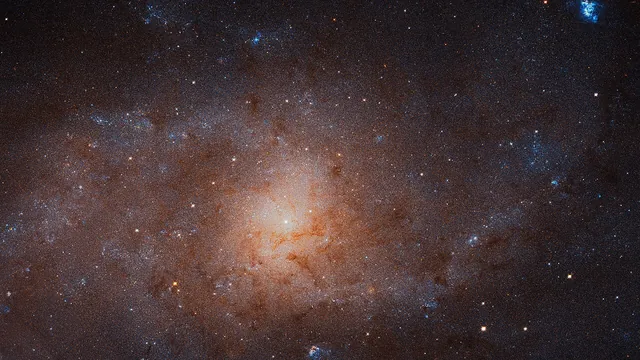
M33’s distance has been measured in many ways. The most precise result so far, from Hubble photometry of 154 Cepheid variable stars, is 840 ± 11 kiloparsecs, about 2.74 million light-years. Other recent studies using red giants, carbon stars and RR Lyrae stars place it at 859–879 kiloparsecs, about 2.8–2.9 million light-years, while radio tracking of water masers gave a purely geometric 730 ± 168 kiloparsecs.2131415
The galaxy spans about 60,000 light-years, against some 100,000 for the Milky Way and 200,000 for Andromeda, and has no bright central bulge. Its famous patchy, many-armed look traces only young stars and gas. Hubble maps of its older stars show a smooth disc with two lopsided spiral arms and a central bar about 1 kiloparsec long, the first confirmation of a bar that earlier accounts said it lacked.1516
Radio maps of its hydrogen show the disc turning at about 100 km/s at 4 kiloparsecs from the centre and 120–130 km/s out to 23 kiloparsecs; beyond 8 kiloparsecs the gas disc warps. Explaining that rotation needs a dark matter halo of about 430 billion solar masses, so ordinary matter makes up only about 2 per cent of the galaxy’s total mass.12
- Distance (RR Lyrae stars)
- 859 kpc, +24/−23 (2.80 million light-years)14
- Distance (red giants, carbon stars, Cepheids)
- distance moduli 24.67–24.72 (859–879 kpc)13
- Geometric distance (water masers)
- 730 ± 168 kpc15
- Diameter
- about 60,000 light-years1
- Central bar
- about 1 kpc long5seen only in older stars
- Rotation speed
- about 100 km/s at 4 kpc; 120–130 km/s out to 23 kpc12
- Dark matter halo
- 4.3 × 10¹¹ solar masses12baryons about 2 per cent of the total
- Morphological type
- SA(s)cd11
M33 and Andromeda
M33 lies about 227 kiloparsecs, roughly 740,000 light-years, from the Andromeda Galaxy and has long been suspected of being a distant but gravitationally bound companion of it. In 2009 a panoramic survey of the region around Andromeda found M33 surrounded by a faint stellar structure, which its authors read as persuasive evidence of a recent encounter between the two galaxies.34814
Measurements of how M33 moves across the sky tell a different story. Orbits computed from those motions suggest it is either on its first passage around Andromeda, having fallen in less than 2 billion years ago, or on a long orbit of about 6 billion years; a close approach within the last 3 billion years appears highly improbable. Gaia data published in 2019 strengthened the case for a first infall.910
The question matters because M33’s gas and stellar discs are strongly warped, and a recent encounter was the obvious explanation. M33 may have small companions of its own: the faint dwarf Andromeda XXII lies about 113 kiloparsecs from it, inside M33’s estimated sphere of influence, but whether it is still bound depends on which orbital history is right.91214
The stars inside
M33 holds about 40 billion stars, at least ten times fewer than the Milky Way and a hundred times fewer than Andromeda. Hubble’s survey of its inner regions catalogued 22 million of them individually. The young stars there follow several fairly tight arms, while the old stars trace a looser two-armed pattern.116
The galaxy is rich in gas and dust and forms new stars at about one solar mass every two years. Within the area of Hubble’s 2019 mosaic, star formation is ten times more intense than in the comparable panorama of Andromeda. M33 also has a faint halo of old stars, estimated at about 500 million solar masses, some 16 per cent of its stellar mass.1517
Its compact nucleus has no detectable supermassive black hole. Models fitted to Hubble images and spectra work best with no black hole at all and set an upper limit of 1,500 solar masses, far below what the motions of the nucleus’s stars would predict. Its discoverers concluded that such black holes go with galaxy bulges, not with discs.6
Notable features
NGC 604
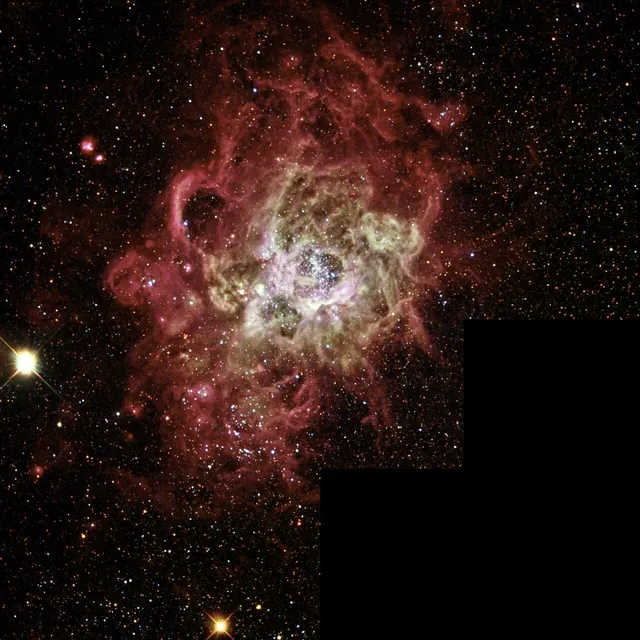
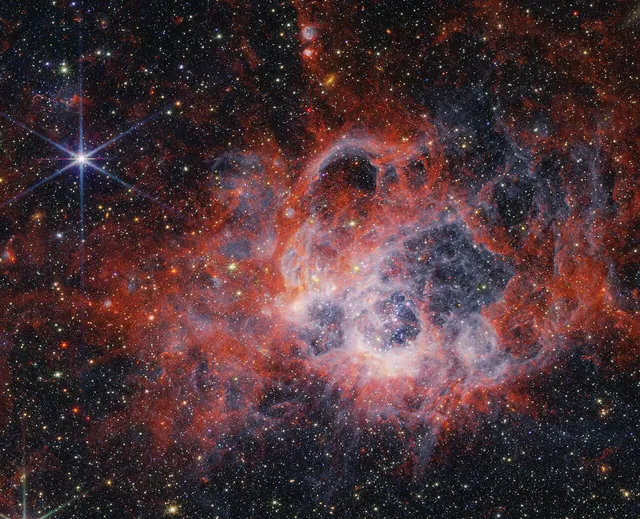
M33’s brightest and largest cloud of ionised hydrogen, in the galaxy’s north-eastern part. Webb puts it at some 1,300 light-years across and about 3.5 million years old; it shelters more than 200 hot, massive O- and B-type stars. ESA calls it the second most luminous such region in the Local Group.14718
NGC 595
Another giant nebula of glowing hydrogen in M33’s spiral arms and one of the galaxy’s four brightest star-forming regions. It appears in Hubble’s 2019 mosaic alongside NGC 604, and earlier Hubble images resolved the hot, massive stars that make its gas shine.14
The bar hidden in old stars
In ordinary photographs M33 shows no bar. Mapping millions of individual old stars from Hubble’s survey revealed one about 1 kiloparsec long, together with two asymmetric spiral arms that may record the tidal interaction thought to have warped the galaxy’s outer disc.15
Discovery and history
M33 was probably first recorded by Giovanni Battista Hodierna before 1654, perhaps together with the star cluster NGC 752. Charles Messier found it independently and catalogued it on 25 August 1764. William Herschel, who otherwise avoided numbering Messier’s objects, listed it as H V.17 after observing it on 11 September 1784, and gave its brightest nebula a separate number, which became NGC 604.34
William Parsons, the third Earl of Rosse, made M33 one of the first ‘spiral nebulae’ recognised as such. In 1926 Edwin Hubble published a study of its variable stars, among them Cepheids, which helped prove that it is not a nebula inside the Milky Way but a separate galaxy far beyond it.34
Seeing it for yourself
M33 lies in Triangulum, and with an apparent magnitude of 5.7 it is, for most people, the most distant object visible to the unaided eye. Seeing it that way takes exceptionally clear, dark skies, because its light is spread fairly evenly over an area nearly four times that of the full Moon, which gives it a very low surface brightness.134
Low magnification and a wide field work best: binoculars show it well, while a telescope at high power can lose it entirely. NASA names November as the best month to look. A 32-centimetre (12.5-inch) telescope should show NGC 604 and other nebulae in its arms, and one observer tracked down five of its globular clusters with a 50-centimetre telescope.34
Telescopes on Triangulum
Hubble’s PHATTER survey, the Panchromatic Hubble Andromeda Treasury: Triangulum Extended Region, imaged the inner galaxy from 54 pointings in six bands, from ultraviolet to near-infrared, between February 2017 and February 2018. The mosaic released on 7 January 2019 has 665 million pixels, the second-largest Hubble image after Andromeda’s, and the survey’s catalogue of 22 million stars is the largest ever made for M33.1161719
Radio and space astrometry have tracked how the galaxy moves. In 2005 the Very Long Baseline Array followed two water masers on opposite sides of M33, yielding both its distance and its velocity relative to the Milky Way. In 2019 data from ESA’s Gaia satellite measured its motion again and even detected its rotation in the sky-plane motions of its most massive stars.1015
On 9 March 2024 ESA and NASA released James Webb Space Telescope images of NGC 604 taken with its NIRCam and MIRI cameras. In near- and mid-infrared light they show cavities blown by the winds of young stars, filaments of molecular hydrogen, and carbon-rich molecules called polycyclic aromatic hydrocarbons.7
Quick answers
- What kind of object is the Triangulum Galaxy?
- The Triangulum Galaxy is a flocculent spiral galaxy (SA(s)cd), no central bulge.1511
- Which constellation is the Triangulum Galaxy in?
- The Triangulum Galaxy lies in the constellation Triangulum.1
- How far away is the Triangulum Galaxy?
- The Triangulum Galaxy is 2.74 million light-years (840 ± 11 kpc) from Earth, from Hubble photometry of 154 Cepheid variable stars.2
- How big is the Triangulum Galaxy?
- The Triangulum Galaxy is about 60,000 light-years across (Milky Way about 100,000; Andromeda about 200,000).1
- How bright is the Triangulum Galaxy in the night sky?
- The Triangulum Galaxy has an apparent magnitude of 5.7 (visible to the unaided eye only under very dark skies).34
- How big does the Triangulum Galaxy look in the sky?
- The Triangulum Galaxy covers 73′ × 45′ of sky (about 2.5 times the width of the full Moon).4
Sources
- Hubble takes gigantic image of the Triangulum Galaxy (heic1901) — ESA/Hubble, 2019
- A 1.3% Distance to M33 from Hubble Space Telescope Cepheid Photometry (Breuval et al.) — Astrophysical Journal 951, 118 (arXiv:2304.00037), 2023
- Messier 33 (The Triangulum Galaxy) — NASA Science, Hubble’s Messier Catalog
- Messier 33 (H. Frommert & C. Kronberg) — SEDS Messier Database (Observatoire de Paris mirror), 2007
- The Panchromatic Hubble Andromeda Treasury: Triangulum Extended Region (PHATTER). V. The Structure of M33 in Resolved Stellar Populations (Smercina et al.) — Astrophysical Journal 957, 3 (arXiv:2308.11618), 2023
- M33: A Galaxy with No Supermassive Black Hole (Gebhardt et al.) — Astronomical Journal 122, 2469 (arXiv:astro-ph/0107135), 2001
- Webb peers into the tendrils of NGC 604 (weic2407) — ESA/Webb, 2024
- The remnants of galaxy formation from a panoramic survey of the region around M31 (McConnachie et al.) — Nature 461, 66 (arXiv:0909.0398), 2009
- Orbits of massive satellite galaxies – I. A close look at the Large Magellanic Cloud and a new orbital history for M33 (Patel, Besla & Sohn) — Monthly Notices of the Royal Astronomical Society 464, 3825 (arXiv:1609.04823), 2017
- First Gaia Dynamics of the Andromeda System: DR2 Proper Motions, Orbits, and Rotation of M31 and M33 (van der Marel et al.) — Astrophysical Journal 872, 24 (arXiv:1805.04079), 2019
- SIMBAD astronomical database: M 33 — Centre de Données astronomiques de Strasbourg (CDS)
- Dynamical signatures of a ΛCDM-halo and the distribution of the baryons in M33 (Corbelli et al.) — Astronomy & Astrophysics 572, A23 (arXiv:1409.2665), 2014
- The Astrophysical Distance Scale. V. A 2% Distance to the Local Group Spiral M33 via the JAGB Method, Tip of the Red Giant Branch, and Leavitt Law (Lee et al.) — Astrophysical Journal 933, 201 (arXiv:2205.11323), 2022
- The Hubble Space Telescope Survey of M31 Satellite Galaxies. I. RR Lyrae-based Distances and Refined 3D Geometric Structure (Savino et al.) — Astrophysical Journal 938, 101 (arXiv:2206.02801), 2022
- The Geometric Distance and Proper Motion of the Triangulum Galaxy (M33) (Brunthaler et al.) — Science 307, 1440 (arXiv:astro-ph/0503058), 2005
- The Panchromatic Hubble Andromeda Treasury: Triangulum Extended Region (PHATTER) I. Ultraviolet to Infrared Photometry of 22 Million Stars in M33 (Williams et al.) — Astrophysical Journal Supplement Series 253, 53 (arXiv:2101.01293), 2021
- Triangulum Galaxy Shows Stunning Face in Detailed Hubble Portrait — NASA Science (Hubble news release), 2019
- NGC 604 — a gigantic gas cloud in the Triangulum Galaxy (image heic1901b) — ESA/Hubble, 2019
- The sharpest view ever of the Triangulum Galaxy (image heic1901a) — ESA/Hubble, 2019
Figures checked against these sources in November 2026. Where a quantity is not known, it is left out rather than estimated.

