galaxy
M110 (NGC 205)
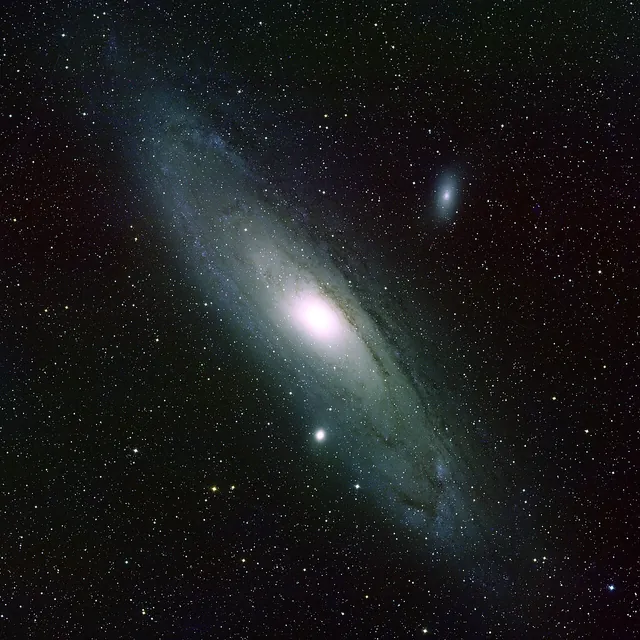
Messier 110 is a dwarf elliptical galaxy, one of the two brightest companions of the Andromeda Galaxy. It lies about 2.7 million light-years away in the constellation Andromeda and shows in a telescope as a faint oval glow close to the much brighter spiral. Charles Messier saw and drew it in 1773, yet it entered his catalogue only in 1966, as the last object added to the list.123
Unlike most elliptical galaxies, it is not entirely dormant. Dark clouds of dust cross it, molecular gas hides among them, and its centre holds a population of young blue stars, the most recent formed only about 25 million years ago. The galaxy contains around 10 billion stars and a family of at least eight globular clusters.23456
Shape and size in space
M110 is a small elliptical galaxy of Hubble type E5 or E6, labelled ‘peculiar’ because of unusual dark structures, probably dust clouds. It is looser and lower in surface brightness than a classic elliptical, so it is often called a dwarf spheroidal; because it is much brighter than typical examples, Sidney van den Bergh introduced the term ‘spheroidal galaxy’ for it and for NGC 147 and NGC 185.378
Measured with RR Lyrae stars, M110 lies 835.6 ± 23 kiloparsecs away, about 2.73 million light-years, and some 58 kiloparsecs, roughly 190,000 light-years, from the centre of Andromeda. The same survey fitted its light with a profile whose effective radius is about 598 parsecs, roughly 1,950 light-years. Published estimates of its mass range from 3.6 to 15 billion solar masses.13
- Distance
- 835.6 ± 23 kpc (2.73 million light-years)1RR Lyrae stars
- Distance from Andromeda’s centre
- 58 kpc, +30/−29 (about 190,000 light-years)1
- Effective radius
- 598 pc, +30/−29 (about 1,950 light-years)1of a Sérsic profile with index 4
- Absolute magnitude
- −16.7 ± 0.1 (V)1
- Mass
- 3.6–15 billion solar masses3
- Radial velocity
- −246 km/s7approaching the Sun
Dust and gas
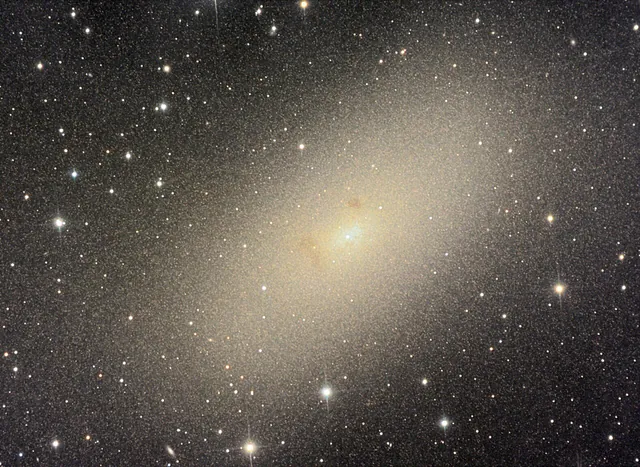
Elliptical galaxies are usually thought of as almost free of gas, but M110 shows dark clouds of dust even in Hubble images. Spitzer infrared images found the dust concentrated in three main regions along the galaxy’s long axis, each about 100–300 parsecs across, with a total mass of around 32,000 solar masses at about 20 K. Very cold dust near the centre may add much more.24
Molecular gas, traced by carbon monoxide, lies closely together with atomic gas and dust on scales of about 100 parsecs, and its clouds resemble the giant molecular clouds of the Milky Way. The amount of gas matches what dying stars should have returned since the galaxy’s last burst of star formation, about 500 million years ago.45
The stars inside
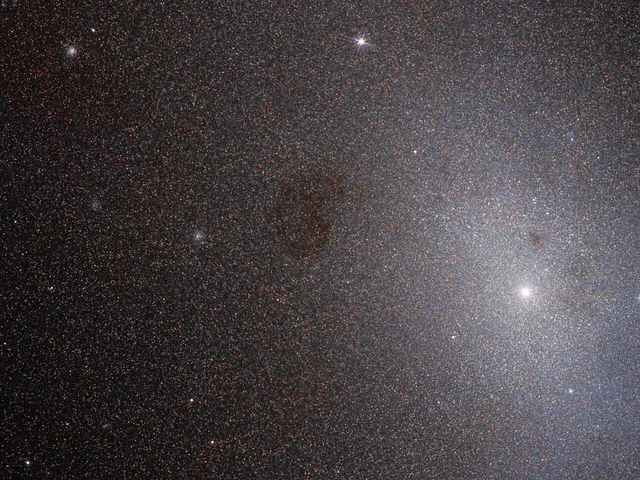
Most of M110’s stars are old, as Walter Baade found when he first resolved it into stars in 1944. But its centre holds a population of young blue stars. Deep Hubble images show that about 190,000 solar masses of stars formed in the central 30″, roughly 120 parsecs, between about 62 and 335 million years ago, with a last small episode about 25 million years ago.236
That star formation went on at a steady rate of about 0.0007 solar masses a year, which argues against a burst set off by Andromeda’s tides and may fit a galaxy on its first interaction with Andromeda. M110 also has a system of at least eight globular clusters; the brightest, G73, shines at about 15th magnitude.236
Discovery and history
Charles Messier discovered M110 on 10 August 1773. He described it in the Connaissance des Temps for 1801 and showed it on his drawing of the Great Andromeda Nebula published in 1807, yet for unknown reasons never gave it a number. Caroline Herschel found it independently on 27 August 1783, and William Herschel catalogued it as H V.18 on 5 October 1784.23
The galaxy entered Messier’s list only in 1966, when Kenneth Glyn Jones added it as M110, the last addition to the catalogue. Long before that, in 1944, Walter Baade had resolved it into stars, confirming that it lies at about the same distance as the Andromeda Galaxy.3
Seeing it for yourself
With a telescope under a dark sky, M110 is fairly easy to spot near the core of the much larger and brighter Andromeda Galaxy. Small telescopes reveal only a faint, diffuse patch of light, while larger ones show an oval with a brighter core. Its brightest globular cluster is within reach of large amateur telescopes. NASA names November as the best month to look.23
Telescopes on M110
Hubble’s Wide Field and Planetary Camera 2 imaged M110 in visible and near-infrared light to study how its globular clusters developed, catching the galaxy’s core, its clusters and its dark clouds of dust. Later, deep images from Hubble’s Advanced Camera for Surveys revealed the blue plume of young stars at its centre, and NASA’s Spitzer Space Telescope mapped its dust at wavelengths from 3.6 to 160 μm.246
A Hubble Treasury survey of Andromeda’s satellites identified 261 RRab-type and 145 RRc-type RR Lyrae variables in M110. Because these pulsating stars have predictable brightnesses, they gave a distance measured on the same scale as Andromeda and its other companions, placing M110 slightly beyond the great spiral.1
- RR Lyrae stars identified
- 261 RRab and 145 RRc1
Quick answers
- What kind of object is M110 (NGC 205)?
- M110 (NGC 205) is a dwarf elliptical (spheroidal) galaxy, E5 pec.37
- Which constellation is M110 (NGC 205) in?
- M110 (NGC 205) lies in the constellation Andromeda.2
- How far away is M110 (NGC 205)?
- M110 (NGC 205) is 2.73 million light-years (836 ± 23 kpc) from Earth, from RR Lyrae stars.1
- How bright is M110 (NGC 205) in the night sky?
- M110 (NGC 205) has an apparent magnitude of 8.1 (V band; other sources give 8 to 8.5).237
- How big does M110 (NGC 205) look in the sky?
- M110 (NGC 205) covers 17′ × 10′ of sky.3
- How massive is M110 (NGC 205)?
- M110 (NGC 205) has a mass of 3.6–15 billion solar masses (range of published estimates).3
- When was M110 (NGC 205) discovered?
- M110 (NGC 205) was discovered on 10 August 1773, by Charles Messier; catalogued as M110 only in 1966.3
Sources
- The Hubble Space Telescope Survey of M31 Satellite Galaxies. I. RR Lyrae-based Distances and Refined 3D Geometric Structure (Savino et al.) — Astrophysical Journal 938, 101 (arXiv:2206.02801), 2022
- Messier 110 — NASA Science, Hubble’s Messier Catalog
- Messier 110 (H. Frommert & C. Kronberg) — SEDS Messier Database (Observatoire de Paris mirror), 2007
- Mapping and Mass Measurement of the Cold Dust in NGC 205 with Spitzer (Marleau et al.) — Astrophysical Journal 646, 929 (arXiv:astro-ph/0604189), 2006
- Properties of the Molecular Clouds in NGC 205 (Young) — Astronomical Journal 120, 2460 (arXiv:astro-ph/0007169), 2000
- The young stellar population at the center of NGC 205 (Monaco et al.) — Astronomy & Astrophysics 502, L9 (arXiv:0907.0029), 2009
- SIMBAD astronomical database: M 110 — Centre de Données astronomiques de Strasbourg (CDS)
- Messier 32 (H. Frommert & C. Kronberg) — SEDS Messier Database (Observatoire de Paris mirror), 2007
Figures checked against these sources in November 2026. Where a quantity is not known, it is left out rather than estimated.

