nebula
Saturn Nebula (NGC 7009)
The Saturn Nebula, NGC 7009, is a planetary nebula in Aquarius: the glowing outer layers of a dying low-mass star. William Herschel found it on 7 September 1782, among the first discoveries of his great survey of the sky. In the 1840s Lord Rosse named it for its look, a faint likeness of the planet Saturn with its rings seen nearly edge-on.123
The “rings” are a pair of knots of gas called ansae, Latin for handles, at either end of the nebula’s long axis, each joined to the inner nebula by a thin jet. Hubble showed a bright central star in a dark cavity, rimmed by a rugby-ball-shaped shell inside a barrel of fainter gas. The nebula is about 6,000 years old, and its star, at some 82,000 K, is on its way to becoming a white dwarf.2345
Shape and size in space
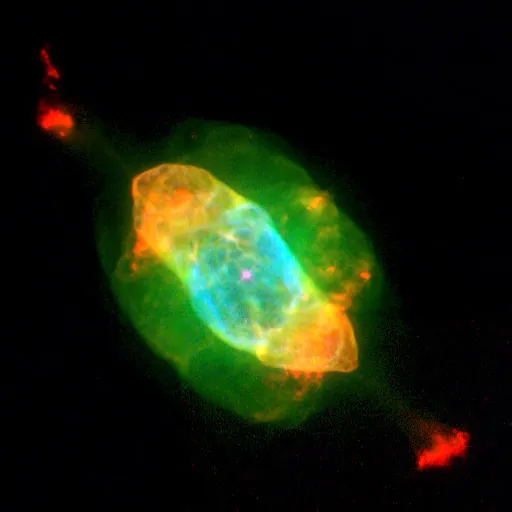
Hubble’s 1997 picture shows a bright central star at the centre of a dark cavity, bounded by a rugby-ball-shaped rim of dense gas. The cavity and its rim sit inside a smooth, barrel-shaped cloud made of the star’s former outer layers. Further out, along the long axis, lies a pair of red ansae, each joined to a tip of the cavity by a long jet of gas. ESO’s MUSE maps add an outer shell and a halo around the whole.23
A 2004 study led by Franco Sabbadin rebuilt the nebula in three dimensions from spectra taken at twelve angles across it. It found several linked parts: an internal shell, the main shell, the streams and ansae, an outer shell, two caps across the ends of the long axis, a ring-like band round the waist, and a halo. Each part expands faster the further it lies from the star, while the halo drifts outwards at only about 10 km/s.45
The bright main shell is an ellipsoid about 16″ by 6″ in its half-axes, with its long axis at position angle 77°. Spectra from the Keck telescope give expansion speeds of about 22 km/s for the main shell and 30 km/s for the outer shell, which its authors take to be the products of two successive ejections. On the sky the nebula is about 36″ across, with a halo of about 100″; MUSE traced it over 50″.191011
Its distance is poorly known. NASA gives about 1,400 light-years, ESA/Hubble 2,300, the SEDS catalogue 2,400, NOIRLab 3,900 and ESO about 5,000. The 2004 model found about 1.4 kiloparsecs. Gaia measured a parallax of 0.812 ± 0.057 milliarcseconds for the central star, from which Bailer-Jones and colleagues estimate 1,182 parsecs, most probably between 1,116 and 1,262. NOIRLab puts the bright nebula at about half a light-year across.123467812
Sabbadin’s team put the nebula’s age at about 6,000 years and its glowing gas at about 0.18 solar masses. In their account the ejected gas first passed through a neutral phase lasting about 3,000 years; ionisation began about 2,000 years ago and had swept the main shell by about 1,000 years ago. Today ultraviolet light from the star passes right through the nebula except at the caps and ansae. ESO expects the nebula to last only a few tens of thousands of years before it fades from view.24
- Other distance estimates
- 1,400 to about 5,000 light-years123812NASA 1,400; ESA/Hubble 2,300; SEDS 2,400; NOIRLab 3,900; ESO about 5,000
- Parallax of the central star
- 0.812 ± 0.057 mas6
- Main shell
- half-axes about 16″ × 6″9long axis at position angle 77°
- Expansion speeds
- about 22 km/s (main shell), 30 km/s (outer shell)10
- Mass of ionised gas
- about 0.18 solar masses4
- Age
- about 6,000 years4
What makes it shine
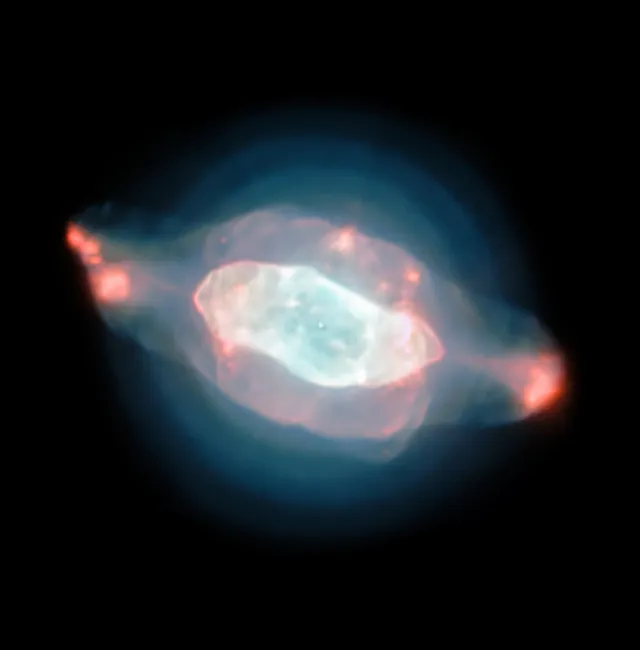
The nebula shines because ultraviolet radiation from the hot core energises the gas that the star blew away. Sabbadin’s model found that every feature of its spectrum can be explained by the star’s light alone. It is a high-excitation nebula: MUSE maps it in light from neutral atoms up to ionised helium and manganese that has lost four electrons.241113
The central cavity is filled with much hotter gas. ESA’s XMM-Newton found X-rays from gas at about 1.8 million K, produced where the star’s fast wind has been shocked. This hot gas does not seem to be at higher pressure than the shell around it: the nebula has reached the stage at which the hot gas starts to lose its influence, as the wind weakens and the cavity grows. NASA’s Chandra later resolved a point source of X-rays at the star inside the diffuse glow.1415
The nebula also holds dust. Infrared spectra from ESA’s Infrared Space Observatory and NASA’s Spitzer show cool dust at about 100 K and the signature of crystalline silicates such as forsterite and enstatite. In 2016 MUSE maps showed, for the first time in a planetary nebula, how the ratio of dust to gas varies: from about 0.7 times the interstellar value near the centre to more than five times at the edge, with a sharp drop at the rim of the inner shell, where dust seems to be destroyed.2513
The star at the centre
The central star, HD 200516, is rather bright for such a star, at magnitude 11.5. Its spectrum shows absorption lines of hydrogen and ionised helium and gives a surface temperature of about 82,000 K. Its luminosity has been worked out for a distance of 1.4 kiloparsecs, so it will change with whatever distance proves right.156
Sabbadin’s team found it to be a post-asymptotic-giant-branch star of 0.60 to 0.61 solar masses, still burning hydrogen in a shell around its core. On the usual evolutionary tracks it has reached the stage where it stays about as bright but grows hotter, implying a mature nebula some thousands of years old. ESO describes it as a doomed star becoming a white dwarf, which will fade once the nebula has dispersed.245
Notable features
The ansae
The two knots at the tips of the long axis are the nebula’s “rings”. Hubble shows them as clouds of low-density gas, each fed by a long jet. Spectra show the eastern ansa approaching and the western one receding, each at about 5.5 km/s relative to the nebula, both at about 9,000 K. Radio images with the Very Large Array show them moving outwards on the sky by about 30 milliarcseconds a year, which would be about 200 km/s at 1.4 kiloparsecs.3516
FLIERs
Bruce Balick and colleagues called knots like these FLIERs: fast, low-ionisation emission regions. The Saturn Nebula has two pairs along its long axis, the caps nearer the shell and the ansae further out. They glow strongly in nitrogen, once taken as a sign that they are rich in it, but a 2006 3D model reproduced them with the same make-up as the rest of the nebula, so the bright nitrogen may be an effect of ionisation.45917
Shocks or starlight?
A 2010 study found the light of the ansae partly consistent with shocks but dominated by the star’s radiation, and saw signs of shocks at the edge of the inner shell and several bow shocks centred on the ansae. Keck spectra suggest the knots and a fast hot bubble, expanding at 130 to 150 km/s, came from two or three later eruptions.913
The dust wave
MUSE found a wave-like crest and trough in the dust at the rim of the inner shell that no instrumental or physical cause could explain, other than a dip in the star’s mass loss, perhaps around 3,500 years ago, while it was still a giant. The inner shell, an expanding shock, may also be smashing or heating dust grains there.25
A sideways twin
A 2012 study of the Eskimo Nebula showed that it is built much like the Saturn Nebula and the Cat’s Eye Nebula, but seen from a direction turned 90°, and that a faint equatorial ring of knots like the Eskimo’s can be traced in the Saturn Nebula too.18
Discovery and history
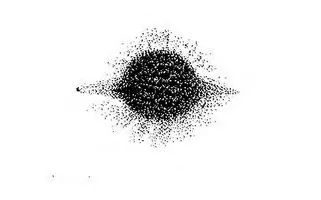
William Herschel discovered the nebula on 7 September 1782, among the first finds of his great survey, and listed it as H IV.1. In the 1840s Lord Rosse named it for its resemblance to Saturn with its rings nearly edge-on. According to Admiral Smyth, it was one of Struve’s nine “rare celestial objects”.1
Seeing it for yourself
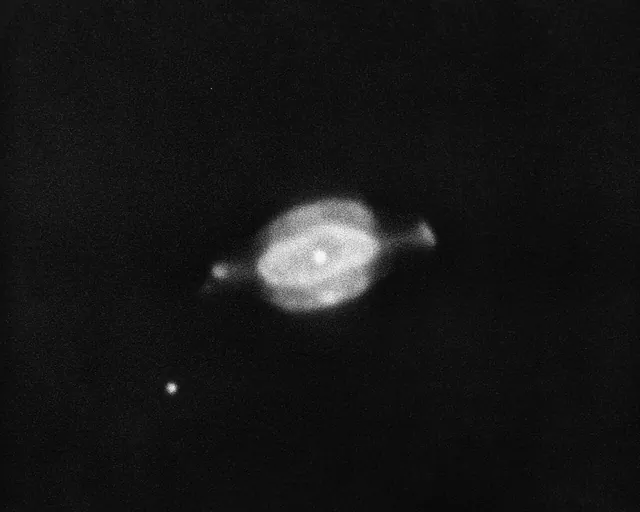
The Saturn Nebula lies in Aquarius and is best placed in September skies. At magnitude 8 it looks like a star in a small telescope; larger telescopes show more detail, including the two extensions on either side that give it its name. High magnification and averted vision, looking slightly away from the nebula, bring out its fainter outer parts.3
Telescopes on the Saturn Nebula
Hubble imaged the nebula with its Wide Field and Planetary Camera 2 in 1996, through filters for oxygen, nitrogen and sulphur, and the picture was released on 17 December 1997. Its observations helped scientists work out the nebula’s composition, structure and temperature. Earlier, in 1975, the 2.1-metre telescope at Kitt Peak had photographed it from the ground.3812
ESA’s XMM-Newton detected its hot gas, reported in 2002, and NASA’s Chandra observed it on 25 June 2011 for its survey of nearby planetary nebulae. ESA’s Infrared Space Observatory and NASA’s Spitzer studied its dust. During the science verification of the MUSE spectrograph on ESO’s Very Large Telescope, MUSE mapped the whole nebula in seeing better than 0.6″, and Keck’s HIRES spectrograph has since mapped the motions of its shells and knots.911131415
- MUSE images released
- 27 September 20172
Quick answers
- What kind of object is the Saturn Nebula (NGC 7009)?
- The Saturn Nebula (NGC 7009) is a planetary nebula.36
- Which constellation is the Saturn Nebula (NGC 7009) in?
- The Saturn Nebula (NGC 7009) lies in the constellation Aquarius.23
- How far away is the Saturn Nebula (NGC 7009)?
- The Saturn Nebula (NGC 7009) is 1,182 parsecs from Earth (from the central star’s Gaia parallax; published estimates range from about 1,400 to 5,000 light-years).237
- How big is the Saturn Nebula (NGC 7009)?
- The Saturn Nebula (NGC 7009) is about half a light-year across (NOIRLab figure, for a distance of 3,900 light-years).8
- How big does the Saturn Nebula (NGC 7009) look in the sky?
- The Saturn Nebula (NGC 7009) covers about 36″, in a faint halo about 100″ across of sky.1
- How bright is the Saturn Nebula (NGC 7009) in the night sky?
- The Saturn Nebula (NGC 7009) has an apparent magnitude of 8.0.13
- How old is the Saturn Nebula (NGC 7009)?
- The Saturn Nebula (NGC 7009) is about 6,000 years old (for a distance of 1.4 kiloparsecs).4
Sources
- NGC 7009, the Saturn Nebula (Frommert & Kronberg) — SEDS Messier Database (Observatoire de Paris mirror), 1998
- The Strange Structures of the Saturn Nebula (eso1731) — ESO, 2017
- Caldwell 55 (Hubble’s Caldwell Catalog) — NASA Science
- The 3-D ionization structure and evolution of NGC 7009 (Saturn Nebula) (Sabbadin et al.) — Astronomy & Astrophysics 416, 955 (arXiv:astro-ph/0312261), 2004
- The extinction and dust-to-gas structure of the planetary nebula NGC 7009 observed with MUSE (Walsh et al.) — Astronomy & Astrophysics 588, A106 (arXiv:1602.06788), 2016
- SIMBAD astronomical database: NGC 7009 — Centre de Données astronomiques de Strasbourg (CDS)
- Estimating distances from parallaxes. V: Geometric and photogeometric distances to 1.47 billion stars in Gaia Early Data Release 3 (Bailer-Jones et al.), entry for Gaia 6889338034837425920 — Astronomical Journal 161, 147; VizieR catalogue I/352, 2021
- The Saturn Nebula, NGC 7009 (noao-02211) — NSF NOIRLab
- The [S II] spectral images of the planetary nebula NGC 7009: II. Major axis (Hyung, Lee & Otsuka) — Astrophysical Journal Supplement Series (arXiv:2212.10056), 2023
- Double shells of the planetary nebula NGC 7009 minor axis (Lee, Hyung & Otsuka) — Astrophysical Journal (arXiv:2209.09052), 2022
- An imaging spectroscopic survey of the planetary nebula NGC 7009 with MUSE (Walsh et al.) — Astronomy & Astrophysics 620, A169 (arXiv:1810.03984), 2018
- Hubble’s Planetary Nebula Gallery: A View of NGC 7009 (opo9738g) — ESA/Hubble, 1997
- Mapping and spectroscopy of the planetary nebula NGC 7009 in the visual and infrared (Phillips, Cuesta & Ramos-Larios) — Monthly Notices of the Royal Astronomical Society (arXiv:1008.4178), 2010
- Diffuse X-ray emission from the planetary nebula NGC 7009 (Guerrero, Gruendl & Chu) — Astronomy & Astrophysics 387, L1 (arXiv:astro-ph/0203049), 2002
- The Chandra X-ray Survey of Planetary Nebulae (ChanPlaNS): probing binarity, magnetic fields, and wind collisions (Kastner et al.) — Astronomical Journal 144, 58 (arXiv:1204.6055), 2012
- Kinematics and proper motion of the ansae in NGC 7009 (Fernández, Schwarz & Monteiro) — arXiv:astro-ph/0310076, 2003
- On the nitrogen abundance of FLIERs: the outer knots of the planetary nebula NGC 7009 (Gonçalves et al.) — Monthly Notices of the Royal Astronomical Society 365, 1039 (arXiv:astro-ph/0511114), 2006
- A Detailed Morpho-Kinematic Model of the Eskimo, NGC 2392. A Unifying View with the Cat’s Eye and Saturn Planetary Nebulae (García-Díaz et al.) — Astrophysical Journal 761, 172 (arXiv:1211.6717), 2012
Figures checked against these sources in November 2026. Where a quantity is not known, it is left out rather than estimated.

