nebula
Pelican Nebula (IC 5070)
The Pelican Nebula is the western part of the great glowing cloud in Cygnus whose eastern part is the North America Nebula. A lane of dark dust, L935, separates the two. The bright curve of the pelican’s head and neck is an ionisation front, where ultraviolet starlight is eating into a cold cloud of molecular gas and sculpting it into pillars.123
That front is one of the busiest stellar nurseries near the Sun. Spitzer found about 250 young stars in the Pelican cluster and a new, deeply buried cluster above the bird’s head, and jets from stars still forming inside the dusty pillars punch out into the glowing gas.145
Shape and size in space
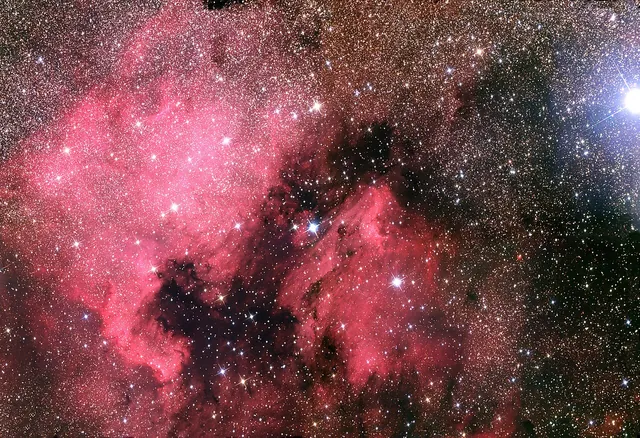
The Pelican and the North America Nebula are the western and eastern parts of one H II region, W80, about 3° across. The bird is drawn by dust: dark clouds in front of the glowing gas form its outline, while the bright edge of its head and neck faces south-east, towards the light that illuminates it.1210
Astronomers name the clouds after the bird: the Pelican’s Beak, Neck and Hat, alongside the Gulf of Mexico and Caribbean regions of its neighbour. A carbon monoxide survey found cold gas at about 10 K throughout the complex, with warmer gas above 20 K outlining the cloud edges heated by the H II region. Each of the six named regions holds roughly 1,000 to 5,000 solar masses of gas.11
Its distance is that of the whole complex. Gaia parallaxes of the young stars give 795 ± 25 parsecs, about 2,600 light-years, while a 2023 study of 131 emission-line stars within IC 5070 found a mean of about 833 parsecs. The clouds are layered: because the central star must have a clear view of the Pelican’s Neck to light it, the dark Atlantic cloud must lie in front of the Neck cloud.2712
What makes it shine
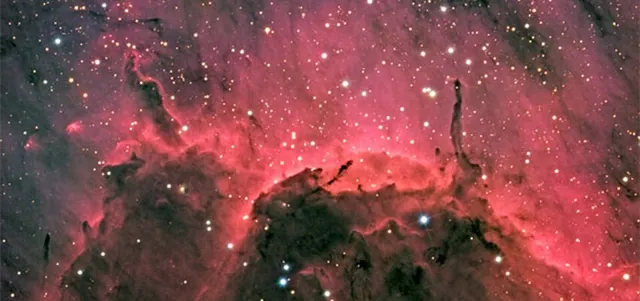
Like its neighbour, the Pelican glows because ultraviolet light ionises its hydrogen. Most of that light is thought to come from the Bajamar star, a binary of spectral type O3.5 hidden behind the dark cloud between the two nebulae, and maps of molecular gas link its radiation to the comet-shaped clouds of the Pelican’s head.31013
Not everyone agrees which star lights the Pelican. In 2014 Bally and colleagues noticed that the pillars and small cometary clouds along its front point towards a different O5 star, about 50′ away on the sky, and judged it the most likely source of the illumination; some clumps deeper in the cloud do point at the Bajamar star.1
Along the south-east-facing cloud edges, ultraviolet light also makes hydrogen molecules glow at a near-infrared wavelength of 2.12 microns, a fluorescent sheen that marks the direction the light is coming from. Narrowband images show the front as a sharp boundary where pillars are being sculpted.13
The stars inside
In 1958 Herbig found a cluster of 12 young stars bright in hydrogen-alpha near IC 5070, denser than the other groups he identified in the complex, and concluded that this was its most active star-forming region. Spitzer’s MIPS camera counted 247 young star candidates in the Pelican cluster, five times as many as were known, and discovered an entirely new, dust-shrouded cluster above the bird’s head, the Pelican’s Hat.4
Gaia motions split the stars of the north-west into separate groups. Group B corresponds to the Pelican’s Hat, Group C sits on the bright rim of the Pelican’s Neck, and Group D, the largest, lies in the Atlantic cloud next door. Most of the Hat cluster is too deeply buried for Gaia to see.2
Many of the young stars flicker. A year-long watch of a 16′ field found 95 variable stars, 67 of them young stars with typical masses of up to one Sun and ages of about 2 million years. A 2023 survey found 131 stars with hydrogen-alpha emission, a sign that they are still gathering gas, mostly stars below 1.5 solar masses.812
Rotation can be measured too. Using data from the citizen-science project Hunting Outbursting Young Stars, astronomers found 40 young stars with regular periods, which cluster around 3 and 8 days, and confirmed that stars still surrounded by discs tend to spin slowly. Spectra from the WIYN 3.5-metre telescope have since measured how fast 54 of the Pelican’s stars rotate.1415
- Herbig’s 1958 cluster
- 12 young stars4
- Young star candidates in the Pelican cluster
- 2474Spitzer MIPS, 24 microns
- Young star candidates in the Pelican’s Hat
- 514Spitzer MIPS, 24 microns
- Variable stars in a 16′ × 16′ field
- 95, including 67 young stars8
- Hydrogen-alpha emission stars
- 13112in about 0.29 square degrees
- Young stars with rotation periods
- 4014periods peak at 3 and 8 days
Notable features
The pelican’s head and neck
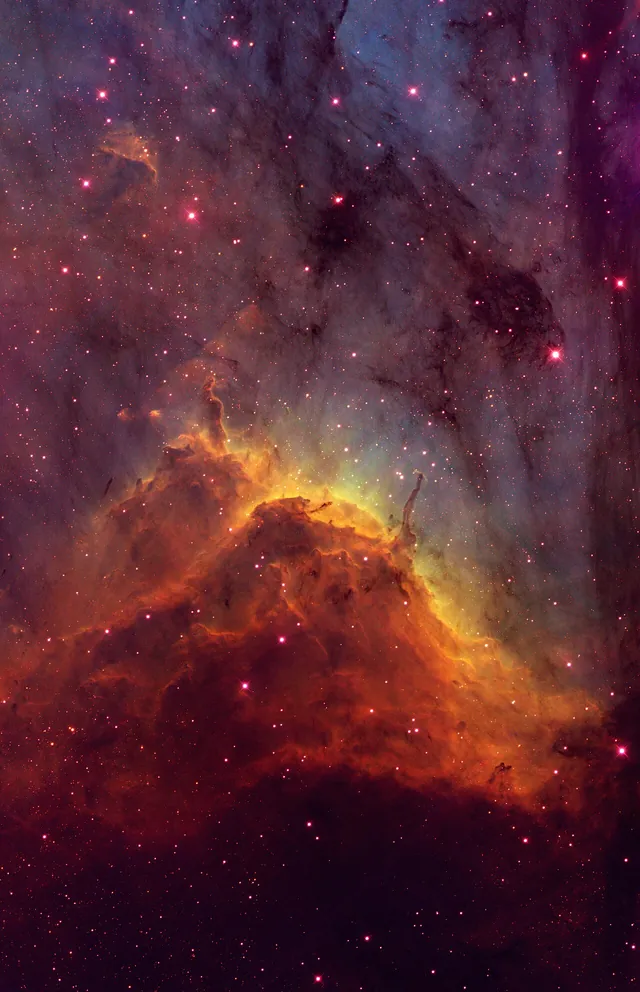
A bright ionisation front facing south-east, where ultraviolet radiation is eroding a molecular cloud. In regions shadowed by dense clumps, parts of the cloud survive as long pillars of dust. In Spitzer’s 160-micron map, the Pelican’s neck is among the brightest parts of the whole complex.1416
HH 555
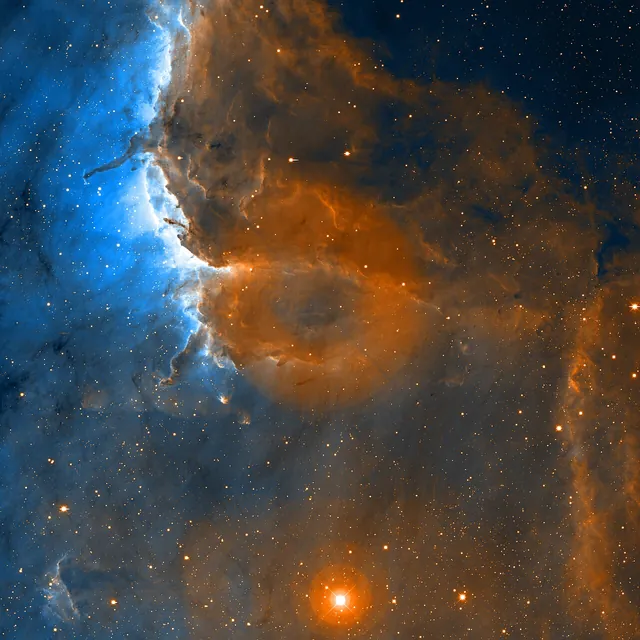
A faint jet squirting from the tip of the longest pillar, apparently a sign of an unseen protostar inside. It is an irradiated jet, lit by the surrounding ultraviolet light, first described by Bally and Reipurth in 2003; Spitzer later found a source at 70 microns at the base of the jet.116
MHO 3400
An X-shaped pair of jets in shocked hydrogen, coming from a young star system buried in a dense clump more than a parsec from the Pelican’s front. The two jets differ in direction by about 80°, and both wiggle in S-shapes, suggesting a binary whose jets precess. If the gas moves at a typical 100 km/s, a new knot was ejected about every 500 years.1
HH 567
The brightest Herbig–Haro object in the Pelican region, one of the glowing shocks found by Bally and Reipurth in the south-east part of the nebula.1
IC 5067 and IC 5068
Two companions discovered with IC 5070. Thomas Espin’s position for IC 5067 falls on empty sky, so it is tentatively identified with a patch of nebulosity north-west of IC 5068. Even so, NOIRLab’s picture of the Pelican’s bright ridge is titled IC 5067, a name sometimes used for the Pelican itself.917
Discovery and history
Max Wolf photographed the North America Nebula’s area in 1890, but the Pelican entered the catalogues through the Reverend Thomas Espin, who recorded it in 1899 together with IC 5067 and IC 5068 and announced them in 1900. He described it only as faint and diffuse, but of the three his position for IC 5070 is the only accurate one.918
Herbig’s 1958 survey singled out the young stars near IC 5070 as the most active group in the complex. In 2003 a deep survey with the 4-metre Mayall telescope revealed many previously unseen shocks from outflows along the Pelican’s clouds, and in 2005 the star lighting the whole region was finally identified.245
Seeing it for yourself
The Pelican lies immediately west of the North America Nebula in Cygnus, high in northern summer skies. The pair make a good target for binoculars or a small telescope, although the Pelican is the fainter of the two. Between them runs the dark lane L935, and the Pelican’s brightest part is the curved edge of its head and neck.127
Telescopes on the Pelican
Spitzer’s infrared surveys, published in 2009 and 2011, picked out the Pelican cluster and the hidden Pelican’s Hat. Near-infrared images of shocked hydrogen, taken in 2009 with the NEWFIRM camera on the 4-metre Mayall telescope at Kitt Peak, traced the quadrupolar jet MHO 3400 and the glowing edges of the clouds, and the CARMA radio array mapped the molecular gas of the Pelican’s head in fine detail.141319
Chandra and XMM-Newton surveyed the region in X-rays, the Himalayan Chandra Telescope searched IC 5070 for hydrogen-alpha emission stars, and the 0.81-metre Tenagra telescope watched its variable stars over 90 nights. Small telescopes keep up a frequent watch through the citizen-science project Hunting Outbursting Young Stars.8121420
Quick answers
- What kind of object is the Pelican Nebula (IC 5070)?
- The Pelican Nebula (IC 5070) is an emission nebula, part of the H II region W80.16
- Which constellation is the Pelican Nebula (IC 5070) in?
- The Pelican Nebula (IC 5070) lies in the constellation Cygnus.3
- How far away is the Pelican Nebula (IC 5070)?
- The Pelican Nebula (IC 5070) is about 2,600 light-years (795 ± 25 parsecs) from Earth, Gaia distance of the whole North America–Pelican complex.27
- When was the Pelican Nebula (IC 5070) discovered?
- The Pelican Nebula (IC 5070) was discovered in 1899, by Thomas Espin.9
Sources
- Outflows, Dusty Cores, and a Burst of Star Formation in the North America and Pelican Nebulae (Bally et al.) — Astronomical Journal 148, 120 (arXiv:1409.6762), 2014
- The Formation of a Stellar Association in the NGC 7000/IC 5070 Complex: Results from Kinematic Analysis of Stars and Gas (Kuhn et al.) — Astrophysical Journal 899, 128 (arXiv:2006.08622), 2020
- The Pelican Nebula (IC 5070) — NOIRLab, 2020
- The North American and Pelican Nebulae II. MIPS Observations and Analysis (Rebull et al.) — Astrophysical Journal Supplement Series 193, 25 (arXiv:1102.0573), 2011
- Pelican Nebula Ionization Front (noao0314a) — NOIRLab, 2003
- SIMBAD: IC 5070 — CDS, Strasbourg
- The North America and Pelican nebulae: This Week in Astronomy with Dave Eicher — Astronomy magazine, 2024
- Variability of young stellar objects in the star-forming region Pelican Nebula (Bhardwaj et al.) — Astronomy & Astrophysics 627, A135 (arXiv:1906.00256), 2019
- Notes on the IC objects (Harold G. Corwin Jr.) — NASA/IPAC Extragalactic Database (NED)
- Escape from the Bermuda cluster: orphanization by multiple stellar ejections (Maíz Apellániz et al.) — Astronomy & Astrophysics 657, A72 (arXiv:2110.01484), 2022
- Molecular Clouds in the North American and Pelican Nebulae: Structures (Zhang, Xu & Yang) — Astronomical Journal 147, 46 (arXiv:1312.3079), 2014
- Survey of Hα emission-line stars in the star-forming region IC 5070 (Panwar, Jose & Rishi) — arXiv:2302.06115, 2023
- High-resolution CARMA Observation of Molecular Gas in the North America and Pelican Nebulae (Kong et al.) — Astronomical Journal 161, 229 (arXiv:2103.04418), 2021
- A survey for variable young stars with small telescopes: IV. Rotation Periods of YSOs in IC5070 (Froebrich et al.) — arXiv:2107.08524, 2021
- Stellar Rotation in the First Six Million Years: Rotational Velocities and Radii Estimates of T Tauri Stars in IC 5070 and IC 348 (Gray, Rhode & Rebull) — arXiv:2601.08048, 2026
- Pelican Nebula Ionization Front (noao-04745) — NOIRLab
- IC 5067, Pelican Nebula — NOIRLab, 2009
- 101 Must-See Cosmic Objects: The North America Nebula (Alan Goldstein) — Astronomy magazine, 2022
- The North American and Pelican Nebulae I. IRAC Observations (Guieu et al.) — Astrophysical Journal 697, 787 (arXiv:0904.0279), 2009
- X-ray survey of the North-America and Pelican star-forming complex (NGC7000/IC5070) (Damiani, Pillitteri & Prisinzano) — Astronomy & Astrophysics 602, A115 (arXiv:1702.05999), 2017
Figures checked against these sources in November 2026. Where a quantity is not known, it is left out rather than estimated.

